When French art historian Pierre Mornand titled his 1937 article “Eduard Wiiralt, visionnaire de diableries et peintre séraphique,”1Pierre Mornand, “Wiiralt — saatanluse selgeltnägija ja valgusingellik kunstnik” [1937], transl. Aleksis Rannit, in: Eduard Wiiralt 1898—1954. Mälestusteos, Lund 1955, 67. Orig.: Pierre Mornand, “Eduard Wiiralt, visionnaire de diableries et peintre séraphique”, in: Le Courrier Graphique 2 (1937). ↩ he successfully captured the essence of one of Estonia’s most famous artists. Wiiralt’s art is indeed imbued with a play of symbols, the torment of evil, apocalyptic visions, a struggle with carnality and surrender to it, inspiration and imagination. But it was an imagination that worked through his trained hand and spirit. Wiiralt was a brilliant draftsman whose unbridled creative energy has become legendary. He found scenes worthy of capturing everywhere: in studios, markets, slums, Parisian cafés and the metro, on the streets and in the Dresden zoo, in bohemian parties and in the caravanserai of Marrakesh. Wiiralt was able to work productively in all kinds of conditions, conveying what he saw (in his mind’s eye) in almost all graphic techniques: he produced ca. 400 prints, hundreds of monotypes, and thousands of finished or sketch drawings.
Wiiralt appreciated the lively art scene and opportunities for self-development that big cities offered. In his eyes, Estonia was a terre maudite, froid2Eduard Wiiralt’s notebook, 13 January 1942. Art Museum of Estonia archival collection, Eduard Wiiralt archive, EKMA.69.1.4.5. ↩ — although this characterization may also have reflected his broader attitude toward the world. As a cosmopolitan man, he settled in Paris in 1925, from where only the events of World War II drove him away for a few years. Paris had the momentum and grand scale that Wiiralt, like other artists who had chosen it as their home, needed for his creative work.
Considering the artistic hierarchies that partly still exist today, Wiiralt was doubly marginalized: he came from the periphery of Europe, and worked in the field of graphic art, which has traditionally been considered secondary to painting. Thus, identifying himself as a citizen of the world, he had to fight against provincialism both within himself and around him, for the sake of remaining a printmaker.
Beginning
The most important events in Wiiralt’s life, dedicated fully to art, took place in his inner world. But in addition to his innate talent, he trained his hand first at the Tallinn (then Reval) School of Arts and Crafts; in 1919—1924, he studied sculpture and printmaking at the newly opened Pallas Art School in Tartu.3Artists’s father Anton Wiiralt, like many other Estonians at the time, had found better sources of income in Russia, in the St Petersburg Governorate. In 1909, the family moved back to Estonia. ↩ As its most talented student, Wiiralt received a scholarship to go to Dresden Academy of Fine Arts in spring 1922 to further his studies in sculptor Selmar Werner’s master class. There, he also worked at Paul Wenzel’s print workshop. In 1923, Wiiralt embarked on a longer trip to Germany’s art capitals Berlin, Leipzig, and Weimar.
In his Dresden period works, Wiiralt was strongly influenced by German Expressionism and Verism, the former’s post-World War I development. The artist saw the works of this movement at exhibitions; parallels with Otto Dix are particularly striking.4Wiiralt’s annual entry cards to Galerie Arnold and Galerie Emil Richter in Dresden (1923), and that of Max Sinz (1924) survive. EKMA.69.1.7.4, p. 3 and 6. ↩ Wiiralt perceived the harsh and sad palette of misery, but behind life’s naturalism and ugliness, he always saw people facing moral dilemmas and emotional chaos. Among his works from the Dresden period, there are already visionary compositions, in which the artist invented new drawing techniques to mystify light and visualize fantasy images that demanded an outlet. In addition to expressive art forms, he also had a serious interest in German Renaissance art. Albrecht Dürer’s monograph was allegedly constantly on Wiiralt’s desk, and the drawing style of some of his works is indeed reminiscent of the elegant lines of Dürer’s prints.
After graduating from art school, Wiiralt settled in Paris, where he experienced all the hardships and creative struggles of the bohemian lifestyle, but also kept training his hand at the Académie de la Grande Chaumière. The spirit of the times, art movements, and events in his personal life intertwined to form a delicate tapestry of images.
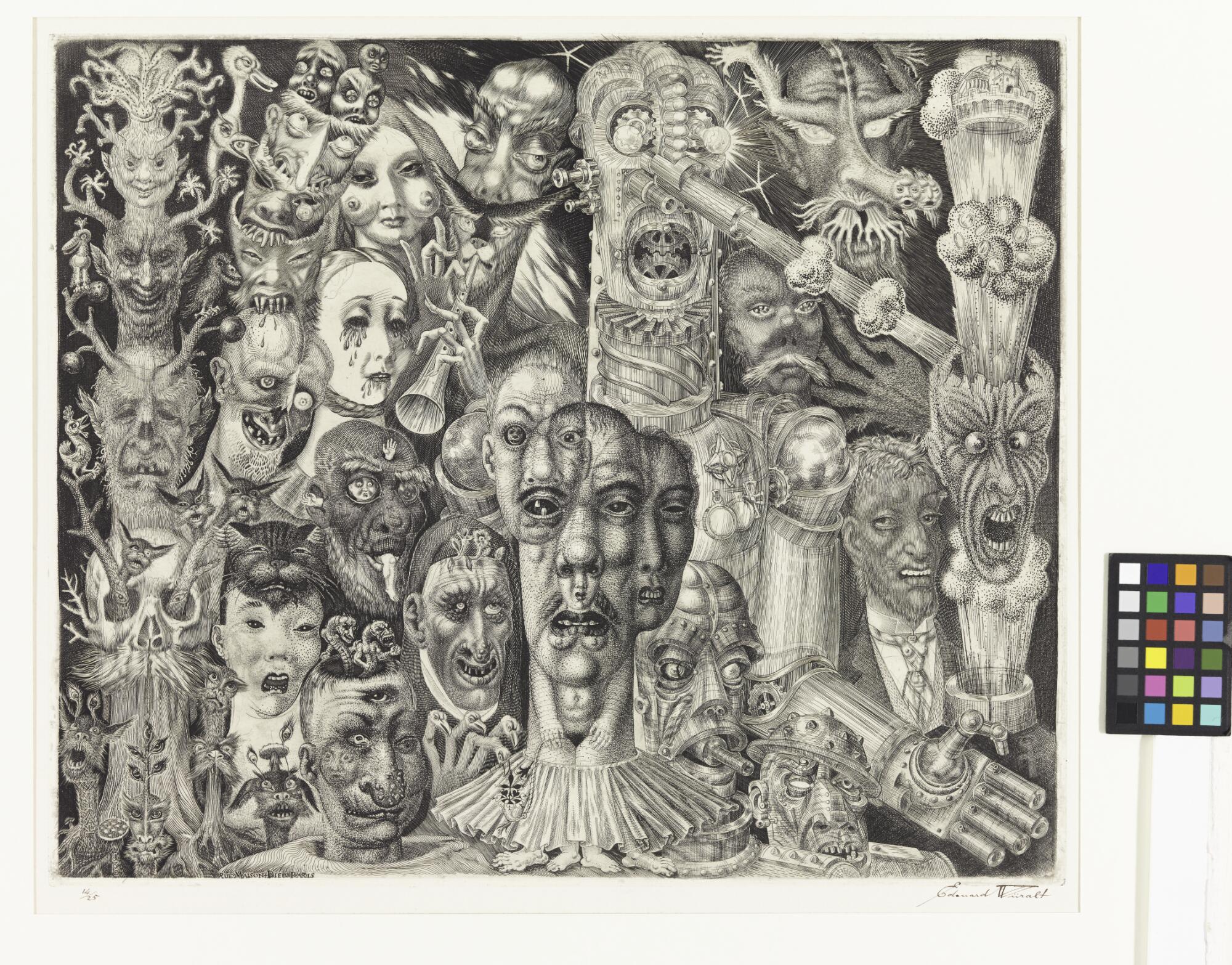
Wiiralt’s most fantastical composition, Hell (also translated as Inferno; original: Põrgu), was preceded by several others in his first Paris period (1925—1939), mainly illustrations of folklore texts — Bible stories and Estonian folk tales. The three volumes of the Religious Education Reader (1924—1925), compiled by Estonian pastor and theologian Eduard Tennmann, are referred to as “Wiiralt’s Bible” after the artist’s 114 illustrations.5Ed[uard] Tennmann, ed., Usuõpetuse lugemik algkoolidele, vols. I—III, illustrations Ed[uard] Wiiralt, Tartu 1924. ↩ Immersing himself in the exotic stories of the Old and New Testament, he was able to put his knowledge of Gustave Doré’s (1832—1883) and Julius Schnorr von Carolsfeld’s (1794—1872) woodcuts for the Bible to good use. In 1924, Wiiralt also illustrated e.g. the fairy-tale-like Võrumaa Stories (1924) by writer and journalist Juhan Jaik,6Juhan Jaik, ed., Võrumaa jutud, vol. I, illustrations Ed[uard] Viiralt, Tallinn 1924. ↩ whose imaginative world may be closer to nature and folk tales than the Bible stories, yet also full of miracles and unusual events.
Thanks to admirers of Wiiralt’s talent, he also began to receive commissions from Paris. The illustrations he created for publisher Trianon in 1928 became a milestone in the artist’s first Parisian period. The five erotic etchings for the book by the famous novelist François Mauriac, Supplément au traité de la concupiscence de Bossuet include the portrait of the writer, for which he supposedly posed at his home.7François Mauriac, Supplément au traité de la concupiscence de Bossuet, illustrations Édouard Wiralt, Paris 1928. ↩ Knowing the artist’s habit of remaining silent in company, the legend that not a single word was exchanged during the session seems plausible. The sensual and spiritual collisions in Mauriac’s texts were not unfamiliar to Wiiralt. The illusionist illustration of monster-like creatures in a moment of passion bears similarities to the imagery of Belgian artist Félicien Rops, likewise rooted in erotic fantasies. For Wiiralt, religious themes were precisely the area, where to humorously ponder the meaning of “the flowers of evil”, the tree of deadly sins and divine providence.
Wiiralt’s method
Looking at Wiiralt’s works, his entire early creative period, culminating in Hell, is a passionate story of the soul, a pure expression of spirituality familiar to the decadent consciousness. The prints and drawings created during his studies — and especially during his first years in Paris — are at times almost impenetrable in terms of their meaning and density of visual elements. It is at times difficult to reconcile his explosive imagination with the artist’s almost autistic nature. Wiiralt is described as a taciturn and reserved person, so the messages of his relatively hermetic spiritual world indeed had to be conveyed primarily through his works: in shaping his images, he seemed to avoid everything that Friedrich Nietzsche would have called self-renunciation (Entselbstung).8Friedrich Nietzsche, Ecce homo, Leipzig 1908. ↩
The image surface of Wiiralt’s works is calculated to the tiniest detail, achieving a sense of eeriness that was further amplified by the shadowy nature of the tones between the black and white of his prints. He always preferred the diversity of ugliness to the uniformity of beauty. As a fanatic of detail, Wiiralt uses polyphony and an excess of imagery, often grotesque and ambivalent — he piles up motives, fearing empty pictorial space in the manner of the Mannerists, to the extent that, when viewing his work, no one can weave a beautiful and coherent fabric of ultimate truth. Wiiralt’s art attracts attention with its style, but only art that accurately conveys the artist’s inner state can truly be stylish (or authentic for that matter). Wiiralt’s genius lies in the fact that, under the pressure of inner loneliness — the inescapable atmosphere of endless questions and ideas — he was able to endure himself, to follow the absolute imperative of chasing himself. Wiiralt’s later oeuvre is less passionate, but just as enigmatic, still seeking support from the spiritual.
The result of constantly straining his senses and imagination, fulfilling the role of a “demonic clairvoyant”, could only result in self-transcendence or -elevation. Wiiralt’s creative process is characterized by a combination of an untamed imagination and engraving work requiring extreme patience. Like a vampire, he sucked information from all the layer of life around him. At a time when his nerves were as tense as violin strings, he directed all the power of his fanaticism into his engraving needle and pencil. Intimacy had to be abandoned, even his father’s funeral skipped. Six months later, he wrote to his brother Oskar: “Art is what makes you forget your surroundings, your loved ones, especially at a time when everything is only taking shape and the ground beneath your feet is unstable. Perhaps it will never come…”9Eduard Wiiralt’s letter to brother Oskar Wiiralt, 29 April 1933. EKMA.69.3.1.16. ↩ This is a chosen, to an extent conceptual and psychologically justified exclusion of himself from everyday life.
Since Wiiralt loved refinement and a sense of completion even before his creative urges calmed and he became more “academic”, his works sometimes seem too focused on technique. Such an impression can only arise, when one overlooks his sketches and drawings, whose spontaneity is often truly admirable. Wiiralt has always been appreciated for his remarkable drawing skills and technical mastery. However, the more thoroughly one studies his works, the more clearly the artist’s wisdom emerges — his ability to see the content hidden behind the outer appearance of things and people. In an essay written for Wiiralt’s solo exhibition in Estonia in 1936, Estonian art critic Hanno Kompus (1890—1974) aptly summed up Wiiralt’s genius:
Here we see his rare versatility, we see the captivating development of a person and an artist, we see tensions and resolutions, catastrophes and lighter lyricism, we see the whole world, not just a narrow excerpt, we see dreams and reality, heavy hallucinations, prophetic eagerness, and the beauty of the world around us captured in the vision of a genius and through the hand of a master.10Hanno Kompus, “Wiiraldi maailm. Eduard Wiiralti ülevaatenäitus”, in: Päevaleht, 7 March 1936. ↩
This is why Wiiralt is admired in Estonia, and this is also why his works serve as a bridge between different cultures.
Wiiralt had a habit of working systematically, using sketches and croquit later in prints and book illustrations. Yet, this did not mean a lack of generalisation or conceptuality: Wiiralt wove well practiced figures, expressions, and poses into compositional and atmospheric wholes, permeated by chains of images. Different recurring motifs emerged, depending on his creative period — angels, music, screaming heads, family, dance, grotesque women with exaggerated gender characteristics — forming strong intertwining lines. The artist had an extraordinary talent for capturing expressive facial expressions and poses, as well as an incredible sense of style, which is why his works are both original and carried by mannerisms. Wiiralt adjusted the black-and-white contrasts of graphic techniques and the drawing style to his mood and sensual “temperature” in each specific composition. Grotesqueness is a constant feature of his visionary works, but depending on the expressive qualities of the graphic line, it takes on a gentle form in some cases, an ironic one in others, and sometimes appears forcefully dramatic.
The path to Hell
In May 1929, Wiiralt signed a contract with Pierre Flajoulot, art critic and director of the Demotte Gallery in Paris. Under the agreement, Wiiralt could spend a couple of months in Brittany in exchange for making drawings.11Eduard Wiiralt’s letter to parents, 6 September 1929. EKMA.69.3.1.1.12. ↩ In August, the artist thus arrived in Antrain-sur-Couesnon, a small cantonal center in the commune of Fougères, close to the La Manche.
Within three weeks, Wiiralt had completed around 75 drawings and watercolors. It was these fantastical “portrait heads”, created in carefree working conditions, that helped him to think through and draw the characters of his soon-to-be masterpiece, Hell. In Antrain, work began on the detailed and unconscious level, perhaps also on its concept. The well-known Estonian writer and essayist Johannes Semper wrote the following to describe the wave of disappointment that followed World War I and also affected Wiiralt: “It was then that er realised we are living in an era of intellectualism and mechanisation, that the metropole with its technology rules the world, that unity with nature had been lost, that people are like machines, that a phase of cultural decline truly seems to be reigning.”12Johannes Semper, “Läbilõige praegusest Saksamaa vaimuelust”, in: Johannes Semper, Mõtterännakuid III. Artikleid ja esseid, Tallinn 1977, 89. ↩
According to contemporary accounts, Wiiralt read the works of Oswald Spengler, Rudolf Steiner, Arthur Schopenhauer, and Ralph Waldo Emerson during those years. In addition to the cult of artistic genius, Wiiralt’s worldview may also have been enriched in France by the mystical idea of vitality developed by Henri Bergson, one of the theorists behind Surrealism. The contrast or juxtaposition of man and machine certainly belongs to the line of philosophical and visual intrigues of Hell: the destructive power of the incomprehensible machine is side-by-side with the destructive work of man, who has lost self-control due to his unleashed instincts. Here, too, Wiiralt was in tune with the spirit of the times, albeit using his own distinctive arsenal of visual imagery.
Hell is one of the works for which the artist made numerous preparatory drawings. This inevitably refers to the process of creating the print: although the composition may have first come to the artist in the form of hallucinations, he worked very intensively even with the imagery born out of his confusion. Among the surviving sketches are some that the artist did not use at all, while others, such as the woman with the cat’s head and the mechanisms, made it into the final version of the composition exactly as the artist had initially seen them in his mind’s eye.
In 1926, Wiiralt wrote a note in French on the margin of his sketch of nudes, probably completed at the Académie de la Grand Chaumière: “Naked women are impossible.” (Les femmes nues sont impossibles).13See Eduard Wiiralt, Female Nudes, 1926. EKM G 13145. See Art Museum of Estonia Digital Collection, https://digikogu.ekm.ee/ekm/search/oid-9950/?searchtype=simple&searchtext=G%2013145&offset=1. ↩ This spontaneously written sentence characterised the artist’s mood at the time, and his struggle with the female body as an object of representation. The artist was cautious about anything that threatened to engulf the primal feminine power in an unknown world. In order to maintain a mental and emotional distance, he placed both vice and virtue far away from himself: in heaven (the Madonna), in hell (the prostitute), in fairy tales or the Bible (mermaids, Eve). Psychologists have called such a self-defense mechanism psychological abstinence — the sublimity of myth protected the artist from the baseness of reality.
In Hell, the female form took on ever more fantastical shapes as an expression of human depravity and complex inner worlds. On the one hand, this may be related to the rise of psychoanalysis as a fashionable trend in Parisian art circles. On the other, the artist’s feverish imagination was able to break down the last barriers of convention in the subjugation of the body to the spirit. Style is intertwined with visionality: this combination is expressed through ecstatically elongated figures, ascetic and sensual faces, long thin violinist’s arms, and characters with their mouths wide open, either screaming or in a state of ecstasy. In French, the word plaisir is used to denote pleasure, with a broad range of meanings that encompass a significant part of the repertoire of the decadent characters in the artist’s early work: the desire to please but also self-restraint, undisguised lust, feigning non-existent love and denying the experienced one. People immersed in alcohol or erotic games offered Wiiralt, who was imprisoned within himself, both sincerity and an experience of self-abandonment. A person who takes pleasure is wide open, unprotected from the gaze of others, while possessing childlike charm and intuitive wisdom.
Hell in close-up
The print Hell released the tensions that had accumulated in the artist’s soul from inner turmoil, frantic work, and excessive use of intoxicants. When examining Wiiralt’s works from this period through the eyes of a psychologist or psychoanalyst, it seems that the Freudian concept of sexuality as a driving force was being replaced by the Jungian idea of libido as the intensity of the psyche’s functioning. The fact that Carl G. Jung’s system credited art with an important role in the unleashing of the subconscious may also explain that unbridled flow of Wiiralt’s distinctive images.14Ene Lamp, Ekspressionism. Ekspressionism Eesti kujutavas kunstis, Tallinn 2004, 171. ↩ A great work of art is like a dream, devoid of rationally comprehensible meanings. Wiiralt’s work clearly features fantasy images seen in delirium: the unusual expressions on the faces testify to heightened senses. At the center of Wiiralt’s world is a human animal, searching for one’s path between the lowly and the sublime, whose fateful ambivalence is resolved with an almost erotic self-indulgence, selfishly, stubbornly, in a constant ecstasy of inspiration.
Wiiralt began engraving Hell in the spring of 1930, and, after a couple of months, produced the first trial print, which already contained the most important elements of the finished composition on the vertical axis: the machine-man, the human figure with an exploding head, and the column of heads. Then there was a break in his work. In the autumn of 1932, Wiiralt resumed engraving Hell, now using the copperplate technique. In the center of the composition, he added the figure of an ecstatic musician — the theme of music-making as a kind of subconscious escapism had become a recurring motif for Wiiralt; he searched for different solutions for years. Other permanent inhabitants of Wiiralt’s imagination, grotesque cat heads, also haunt Hell. Whereas the print does reflect the culmination of his tense inner life, the artist actually worked with the same set of figures both before and after its completion.
Wiiralt’s vision of hell is a unique combination of imagination and the real world. Like Dante, Wiiralt was probably concerned with visualising hell on earth.15Mai Levin, Eduard Wiiralt. 1898—1954, Tallinn 1998, 57. ↩ The artist himself hinted at it, when asked about the idea behind Hell, an answer that avoids a straightforward explanation but is nevertheless fairly clear: “I have depicted the helplessness and transience of humanity — a révolte against all gods.”16Eduard Wiiralt’s letter to Alfred Rõudele from Paris, 21 February 1938. EKMA.69.3.1.9.9, p. 106. ↩
In addition to absinthe, his unrestrained pursuit of sensual pleasures and eroticism was undoubtedly influenced by his romantic relationship with Nelly Stulz (1892—1969), an artist, poet, and the artist’s patron, who lived in Strasbourg, lasting from 1931 to spring 1933. From there, Wiiralt also paid visits to Colmar and was blown away by Matthias Grünewald’s Isenheim Altarpiece (1516). Wiiralt honestly admitted its influence himself: “I see these figures everywhere I look, even on trees.”17Jaan Grünberg, “Wiiralt Pariisis”, in: Eduard Wiiralt 1898—1954. Mälestusteos, 15. ↩
While the influence of Verism has been pointed out in the case of Hell, one cannot ignore the connections with Surrealism, which was topical in Paris at the time — the second Surrealist Manifesto was published in 1929. As powerful as the artist’s imagination was, it is difficult to imagine the Antrain series and Hell completely outside the experience of Surrealism. Like Hieronymus Bosch’s monsters, Wiiralt’s bizarre figures are the result of rationalisation taking place in the psyche. It is also interesting to note that any parallels to Wiiralt’s “master print” it are difficult to find among contemporary French graphic artists, who were mainly interested in the possibilities of different printing techniques, but parallels do occur with Dutch and German art. In analyzing Wiiralt’s works, Estonian art historian Mai Levin has often mentioned Pieter Brueghel alongside Grünewald and Bosch, but she has also drawn parallels with the tragic-grotesque prints of James Ensor and Belgian etcher Jules de Bruycker. Wiiralt’s “teachers” could be said to include Goya and Rembrandt. In the visions of the final years of his first Paris period, Wiiralt’s figures are particularly reminiscent of El Greco’s religiously ecstatic saints, although the artists are often also intoxicated by their own mission.
Wiiralt had already experienced in Dresden, what the shattering of illusions and the collapse of the existing value system had brought to post-World War I Europe. He had immersed himself in the spirit of the times, with all its naturalism and unabashed abandon. By treating women as ugly, amplifying sensuality to the point of eroticism and sexuality to grotesqueness, he was, on the one hand, a bearer of the spirit of the times. On the other hand, it also reflected the straightforwardness that had actually characterised the artist’s work from the beginning, the absence of any sentimentality — even in cases where the subject of the picture (e.g. children and animals) might have provoked it.
The artist also had two sworn enemies, when creating Hell — mediocrity and bourgeois morality — which he defied by stimulating his creative abilities with intoxicating substances and unrestrained sexual activity, even when there was no desperate need.
The visual vocabulary of Hell
Wiiralt’s visual lexicon is extremely unique and so rich that it tends to slip away from those seeking meaning. The artist’s “vocabulary” includes ecstatically stretched or sensually plump figures; ascetic faces with upturned eyes or round faces with female breasts; high arched foreheads, long violinist hands with thin fingers, figures screaming with their mouths wide open or dreaming with their eyes half closed; male and female monsters, multiplying heads, figures formed from female body shapes; a man’s bowtie below his exposed teeth, a cigar-like plug in the mouth of a man with a massive forehead. Horns grow out of satanic heads, ending in blossoms, animal heads, or Medusa- and snake-like creatures. A pair of heads with crazed eyes have made their home in another set of heads placed inside each other like matryoshka dolls. In the middle is a pale woman shedding (blood) tears, simultaneously present and ready to vanish. One detail that shapes the figures and the mood of the entire piece is the characters’ teeth — from a few preserved stumps to perfect parade smiles. Those familiar with the oeuvre of Rops may recall one of his favorite themes — women and madness ruling the world.
The emphasised vertical axis of the composition of Hell introduces, in addition to satanic figures, a sense of space for a person searching for their essence between the so-called upper (divine) and lower (satanic) realms. Satan is a popular figure in the work of artists with a sense of decadence, interpreted both as a symbol of both evil and rebellion. At once terrifying and powerful, Satan has control over weak humans, but he himself too has (human-like) tendencies that enslave him. The multiplied figures with horns (the tree of corpses) seem to represent the different stages of human life on their vertical axis — from a smiling androgyne to a skull marking the end of a fruitful middle age.
The imagery of the work is undoubtedly influenced by the artist’s experience with substances that affect the psyche, triggering a fear of death alongside traumatic memories. It has been claimed that this is indeed a psychedelic work of art. The artist has referred to situations that make human life hellish (war, fear, depression and half-wittedness, death, the complexity of relationships between men and women) as well as types of people from whom/which there is no escape (leaders, pimps, warmongers). The traces of many of the images are difficult to pinpoint. The three-leaf clover may symbolise the Holy Trinity; in Estonian folklore, it is a symbol of good luck; but together with the broken heart in the work, it may instead signify hopelessness (a possible reference to the artist’s strained relationship with Nelly Stulz). The androgynous central figure is being watched by a cunning Satan disguised in monk’s robes, with “the flowers of the evil” sprouting from his forehead — a recurring image from Charles Baudelaire’s poem, representing the temptations of human life in a decadent world.18Lola Annabel Kass, “Hümn inetusele. Kurja õied Eesti dekadentlikus kunstis”, in: Kunstiteaduslikke Uurimusi / Studies on Art and Architecture 31, no. 1/2 (2022), 64-65. See also Eduard Wiiralt, War. Study for Engraving Hell, 1930. EKM G30375, in: Art Museum of Estonia Digital Collection, https://digikogu.ekm.ee/eng/fpage/search/oid-26809/?searchtype=simple&searchtext=wiiralt%20war&offset=19. ↩
By the time of his solo exhibition at the Strasbourg gallery La Librairie de la Mésange 1932, Hell was not yet finished. Wiiralt’s prints received a warm welcome there and the criticism was friendly: parallels were drawn with Edgar Allan Poe and Arthur Rimbaud. Even Baudelaire’s verse was quoted, just as suitable also for characterising Wiiralt’s engraving:
C’est un satirique, un moqueur;
Mais l’énergie avec laquelle
Il peint le Mal et sa séquelle
Prouve la beauté de son coeur.19Quoted from Levin (1998), 61. Fragment from Charles Baudelaire, “Vers pour le portrait de M. Honoré Daumier”, in: Les Fleurs du mal, Paris 1868. ↩
In 1938, when the artist’s creative style had changed somewhat, he wrote about Hell to Alfred Rõude (1896—1968), a collector and sales agent of his works:
it is a pity that you want to publish this work, which was created as a result of hallucinations, and depicts perish and destruction, for my birthday. To a serious enthusiast, it doesn’t actually matter what the work depicts — the publication will show the technical execution of the engraving — but, to broader audiences, there is no point in showing this “evil spirit” born of beer fumes.20Wiiralt to Rõude, EKMA.69.3.1.9.9, p. l05. ↩
Judging by the artist’s other comments, Wiiralt nevertheless valued this work as a document of his turbulent years on Montparnasse. His self-destructive lifestyle culminated in 1933, shortly after the completion of Hell, in a mental and physical crisis; after recovery, fearing death, he gave up alcohol and psychedelics completely. This also marked Wiiralt’s youth coming to an end; debauchery lost its appeal for him — one cycle of images and one level of perception had finally been exhausted.
Afterlife
Although the artist did not visit his homeland before World War II, his works were included in exhibitions of Estonian art held in Riga, Helsinki, Berlin, Moscow, Kaunas, Rome, and Budapest, as well as in several international graphic art exhibitions. During his lifetime, the artist had solo exhibitions in Paris (1927, 1928), Strasbourg (1932, 1939), Helsinki (1937), and Amsterdam (1935, 1939).
For the domestic audience, collector Rõude organized an exhibition in Tallinn and Tartu in 1936, displaying nearly 350 works by Wiiralt, created between 1915 and 1936, including Hell. Since then, it has been displayed at over a hundred exhibitions, as far as the fragility of the paper-based print has allowed. Ten copies of Hell, along with proofs and prints of its details, have been preserved in Estonian national art collections; the printing plate is held at the graphic art collection of the Art Museum of Estonia.
In 1983, Estonian director Rein Raamat made an animated film Hell based on Wiiralt’s print. From 1996 to 2021, his most important works were on permanent display at the Eduard Wiiralt Gallery in the Estonian National Library (undergoing renovation until 2027). Since 2004, the Estonian Ministry of Culture has been awarding a scholarship named after Wiiralt to art students or young artists for studies abroad.
Eduard Wiiralt is buried at the Père-Lachaise Cemetery in Paris.
- Tiina Abel