Courtesy of the Art Museum of Estonia, Tallinn, All rights reserved, Please refer to the terms and conditions of the institution holding the object
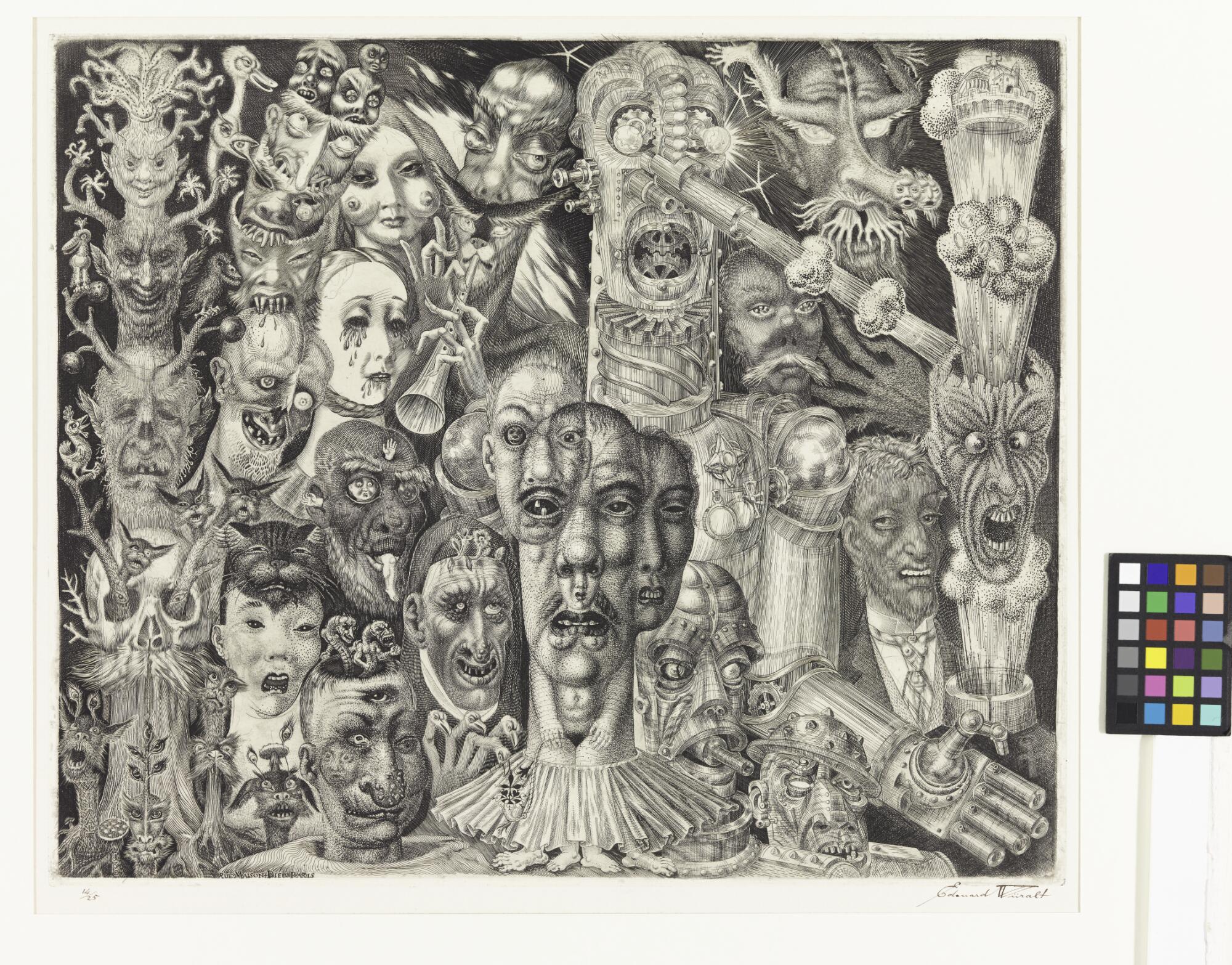
Hell
1930-1932
- Art Museum of Estonia, Tallinn, Estonia
Creator(s)
Title(s)
Date of creation
1930-1932
Materials and techniques
Etching and copperplate engraving on paper
Place of conservation
External links
Rights
When French art historian Pierre Mornand titled his 1937 article “Eduard Wiiralt, visionnaire de diableries et peintre séraphique,”[^1] he successfully captured the essence of one of Estonia’s most famous artists. Wiiralt’s art is indeed imbued with a play of symbols, the torment of evil, apocalyptic visions, a struggle with carnality and surrender to it, inspiration and imagination. But it was an imagination that worked through his trained hand and spirit. Wiiralt was a brilliant draftsman whose unbridled creative energy has become legendary. He found scenes worthy of capturing everywhere: in studios, markets, slums, Parisian cafés and the metro, on the streets and in the Dresden zoo, in bohemian parties and in the caravanserai of Marrakesh. Wiiralt was able to work productively in all kinds of conditions, conveying what he saw (in his mind’s eye) in almost all graphic techniques: he produced ca. 400 prints, hundreds of monotypes, and thousands of finished or sketch drawings.