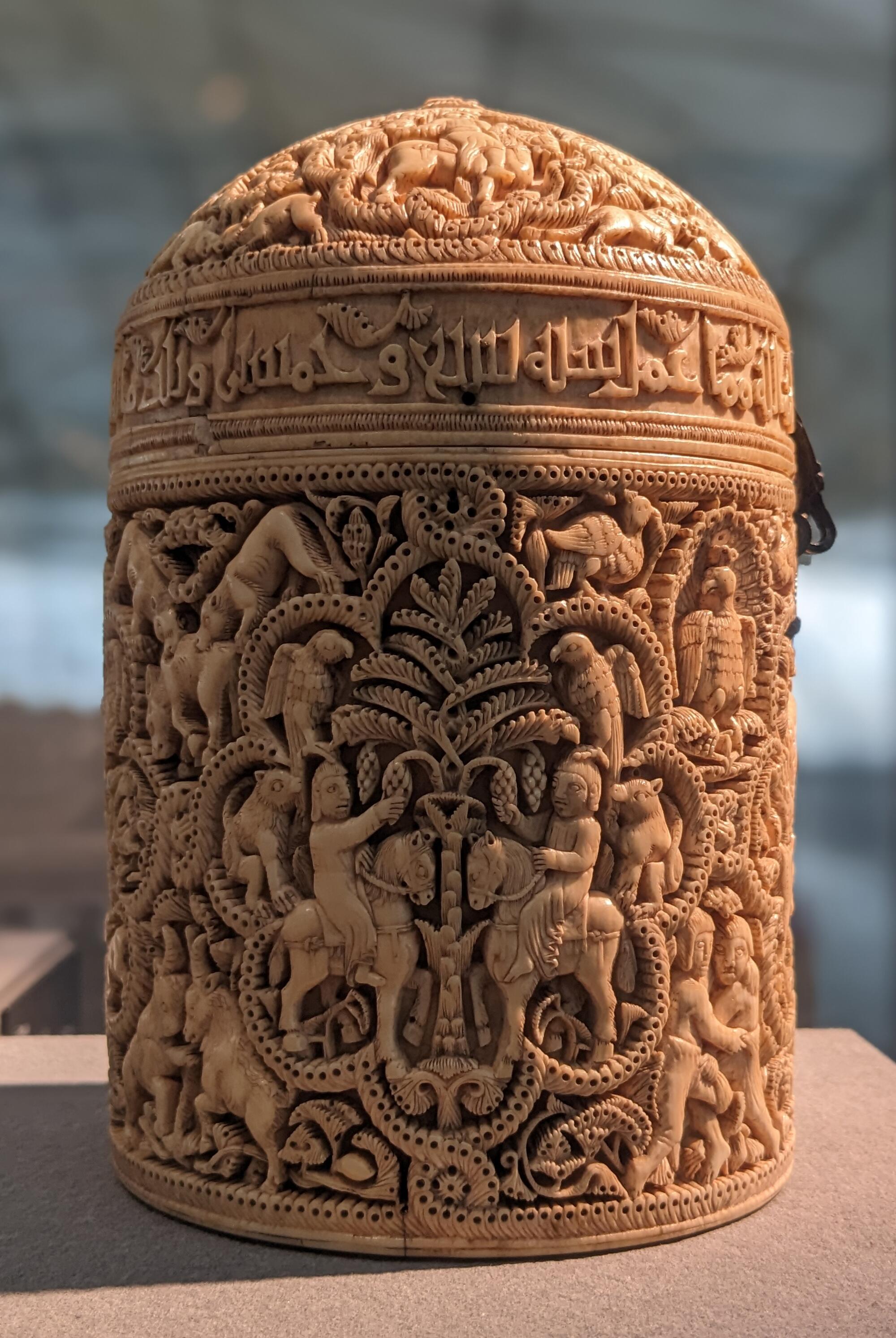
This intriguing object, standing little more than eighteen centimetres high, can be carried in your hands. In fact its curved, deeply-carved surface was meant to be held, to be turned and closely examined, its Arabic inscription deciphered, its lid lifted and its scented contents deeply inhaled. On its surface you will find images of people from a thousand years ago, of a prince and his companions, in gardens real and fantastic, of animals and birds beneath a dedication to a long-dead prince, his life cut short before he reached his promised power. It tells perhaps of a mother’s ambition for her youngest son, through a personal gift made by crafts people who were at the height of their powers, their singular skills highly sought after by their royal patrons. Look closer and you will see it is made of elephant ivory, its creamy white surface lightly cross-hatched with the cellular remains of an elephant who roamed the African bush, its tragic fate held in tusks which were prized then just as they are now.
Known as the ‘al-Mughira Pyxis’, this cylindrical casket is a supreme example of tenth-century sophistication of artistic expression and craftsmanship. Preserved in the Musée du Louvre (accession number OA 4068), its inscription tells us that it was made in the year 968CE for al-Mughira (ca.950–976CE), son of the Andalusi Umayyad caliph Abd al-Rahman III (r.912–961).1https://collections.louvre.fr/ark:/53355/cl010329109 ↩ A deeper look into its patronage reveals that it may have been commissioned by his mother, a powerful woman in the court, offering a rare glimpse into female artistic agency and family relationships from the period.
It is one of around thirty ivory objects that survive in international collections today that were made for the court in Cordoba, southern Spain, when it was the capital of the Andalusi Umayyad caliphate from the mid tenth to eleventh centuries. Many were associated with the reign of the first Umayyad caliph in Al Andalus, Abd al Rahman III and his son caliph al-Hakam II (r.961–976). From the eighth to eleventh centuries the Umayyads were the most powerful rulers of the western Islamic world. Their capital in Cordoba was where they built the Great Mosque, while five kilometres outside of the city in the later tenth century the court and its workshops moved along the Guadalquivir river to the palace city of Madinat al-Zahra. The court placed great value on objects of value and status, establishing a royal mint and textile workshop as well as dedicated royal workshops to make objects of ivory, ceramics and metalwork and an extensive royal library that not only collected but also produced manuscripts and translations of texts from across the world. At its height when this al-Mughira pyxis was made, the Umayyads in Cordoba were among the wealthiest, most literate and sophisticated societies in the world.
The carved ivories were made for the elite of the royal court to whom they were frequently inscribed with dedicatory and poetic inscriptions, and carved with images of vegetation such as vine scrolls, stylised plant motifs as well as figural images of people, paired animals and birds both real and fantastical. Helpfully, many of the inscriptions, which were written in Arabic around their lids, tell us when, for whom and sometimes by whom the ivories were made, enabling scholars to better understand their patronage, including the presence of female patronage within the court. Their interpretation has led to a more complete understanding of the production of the ivories within a well-organised workshop environment that was closely tied to the court. It has also revealed how the patronage of luxury objects was profoundly connected with the display of social position, status and loyalty to the ruler.
Description
At eighteen centimetres high including its lid, and with a diameter of 11.8cm, the al-Mughira pyxis is made from a section of elephant ivory tusk that was cut longitudinally and then hollowed out, its diameter being the girth of the tusk. They are made from tusks of the African elephant, Loxodonta africana, which are the only elephants to produce tusks with a girth wider than eleven centimetres. The raw tusks were traded by the Umayyads who were competing with contemporary Fatimid traders for control of luxury raw materials including ivory, gold and salt from sub-Saharan Africa.2Sarah M. Guérin (2013) “Forgotten Routes? Italy, Ifrīqiya and the Trans-Saharan IvoryTrade”, in Al-Masaq, 25:1 (2013), 70-91 ↩
Ivory was a rare and expensive material that was keenly valued for its pure and creamy colour, its density and durability as well as its potential to be carved into high relief. At this point in the tenth century it seems to have been readily available within the Cordoban court, as the containers are made from thick slabs of ivory (0.4cm thick in the case of the al Mughira pyxis) taken from the most valuable, lower section of the tusk where the dentine is found.3Silvia Armando “Caskets Inside Out. Revisiting the Classification of ‘Siculo-Arabic’ Ivories”, in Journal of Transcultural Medieval Studies (2017) 4 (1-2), 51-145:62. ↩ The pyxis is comprised of a section of the lower part of the tusk, which was hollowed out using a hand lathe, before being deeply carved on the exterior. The base and inside of the pyxis are plain and uncarved. The blackened metal fittings evident on the pyxis today appear to be later additions, as is evident from a close examination of their position and a comparison with other, contemporary ivories.
One contemporary ivory pyxis from 968CE, now in the collection of the Hispanic Society of America, has a poetic inscription that offers fascinating insights into how the objects looked and were used. It reads “The sight I offer is the fairest of sights, the still firm breast of a lovely young woman. Beauty has bestowed upon me a robe clad with jewels, so that I am a vessel for musk, camphor, and ambergris.”4Heather Ecker Caliphs and Kings: The Art and Influence of Islamic Spain, exh. cat., Arthur M. Sackler Gallery, Smithsonian Institution (Washington, D.C., 2004), 125-126. ↩ This reference to the female body hints at a connection with female fertility and youth that may offer insights into both the patronage and recipient of the ivories. Anderson and Rosser-Owen point out that its comparison of the domed ivory lid with a breast was also found in pre-Islamic verse that was known by the Umayyad Andalusi caliph al-Hakam II, in which the poem states that “the tender breast is like the lid of an ivory”.5Glaire D. Anderson and Mariam Rosser-Owen “Great Ladies and Noble Daughters. Ivories and Women in the Umayyad Court at Córdoba”, in Landau, Amy (ed.) Pearls on a Strong. Artists, Patrons and Poets at the Great Islamic Courts (Baltimore, the Trustees of the Walters Art Gallery,2015), 37. ↩ Most importantly, the inscription tells us about the function of the pyxis, as a container for expensive perfumes: ambergris, camphor and musk. These were, arguably, more expensive and rare substances than ivory, and were used by both men and women as luxury scents. The al Mughira pyxis was probably made to contain such a scent. It would have formed part of a display of luxury objects of different materials within a courtly context, that were commissioned, made and received as symbols of the prince’s status and authority.
Patronage and Inscriptions
The Arabic inscription on the pyxis is situated around the lower part of the lid, beneath its dome. It is carved in a clear angular “Kufic” script, in rather a jaunty fashion with an undulating base line, and with half palmette motifs filling the gaps above. The inscription reads “Blessings from God, goodwill, happiness and prosperity to al-Mughira, son of the Commander of the Faithful [amīr al-muʾminīn], may God’s mercy be upon him; made in the year 357 [968 CE].”6Ernst Kühnel and Adolph Goldschmidt, DieIslamischen Elfenbeinskulpturen VIII.-XIII Jahrhundert, Berlin, Deutscher Verlag für Kunstwissenschaft,1971, p. 38-39, pl.XVII-XVIII, no.31. ↩
The inscriptions on many of the Umayyad Andalusi ivories offer valuable information about when, where and for whom they were made. They tell us that these ivories were made as gifts by powerful royal figures for other elite members of the court, in some cases for specific named members of the royal family, made in royal workshops in Cordoba or Madinat al-Zahra. Several Andalusi ivories have inscriptions that tell us they were made for the daughter of caliph Abd al-Rahman III, (for example the casket made in Madinat al-Zahra in 961, V&A A.580–1910), and the paired caskets made for princess Walled, sister of al-Hakam II.7Anderson and Rosser-Owen (2015), 34. ↩ The Zamora pyxis, preserved at the use Arqueológico Nacional in Madrid (number 52113) commemorates in its inscription the birth of a child to the ‘noble lady’ Subh, wife of al-Hakam II in the year 964CE. This kind of inscription is not unusual. The practice of gift-giving in medieval Islamic societies is well documented through a study of surviving objects and of written descriptions. The Book of Gifts and Rarities documents the exchange and content of royal gifts from the sixth to eleventh centuries, written by Ibn al Zubayr who was a Fatimid official in the eleventh century. It includes a description of several gifts presented by the Abbasid caliph to his wife on the birth of their child, as well as descriptions of the wealth of objects owned by women in the Abbasid court including boxes of jewellery, cloth and scent.
The inscription identifies al-Mughira as the recipient, but does not tell us who ordered it to be made. This has led to speculation about the identity and motives of the patron. One theory is that the pyxis and its sophisticated iconographic programme were ordered by one of three high-ranking members of the court who were known for sponsoring works of art and held positions of confidence, including as treasurer, commander of the guard and head falconer, who supported al-Mughira as potential caliph.8Sophie Makariou “The Al-Mughira pyxis and Spanish Umayyad Ivores: aims and tools of power”, in Borrut, Antoine and Paul M. Cobb (eds.) UmayyadLegacies, medieval memories from Syria to Spain Leiden, Brill, 2010, 313-335: 328-331. ↩ Others have argued convincingly that it was ordered by his mother, al-Mushtaq, who had been the favoured consort of caliph Abd al-Rahman III.9Anderson and Rosser-Owen (2015). ↩ There is evidence for her patronage of architecture in a white marble inscription that survives in the Museo Arqueológico de Córdoba which recalls the construction of a minaret and gallery in the 960s, reading:
“In the name of God, the Merciful, the Compassionate / There is no power or strength except in God, the Unique. The Lady Mushtaq, mother of the brother [of al-Hakam II] al-Mughira, Order the construction of this minaret and the gallery adjoining it and the renovation of the decoration of this mosque and it was completed with the help of God under the direction of ‘Atiq bin ‘And al-Rahman, [his] eunuch servant in the month of Ramadan in the year three [hundred] and sixty […]”.10Glaire Anderson “A Mother’s Gift? Astrology and the Pyxis ofal-Mughira” Journal of Medieval History 2016 vol.42 no.1, 107-130: 113. ↩
In court chronicles such as that compiled by Ibn Hayyan (d.1076), al-Mushtaq is described as the mother of the favoured son of Abd al-Rahman III, al-Mughira. Given her closeness to the caliph, her established role as a patron and the association of ivories with female patronage in the court, we could interpret the pyxis as a message from mother to son, identifying him as the son of the deceased caliph Abd al-Rahman III and as such, as caliph-in-waiting to his brother al-Hakam II (r.961–76). At the time of its making in 968, al-Mughira had just turned eighteen; ambitions for him to ascend the caliphal throne had recently been thrown into doubt with the birth of his brother the caliph’s first son, the future caliph Hisham II (b.965). In this interpretation of the object’s patronage, this was not simply a personal, private object, but rather a gift with an ambition inscribed on its surface, of accession to the caliphal throne and loyalty to his mother’s line. As it turned out, al-Mughira was never made caliph. He was assassinated in 976 following the death of his brother and Hisham II took power.
Workshops
In several cases, the inscriptions can also tell us about the workshop in which it was made. While named crafts people are not found on the al-Mughira pyxis, their presence elsewhere helps to understand the workshop structure and social context within which this object was made. It’s not often that we get a glimpse of the hand of the maker from a thousand years ago, but these ivories offer us that insight. These usually features at the end of the inscription. For example, the Hispanic Society pyxis with its poem describing the perfumes, includes the words phrase “‘amala khalaf” at the end, referring to a known artisan called ‘Khalaf’ who was also named on the casket in the V&A made for Wallada, daughter of the caliph, which similarly includes the words “Khalaf”.
There was a close association between the royal court and the workshops, one of direct patronage and a keen interest in the production of luxury objects in particular ivory. The workshop that made the ivories for the royal court was located first in the south-west of the city of Cordoba, then relocated to the palace city of Madinat al Zahra during the reign of Abd al Rahman III. Known as the Dar al-Sina’a, the Cordoban workshop was credited with the production of luxury objects for the court including ivory, as part of an organised and strictly hierarchical team of craftsmen who would also have worked on architectural decoration. As Rosser-Owen has explored, it was located alongside other workshops including the royal mint where precious metals were stored, and the workshops that produced books and bindings.11Mariam Rosser-Owen Articulating the Hijaba: Cultural Patronage and Political Legitimacy in al-Andalus. The Amirid Regency c.970 - 1010 AD. Handbook of Oriental Studies vol.156, Leiden, Brill 2022,206-271. ↩ The textile workshop was situated separately in the Dar al-Tiraz, nevertheless it would have been closely associated with the court workshops, as luxury textiles were often used to line the interior of the ivory containers.
Figurative Images
Beneath the inscription on the al-Mughira pyxis are the highly legible and stylised carved figurative images on the pyxis. The main body is organised into four main cartouches and eight smaller vignettes, these comprise a mix of animal and human scenes surrounded by flora and fauna. They show scenes alluding to elements of courtly life including leisure pursuits of hunting, figures seated on thrones, drinking with companions, playing and listening to music and sitting in fertile gardens. These are familiar images from across the contemporary Islamic world, found on textiles, painted on walls and on decorated objects such as ivories and ceramics, used to reinforce a courtly way of life and status associated with the elite.
Some of the scenes are more unusual however, inviting multiple different interpretations. They may represent events from the young life of al-Mughira and allegorical references to political events,12Makariou (2010) ↩ or zodiacal images and images of seasonal significance linked to the Cordoban agricultural calendar or al-Mughira’s birthday.13Anderson (2016) ↩
The eight-lobed cartouches frame the four principal scenes. On the first cartouche there are three figures, one seated and holding a drinking vessel and holding a plant or flower, while another seated figure holds a flabellum and a central standing figure plays a stringed instrument; they are seated on a dais, held up by paired lions beneath. This image of leisure, drinking and music in the garden is typical of a royal scene. The figures are robed in cloth decorated with what look like decorative bands on their upper arms, a sign of high status textile. They are barefooted and their heads are uncovered, their expressions are blank, and their eyes are wide and staring. The expression is instead found in the depth of carving, in particular in the bodies of the figures and their envelopment in clothing - the foot of the seated figure, for example, whose toes peep out beneath his crossed leg, or his hands which encircle a vessel and a staff, their grip shown with a three dimensionality of carving that gives depth and movement to the figure.
Moving from right to left, the next eight-lobed cartouche shows a mirrored image of paired animals in combat, also typical of contemporary designs on textiles and other media. A bull, with large eyes and paired horns and cloven hooves, looks back towards its rear, as a male lion stands, its back arched, on its back and its teeth and claws bite into its skin. Unlike the three humans in the previous cartouche, these paired animals are suspended in space, without a ground or a floor to support them. They are shown in high relief, their rear inner back legs clearly carved and visible. Filling the space around the animals are half palmettes and palmettes, symmetrically organised. Between the previous cartouche and this, are other paired animals - above a pair of peaceful adores eagles, while below a pair of facing griffins, seemingly unaware that their rear ends are being pierced by the biting of smaller quadrupeds.
The next cartouche is less common, showing a pair of young men on horseback picking dates from a palm tree, while falcons perch above their heads, their tails gripped by cheetahs. The men are barefoot, wearing flowing robes, and their heads are uncovered, one hand gripping the rein of their horse, while the other pulls on the large dates. Between this and the previous scene are inserts of a peacock flanked by paired birds, while beneath a pair of entangled boys, shirtless and barefoot, wrestle with each other, their legs entwined and hands pulling up each others’ shorts.
The final scene enclosed within an eight-lobed cartouche, also untypical of its time, shows a symmetrical scene of a pair of older, bearded men, their backs to each other, one bare foot gripped by a small dog, while the other foot stands on its head. Their arms reach up to a falcon’s nest towards the eggs within. Above their heads, a central nest with hatched birds inside. Between this and the previous cartouche, an upper image of a defeated-looking quadruped, perhaps a donkey, bitten by two larger feline-looking creatures, while below two goats raise up on their hind legs to challenge each other. The scene after this final cartouche, includes a pair of falconers with their birds, above a pair of gazelles, standing proud with their antlers high and facing each other. These two uncommon scenes may refer to particular stories or events from the time, the meaning of which has been all but lost today. All four cartouches and infill scenes are carved in high relief against a complex intertwining web of palmettes and half-palmettes, pierced with drill holes throughout. The domed lid is carved with four corresponding, smaller eight-lobed cartouches, showing adorned lions, facing peacocks and facing gazelles, and a mounted falconer. These are interspersed with small birds, facing lions, paired quadrupeds, and paired eagles. The central knop, which would have been used to lift the lid, is broken off.
The metal clasps on the pyxis are later additions. While other ivories almost always have metal mounts made of nielloed silver gilt (eg Hispanic Society of America), there are no gaps left in the carving of the al-Mughira pyxis where these mounts might have been situated.14Mariam Rosser-Owen “The Metal Mounts on Andalusi Ivories: Initial Observations”, in Metalwork and Material Culture in the Islamic World: Art, Craft and Text. Essays presented to James W. Allan, eds. Venetia Porterand Mariam Rosser-Owen, eds., London: IB Tauris, 2012, 303. ↩
Alterations to the ivory highlight the long life of the object after the end of the Umayyad caliphate in the early eleventh century. We do not know where it went after this, but many of the ivories found their way into ecclesiastical treasuries, particularly in Spain but also across western Europe, where they were used as reliquaries. This phase of its life is silent, it probably lay quietly in a treasury amongst other eclectic objects accumulated over the medieval period. In 1898 it was bought by the Louvre from the art dealer Stanislas M. Baron, who had a shop in Paris and a keen interest in medieval Spanish art. Baron probably bought it from the collection of Juan Facundo Riaño y Montero (1829–1901), another art dealer who specialised in Spanish antiquities at the turn of the century.15Ulrike Müller “The Reception of Late Gothic Spanish Sculpture around 1900. A Case Study of Collectors’ Archives as a Tool for Art-Market Research” Getty Research Journal 18, 83-106. ↩ For over a thousand years, this enigmatic object has been treasured, a testament to its exceptional quality and I think to the deeply personal and moving insight it gives us into the world of a young prince in tenth century Cordoba.