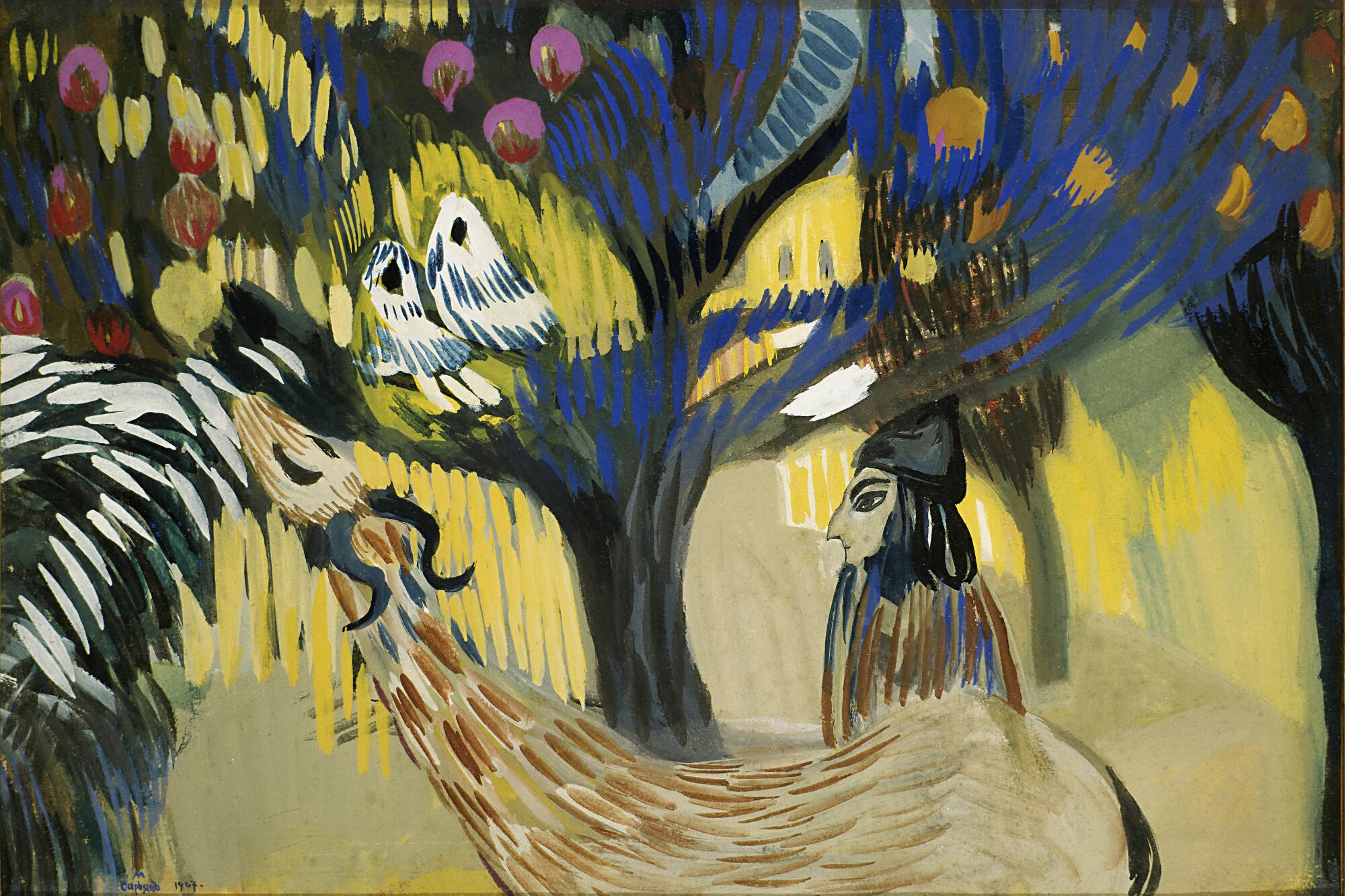
Martiros Sarian (Nor Nakhichevan, now a district of Rostov-on-Don, 1880—Yerevan, 1972), original title in Russian: U granatovogo dereva, in English — Near the Pomegranate Tree, 1907, tempera on cardboard, 34.5 × 52.5 cm, signed and dated ” M. Sarian 1907” in the lower left corner, Moscow, State Tretyakov Gallery, inv. RF 5966. The work was acquired from the author by Ivan Morozov from the “Golden Fleece” exhibition in 1908 and remained in his collection until 1920, from 1923 to 1925 it was housed in the State Museum of New Western Art, and in 1925 it entered the State Tretyakov Gallery.
Earlier, Sarian’s painting after graduating from the Moscow School of Painting, Sculpture and Architecture was primarily associated with his watercolor cycle “Tales and Dreams,” which emerged in the context of Russian “second wave” symbolism between the “Scarlet Rose” (1904) and “Blue Rose” (1907) exhibitions. It remained a unique and unrepeatable milestone in the artist’s biography.
“Near the Pomegranate Tree”—a symbolically saturated work by Sarian—was first exhibited at the “Blue Rose” exhibition in Moscow in March 1907. It was organized by the symbolist literary and artistic journal “Golden Fleece”, whose patron was industrialist and art collector Nikolai Ryabushinsky (1877—1951). A very important role in the ideological preparation of the exhibition was played by the “Free Aesthetics” society, headed by symbolist poet Valery Bryusov (1873—1924), under whose editorship the journal “Wreath” was published. The main participants of the “Blue Rose” exhibition were precisely members of “Free Aesthetics”, among whom was Sarian. The 15 works by Sarian exhibited at this exhibition, including “Near the Pomegranate Tree”, attracted the attention of critics and art historians. Regarding Sarian’s works, writer and art historian Pavel Muratov (1881—1950) stated: “Glimpses of the only real fairy tale at the exhibition flash by […]”.1Pavel Muratov,“Exhibition of paintings, “Blue Rose”, Russkoe slovo, 1 April 1907, 5. ↩ And years later, poet, art critic and organizer of art exhibitions Sergei Makovsky (1877—1962) wrote: “Just a few years ago at the ‘Blue Rose’ exhibition, Sarian’s works struck me with their captivating fantasy, sharp simplification of drawing and coloring, and most importantly, their unique character, childlike quality that reminded me of none of the Parisian or Moscow primitivists. […] In each page of these paradoxical ‘fairy tales’ there was magic, the power of suggestion, thanks to which an elusive line deviation, a twist of a color spot, an intentionally incorrect proportion or involuntarily emphasized detail becomes more convincing than any verisimilitude and plunges the viewer into a magical world”.2Sergey Makovsky,” Exhibition of the “New Society”, Apollo, no.1, 1911, 72. ↩
For the first time in Western art historiography, American scholar John E. Bowlt wrote about this landmark exhibition of Russian symbolism in 1973 in his study “Russian Symbolism and the ‘Blue Rose’”.3John E. Bowlt, “Russian Symbolism and the,“Blue Rose” Movement ”, in: The Slavonic and East European Review, 51, no. 123 (Apr., 1973), 161-181. ↩
At the center of the composition of Sarian’s work “Near the Pomegranate Tree” is the pomegranate tree itself, which gave the painting its name. It embodies the idea of the Tree of Life. In Armenia, the pomegranate tree is one of the most important and widespread national symbols and occupies a special place in Armenian art. It is filled with profound meaning. In Armenian tradition, the pomegranate is an ancient symbol of life, fertility, love, and immortality. Its blazing scarlet fruits are like the heart of nature, generous and passionate. In Sarian’s painting, the pomegranate tree becomes the sacred center of the composition, radiating the energy of life, color, light, and warmth.
Starting from 1904, graphic and pictorial works were created one after another, in which Sarian forms his imaginative perception of nature, the world and the universe, and determines man’s place in this space. Among them, a special place is occupied by the 1904 watercolor “Under the Tree. A Fairy Tale” in which the motif of the Tree of Life first appears in his work. Drawing from knowledge accumulated over millennia by different peoples and cultures, creatively developing the aesthetic and artistic traditions of medieval Armenian miniature painting, Sarian creates his own world of images and symbols, among which a special place is given to the Tree of Life. Sarian’s greatness lies precisely in the fact that he completely reinterprets, using the means of contemporary pictorial language, the numerous transformations of the Tree motif—as the World Tree (Arbor Mundi), as the Axis and model of the World (Axis and Imago Mundi). These symbols are united by one idea, they are the connecting link between Earth and Heaven, embodying the aspiration to God, to the Higher Mind, to perfection, to immortality. Sarian creates his own fairy tale, his own conception of earthly paradise, and continues mythmaking in contemporary art. In “Near the Pomegranate Tree”, the tree resonates with the artist’s inner state, while its crown and fruits glow with colors, intensifying the overall sense of the fullness of being. To the right of the tree is depicted a poet-sage, a figure that is spiritualized and calm, frozen in meditative contemplation of nature. He seems to merge with the surrounding environment, conducting an inner dialogue with the world around him, the realm of flora and fauna. This image is present in several early works by Sarian, and according to his own interpretation, he identifies himself with it. Let us recall such works by the artist as “At the Foot of Ararat. A Fairy Tale” (1904), “Poet” (1906), “Man with Gazelles” (1906), “Comet” (1907), “By the Sea. Sphinx” (1908).
The inseparable companion of the poet-sage is the Gazelle, an image imbued with tenderness, Eastern poetry, and the artist’s personal associations. The gazelle in Sarian’s work is not just an animal. It is a symbol that has absorbed the features of the ideal of beauty, refinement, and spiritual freedom, tracing back to images from Eastern lyrics, Persian and Armenian poetry. At the same time, the gazelle has a specific autobiographical basis: once, while still a schoolboy, Martiros saw through a garden fence a wild gazelle tied to a tree. Her longing, pleading gaze, her striving for freedom, impressed the young artist and remained in his memory for life as the strongest experience, symbolizing the conflict between living nature and violence, between beauty and suffering. Since then, the image of the Gazelle became for Sarian the embodiment of spiritual purity, the striving for liberation and return to the natural state of being.
The painting is built on the pulsating rhythm of lines and color spots, which gives it musicality—a key feature of symbolist art. The figure of the sage, the smooth contours of the Gazelle, the twisting branches of the tree—everything is subordinated to inner harmony. The color palette is saturated: wine, lilac, and bright red shades of pomegranate fruits contrast with the blue and green of the foliage, through which yellow rays of the daylight penetrate, painted with vertical, parallel brushstrokes. In the depths of the painting, through the mighty branches of the tree, one can see a sun-lit yellow wall of a single-story dwelling. With interrupted strokes of ochre and terracotta, a graceful gazelle is painted, stretching her graceful neck toward the branches of a bush growing next to the tree. Not far from her head, on a branch of the pomegranate tree, sit two white doves.
The dove itself is also a symbol of peace, purity, tenderness, love, and fidelity. All this together creates the effect of a pictorial symphony.
These images, woven together by the “singing” rhythm of lines and a rich, almost musical palette, create a unified space where there is no conflict or alienation. This is the artist’s personal Eden, his conception of earthly paradise, where human, animal, and plant coexist in absolute harmony.
Thus the painting “Near the Pomegranate Tree” becomes not just a work of art, but a manifesto of Sarian’s faith in the healing, unifying, and spiritualizing potential of nature. The painting affirms that the true essence of man is revealed not in opposing oneself to the world, but in merging with it. It reflects faith in nature’s ability to elevate man, to awaken in him eternal feelings—love, compassion, and an unquenchable thirst for truth and freedom.
In Sarian’s world, nature is not a passive backdrop for human life, but an active, living, and spiritualized principle. The painting represents a model of an ideal world that serves as a refuge and source of healing for the soul, tired of the vanity, fragmentation, and violence of civilization.
The relevance of this “philosophical parable” today is perhaps even sharper than at the beginning of the 20th century. In an era of urbanization, digital isolation, and ecological crises, Sarian’s voice calling for harmony sounds more powerful than ever. His work is an eternal reminder of our lost unity with the world and the possibility of regaining it through contemplation, empathy, and recognition of beauty as the highest spiritual value. The painting ceases to be an artifact of the “Blue Rose” era and becomes a portal to an ideal world, a source of spiritual and aesthetic consolation for viewers of any time.
“Near the Pomegranate Tree”—a landmark work by Martiros Sarian—has a very interesting exhibition history and is included in many of his albums published in Armenia, Russia, France, and Canada. As it was mentioned above, the painting was first exhibited at the famous Russian symbolism exhibition “Blue Rose” in Moscow.
The organizer and patron of the exhibition was Nikolai Ryabushinsky, a representative of the famous Moscow merchant dynasty, collector, and one of the central figures of the Silver Age of Russian culture. He is particularly known as the founder and publisher of the artistic-literary journal “Golden Fleece” (1906—1909), which played an important role in the development of Russian Art Nouveau and symbolism. “Blue Rose” played an important role in consolidating young artists, following painters Mikhail Vrubel and Borisov-Musatov and adherents of the symbolist direction of Russian art at the turn of the 19th-20th centuries. The main core of the Blue Rose artists (as the participants of the “Blue Rose” exhibition came to be called) were graduates of the Moscow School of Painting, Sculpture and Architecture, led by Pavel Kuznetsov, Sarian’s fellow student. “Blue Rose” was the only exhibition under this name, and only in 1925, already under completely different historical and political conditions, in Moscow, at the Tretyakov Gallery, a retrospective exhibition “Masters of the”Blue Rose” was organized, at which Sarian’s work “Near the Pomegranate Tree” was again exhibited.
But let us return to the artistic life of pre-revolutionary Russia. Ryabushinsky’s desire to continue exhibitions under the same name “Blue Rose” with the involvement of French artists did not find support from many Blue Rose artists and the symbolist journal “Vesy” (Scales). Disagreements between the two symbolist journals and their editors, Bryusov and Ryabushinsky, continued to grow: “Vesy” followed the former principles of symbolism, while “Golden Fleece” sought to become a conductor of new trends coming from the West. At the end of 1907, supporters of “Vesy” in St. Petersburg organized their own independent exhibition, called “Wreath. Stefanos”, at which Sarian exhibited seven works, including “Near the Pomegranate Tree”.
Ryabushinsky, who did not abandon the idea of joint exhibitions, began organizing exhibitions of works by Russian and French artists under the same name from April 1908, parallel to the published journal “Golden Fleece”. This was a very important event in the artistic life of Russia at the beginning of the century, when works by the best French masters such as Bonnard, Braque, Van Gogh, Gauguin, Degas, Denis, Derain, Marquet, Matisse, Renoir, Redon, Rouault, and others were exhibited alongside works by young Blue Rose artists. Sarian’s painting “Near the Pomegranate Tree” was among the exhibits of the “Golden Fleece” exhibition of 1908 and was acquired by Ryabushinsky himself. From this same exhibition, Ryabushinsky acquired Vincent Van Gogh’s famous work “The Night Café”.
Already being the property of Ryabushinsky, the painting “Near the Pomegranate Tree” was exhibited at the “7th Exhibition of the New Society of Artists” in 1910 in St. Petersburg, and the “1st Spring Exhibition of the Rostov Nakhichevan-on-Don Society of Fine Arts” in 1911.
After the establishment of Soviet power, this work was exhibited at the aforementioned exhibition “Masters of the ‘Blue Rose’” in 1925 in Moscow, after which its exhibition history was interrupted for 31 years. And this is understandable: how could a work of symbolist nature be exhibited during the years of Stalin’s regime. One can only rejoice that it did not disappear entirely and was preserved in the reserves of the Tretyakov Gallery.
Starting with Sarian’s anniversary exhibition of 1956, organized in Moscow and St. Petersburg and dedicated to the 75th anniversary of the artist’s birth, the work “Near the Pomegranate Tree” figures in his personal exhibitions, which took place in Yerevan and Moscow4Genrich Igityan, Martiros Sarian, cat. exp*.* (Yerevan, House ofArtists, March-May, 1965), Yerevan, 1965. ↩ in 1965, then in Bucharest and Prague5Genrich Igityan, M.S. Sarian, cat. exp, (Prague,Gallery at Charles Square), November 1965- January1966), Prague, 21. ↩ in 1965, and a year later in the same exhibition held in Bratislava and Berlin in 1966. “Near the Pomegranate Tree” was exhibited in the halls of the USSR Academy of Arts in Moscow, at the anniversary exhibition dedicated to the 100th anniversary of Sarian’s birth, in 1980.6Shahen Khachaturyan, Martiros Sarian, Dedicatedto 100th Anniversary of His Birth,cat. exp. (Moscow, USSR Academy of Arts, February-June 1980),Moscow, 1980, 32. ↩
Interest in Sarian’s early work “Near the Pomegranate Tree” particularly increased in the 1990s, after the publication of art historian Ararat Agasyan’s book “Martiros Sarian. Early Art”.7Ararat Aghasyan, *Martiros Sarian. Early Art,*Yerevan, 1992 [in Russian]. ↩ In 1993, in Sarian’s House-Museum in Yerevan, and then in Moscow, in the Engineering Hall of the Tretyakov Gallery, Sarian exhibitions were organized under the title “Tales and Dreams”. At the Moscow exhibition, the painting “Near the Pomegranate Tree” was displayed. It was reproduced in Ida Hoffman’s album “Blue Rose”, published in 2000.8Ida Hoffman, Blue Rose, Moscow, 2000, 117 [in Russian]. ↩
For the first time in Europe, “Near the Pomegranate Tree” was exhibited at a Martiros Sarian exhibition titled “In the Land of the Soaring Sun” (Au pays du soleil volant) in 2003, from June 28 to October 5, in the south of France, in the city of Antibes, at the Picasso Museum, Château Grimaldi. The work is reproduced in the exhibition catalog.9Jean-Louis Andral and others, Sarian. Au pays du soleil volant. cat. exp. (Antibes, MuséePicasso, 28 June – 5 October 2003), Antibes, RMN, 77. ↩
Relatively recently, “Near the Pomegranate Tree” was exhibited in Paris, at the Louis Vuitton Foundation at the exhibition “La collection Morozov: Icônes de l’art moderne”.10Anne Baldassari/Curator-in-Chief, TheMorozov Brothers’ Collection. Icons of Modern Art,cat. exp. (Paris, Fondation Louis Vuitton, 22 September 2021-3 April 2022), Paris, p. 501. ↩ The exhibition showed about 200 masterpieces of modernist French and Russian art, including 2 works by Sarian, exhibited alongside Matisse, Manet, Monet, Gauguin, Modigliani, Vrubel, and others. Besides “Near the Pomegranate Tree”, Sarian’s painting “Constantinople Street”, 1910 (cardboard, tempera, 59.5 × 63.5 cm), also from the Tretyakov Gallery collection, was exhibited.
After the exhibition closed in Paris, “Near the Pomegranate Tree” was also exhibited in Moscow at the exhibition “Brother Ivan. The Collection of Mikhail and Ivan Morozov” at the Pushkin State Museum of Fine Arts,11Natalia Y. Semenova. BrotherIvan. The Collection of Mikhail and Ivan Morozov, cat. exp. (Moscow, PushkinMuseum of Fine Arts, 28 June-30 October 2022), Moscow, 548, [in Russian]. ↩ organized from June 28 to August 30, 2022. The work was placed in a hall titled “Gauguin. Meditation and Exoticism”, together with works by Paul Gauguin. The exhibition text on the wall of the Pushkin State Museum of Fine Arts noted the following:
“In Morozov’s subtle interpretation, the exoticism of Gauguin’s art intertwined with a new understanding of the role of non-European and folk cultures, consonant with ethnographic and curatorial experiments of the early 20th century. The collector saw intersections with Gauguin’s aesthetics in the ornaments and local colors of folkloric scenes by B. Kustodiev or A. Ryabushkin, in the theatrical fantasies of B. Anisfeld, and in the hot colors of M. Sarian.”