Courtesy of the ©Sarian Family, All rights reserved, Please ask the estate for permission before re-using the image
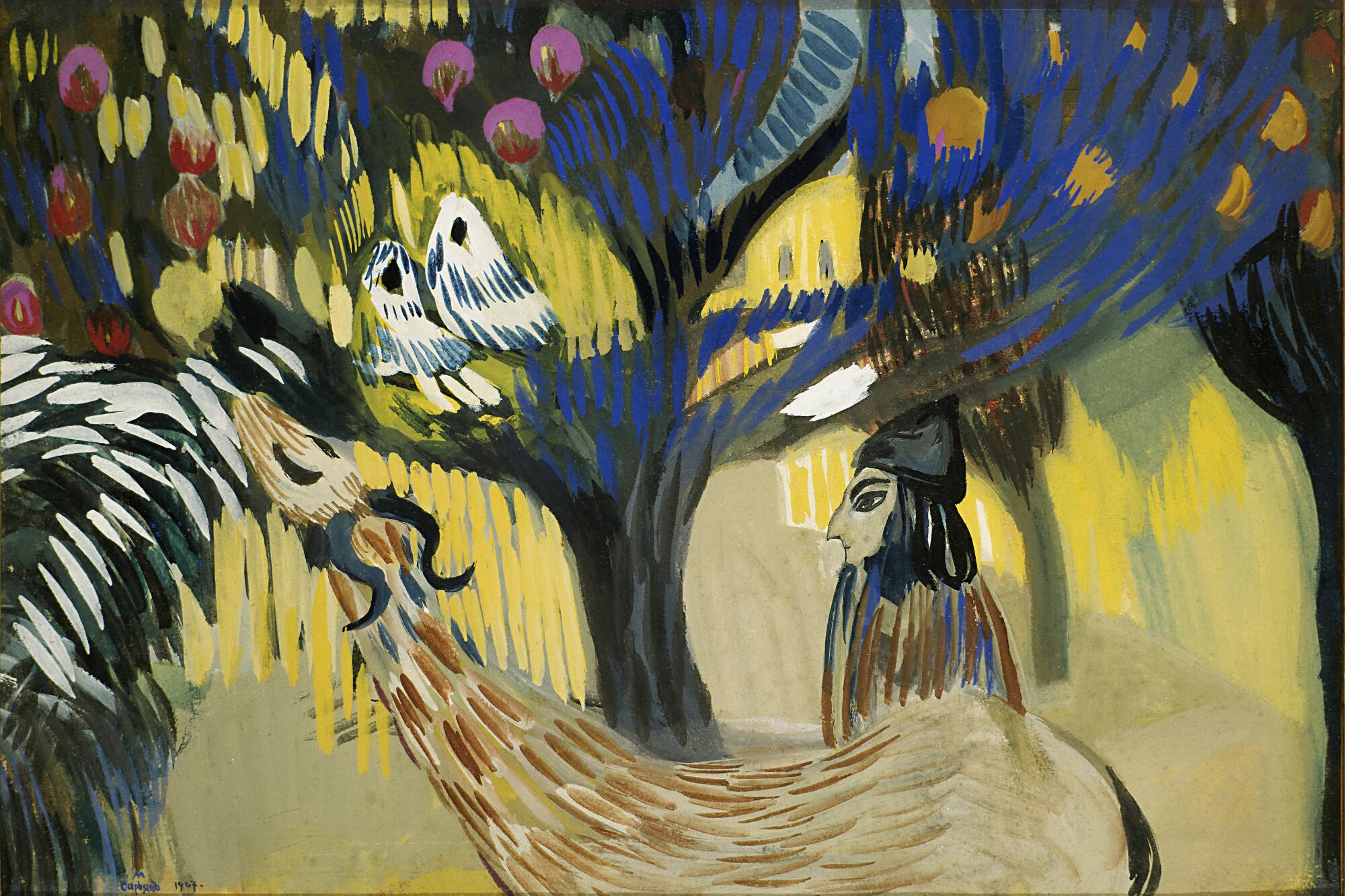
Near the Pomegranate Tree
1907
- State Tretyakov Gallery, Moscow, Russia
Creator(s)
Title(s)
Date of creation
1907
Materials and techniques
Tempera on cardboard
Dimensions
Inscriptions
Place of conservation
accession_number
Acquisition details
Rights
The work “Near the Pomegranate Tree”occupies a unique place in art history, being not just a gem of Martiros Sarian’searly work, but also a key work that allows us to take a fresh look at theartistic processes of the early 20th century. In the context of Russian art,“Near the Pomegranate Tree” represents one of the highestflights of the “Blue Rose” symbolist movement andsimultaneously is a work that transcends its boundaries. Sarian’s painting isconnected with the aesthetics of “Blue Rose” symbolism,however, without falling into mysticism and decadent moods inherent in manyartists of this circle, Sarian brought a powerful, life-affirming “Easternspirit” to the movement. He filled the conventional language of symbolismwith hot colors and ancient images of his homeland, creating a unique synthesisand becoming a bridge between refined Russian symbolism, and the comingcoloristic revolutions of Russian avant-garde.
During the years of Stalin’s regime, when symbolism andformal searches were banned, the work, preserved in the reserves of theTretyakov Gallery, proved its cultural viability. On the world stage, Sarian’swork enters into direct dialogue with the artistic searches of its time, beingconsonant with the experiments of French Fauvists and Paul Gauguin’ssynthetism. However, Sarian is not an imitator. If Gauguin sought his paradisein exotic Tahiti, Sarian found his in the land of his ancestors.Collector IvanMorozov, who gathered masterpieces of French modernists, acquired thispainting, and a century later it was exhibited in the same hall with works byPaul Gauguin at the exhibition “Brother Ivan. The Collection of Mikhailand Ivan Morozov”, is the highest recognition. Immediately noticed andappreciated, it entered one of Russia’s finest collections. Its triumphantmarch through the world’s major museums in the 21st century—from the PicassoMuseum in Antibes to the Louis Vuitton Foundation in Paris—demonstrates thatits language is universal and speaks to viewers across cultural and temporalbarriers.
“Near the Pomegranate Tree” is aliving participant in cultural dialogue, a bridge between East and West,personal myth and universal parable. Its journey from the artist’s studiothrough the greatest collections and exhibition halls of the world isindisputable testimony that Martiros Sarian created not just a painting, but aneternal symbol of harmony, whose artistic and spiritual value only increaseswith time.