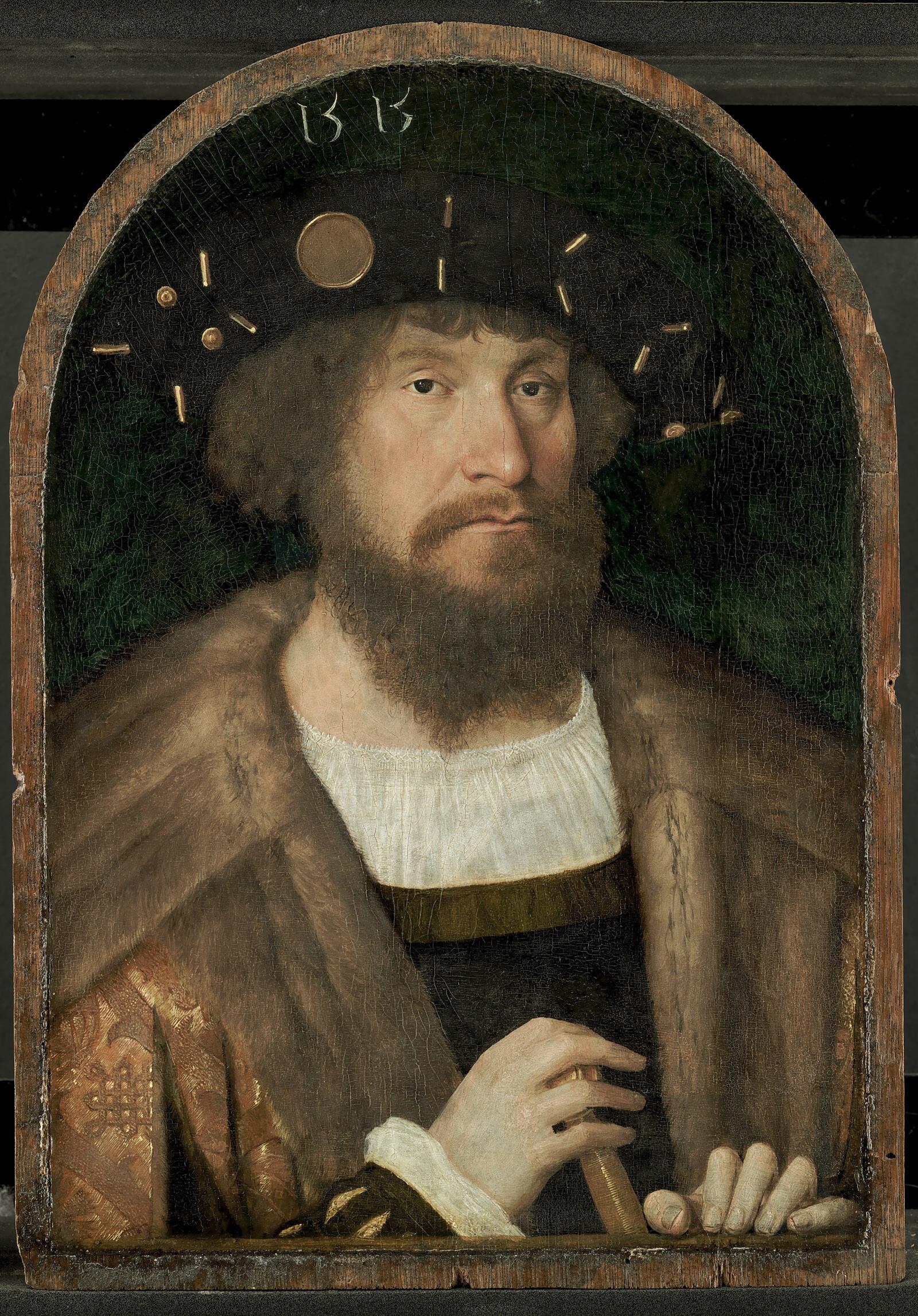
The Portrait of King Christian II of Denmark (1481—1559) is one of the best documented works by Michel Sittow, an internationally renowned painter from what is now Estonia. During his lifetime, the artist worked at the courts of Spain, the Netherlands, Denmark, and England (?), but also spent a long time in his native Hanseatic city of Tallinn (German Reval). Due to his nomadic lifestyle, Sittow did not fit into the narrative of national art histories that developed in the nineteenth century. Sittow’s artistic career and oeuvre instead highlight themes of international artistic contacts, mobility, and adaptation — and these resonate with us today.
The work depicts Christian as a strong and determined Scandinavian ruler, which is how the king wished to present himself. It is the first official portrait of him as king. This painting is an important reference point in the reconstruction of Sittow’s work, gradually rediscovered in the early twentieth century. Yet scholars still disagree on the circumstances and exact date of the painting’s completion, and whether it is the original portrait or a copy made by the artist himself.
Attributing the work
The Danish National Archives hold a letter sent by customs officer Hans Pedersen from Elsinore (Helsingør) to King Christian II in Copenhagen (dated 1 June 1514), informing him of the arrival of the long-awaited master Mechil from Tallinn. The letter was already known to Danish researchers at the end of the nineteenth century, but at that time it was not yet linked to the portrait in the royal collection, which was previously thought to have been painted by Albrecht Dürer.1Gustav Falck, “Meister Michiel of Kunstmuseets Portraet of Christiern II”, in: Kunstmuseets Aarsskrift 13—15 (1926—1928), 129-133. ↩
In 1915, however, Max Jacob Friedländer, an art historian working at the Gemäldegalerie in Berlin — one of the most respected experts on Early Netherlandish and German art in his time — published an article attributing to Master Michel a painting recently acquired by the museum, Madonna with Child (c. 1515—1518).2I.e. Michel Sittow, Maria mit dem Kind, Staatliche Museen zu Berlin, SMB 1722, https://recherche.smb.museum/detail/829489/maria-mit-dem-kind (all links last accessed 27 August 2025). ↩ Friedländer also considered the paintings then known as Portrait of a Lady (c. 1514)3I.e. Michiel Sittow, Mary Rose Tudor (1496—1533), Schwester Heinrichs VIII. von England (?), Kunsthistorisches Museum, Vienna, KHM 5612, https://www.khm.at/kunstwerke/mary-rose-tudor-1496-1533-schwester-heinrichs-viii-von-england-1788. Curiously the English version of the same webpage identifies her as Idealised Portait of Queen Isabella I. of Castile (?) instead: https://www.khm.at/en/artworks/idealised-portait-of-queen-isabella-i-of-castile-1788-1. Friedländer in his turn thought the depicted woman to be Catherine of Aragon, Queen of England. ↩ and the Portrait of a Man (c. 1515—1518)4I.e. Michel Sittow, Portrait of Diego de Guevara (?). In Friedländer’s time in a Madrid private collection, today at the National Gallery of Art, Washington DC, WNGA 1937.1.46, https://www.nga.gov/artworks/53-portrait-diego-de-guevara. Previously identified also as the Portrait of the Knight of the Order of Calatrava. ↩ to have been painted by the same artist. Master Michel was a “code name” given to a then anonymous artist — Friedländer identified him as a Netherlandish painter, who worked in the service of Isabella of Castile (1451—1504) and Margaret of Austria (1480—1530) and who was mentioned in court documents under various names, including Michel Zittoz and Maître Michiel.5Max J. Friedländer, “Ein neu erworbenes Madonnenbild im Kaiser-Friedrich-Museum”, in: Amtliche Berichte aus den köningliche Kunstsammlungen 36, no. 9 (1915), 179-183. ↩
Based on stylistic comparison, the Portrait of King Christian II of Denmark was soon attributed to Master Michel as well, further confirmed by the aforementioned letter. It was wondered, however, why would the presumed Dutch master travel to Copenhagen via Tallinn.6Falck (1926—1928). ↩
Michel Sittow and his creative path
The mystery was solved at the beginning of World War II by Paul Johansen, a historian of Danish origin and director of the Tallinn City Archives, who managed — with the help of archival materials from Tallinn and Lübeck — to establish the artist’s true historical identity: Michel Sittow was a master who was born in Tallinn, were he also worked and died — a citizen of Tallinn who had served both Isabella of Castile and Philip the Handsome (1478—1506), Duke of Burgundy.7Paul Johansen, “Meister Michel Sittow, Hofmaler der Königin Isabella von Kastilien und Bürger von Reval”, in: Jahrbuch Preussischer Kunstsammlungen 61 (1940), 1-36. ↩
A key discovery was a letter sent to the Lübeck Court of Appeal in inheritance matters (dated 16 March 1507), the original of which has been lost. (In 1944, Soviet troops took the Lübeck archive materials with them, and it is likely that the letter is still among the sources stored in Russian closed repositories. A photograph of the letter is kept in the Tallinn City Archives.)8Tallinn City Archives, TLM F 1465.1.7.19. ↩
With German roots on his father’s side and Swedish roots on that of his mother’s,9According to Johansen, Sittow’s mother was of Finnish-Swedish descent on her father’s side, and of Swedish descent on her mother’s side. ↩ Sittow received his early training in art under his father Clawes van der Sittow (d. 1482), a renowned Tallinn painter and sculptor at the time. From 1484, Michel continued his studies in Bruges, presumably in the workshop of the famous Hans Memling (1430—1494), where he mastered the illusionistic painting technique characteristic of Early Netherlandish painting.
Sittow’s creative path in fact encompasses two artistic careers: in addition to his career as a court artist traveling between different countries, which began in 1492 when he entered the service of Isabella of Castile in Toledo, Sittow worked as an artist-craftsman in Tallinn from 1506 to 1513/1514, and from 1518 to 1525. Although Tallinn was a relatively prosperous Hanseatic city at the time, due to the socio-economic context his works from these two periods are very different from the works — mostly small-format portraits and devotional paintings reminiscent of miniatures — that he painted as a court artist in the major European centers.10The most detailed overview of Sittow’s itinerant career and the works attributed to him has been provided by Matthias Weniger, Sittow, Morros, Juan de Flandes. Drei Maler aus dem Nordem am Hof Isabella von Kastilien, Kiel 2011. Archival materials concerning the artist’s periods in Tallinn have been critically reviewed by Anu Mänd, “Michel Sittow and Reval (Tallinn). A New Look at Records in the Tallinn City Archives”, in: Tiina Abel, ed., Michel Sittow 1469—1525. The Artist Connecting Estonia with the Southern Netherlands, Tallinn 2001, 3-14. ↩
Over the past hundred years, Sittow’s work has been viewed on the international art scene primarily from the perspective of the Netherlandish school of painting. The history of the region has played a significant role in this, as Estonia was closed off behind the Iron Curtain of the Soviet Union for half a century. It was not until 2018 that the first monographic exhibition dedicated to the artist, Michel Sittow: Estonian Painter at Courts of Renaissance Europe, took place, held at the National Gallery of Art in Washington DC, and the Kumu Art Museum of the Art Museum of Estonia in Tallinn (curators John Oliver Hand and Greta Koppel). Although this exhibition focused on the more elite part of the artist’s oeuvre — his work for the courts — it also raised questions about his work in his hometown, based on one of Sittow’s works preserved in Tallinn.11John Oliver Hand and Greta Koppel, eds., Michel Sittow: Estonian Painter at the Courts of Renaissance Europe, New Haven 2018. ↩
In 2023, a follow-up exhibition Michel Sittow in the North? Altarpieces in Dialogue took a closer look at his work in Tallinn in the first quarter of the sixteenth century, bringing together works from the Baltic Sea region related to Sittow and other Tallinn masters.12Merike Kurisoo, ed., Michel Sittow in the North? Altarpieces in Dialogue, Tallinn 2023. ↩ Recent research has thus highlighted the need for a more comprehensive and open approach to the work of Sittow as a Castilian court artist, a Netherlandish master, and an artist-craftsman of Old Livonia.
In the artist’s biography, the Portrait of Christian II, painted in 1514—1515 and exhibited in the permanent display of the National Gallery of Denmark, has been seen as the motivation for his second European tour (first tour lasted through 1492—1506, the second 1513/1514—1518), thus also being a link between these different, long-separated artistic spheres.
The genesis of the portrait. Marriage and coronation
Christian II is one of the most frequently depicted crowned heads of his time. He has been portrayed by Albrecht Dürer, Lucas Cranach the Elder, Quinten Metsys, Jan Gossaert, Bernard van Orley, Jan Mostaert and others, but it is Sittow’s portrait that has been considered the most iconic image of him as a ruler. The fact that the portrait was to the king’s liking is also evidenced by the fact that subsequent portraits are based on this model to a large extent.13Lars Hendrikman, “Portraits and Politics. Evolution in the Depiction of King Christian II of Denmark during His Reign and Exile (1513—1531)”, in: Hanno Brand, ed., Trade, Diplomacy and Cultural Exchange: Continuity and Change in the North Sea and the Baltic c. 1350—1750, Hilversum 2005, 186-210. ↩
The completion of the portrait is linked to Christian’s marriage to Isabella of Austria (also Elizabeth, 1501—1526), whose grandfather was Holy Roman Emperor Maximilian von Habsburg (1459—1519); her brother was Archduke Charles (Karl von Habsburg, 1500—1558), future Duke of Burgundy, King Carlos I of Spain from 1516, and Holy Roman Emperor Charles V from 1519. Through this marriage alliance, Christian II gained access to the European power elite. For the Habsburgs, at the same time, their alliance with Christian, who became King of Denmark and Norway in 1513, was important primarily for maintaining favorable trade relations with Scandinavia and the Baltic region.
The marriage took place in Brussels on 11 June 1514 — Christian II himself did not attend, but instead had himself crowned king in Copenhagen at the same time. Sittow’s portrait of the king is the first and one of the few official portraits in which Christian is holding a sword — in Denmark, the sword was the first attribute of power given to the king during the coronation ceremony.14Hendrikman (2005), 188. ↩ It can therefore be said that although the portrait was commissioned to mark the marriage, it also commemorated Christian’s accession to the throne.
It is believed that Sittow personally delivered the portrait to the court of Margaret of Austria in Mechelen (in present-day Belgium), under whose care Isabella remained until August 1515. Contacts between Margaret, then regent of the Netherlands, and the artist are confirmed by a document issued in Ghent on 23 March 1515 concerning a payment for his work.
An original portrait or author’s copy? Technical art history giving new knowledge
Michel Sittow’s Portrait of Christian II was painted on top of another portrait. That first layer was identified from an X-ray photograph as early as the 1960s; recognizable details included the imposing chain of the Order of the Golden Fleece, founded by the dukes of Burgundy, and the physiognomy characteristic of the Habsburgs — a elongated, protruding jaw. The person depicted in the now hidden layer was initially identified as the young Archduke Charles of the Habsburg family.15Else Kai Sass, Studier i Christiern II’s ikonografi, Copenhagen 1970. She identifies the underneath portrait as of 15-year-old Charles and sees similarities with Bernard van Orley’s Portrait of Charles V (multiple versions, 1515), concluding that the portrait in the top layer of the painting held at the National Gallery of Denmark must be a copy after Sittow’s original. Later dendrochronological investigations do not support relying on this line of argument. ↩ Another possible candidate has been the latter’s father, Philip the Handsome, Duke of Burgundy, in whose service Sittow had previously worked (c. 1504—1506).16Jazeps Trizna, Michel Sittow. Peintre revalais de l’école brugeoise (1468—1526), Brussels 1976 (= Les Primitifs flamands III; Contributions à l’étude des Primitifs flamands, 6), 47-48. ↩ The third option for the portrait in the lower layer is Charles’s younger brother Ferdinand von Habsburg (1503—1564, later Holy Roman Emperor Ferdinand I).17Weniger (2011), 80-81. ↩
Dendrochronological analysis of the panel showed that the tree from which it was made was felled around 1470. Adding the average growth rate of sapwood and up to a couple of years of seasoning, the lower portrait can be dated to 1490s.18See Aoife Daly, “Dendrochronological Analysis of a Portrait of King Christian 2 Attributed to Michiel Sittow (ca. 1468—1525)”, in: RKD Research (2014), https://rkd.nl/technical/5017958. ↩ The possibility that the felled timber was simply not used for decades cannot be ruled out completely. In light of this technical study, it seems more likely, however, that the painting depicts Philip the Handsome, who married Princess Joanna of Castile (1479—1555) in 1496.
In 2016—2017, near-infrared reflectography analysis, furthermore, revealed damage to the lower layer of paint, which may have occurred already centuries ago19Conservators have concluded the likely reason to be moisture damage. Troels Filtenborg, “Michel Sittow’s Portrait of Christian II of Denmark: Its Genesis and History”, presentation at the symposium “The Stories of Michel Sittow’s Art. Facts and Fables” in Tallinn, 15 September 2018. Accessible: YouTube, https://www.youtube.com/watch?v=GcLfHzrhpZo&list=UUtScwL7sXQO6PGI5RcvkXeg&index=60. ↩ — if so, this would help to explain the decision to use the older Habsburg portrait as the basis for a new painting.
The existence of the lower painting layer is the main reason why there has been doubt as to whether the Portrait of Christian II by Sittow is indeed the original work that he traveled to paint in Copenhagen in 1514. It is for this reason that some researchers have considered the portrait rather to be a copy commissioned by Margaret of Austria in Mechelen instead.
The portrait gallery of Margaret of Austria contained several portraits of both her father Philip the Handsome and her brother Charles, hence it is not surprising that a damaged portrait could have been reused there. Danish art historian Hanne Kolind Poulsen has linked Sittow’s Portrait of Christian II to Margarete’s “portrait gallery project” (a series depicting her family members and allies), believing that it was not painted in Copenhagen in 1514, but in Mechelen in 1515. According to her, this dating and such a motive behind the commission would also help to explain the iconography of the portrait: in courtship portraits, the subject is traditionally depicted holding a bouquet of flowers, but in this case Christian is portrayed as a ruler of the Nordic countries, a strong ally, holding the hilt of his sword firmly in hand.20Hanne Kolind Poulsen, Pictures and Power. The Visual Politics of Christian II, Copenhagen 2017, 14-23. ↩
The 1523—1524 inventory of the Palace of Margarete of Austria in Mechelen does mention a portrait of King Christian II of Denmark,21Dagmar Eichberger, “Family Members and Political Allies: The Portrait Collection of Margaret of Austria”, in: Art Bulletin 77, no. 2 (1995), 234. ↩ but its description does not match the one painted by Sittow. Therefore, even if the painting was commissioned by the regent, it is more likely that it traveled (back?) to Denmark with Isabella, who began her journey to her new homeland on 23 July 1515.
The National Museum of Denmark, Copenhagen, has a central panel from an altarpiece that was originally in St. Mary’s Church (Skt. Mariæ Kirke) in Elsinore, depicting the Last Judgment, with figures of King Christian II and Queen Isabella of Denmark added. Christian’s portrait on this panel is undoubtedly based on Sittow’s portrait and seems to further confirm the portrait’s presence in Mechelen by then. Artistically, the central panel of the retable clearly represents the Dutch school of painting, and, based on stylistic analysis, experts have attributed it to Jan Mostaert (c. 1474—1552/1553),22Hendrikman (2005), 192. ↩ who completed several commissions for Margaret of Austria and was appointed her court artist in 1518. As the royal couple is depicted without children in this panel, it was most likely completed between 1514 and 1516 — the altarpiece was possibly a wedding gift from the regent of the Netherlands to the young couple.23Kolind Poulsen (2017). ↩
Another important argument why Sittow’s Portrait of Christian II has been considered to be a copy of the original portrait painted in June 1514 is the date “1515” added to the upper edge of the front of the painting. Here, too, technical studies have proved helpful, confirming that the date was certainly added later — it is located on top of the original layer of varnish and therefore does not necessarily indicate the year in which the painting was completed. In case the portrait was commissioned to celebrate the marriage, the year could also refer to the royal couple’s ceremonial wedding, which took place in Copenhagen on 2 August 1515.
The majority of scholars agree that the portrait by Michel Sittow that has survived to this day was probably completed in Mechelen, based on the example of his original painting.24Kai Sass (1970); Hendrikman (2005); Weniger (2011); Kolind Poulsen (2017); Micha Leeflang, “Christian II in Portraits. The Relationship between King and Painters”, in: Micha Leeflang, ed., King Christian II of Denmark in Portraits. A Portrait by Joos van Cleve Rediscovered, Helmond 2017, 29-51. ↩ Yet, assuming that the Portrait of Christian II is a copy by the artist, the question remains as to what happened to the original portrait that Sittow was invited to paint in Copenhagen. It also remains unclear why Isabella would have taken it with her to Denmark, if it had been painted for the portrait gallery of Margaret of Austria.
The X-ray image of the painting was known already to Jazeps Trizna, author of the first international monograph on Sittow. Trizna considered it likely that the painting underneath depicted Philip the Handsome and that it belonged to Sittow himself. According to this version, Sittow decided to use his own earlier painting as the basis for the portrait of Christian II — Sittow had indeed been in Philipp’s service before moving to Tallinn in 1506 and could have taken the portrait of his employer with him. (Based on the Lübeck court records, we can conclude that Sittow’s visit to Tallinn was planned as a temporary one, only changed by Philipp’s sudden death in autumn 1506.) Sittow had little time to complete the Portrait of Christian II, which, according to Trizna, was indicated by the king’s rushed, unfinished right hand holding the sword, in sharp contrast to the extremely precise and detailed execution of the rest of the painting.25See Trizna (1976), 47-48. ↩ The previous painting layer could have been used as a prepared base, having advantages also in this regard — it did not require priming.26E.g. Weniger (2011), 81-82. ↩
The story behind Sittow’s Portrait of Christian II remains unsolved to this day and continues to challenge researchers as they try to piece together historical events and political intrigues. After re-reading archival sources, Polish art historian Oskar Rojewski has suggested, for example, that Sittow may have also performed espionage tasks while in the service of Margaret of Austria.27Oskar Rojewski and Mette Birkedal Bruun, “The Privacy of a Court Painter. Michel Sittow and His Journeys to the Courts of Isabella of Castile, Christian II of Denmark, and Margaret of Austria”, in: Baltic Journal of Art History 27 (2024), 30, https://doi.org/10.12697/BJAH.2024.27.02. ↩ The Portrait of Christian II painted on top of an older Habsburg portrait would indeed seem to be compelling evidence to support such a claim.
The earliest written evidence clearly associated with this particular portrait dates from 1690, when it was listed in the inventory of the Danish Royal Court. Due to the scarcity of sources, the history of the work predating 1690 thus remains a matter of speculation.
The most realistic effigy of a despotic king?
The Portrait of King Christian II of Denmark belongs — together with the Portrait of Don Diego de Guevara (?, c. 1515—1518, National Gallery of Art, Washington DC) and the Portrait of a Man (c. 1510, Royal Picture Gallery, Mauritshuis, The Hague, 832) — among the finest examples of Sittow’s portraiture. On the one hand, it demonstrates the perfectly honed illusionistic painting technique characteristic of the Early Netherlandish school: the exquisitely painted gold-threaded oriental pattern on the stiff brocade overcoat, the soft fur (mink or sable) collar, the fine linen shirt with embroidered and pleated collar, and the metal buckle on the wide-brimmed beret create the illusion of tangibility.
On the other hand, Sittow’s portraits reveal a characteristic psychological realism. The king’s gaze accurately captures the despotic king that history has portrayed Christian to be — the Nero of the North, mentally unstable, unpredictable and cruel, capable of orchestrating, among other things, the Stockholm Bloodbath (1520). As no contemporary written accounts of Christian II’s appearance survive, Sittow’s portrait gaines further in relevance: it is this painting that has helped to provide a retrospective psychiatric diagnosis of the king — schizoid personality disorder bordering on psychopathy.28Kolind Poulsen (2017), 28. ↩
Sittow’s exceptionally detailed painting technique in depicting materials and costumes is probably the reason why this portrait of the king is considered the most realistic and authentic of him. However, it should be remembered that this is not photorealism, but rather a portrait of the time that takes into account the wishes of the client (how they wanted to be portrayed) as well as the specific portrait models the artist had developed for himself.
And yet, against the backdrop of later events, in the gaze, which the patron perhaps wanted to convey as determined and strong-willed, the viewer sees both cunning and cruel intentions. This is probably why this portrait has become the main model for later historical paintings of the same king.29E.g. Eilif Petersen, Christian II Signing the Death Warrant of Torben Oxe, 1875—1876. National Museum of Norway, Oslo, NG.M.03118. https://www.nasjonalmuseet.no/en/collection/object/NG.M.03118. ↩
The Portrait of King Christian II of Denmark has also been an important reference point in attributing several other works to Sittow. For example, in the pilgrim saint James the Elder depicted on the exterior panel (c. 1518—1525) of the Passion Altarpiece in St Nicholas’ Church (Nikolaikirche, Niguliste; formerly known as the Altarpiece of St Anthony) in Tallinn, as well as in Judas Thaddeus on the interior panel and St Olaf on the exterior panel of the Holy Kinship Altarpiece in Bollnäs Church in Sweden (c. 1510—1520), similarities to the Portrait of Christian II have been noted.30Inga Björkman-Berglund, “Det stora altarskåpet i Bollnäs — ett verk av Michel Sittow?”, in: Konsthistorisk tidskrift 50 (1981), 105-118. ↩ The Tallinn and Bollnäs retables have not been confirmed to Sittow by archival sources, but a stylistic comparison with works that can definitively be attributed to him (including a comparative analysis of painting techniques and the history of the works) points to their artistic kinship with both Sittow’s work and that of the wider circle of masters active in Tallinn in the first quarter of the sixteenth century.31Greta Koppel, “Bollnäs Holy Kinship Altarpiece and the Paintings on the Outer Side of the Wings of the Tallinn Passion Altarpiece — Two Works from Michel Sittow’s Workshop in Tallinn?”, in: Kurisoo (2023), 101-113. ↩
Michel Sittow’s Portrait of Christian II is thus a material testament to history, layered with many meanings and stories intertwined with one another. As recent exhibitions have shown, this work occupies a central place not only in the history of Early Netherlandish painting,32Exhibition The Age of Van Eyck: The Mediterranean World and Early Netherlandish Painting, Groeningemuseum, Bruges, 2002 (curator Till-Holger Borchert). ↩ but also in the political history of Denmark33Exhibition Images and Power. Christian II’s Visual Politics, National Gallery of Denmark, 2017 (concept by Hanne Kolind Poulsen). ↩ and Europe, and also in the multifaceted oeuvre of Sittow.34Exhibition Michel Sittow: Estonian Painter at Courts of Renaissance Europe, National Gallery of Art, Washington DC, and Art Museum of Estonia’s Kumu Art Museum, Tallinn, 2018 (curators John Oliver Hand and Greta Koppel). ↩
- Greta Koppel