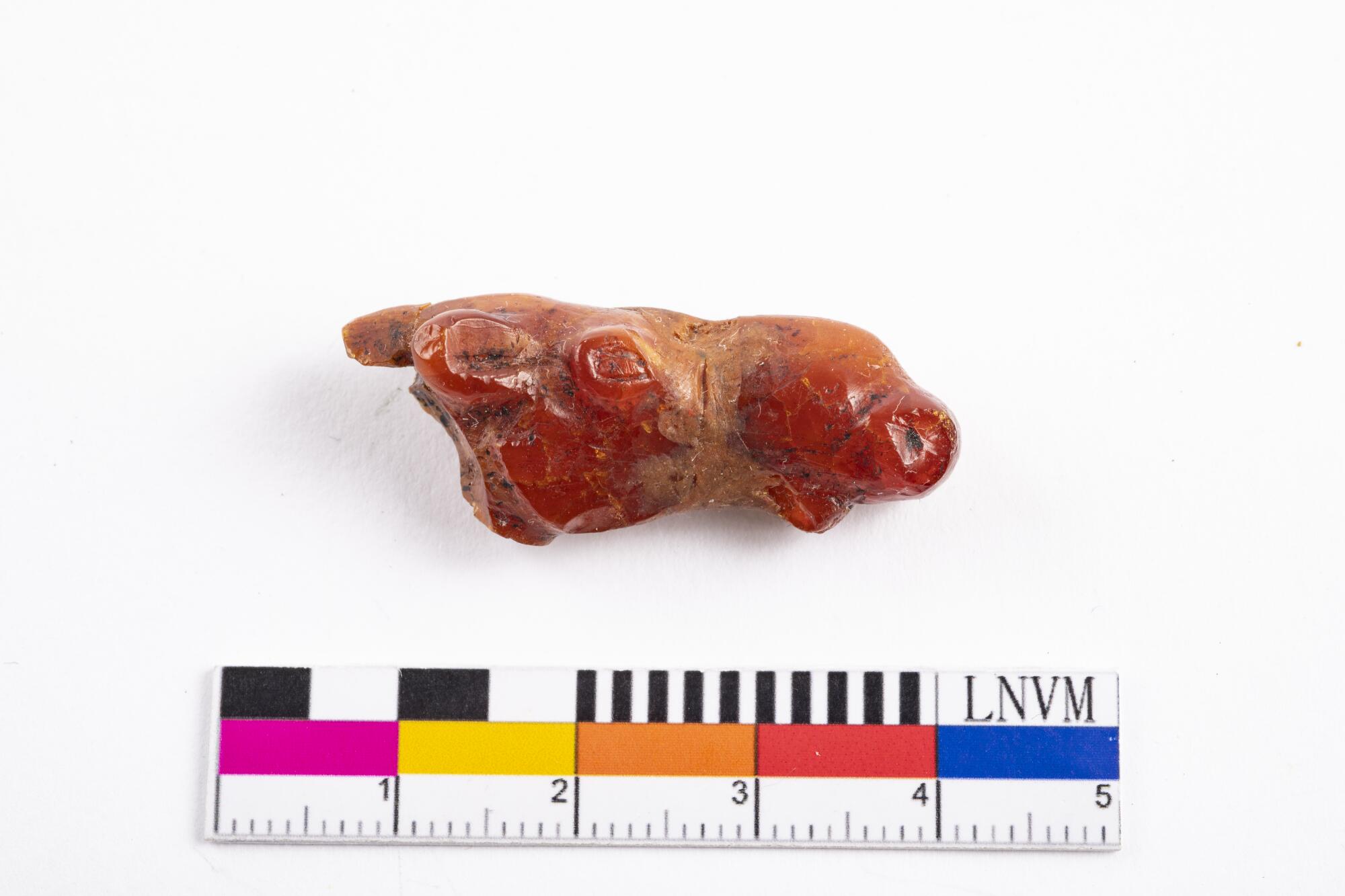
Neolithic round sculptures of elk heads were widespread across the vast forested regions of Northern and Eastern Europe, including Scandinavia, western Russia, and the Eastern Baltic. They are also found in Mesolithic sites. Stone, antler, or wood was used as the material for crafting these sculptures. Overall, the number of Stone Age finds is limited, which is why each object holds special significance. Particularly noteworthy are the highest-quality examples, which demonstrate early humans’ ability to observe nature, their skill in reproducing these observations, and their capacity to imbue an object’s form with aesthetic qualities. Unlike tools necessary for practical activities, figurative images and ornamentation form a distinct group linked to the question of the origins of art. In Latvia, this includes an amber carving of an elk’s head, discovered during the archaeological excavations of the Sārnate settlement led by Lūcija Vankina.
Circumstances of the Find
The amber elk head figurine was found in the 3rd dwelling of the Sārnate settlement in 1957. The dwelling was established on a light-coloured sand hill (explored over an area of 64 m²), with its cultural layer formed directly above a peat base.1Lyutsiya Vankina, Torfyanikovaya stoyanka Sarnate [The peat site at Sārnate], Riga 1970, 111, Fig.144, Table LV:2. ↩ The dwelling’s boundaries were marked by a 12.5 m long and 5–6 m wide, nearly regular oval sand mound. Archaeological excavations were conducted by dividing the study area into four sectors, similar to how burial mounds are studied. Notably, the elk’s head was broken into three pieces, and its fragments were found in different locations: in two adjacent sectors of the excavation site (the third and second) near the hearth – to the southwest and southeast of it. In addition, unworked pieces of amber, several bead blanks, cup-shaped beads, a small disc, an asymmetrical pendant, and the torso of a bear figurine were found at the site. Judging by these finds, it must be assumed that the dwelling belonged to an individual who had not only mastered standard amber-working techniques but had also developed artistic skills in the depiction of animal figures.2Vankina (1970), Table 6. ↩
Although the 3rd dwelling at the Sārnate settlement does not stand out for the large number of amber artifacts – for example, compared to the nearby 2nd dwelling, where the location of an amber workshop is clearly identifiable— there is no doubt that the inhabitant of the 3rd dwelling was also engaged in amber processing.
In the dwelling where the possible maker of amber animal figurines lived, bifacial flint arrowheads, flint scrapers, and other everyday tools were also discovered, as well as shards of clay pots belonging to the Comb Ceramic culture. A vessel decorated with nail-like impressions not only along the rim but also diagonally catches the eye. A similar clay pot found at the Ģipka A settlement in the North Kurzeme dunes contained ochre powder, suggesting that the similarly decorated pot at the Sārnate 3rd dwelling may have been used for ritual activities during which the head of an amber elk and a bear figurine were broken.
Age of the Find and Cultural Affiliation
The collection of finds at the Sārnate settlement indicates that the amber elk head belongs to the Comb Ceramic culture, characterized by simple geometric ornamentation and bifacial flint arrowheads. These features narrow the scope of analogies for the amber elk head – it is primarily associated with the Comb Ceramic culture area in Estonia and southern Finland.
Comb-patterned pottery in Sārnate, according to the latest data, is dated based on a sample from the MD settlement, which represents early Sārnate-type pottery. The results were obtained by analysing food residues on the inner surface of a clay cooking pot. The vessel was made in the ornamental style characteristic of comb-pattern pottery.3Valdis Bērziņš, Sārnate: Living by Coastal Lake during the East Baltic Neolithic: Academic Dissertation, Oulu 2008, 473. (Acta Universitatis Ouluensis. Ser. B. Humaniora, 86). ↩ This period is associated with the arrival of new settlers in Sārnate, who encountered the coastal comb-pattern pottery culture and the production of elk heads in amber. This assumption is confirmed by the radiocarbon dating of food remains—5065±75 (UA-15984) – as it indeed corresponds to the age of Comb Ceramic Culture samples found elsewhere in Latvia, such as at the Kvāpāni II settlement at the mouth of the Rēzekne River and at the Zvejnieki burial ground on the shores of Lake Burtnieks.
Publicity of the Find
The amber carving of the Sārnate elk head has not yet been the subject of specific research. Lūcija Vankina, who discovered the fragment, did not analyse it in detail. However, this artifact has been highlighted in Finnish and Lithuanian archaeological literature. It is mentioned in Finnish researcher Christian Carpelan’s work on Neolithic elk and bear sculptures in Northern Europe, where the Sārnate artifact served as an example, highlighting a previously unnoticed phenomenon – the diversity of Neolithic animal figures.4Christian Carpelan, “Ålg- ochbjörnhuvedföremäl från Europas nordliga delar” [Elk and bear head ornaments from Northern Europe], in: Finskt Museum 1975, Helsingfors 1977, 5–67. ↩ Chronologically and typologically, the author has attempted to place the Sārnate elk head within a broader context of related Mesolithic and Neolithic phenomena, highlighting it as one of the most significant examples in the Baltic region.5Marius Iršėnas, “Elk Figurines in the Stone Age of the Baltic Area”,in: Adomas Butrimas, ed., Prehistoric Art in the Baltic Region, Vilnius 2000, 101, Fig. 8:7 (= Acta academiae artium Vilnensis, 20). ↩ The nuanced modelling of the animal’s head allows it to be classified as a work of art.
The Sārnate elk head is also discussed in Lithuanian archaeologist Marius Iršėnas’s work on Stone Age elk sculptures in the Baltic region , where it is indirectly compared (by placing it in the same image) with a Mesolithic amber elk figurine found in Denmark. In addition, the depiction of the Sārnate elk head in amber is included in the exhibition catalogue organized by the Polish State Archaeological Museum, the Warsaw branch of the Polish Archaeological Society, and the Latvian National Museum of History in Warsaw.6Anna Bitner-Wróblewska, ed., Skarby starożytnej Łotwy = Treasures of Ancient Latvia, Warsaw 2007, 365, No. 253. ↩
All of the aforementioned publications have contributed to the popularity of the Sārnate amber elk head among archaeologists. However, the artistic qualities of this small masterpiece have not yet been identified or explained within the Latvian art history community. Therefore, the purpose of this short article is to demonstrate the significance of the Sārnate amber elk head from a comparative perspective, to promote its recognition among the general public, and to attempt to include it in the local art canon.
The Modelling of the Elk Head
The modelling of the Sārnate elk head is distinguished by a nuanced profile, with features of realistic observation provided by the rounded shape of the muzzle, the drooping lower lip, as well as the shape of the eyes and ears. The transition of the head to the massive neck is emphasized by a barely perceptible depression. The flattened ears are separated from the head and sculpted with a sense of volume. However, the uniqueness of the elk’s head lies in the shape of the nostrils, where natural observation is combined with an abstract circular elevation symmetrically on both sides of the head. The formal rigidity is enlivened by a small indentation in the centre of the nose, as if allowing the depicted animal to breathe. The spherical eye shape with an emphasized pupil in the centre is carved only on the right side. The left eye is not depicted. The head of the Sārnate elk is only 3.5 cm long and 1 cm wide; nevertheless, the silhouette of the forest animal is clearly discernible and attests to a thorough understanding of the anatomical features of the chosen subject, as well as the skill to render it convincingly in a material as fragile as amber. Although the Sārnate elk head, with its sculptural execution, occupies a unique place among Latvian Mesolithic and Neolithic amber artifacts, it is undeniably not an imported piece but confirms the significance of the Sārnate amber processing centre and its ability to bring animals observed in nature to life.
The Sārnate Find in the Typological and Iconographic Context of the Baltic Region
Stone Age depictions of the elk have not been analysed in archaeological literature from an art-historical perspective but have been published to incorporate the most significant archaeological finds into the broader scientific discourse. The image of the elk in the Baltic region and neighbouring lands is found in Stone Age rock paintings and in sculptural carvings on bone, antler, wood, stone, or amber. Rock paintings typically depict one or more elk figures as part of a herd or hunting scene, whereas sculptural works emphasize individual characteristics or the shape of the head. The elk head found at the 3rd dwelling of the Sārnate site is the only known amber artifact of its kind to date, making it unique. In attempting to assess the artistic significance of the Sārnate elk head, one must consider the context of the accumulated archaeological material and attempt to situate the find within the framework of typological studies. Therefore, the specific features of the image’s design must be emphasized once again. These include the realistic depiction (the protrusions resembling the animal’s nostrils are particularly notable). This feature not only distinguishes the Sārnate elk head within the broader corpus of European amber carvings but also characterizes the development of artistic expression in Neolithic societies of the Baltic region.
In this context, elk heads from neighbouring regions, executed in various materials, have been compiled for comparison. A related example is the elk head find from Palojoki, Finland – the design is strikingly similar, but this similarity is based more on the animal’s anatomical structure, as a different material (stone) was used, the dimensions differ, and the degree of stylization of the Palojoki elk is greater.7Torsten Edgren, Finlands historia I: Den förhistoriska tiden [The History of Finland I: Prehistoric Times], Esbo1992, 83. ↩ As more distant analogies, mention should be made of the elk head carved into the horn at the end of a ceremonial mace from the Oleniyostrov burial ground on Lake Onega8Nina Gourina, Le Monde par les Yeux de sAnciens Peintres de la Karélie = Mir glazamidrevnego khudozhnika Karelii [World through the eyes of the ancient Karelianartist], Leningrad 1967, Fig. 1. ↩ and the two elk head finds from the 56th grave at the Oleniyostrov burial ground, one of which is carved in stone and the other in horn.9Gourina (1967), Fig. 2. ↩ This group also includes a stone ceremonial mace from Padozero in Karelia, where the curved shape of the stone flows smoothly into the form of an elk’s head.10Carpelan (1977), Pl. VII: 1 (401 H). ↩
Another group consists of Fennoscandian elk head finds. There are three such sculptures. The first two are carved from stone and were found in Alunda, Uppland Province in Sweden, and near Lake Särkijärvi in Finland.11Carpelan (1977), Pl. XI:1 (220 H); Edgren (1992), 81. ↩ What is striking is the similarity in the silhouette of both stone carvings, featuring a button-like eye, folded ears, and an open animal mouth, which may indicate the prevalence of some archaic representational tradition. The third figure is carved from the main body of the antler and its branch. The find was recovered by Nina Gurina during archaeological excavations at the Neolithic settlement of Mayak 2 on the Kola Peninsula.12Nina Gurina, Istoriya kul’tury drevnego naseleniya Kol’skogo poluostrova = The History of the Culture of the Ancient Population of the Kola Peninsula, St. Petersburg 1997 (= Russian Academy of Sciences, Institute of Material Culture History. Archaeological Research, 32). ↩ The wooden elk head sculptures from Lehtojärvi and Noormarkku (Satakunta) in Finland, like the wooden sculptures from the Shigir bogs, are characterized by a long, elongated form.
Individual finds associated with the eastern part of the Baltic region also belong to this group. Notably, the ceremonial sticks found on the northwestern coast of Lithuania should be mentioned. One of them is a young elk head with upright ears from the Šventoji 4th settlement,13Iršėnas (2000), 96, Fig. 3. ↩ while the find from the Šventoji 3rdB settlement is, from a formal point of view, a high-quality specimen distinguished by fine net-like incised decoration on the head and an ornamental composition below the neck.14Rimutė Rimantienė, Akmens amžiaus žvejai prie Pajūrio lagūnos: Šventosios ir Butingės tyrinėjimai [Stone age fishermen at the Pajūrio Lagoon: Excavations at Šventoji and Butinge], Vilnius 2005, 342, Fig. 220. ↩ A bone mace with a simplified depiction of an elk’s head at the top was also found in Latvia – in the grave goods of the 57th female burial at Zvejnieki burial ground.15Ilga Zagorska, “Radiocarbon Chronology of the Zvejnieki Burials”, in: Lars Larsson and Ilga Zagorska, eds., Back to the Origin: New Research in the Mesolithic–Neolithic Zvejnieki Cemetery and Environment, Northern Latvia, Stockholm 2006, 91–113 (= Acta Archaeologica Lundensia. Series in 8⸰; No. 52). ↩
The Functional and Symbolic Significance of the Elk Head
Although the special place of the elk image in Neolithic people’s mythological conceptions belongs to issues explained at a hypothetical level, the efforts of early artists to imitate nature are not always linked to practical goals, even though their significance is considerable and, presumably, even dominant. Data recorded in ethnographic literature point to the role of the elk in the diet of Neolithic people. In this regard, the annual so-called “festival of life renewal”, which lasts eight days and was practiced until recently by the Nerchinsk Evenks in Siberia, is particularly revealing.16Sergei Ivanov, Skul’ptura narodov Severa Sibiri XIX – pervoy poloviny XXv [Sculpture of the peoples of Northern Siberia in the 19th–first half of the 20th centuries], Leningrad 1970, 148–149. ↩ During this festival, the pursuit of an elk, its killing, skinning, and the division of the meat were imitated. This ritual took place near the shaman’s chum – within an area marked off by birch branches, a theatrical encirclement was staged under the shaman’s guidance around a wooden effigy of a “divine” elk.17Glafira Vasilevich, “Drevniyeokhotnich’i i olenevodcheskiye obryady evenkov” [Ancient hunting and reindeer herding rites of the Evenks], in: Sbornik Muzeya antropologii i etnografii [Collected articles of the Museum of Anthropology and Ethnography], Moscow-Leningrad 1957, Vol. 17, 151–185. ↩ Only on the final day was the elk “killed”, and the wooden figure was distributed among the participants of the festival. Ethnographers believe that this festival reflects collective hunts during the pre-shamanic era. This indicates that shamanism is a more recent phenomenon compared to the mythology of the Neolithic era, known as archaeomythology. The depiction of an elk’s head or figure is associated with so-called mimetic magic of partial hunting objects, in which the source of magical power was directed not at the object itself (the elk), but rather at its substitute.
The elk also featured in the ritual activities of the Evenk shamans’ assistants.18Arkady Anisimov, “Predstavleniya evenkov o shingenakh i problema proiskhozhdeniya pervobytnoy religii” [TheEvenks’ concepts of Shingkens and the problem of the origin of primitive religion], in: Sbornik Muzeya antropologii i etnografii [Collected articles of the Museum of Anthropology and Ethnography], Leningrad 1949, Vol. 12, 160–165. ↩ In Evenk beliefs, the elk is considered an assistant to the spirits of the hunting grounds (shingken), performing the functions of these spirits. Data collected by ethnographers on the significance of the elk in Evenk mythological concepts may be useful in explaining the ritual significance of the amber elk head found in Sārnate’s 3rd dwelling. It is possible that the artifact was used in similar hunting rituals, as not only a depiction of an elk’s head but also a bear figure were found in a broken state near the hearth of the 3rd dwelling.
No less important are the aesthetic qualities of the examined specimens, which create a generalized animalistic form and compositionally convincingly incorporate animal-characterizing and decorative elements into it. The function of the ceremonial sticks is easier to specify – they could have been made by the community’s elder or a shaman for performing magical rituals to ensure success in hunting, or for organizing a festival in honour of the elk.
First published in:
Ilze Loze, “Neolīta dzintara aļņa galvas figūra Sārnatē”,in: Mākslas Vēsture un Teorija 13 (2010), 5–8.
- Ilze Loze