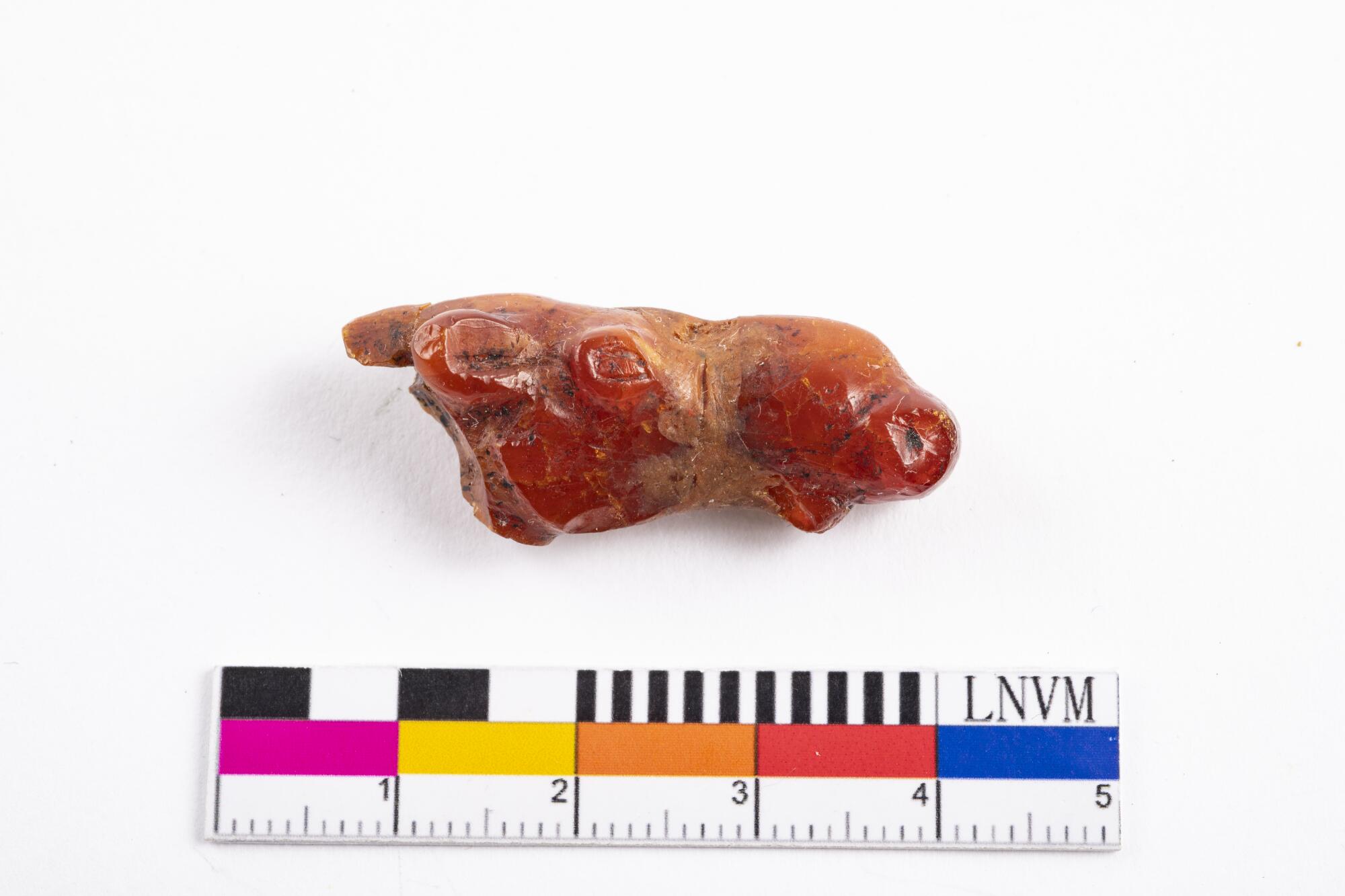
Courtesy of the Latvian National Museum of Art, Sofia, All rights reserved, Please refer to the terms and conditions of the institution holding the object
Elk head from the Sārnate Settlement in Užava
- Non-identified artist
3400–2300 BCE
- Latvian National Museum of History, Riga, Latvia
Creator(s)
Title(s)
Date of creation
3400–2300 BCE
Materials and techniques
Amber
Dimensions
Place of conservation
accession_number
Rights
External links
Neolithic round sculptures of elk heads were widespread across the vast forested regions of Northern and Eastern Europe, including Scandinavia, western Russia, and the Eastern Baltic. They are also found in Mesolithic sites. Stone, antler, or wood was used as the material for crafting these sculptures. Overall, the number of Stone Age finds is limited, which is why each object holds special significance. Particularly noteworthy are the highest-quality examples, which demonstrate early humans’ ability to observe nature, their skill in reproducing these observations, and their capacity to imbue an object’s form with aesthetic qualities. Unlike tools necessary for practical activities, figurative images and ornamentation form a distinct group linked to the question of the origins of art. In Latvia, this includes an amber carving of an elk’s head, discovered during the archaeological excavations of the Sārnate settlement led by Lūcija Vankina.