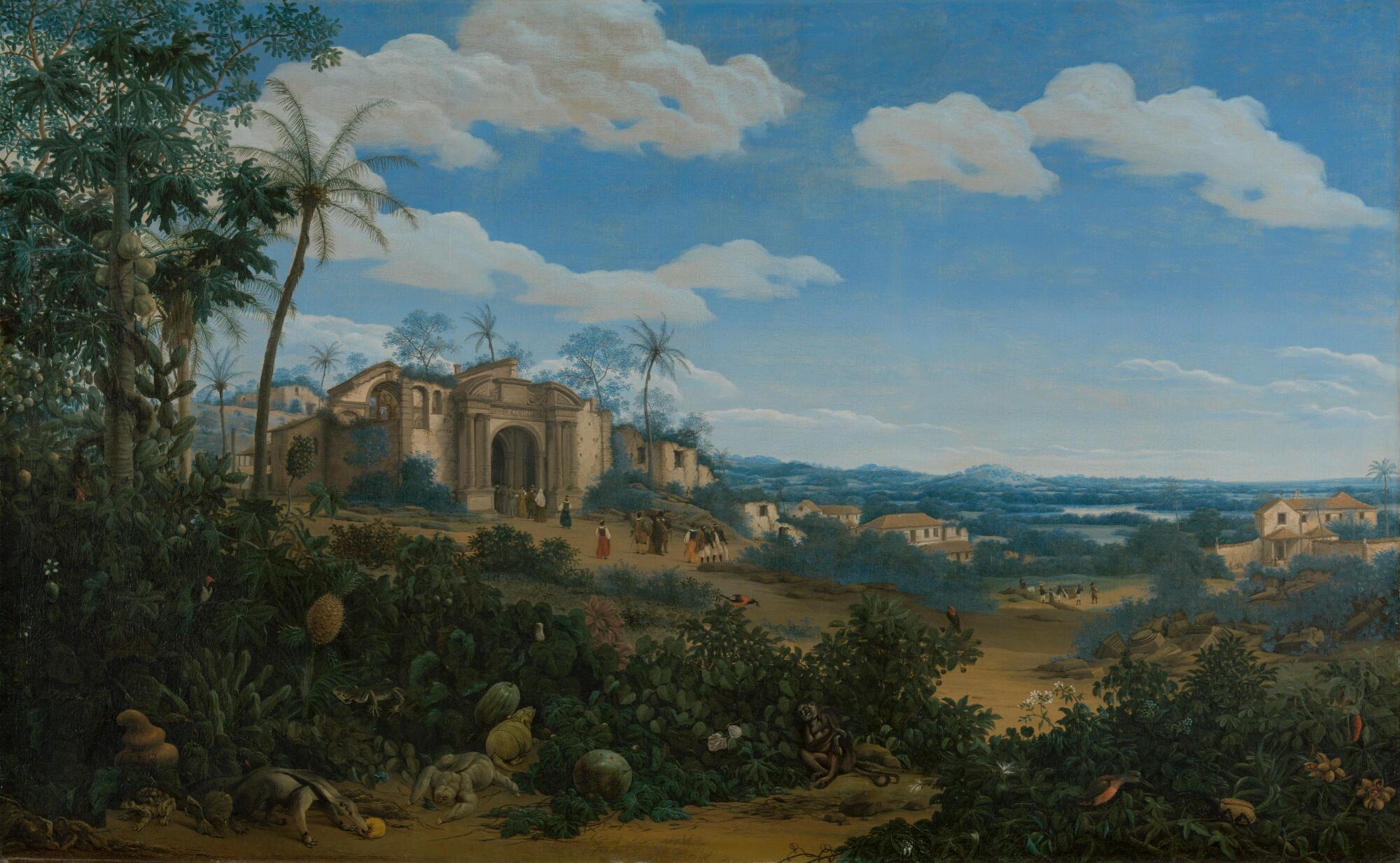
Frans Post’s View of Olinda, Brazil, 1662, one of the artist’s later works, participates in the rich seventeenth–century landscape production of the Low Countries. Often, this production included views of land of topical relevance and interest. Post, son and brother of painters, glass painter Jan Jansz. Post (Leiden, 1575 – Haarlem, 1614), and painter and architect Pieter Post (Haarlem, 1608 –The Hague, 1669), respectively, specialized in landscape painting, more specifically, in depicting the Brazilian land.1Alan Chong, “Frans Post”, in: Peter C. Sutton et al., Masters of 17-Century Dutch Landscape Painting, exh. cat., Amsterdam, Boston, Philadelphia 1987, 410; Jan Piet Filedt Kok et al., Nederlandse kunst in het Rijksmuseum 1600 – 1700, Amsterdam Zwolle 2001, 158-159 (= Nederlandse kunst in het Rijksmuseum, 2). ↩
The context
The work is exhibited in the Rijksmuseum and isincluded within the framework of the museum’s intention to address the questionof slavery and the Netherlands’s involvement in it. In the booklet Rijksmuseumand Slavery, we read:
The Rijksmuseum, the Netherlands’s museum of art and history, works permanently to present a more complete picture of the Dutch past. […] This colonial power is inextricably linked to a system in which slavery was a matter of state practice. Under Dutch rule, men, women and children around the Atlantic and the Indian Ocean were enslaved, subjected to forced labour and reduced to objects in administrative records.2Rijksmuseum, Rijksmuseum and Slavery,Amsterdam 2021, 3, https://enfilade18thc.com/wp-content/uploads/2021/08/document.pdf(accessed December 1, 2025). ↩
The booklet is connected with the exhibition Slavery, 2021. In the exhibition accompanying book it is stated, admittedly with self-awareness, that the “[colonial] past has long been insufficiently examined in the national history of the Netherlands, including at the Rijksmuseum”.3Eveline Sint Nicolaas et al., Slavery: theStory of João, Wally, Oopjen, Paulus, van Bengalen, Surapati, Sapali, Tula,Dirk, Lohkay, Amsterdam 2021, 9. ↩ Besides the exhibition itself, the museum added 77 labels to paintings and objects in the permanent collection, in order to give prominence to the issue. Post travelled to Brazil in 1636, as part of the retinue of Johan Maurits (1604 – 1679), count and prince of Nassau-Siegen, the Dutch Brazil’s governor between 1637 and 1644. In order to disrupt Spain and Portugal’s dominance in the Americas, the Dutch West India Company (WIC) conquered the region of Pernambuco, known for its considerable sugar production. Pernambuco is situated in the northeastern part of Brazil, where Olinda is situated as well.4Lukas van den Berge, “Dealing withAmbiguity: Johan Maurits, Black Pete and the Crisis of Dutch Identity”,in: Netherlands Journal of Legal Philosophy, 47/1 (2018), 3-12: 3-4. OnMaurits’s activity in Brazil, see Rüdiger Joppien, “The Dutch Vision ofBrazi. Johan Maurits and his Artists”, in: Ernst van den Boogaart, HendrikRichard Hoetink and Peter John Percy Whitehead (eds.), Johan Mauritsvan Nassau-Siegen 1604-1679: A Humanist Prince in Europe and Brazil; Essays onthe Occasion of the Tercentenary of His Death, The Hague 1979, 297-376. ↩ Johan was the great nephew of William the Silent, Prince of Orange, leader of the Dutch revolt against the Spaniards.
Post’s surviving sketchbook with nineteen views drawn on the route to Brazil, recording the voyage of the fleet across the Atlantic, highlights the governor’s wish to register his colonial possessions.5Margaux Shraiman, “Commercialising EdenFrans Post’s drawings of the Fortunate Isles”, in: NederlandsKunsthistorisch Jaarboek 75 (2025), 184-212: 185. ↩ Besides, Post provided the illustrations for Caspar Barlaeus’s Rerum per octennium in Brasilia et alibi gestarum sub praefectura Comitis Ioannis Mauritii Nassoviae, etc. Historia, 1647 (The History of Brazil under the Governorship of Count Johan Maurits of Nassau 1635–1644), a panegyric of Maurits’s governorship. Fifty–five high–quality engravings after sketches of landscape views drawn by Post are included in this publication. The following quotation clarifies the intention behind this endeavor as well as the character of Post’s drawings.
Whoever reads this will agree that the Company, Count Johan Maurits, and the Supreme Council have left nothing undone that can promote the public good. They have sought to acquire profit by means of warfare, trade, and expansion of territory. Forests, mountains, rivers, or seas could not stop their quest for gain. Respect for money is so strong that it dares man to do the extraordinary and enables him to do the incredible, whether this means looking for hidden wealth or grasping for palpable riches.6Caspar van Baerle, TheHistory of Brazil under the Governorship of Count Johan Maurits ofNassau 1635-1644, trans. Blanche T.Van Berckel-Ebeling Koning, Gainesville, Florida 2011, 215-216. ↩
The landscapes by Post in the Rerum per octennium in Brasilia often depict the diverse inhabitants of Brazil, such as the Dutch and Portuguese planters, enslaved Africans, indigenous Brazilians, Christianized Indians who lived in the colony, Tapuya Indians and so forth,7See, for example, Jay A. Levenson et al., Encompassingthe globe: Portugal and the world in the 16th & 17th centuries, exh.cat., Washington, D.C. 2007, 94 and van den Boogaart (2011), 243-259. ↩ in peaceful coexistence and harmonic collaboration, albeit within the strictly hierarchical structure of this society.8Ernst van den Boogaart, “A Well-GovernedColony: Frans Post’s Illustrations in Caspar Barlaeus’s History of Dutch Brazil”,in: The Rijksmuseum Bulletin 59/3 (2011), 236-271. ↩ In the print View of Olinda by Jan van Brosterhuysen (Leiden, ca. 1596 – Breda, 1650), after Frans Post, for example, black people on the shore are shown going about their tasks, mostly carrying things on their heads, rather calmly. No signs of exploitation or maltreatment are included.9van den Boogaart (2011), 258. Joanna SheersSeidenstein, “Shifting Terrain, Environmental Change, Global Expansion,and the Drawn Landscape” in: Joanna Sheers Seidenstein and Susan Anderson(eds.), Crossroads: Drawing the Dutch Landscape, exh. cat., Cambridge,MA, New Haven, London 2022, 72-105. ↩
The registration of the Brazilian land, particularly its flora and fauna, has significantly been the work of Zacharias Wagener (1614 – 1668), who served at The Hague court as a quartermaster, while also accompanied Maurits on his travels in Brazil. Having acquired experience as a draughtsman of maps, Wagener wrote his famous Thierbuch (The Book of Animals), 1634-41. In the prologue of this book Wagener informs his readers that:
Since the time that […] I came in 1634 from the Old World to the New World of America, where lies the remote and very famous land of Brazil, as the days passed, I acquired greater knowledge of new marvels, such as great fish and unknown birds, useful and harmful animals, beautiful, tasty and wholesome fruits, venomous and dangerous beasts, savages with copper-coloured or blackened skin.10Cristina Ferrao and José Paulo Monteiro Soares, eds.,The “Thierbuch” and “Autobiography” of Zacharias Wagener,vol. II, trans. Richard Trewinnard, Rio de Janeiro 1997, 26. ↩
Later on in Thierbuch he elaborates on his views on the savage inhabitants of Brazil:
When one among them dies, be it man or woman, they do not bury the body, but cut it up and divide it up into many small parts, some of which they eat raw and some roasted, claiming that their friend is better protected in their bodies than in the heart of the black land. […]
What is truly horrific, however, and for many ears abominable, is that when a child is stillborn, the mother immediately cuts it up and eats as much as she can, on the pretext that it was her child […] and that as such it will be best protected by going back to the same place.11Ferrao and Monteiro Soares (1997), 169. ↩
A similar view is proposed by Barlaeus in his History of Brazil, when referring to the inhabitants of Northeastern Brazil:
The native people have a tall, sturdy build, suitable for carrying burdens. They have flat nostrils and are dark-skinned, almost the color of olives. […] They are cannibals, savage with their enemies, whom they fatten carefully and then slaughter and devour. The Tapuyas are their neighbors but also their enemies.12van Baerle (2011), 219-220. ↩
Apart from his views on the brutal character and habits of the indigenous people of Brazil, the illustrations in Wagener’s Thierbuch display the fascination with the exotic. The land, with its biota, becomes an object worthy of systematic depiction, while the author reassures his reader of the accuracy of the images, as we read in the prologue.13Ferrao and Monteiro Soares (1997), 6-10. ↩
Within the context of Maurits’s effort to gain economic and political control in the area, he sought to map the country’s natural history, geography and architecture. Thus, he employed collaborators, such as the physician Willem Piso and the geographer and astronomer Georg Marcgrave, in order to record his scientific achievements in the New World. They created significant botanical and zoological collections, which were published in Amsterdam in 1648.14Carlos Ossenbach, “Precursors of the Botanical Exploration of South America. Wilhelm Piso (1611 – 1678) and Georg Marcgrave (1610 – 1644) “in: Lankesteriana International Journal on Orchidology 17/1 (2017), 93-103, https://www.redalyc.org/articulo.oa?id=44353205005 (accessed December 7, 2025). ↩ Except for the painters Post and Albert Eckhout, the architect Pieter Post, brother to Frans, designed the city of Mauritsstad, on the island of Antonio Vaz, named after the governor. Maurits had also an astronomical observatory built in New Holland and founded a Botanical and Zoological Garden.15Wim Klooster, The Dutch in the Americas, 1600– 1800: A Narrative History with the Catalogue of an Exhibition of RarePrints, Maps, and Illustrated Books from the John Carter Brown Library,Providence, RI 1997, 28. ↩
Post’s View of Olinda
At the left middleground of Post’s View of Olinda, under a bright blue, slightly clouded sky, an image of the remnants of the cathedral of the Holy Saviour of the World is included. Olinda was the capital of the province of Pernambuko. The church was erected by the Catholic Portuguese in 1540, while Post’s decision to depict it at a ruined state, as is seen in several pieces of broken stone pillars at the right mid-diagonal section of the painting, most probably reflects the Dutch Protestant domination over their Portuguese predecessors. Besides, as we learn from Barlaeus, Maurits reclaimed Olinda’s masonry to build Mauritsstad.16Elizabeth Sutton, “Possessing Brazil in Print, 1630 – 54”, Journal of Historians of Netherlandish Art 5/2013), https://jhna.org/articles/possessing-brazil-in-print-1630-54/#citation (accessed December 5, 2025), 1-28: 13. ↩ Moreover, as it is known, the church did not stand isolated in the land. By isolating it, the painter probably aimed at creating a more dramatic effect for the viewer. Post also chose to portray certain features from the Franciscan abbey of Saint Anthony in Igaraçu for the church at the right.17Katharina Schmidt-Loske and Kurt Wettengl, “Framing the Frame: Frans Post’s View of Olinda, Brazil (1662)”, in: The Rijksmuseum Bulletin 68/2, 2020, 100-125: 114; Pieter J. J. van Thiel, Framing in the Golden Age: Picture and Frame in 17th-century Holland, Amsterdam, Zwolle 1995, 247; Benjamin Schmidt, “The “Dutch” “Atlantic” and the Dubious Case of Frans Post ”, in: Gert Oostindie and Jessica V. Roitman, eds., Dutch Atlantic Connections, 1680-1800: Linking Empires, Bridging Borders, Brill 2014, https://brill.com/display/book/edcoll/9789004271319/B9789004271319-s012.xml (accessed December 5, 2025), 249-272: 261-262. ↩
Post’s depiction of flora displays his predilection for the exotic. As we read, his portayals of the Brazilian land were much sought after “not only [for] the attractive exoticism of tropical flora and fauna, but also [for] a successful colony that symbolized Holland’s military and mercantile success”.18Schmidt-Loske and Wettengl (2020), 114; Nils Büttner, Landscape Painting: A History, trans. Russell Stockman, New York, 2006, 185. ↩
This response summarizes the reception of the painter’s oeuvre and the governor’s endeavor, but it also provides a first idea of the painter’s botanical selection. Post enriched his image by combining plants known from Africa and Europe as well within a lush scenery of idealized vegetation. Palms, cacti, papaya trees, pindoba, the mandacaru, the achiote, the chilli pepper, the rooster flower and so on, grown in the American soil, are depicted along with African watermelon, calabash, or castor plant, and European ivy, hops, and acanthus, for instance. The foreign plants or seeds had been brought in the tropical Americas by the Portuguese and the Dutch by way of colonization and slave trade.19Benjamin Schmidt (2014), 264; Schmidt-Loske andWettengl (2020), 114-115. ↩ The painting’s carved frame repeats the combination of exotic and European flora. Although the frame maker is not known, it is assumed that Post collaborated closely with him.20Schmidt-Loske and Wettengl (2020), 115. ↩ Besides, as noted by Katharina Schmidt-Loske and Kurt Wettengl.
Whereas the foreign fruits signify the novel and exotic, ivy and hops are familiar European cultivated plants. The acanthus motif is a cultural signifier going back to Antiquity and the Renaissance, while laurel serves as a political symbol of conquest and victory.21Schmidt-Loske and Wettengl (2020), 115. ↩
The same awe for the exotic applies for Post’s depiction of animals and birds. Post chose Brazilian bird species, mostly in red and orange plumage. They are the lineated wood-pecker, campo trupial, red-capped manakin and great jacamar. He also depicted reptiles including the green anaconda and the green iguana, as well as an amphibian species. Mammals, such as the giant anteater, the sloth, the armadillo and a kind of spider monkey are included within the array of exotic fauna. As also pointed out by Schmidt-Loske and Wettengl, the painting also portrays an insect that was particularly popular among collectors of naturalia: an enormous beetle, posing conspicuously, and, interestingly, out of proportion in the right foreground.22Schmidt-Loske and Wettengl (2020), 114. ↩ Once more, his fauna selection is repeated in the frame of the work.
Several motifs that Post used in both the painting and the frame, mostly animal, are based on sketches he made, while living in Dutch Brazil. Thirty–four sheets, which comprise twenty–four finished studies in gouache and watercolor, with nine examples relating to a corresponding sketch version in graphite, and one case of a graphite study without a related colored version have been relatively recently attributed to Post and related to his oil paintings, depicting Brazilian plants and animals.23Alexander de Bruin, “Animals inBrazil”, in: Master Drawings 54/3, (2016), 292-368: 5-6. ↩ Among the many instances one could locate, the sloth in the foreground of the View of Olinda, featured toward the left side of the image, seems to repeat quite faithfully Post’s watercolor and gouache drawing as well his graphite sketch.24de Bruin (2016), cat. nos. 5-6, 65-66. ↩
These drawings obviously predate the painting of Olinda, which was painted about twenty years after his return to Haarlem, where he produced Brazilian landscapes for collectors. The stadholder of the Northern Provinces himself, Frederik Hendrik (1584 – 1647), an important collector, bought West Indian landscapes from Post for large amounts of money.25Peter John Percy Whitehead and MarinusBoeseman, A Portrait of Dutch 17th Century Brazil: Animals, Plants andPeople by the Artists of Johan Maurits of Nassau (Amsterdam, Oxford, andNew York: 1989), 179-180. ↩
Aside from the architecture, and the flora and fauna, Post populates his scene with a number of human figures, mostly in small scale. Although they do not dominate in the land, they also consist in a mixture of various origins. Thus, he combines Portuguese and, possibly, Dutch colonizers with enslaved African people, typically carrying baskets and a palanquin, as well as, possibly, Mestizo or Mulatto women in long dresses with long sleeves and sleeveless bodices.26Whitehead and Boeseman (1989), 190-191. ↩ The dress and skin color assumingly befits the figures’ respective countries. Preachers greet the people at the gate of the cathedral, in what appears to be Catholic clerical hooded cloaks, hence a reminder of Brazil’s previous Portuguese domination ended by the Dutch.
It has long been noted that Post’s compositions after his return to Holland differ from the ones he painted, while living in Brazil, as they adopted certain Dutch landscape painting conventions. Among the most important is the diagonal tree and foliage repoussoir, replete with flora, animals and birds, starting at the left foreground. Yet, unlike his Haarlem landscape-painting colleagues, such as Pieter de Molijn (London, 1595 – Haarlem, 1661), Jan van Goyen (Leiden, 1596 – The Hague, 1656), Jacob van Ruisdael (Haarlem, ca. 1628/29 – Amsterdam, 1682), Post replaces the monochromatic palette, the quick brushstrokes, the heavily clouded skies and the barren land with vivid color, a deeply saturated palette, rich details and a highly finished manner. Cornelis Vroom (Haarlem, ca. 1591 – Haarlem, 1661) has been pointed as an influence for the use of repoussoir and the crispness of the foliage against the sky,27Chong, “Ruins of the Cathedral ofOlinda” (1987): 414-416: 414-415. ↩ Salomon van Ruysdael, (Naarden, ca. 1600/03 – Haarlem, 1670) may be pointed as another, especially for his repoussoirs, among several Haarlem landscapists.
Remarkably, his few known Brazilian-period paintings differ in their great simplicity, directness and even their sketchiness, perhaps reflecting the character of the exotic Brazilian scenery. Their relationship with the landscapes painted by his brother, Pieter, has been rightly noticed. (Fig. 1) Also, next to Frans’s São Francisco River with Fort Maurits, his View of Olinda, bears testimony to his distinctive post-Brazil lush, elaborate manner.28Chong, “São Francisco River with FortMaurits” (1987): 411-413. ↩ This composition also differs significantly from his View of the Ruins of Olinda, Brazil, 1665, in the Museo Nacional Thyssen-Bornemisza, Madrid, which employs a high viewpoint and portrays a broad plain that extends on the right to the horizon where we see a large stretch of sea.29Mauritshuis, “Dune Landscape with Haystack”, https://www.mauritshuis.nl/en/our-collection/artworks/970-dune-landscape-with-haystack (accessed December 3, 2025). ↩ (Fig. 2) The Rijksmuseum painting, lacking the sweeping panorama of its Thyssen-Bornemisza counterpart, reminiscent of Jan van Goyen or Jacob van Ruisdael, invites, nevertheless, the viewer inside the foreign land, inhabited by curious, yet attractive exotic specimens.