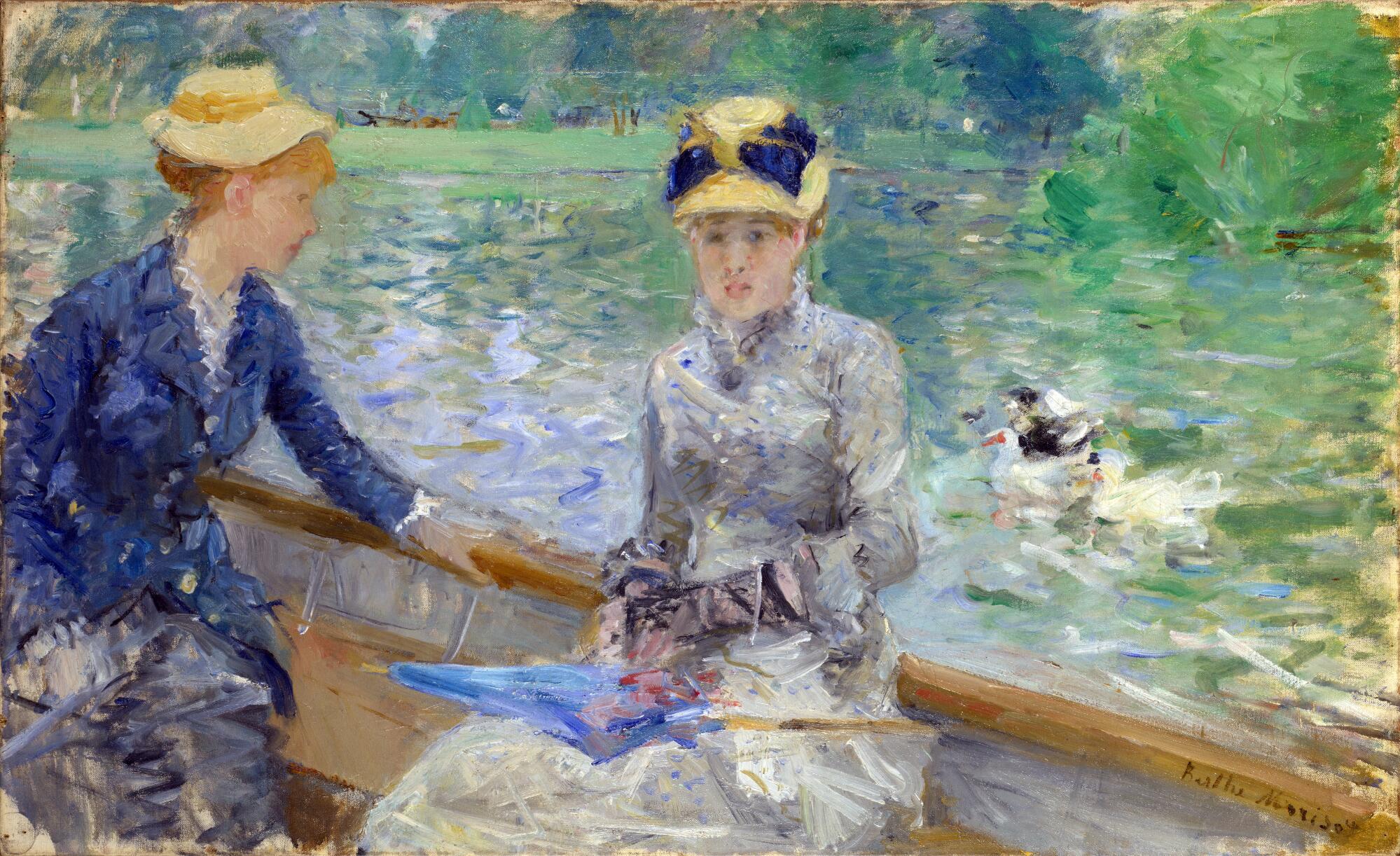
Berthe Morisot’s Jour d’Ete (Summer’s Day) 1879 depicts two fashionably dressed young women seated in a rowing boat on an ornamental lake with a view of trees and parkland behind them. A speeding horse and carriage can be deciphered in the distance. The setting is the northern end of the Lac Inférieur, the larger lake in the Bois de Boulogne, a parkland acquired by the city of Paris in 1852 and developed in to a major pleasure ground for its citizens with artificial lakes, a zoo and a botanical garden.1David Bomford, Art in the Making - Impressionism, Yale University Press, 1990, 178. ↩ The women are similarly attired in straw hats decorated with ribbon, tight fitting bustled garments and each carries an umbrella. The figure on the right wears black lace fingerless gloves and a more elaborate hat and a high-necked grey silk dress. Her companion is wearing a dark blue jacket over a grey blouse and skirt. Figures dressed in the same costumes appear in Morisot’s Jeunes Femmes Cueillant des Fleurs, or In the Bois de Boulogne, (National Museum, Stockholm).2Bomford, Art in the Making, 176. ↩ It is likely that both works originate with the same visit to the park.
The figure, seen in profile, on the left gazes down at ducks on the water. Her extended left arm grips the edge of the boat. Her companion looks directly out at the viewer. The structured composition of the foreground delineated by the diagonal line of the boat, the horizontal sweep of the parkland behind and the two vertical forms of the figures contrasts with the amorphous nature of the paint surface. The cut off left edge of the composition creates a sense of instantaneity and informality as if the scene were glimpsed in a moment. The shimmering effect of sunlight on water is conveyed in the loose zigzag application of paint in which myriad brushstrokes are evident. The palette is dominated by blues and greens which are accentuated in the blue jacket, ribbon and umbrella of the women. Tiny flecks of paler blues on their costumes convey the reflection of light on the figures uniting them with their surroundings while the shape of the boat separates them firmly from the background. The blue jacket is painted using three different blue pigments — cerulean blue, cobalt blue and the final strokes are of ultramarine which denote the fall of direct sunlight on the fabric. Black has been used to darken the tones. The main phase of painting in which wet paint is applied to wet paint took a considerable period to complete. Pentimenti have been detected beneath the surface. The river bank was originally higher but Morisot moved it down to distinguish the hats of the figures which are now above the bank. The final brushstrokes to be applied are the olive green swirling lines on the dress of the figure on the right which may suggest shadow but which equally assert the materiality of the paint surface.3Bomford, Art in the Making, 180-81. ↩
Morisot was the youngest daughter of Edmé Tiburce Morisot, an administrator and Marie-Joséphine-Cornélie Thomas, an upper middle class couple who settled in Paris in 1852. She and her elder sister Edma trained as artists with Joseph Guichard. He later encouraged them to study plein air painting, that is painting out of doors, so that the transitory effects of light on nature can be observed and recorded, with Jean Baptiste Camille Corot in the 1860s. Morisot exhibited, mainly landscapes, at the Salon from 1864-73. In 1869 Edma, whose work was also shown at the Salon, married and she withdrew from her career as an artist. Berthe Morisot persisted, meeting the radical painter Edouard Manet in 1868, and being invited by Edgar Degas to join the Impressionists in 1874. Degas wrote to Morisot’s mother to secure her permission for this controversial decision.4Belinda Thomson, Impressionism Origins, Practice, Reception, Thames and Hudson, 2000, 123 ↩ Her rejection of the Salon and its rigid attitude to painting resulted in her becoming a founding member of the group and participating in all, bar one, of its exhibitions. She shared the Impressionists’ commitment to exploring modern life and to analysing the effects of light and atmosphere in nature. She remained a dominant figure in the movement.
Her parent’s home was a regular meeting place for artists like Manet and Degas who came from the same upper echelons of Parisian society as Morisot thus enabling her to integrate with the more radical facets of the French art world. They lived in the elegant neighbourhood of Passy in the 16^th^ arrondisement of Paris and Morisot remained in this district throughout her career. She was residing in an apartment on the avenue d’Eylau with her husband, Eugene Manet, Edouard’s brother, and their baby daughter, Julie, at the time she painted Jour d’Ete. The area was close to the Bois de Boulogne which Morisot included in many of her paintings. During the Second Empire, (1852-70), under the rule of Napoleon III, Paris underwent a remarkable overhaul. Masterminded by the city planner, Baron Georges-Eugène Haussmann a network of 135 kilometres of wide avenues was built across the centre of the city. The creation of the city of grand boulevards, cafés, shops and public parks that we associate with Paris today helped it to become arguably the capital of the 19^th^ century and provided the Impressionists with subjects that expressed the incursion of modernity into everyday lives. The renovation of parks and open landscape sites was a priority. The Bois de Boulogne to the west, and the Bois de Vincennes to the east of the city centre, along with three interior parks and 24 urban squares were created. The Bois de Boulogne was the first to be completed. The 2000 acre, former royal hunting grounds were transformed into a grand public park. The lead horticulturist, Jean-Pierre Baritter-Deschamps oversaw the planting of more than 40,000 new trees and the setting out of a Theatre de Fleurs, an outdoor amphitheatre with chairs for 2000 spectators, as well as two lakes for boating.5Colta Ives, Public Parks, Private Gardens. Paris to Provence, Metropolitan Museum of Art, New York, 2018, 49-54. ↩
Although a popular destination for many Parisians, as Kathleen Adler and Tamar Garb have noted, the park appears empty in Morisot’s work. ’ [As] a Passy dweller, [she was] privileged to enjoy the park at its most tranquil and serene.’6Kathleen Adler and Tamar Garb Berthe Morisot, Phaidon, Oxford, 1987, 124. ↩ Both figures are posed by professional models.7A. Clairet, D. Montalant, Y. Rouart, Berthe Morisot 1841-1895 Catalogue Raisonné de L’Oeuvre Peint, Céranrs, Montolivet, France, 1997, 152. ↩ The American artist and acquaintance of Morisot, Mary Cassatt suggested that Marie Renard posed for the painting. Renard, who modelled for many of Morisot’s paintings, later wrote that she was ‘often dressed in the artist’s gowns’ and that ‘she would meet me [in Bois de Boulogne] at half past six in the morning. At nine, her ‘effect’ was finished and we returned to her home for a cup of coffee.’8Quoted in Bill Scott ‘A Painter’s Painter’, Berthe Morisot. Woman Impressionist, Rizzoli, Electa, New York, 2018, 192. ↩ (The same models posed for Jeunes Femmes Cueillant des Fleurs.) A preparatory watercolour suggests that Morisot used this more portable medium for her initial painting of Jour d’Ete. She is likely to have painted the oil in her studio but completed it with models posing in her garden. The marks of double pointed canvas pins mounted in corks are visible in the lower left and upper left of the canvas which indicate that Morisot transported the picture while still wet.9Bomford, Art in the Making, 179. ↩
The painting was shown along with 9 other oil paintings, including Jeunes Femmes Cueillant des Fleurs, four watercolours and a painted fan at the fifth Impressionist exhibition in 1880. Two of the paintings depicted Parisiennes in rowing boats, a new addition to the range of Morisot’s subject matter.10Nicole R Myers, ”Extreme Novelty or Things of the Past’. Morisot and the Modern Woman’ in Berthe Morisot. Woman Impressionist, Rizzoli, Electa, New York, 2018, 93. ↩ The presence of water, as also seen in the work of Claude Monet, facilitated the fragmentation of form and enabled the portrayal of the dynamic play of light on a moving surface. One reviewer noted ’ I have been utterly seduced and charmed by Morisot’s talent. I have seen nothing more delicate in painting. Her works*, L’été* [and] Le lac du bois de Boulogne… have been painted with extraordinarily subtle tones’.11Quoted in Bomford, Art in the Making, 176. ↩ The artist Odilon Redon who reviewed the exhibition paid close attention to the work of Morisot. ‘Perhaps the only woman who has had ability as a painter. She has given some charming and very distinguished notes in this concert of uncompromising ones who now group themselves only under the banner of the independent artist.’12Odilon Redon, ‘Reflections on an exhibit by the Impressionists’, 10 April 1880, reprinted in ed. E G. Holt, From the Classicists to the Impressionists: Art and Architecture in the Nineteenth Century, Documentary history of Art, III, Doubleday and Co, New York, 1966, 498. ↩ Others were, however, frustrated by the imprecision of her work. Paul Mantz, writing in Le Temps, referred to her paintings, as ‘promises of paintings that will never be done’. The critic, Paul de Charry queried, ‘Why with her talent, does she not take the trouble to finish?… Morisot is a woman, and therefore capricious. Unfortunately she is like Eve, who bites the apple and then gives up on it too soon. Too bad, since she bites so well!’13Adler and Garb Berthe Morisot, 64. ↩
While Morisot exhibited industrial subjects such as, Boats under Construction at the second Impressionist exhibition in 1876, 14Thomson, Impressionism Origins, Practice, Reception, 152-53. ↩ and made several paintings of harbours at Lorient, Cherbourg and Fécamp, most of her work, like that of other Impressionist female painters, focuses on the world of middle class Parisian women, their daily domestic rituals and limited public life such as promenading, boating or going to the theatre. Morisot enacted some of the latter in her own home using models or close family to pose as ladies on their evening out, as in At the Ball, (1876, Musée Marmatton) which was painted in her family home on rue Franklin. Jour d’Ete, with its staging of models, can be seen as part of this practice. As Adler and Garb have written, ‘the heavily chaperoned, corseted and formally dressed woman artist could not become an unobtrusive observer participator of the pageant of modern life as played out in café concerts, dance halls and street life of the growing city.’15Adler and Garb, Berthe Morisot, 80. ↩ Her chosen subject matter of the modern woman had become common in the work of more mainstream artists such as James Tissot and, her friend, the Belgian painter, Alfred Stevens. Morisot differentiated her approach from theirs by her embrace of plein air painting and by her increasingly unconventional technique but also by the way in which she presented her figures. Jour d’Ete can be contrasted with Tissot’s Young Lady in a Boat, (1870, Private Collection) in which a young fashionably dressed woman gazes wistfully at the viewer. The bouquet of flowers beside her suggests a romantic tryst. By contrast Morisot’s boaters lack any sentimental aura and their stiff demeanour indicates a sense of reserve and even tension in this public milieu.
The lack of narrative and the laconic mood of the figures in the painting can be linked to the artist’s interest in contemporary fashion plate illustration. ‘Nothing happens in fashion plates or Morisot’s pictures’, according to Anne Higonnet.16Anne Higonnet, Berthe Morisot’s Images of Women, Harvard University Press, 1992, 108. ↩ This modern industrially produced source of feminine visual culture provided the Impressionists and especially female Impressionist artists with an innovative way of presenting contemporary life in their paintings. As Ruth Iskin notes Charles Baudelaire’s pivotal essay, ‘The Painter of Modern Life’ (1863) ‘uttered a passionate plea for artists to represent modernity by depicting contemporary fashion’.17Ruth Iskin, Modern Women and Parisian Consumer Culture in Impressionist Painting, Cambridge University Press, 2013, 62. ↩ Morisot was an avid reader of such popular ladies journals as Le Moniteur de la Mode and L’Illustrateur des dames. These monthly magazines included up to three full-page, handcoloured fashion plates, a genre which has been reinvented by the illustrator, Paul Gavarni c. 1830 when he presented the fashion models posed in scenes from daily life rather than against blank backgrounds.18Higonnet, Berthe Morisot’s Images of Women, 90-91. ↩ The contrasting stances of the figures in Jour d’Ete may have been suggested by the way fashion plate illustrations concentrate on two figures shown together, with one in profile. 19Higonnet, Berthe Morisot’s Images of Women, 90-95. ↩ But Morisot ignores the attention to detail of the fashion plate in lieu of focusing on the ladies’ ‘dynamic participation in modern life’.20Iskin, Modern Women and Parisian Consumer Culture in Impressionist Painting, 211. ↩ Furthermore, Morisot had an advantage over male artists in her treatment of the Parisienne in the fact that she actually wore female fashions and understood their impact on the wearer. As Belinda Thomson notes, ‘Where Alfred Stevens’s fashionable subjects somewhat resemble clothes horses, Morisot’s women get on with their lives, often with the ribbons on their bonnet adrift’.21Thomson, Impressionism Origins, Practice, Reception, 165. ↩ This is particularly evident in the second painting of the two figures, Jeunes Femmes Cueillant des Fleurs where they are shown in action.
Morisot’s work, as painted by a woman, as has been seen, was subject to critical reviews based on stereotypical ideas of the female sex. The artist seemed determined to resist such expectations in making work that defied conventional feminine attributes. Her engagement with the theme of the Parisienne and her daily rituals has recently been interpreted as ‘innovative, deliberate and strategic’.22Myers, Berthe Morisot. Woman Impressionist, 78. ↩ She cautioned women artists that ‘we can accomplish a great deal provided that affectation, pedantry and sentimentalism do not spoil everything’.23Quoted in Nancy Mowll Mathews ‘Documenting Berthe Morisot’, Woman’s Art Journal, (Spring - Summer, 1989), 10, 1, 47. ↩ Jour d’Ete supports this philosophy in its refreshing lack of sentimentality and insipidness. Like her other work, it subtly expresses the reality of the female experience of the public sphere. The compression of space in the foreground of the painting, the interior of the boat, can be related to Griselda Pollock’s theory of the spaces of femininity.24Griselda Pollock, ‘Modernity and the Spaces of Femininity’, Vision and Difference, Routledge, London, New York, 1988, 50-90. ↩ The edge of the boat marks a border between the female artist’s domain while beyond is the public sphere and the wider world. The viewer is prompted to experience the same sense of dislocation and confinement that the artist, and other women of that time, perceived in such an environment.
The treatment of the paint surface is the most radical rejection of conventionality in Jour d’Ete and is typical of Morisot’s technique in the years around 1880. The freedom of her approach in which layers of pigment are loosely applied creates a spontaneous quality. The strong daylight and the movement of the natural forms are the outcome of Morisot’s commitment to plein air painting which she mastered under the direction of Corot. Her skill and practice as a watercolourist also influenced her unconventional use of oil paint, which is sometimes heavily diluted and rapidly applied. Her subject matter and her use of modern visual sources can be compared to that of Monet and Auguste Renoir, particularly in its emphasis on the domestic context and images of young woman boating and at leisure. But Morisot’s technique was unique and troublesome to critics due to its apparent lack of finish. The diversity of brushstrokes and the various textures of the pigment problematise the apparent simplicity of the subject matter. Above all they highlight the physical construction of the work and the presence of the artist in its making. This aspect is very apparent in Jour d’Ete where parts of the composition seem to have been left unfinished such as the skirt of the figure on the left, the vague outline of her umbrella and parts of the structure of the boat itself. The edges of the canvas are without paint. Despite this, the work retains a remarkable unity and evokes a spontaneous image of a summer’s day while at the same time communicating the intellectual and physical work that went into its production.
The painting was purchased by Hugh Lane from the Parisian art dealer, Paul Durand-Ruel for £1000 in December 1912.25Philip McEvansoneya, ‘Lane’s Choices: Degas, Monet, Pissarro and Puvis de Chavannes’, in ed. Barbara Dawson, Hugh Lane Founder of a Gallery of Modern Art in Ireland, Scala Publishers, 2008, 40. ↩ It was the last of the eleven major Impressionist works acquired by the Irish collector which he intended for his gallery of modern art in Dublin. Having bought work by Monet, Renoir, Edouard Manet, Edgar Degas and Camille Pissarro, Lane should have a work by the other leading Impressionist, Morisot. As noted by Philip McEvansoneya, Lane ‘needed a work by Berthe Morisot: she exhibited more works in more of the [Impressionist] exhibitions than Renoir or Monet. … Perhaps Lane agreed with the claim made by Wynford Dewhurst, who included a whole chapter in his [1904] book, on women painters, that ‘Impressionism… was the very first artistic revolt in which women took part”.26McEvansoneya, ‘Lane’s Choices: Degas, Monet, Pissarro and Puvis de Chavannes’, 43. Dewhurst’s book was Impressionist Painting: Its Genesis and Development, George Newnes, London, 1904. ↩ In August 1913 Lane removed the Morisot work from the provisional Harcourt Street Dublin Municipal Gallery along with 38 other ‘Conditional Gift’, mainly French, paintings. These were offered on loan to the National Gallery London, and fifteen of them including the Morisot were accepted. Lane left the 39 paintings to the National Gallery, London in his will. Despite his wishes that the works be put on display, the National Gallery put them in storage in the basement. Lane later regretted his decision and told his aunt, Lady Gregory, and others that he would change his will and leave the paintings to Dublin.27Morna O’Neill, Hugh Lane. The Art Market and the Art Museum, Yale University Press, 2018, 72-74. ↩ In May 1915 Lane died unexpectedly when the Lusitania, on which he was travelling, was sunk by a German torpedo off the coast of Cork. An unwitnessed codicil changing the terms of his will to leave the ‘Conditional Gift’ paintings to Dublin was found but it had been left unsigned. In 1924 a committee appointed by the British government recommended refusing validation of the unsigned codicil in Lane’s will, meaning that the works remained in the possession of the London gallery. The loss of the paintings became a cause celebre in post-independence Ireland with a room left empty for their return in the new Dublin Municipal Gallery of Modern Art which opened in Parnell Square in 1932. On 12 April 1956, out of frustration at the lack of progress in resolving the controversy, the National Students’ Council staged the theft of Jour d’Ete from the Tate Gallery, where it was then on view. William Fogarty, a veterinary student at University College Dublin and Paul Hogan, a student at the National College of Art, Dublin carried out the deed. A statement issued on behalf of the Council declared that their ‘action had been taken in the Irish national interest with the approval of the majority of the people of Ireland and of the liberal-minded people of Britain, all appeals to the past, both to the honour of Britain, and in law, having failed’.28William Fogarty, ‘Coup de Tate’, Pegasus, 1956, 16. ↩ Having been hidden in the flat of a friend in London, the painting was handed over to the Irish embassy after a few days. It was returned to the Tate. Three years later, and apparently unconnected to this gesture, the first in a series of agreements between the Irish and British governments concerning Lane’s bequest was finally reached.29Lucy McDiarmid, The Irish Art of Controversy, Lilliput Press, 2005, 40-48. ↩ Since 1979, Jour d’Ete, along with seven other key Impressionist works are shared between the National Gallery London and the Hugh Lane Gallery, formerly Dublin Municipal Gallery of Modern Art.
As one of the first works by Morisot to enter a public collection, Jour d’Ete is amongst the artist’s best known and most reproduced paintings. It featured in the most recent revival of interest in her work, being shown in the 2018 exhibition Berthe Morisot: Woman Impressionist which toured Quebec, Philadelphia and Dallas before coming to the Musée d’Orsay, Paris. The painting was also included in Berthe Morisot. Shaping Impressionism at the Dulwich Gallery, London in 2023. A paradigm of Morisot’s treatment of the theme of the Parisienne at leisure, Jour d’Ete is equally an excellent exemplar of the artist’s radical ‘sketchy’ technique that confounded contemporary commentators and continues to impress and challenge viewers.