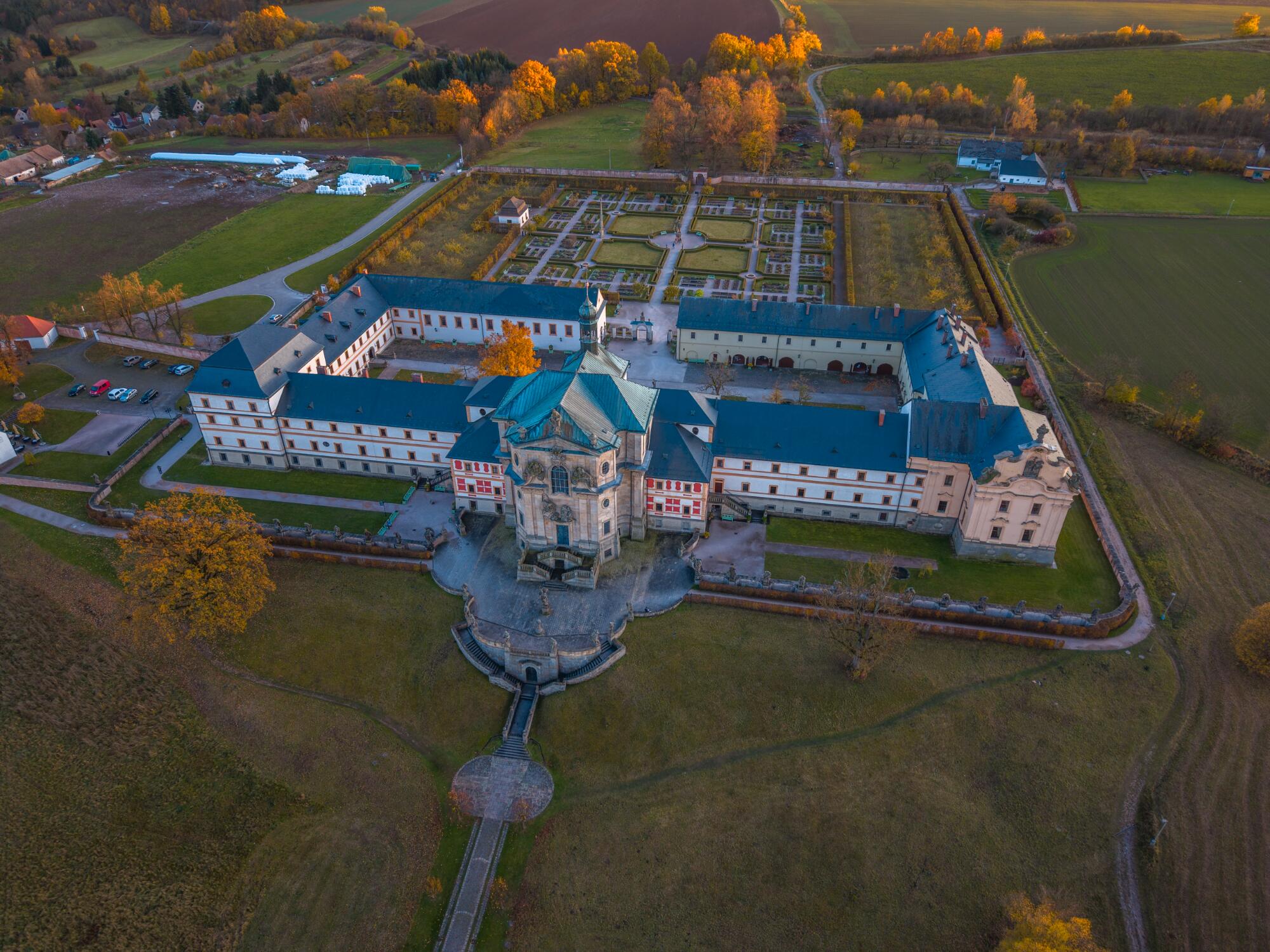
There are few sites that capture the culture and social atmosphere of the early 18th century in Bohemia as vividly as Kuks in the eastern part of the country. The spa settlement with its Hospital of the Brothers Hospitallers, created in the late 17th century in the picturesque valley of the Elbe River, is, on the one hand, an exceptional complex which, in both its conceptual design and artistic quality, had few parallels in its time. On the other hand, it also represents a characteristic example of contemporary ideas concerning appropriate spiritual and social representation, and stands as one of many testimonies to the wealth, ambitions, but also the limitations of the Bohemian Baroque aristocracy.
The history of Kuks cannot be separated from the life of its founder, Count Franz Anton von Sporck (1662–1738). Here he acted not only as builder and patron of artistic commissions, but to a considerable extent also as co-creator of the conceptual and ideological form of the complex. Sporck ranks among the most distinctive—and today also among the most widely recognised—figures in 18th-century Bohemian history1The most detailed and comprehensive study to date isby Pavel Preiss, František Antonín Špork a barokní kultura v Čechách,Praha 2003. ↩, and Kuks reflects, partly deliberately and partly unwittingly, both his personal ambitions and his often contradictory attitudes to life and religion.
Sporck’s life trajectory is a paradigmatic example of the consequences of the social transformations that took place in the Bohemian lands after the Thirty Years’ War. The triumph of the Habsburg imperial house over the non-Catholic Estates opposition resulted in a profound restructuring of the regional elites: a large part of the traditional Bohemian nobility was forced into exile, and their place was rapidly taken by new elites, some arriving from other regions, and others newly ennobled. The Sporcks were typical representatives of this development. The founder of the family, Franz Anton’s father, Johannes Sporck (1595/1597–1679),2Preiss (2003), 20-30. ↩ came from a Westphalian peasant background and began his career in the lowest ranks of the army, initially Bavarian and only later Imperial. Thanks to his undeniable talent, he rose to the rank of general and amassed considerable wealth. In 1664, he was elevated to the status of hereditary Imperial Count. At that time, his firstborn son had already been alive for two years. Franz Anton Sporck himself was therefore not born a count, and the fact that he originated from a non-noble family, the son of an uneducated soldier without traditional alliance networks or court connections, constituted a significant handicap in his later career. His ambitions, however, were considerable: Sporck sought to establish himself within the close circle of Emperor Charles VI, Holy Roman Emperor, and to become a member of the Order of the Golden Fleece. The means by which he intended to achieve these ambitions included his activities as builder and founder, above all in connection with his most celebrated project: Kuks.
Today, the town of Kuks is renowned above all for its hospital, with the monumental Church of the Most Holy Trinity and its remarkable cycle of Baroque sculptures. Originally, however, it was conceived primarily as a spa complex for a select clientele.3Recent works on the history of Kuks include,especially, Pavel Vlček, Hospitál v Kuksu, Praha 2023; Preiss(2003), 201-324. ↩ The local area is not notable for medicinal or mineral springs, yet this played a negligible part in the establishment of the spa. At the beginning of the 18th century, therapeutic cures using mineral waters were becoming fashionable among the social elite, along with the broader culture of spa resorts and visits.4A detailed overview of the topic, including an extensivebibliography, is provided in the nomination documents for selected European spatowns on the World Heritage List: Nomination of The Great Spa Towns of Europefor Inclusion on the World Heritage List. Volume I–17. History and Development,Paris 2019, https://www.greatspatownsofeurope.eu/the-great-spa-towns/downloads/the-nomination-document/ (accessed February 15, 2026). ↩ Convalescence at a spa thus became not only a matter of health, but above all a means of acquiring social capital and an opportunity for informal social encounters at the highest level. The Bohemian lands, however, had relatively little to offer in this regard. Although Karlovy Vary had already achieved considerable renown—its miraculous effects being sought even by the monarch himself5Petra Vokáčová, “Dvornícesta císaře Karla VI. do Karlových Varů 1732”,in: Opera historica 10 (2003), 457-468. ↩ —it long lacked suitably luxurious facilities for appropriately comfortable stays.6Lubomír Zeman, Karlovy Vary. Architektura baroka aklasicismu (1650–1850), Karlovy Vary 2005. For a brief summary of thehistory of Karlovy Vary in English, see Lubomír Zeman, Průvodcearchitekturou Karlových Varů / Karlovy Vary Architecture Guide, Prague2012, 26-35. ↩ Franz Anton Sporck recognised an opportunity here and resolved to establish a “spa resort” that would compensate, in terms of comfort, for what it lacked in curative properties.
The first outlines of Sporck’s project began to take shape at the very end of the 17th century. Preparatory work probably commenced in 1692, and by 1695 at the latest the spa, now furnished with promptly commissioned expert opinions attesting to the beneficial qualities of the local springs, was already in operation.7Preiss (2003), 227-233. ↩ On the slope of the left bank of the river, a symmetrically composed complex was laid out around a central monumental staircase, which still defines the basic form of the town today. The spa originally featured a long wooden colonnade and, on the main axis of the entire complex, its own Chapel of the Assumption of the Virgin Mary. However, this initial form, though functional, remained only provisional, and Sporck continued to expand and embellish it: additional spa houses, fountains, an inn, a riding oval, and a theatre capable of mounting demanding operatic performances were gradually added. Building activity on this bank culminated around 1710 with the construction of the “chateau”—a new spa building on the central axis of the complex, which also included the count’s luxurious apartment.
At that time, work was already under way on the right bank of the Elbe, on the sacred part of the complex, which—unlike the spa—has survived almost in its entirety to the present day. Given the building history of Kuks, which underwent numerous conceptual changes, modifications and reconstructions, it is not possible to determine with certainty whether the establishment of a monastery or hospital had been envisaged from the outset. Whatever the case, Sporck began negotiations concerning a new hospital foundation on his estates in the mid-1690s, and in 1696 he issued a foundation charter for a Hospital of the Brothers Hospitallers, confirmed by the emperor in 1699. By this point, the project must already have assumed a more definite form. Its realisation was subsequently complicated by the reversals and legal entanglements characteristic of Sporck: construction was initially begun of a convent of the Annunciates, only ultimately to be assigned to the Brothers Hospitallers. Despite these complications, however, the “sacred” right-bank side of Kuks was transformed over the course of the first half of the 18th century into a unique architectural and artistic ensemble, which secured Sporck’s project a significant place on the artistic map of Central Europe.8For an overview see Vlček (2023); Martin Krummholz, “Vídeňskyorientovaná architektura kolem roku 1700 a Giovanni Battista Alliprandi”,in: Petr Macek, Richard Biegel and Jakub Bachtík, eds., Barokní architekturav Čechách, Praha 2015, 227-247:243-244; Věra Naňková, “Architekturavrcholného baroka v Čechách”,in: Dějiny českého výtvarného umění, vol.II/2, [without editor], Praha1989, 391-454: 409-410. ↩
The hospital was founded in a dominant position and composed symmetrically on the same axis as the spa town and the castle. The four-winged structure of the rectangular plan, with the Church of the Most Holy Trinity projecting on the axis of the façade and with a terrace adorned with sculpture, was constructed in several phases and attained its final form only long after Sporck’s death.9For the most detailed account of architecturaldevelopment see Vlček (2023). ↩ Its fundamental conception and architecturally most valuable parts, however, are associated with the first two decades of the 18th century and with the name of Giovanni Battista Alliprandi (1665–1720).10Pavel Vlček, ed., Encyklopedie architektů,stavitelů, zedníků a kameníků v Čechách, Praha 2025, 22-26;Krummholz (2015), 236-246. ↩ A native of Lombardy from a family of stucco workers, Alliprandi gained his initial professional and practical experience in Vienna at the workshop of the lesser-known architect Francesco Martinelli. He began his independent career after 1695 in Bohemia, in the service of the prominent Černín family (Kosmonosy Castle), and very quickly established himself among the local aristocracy as a much sought-after designer of palaces and aristocratic residences (for example, the Lobkowicz Palace in Prague). Alliprandi introduced into Bohemia the style of monumental Viennese Baroque in the spirit of Domenico Martinelli and Johann Bernhard Fischer von Erlach, thus offering the local aristocracy the possibility of keeping pace, under domestic conditions, with the latest fashions at the centre of the monarchy. This, together with his undeniable artistic talent, made Alliprandi one of the leading architectural figures in early 18th-century Bohemia.
His prestige among aristocratic patrons, together with his mastery of “Viennese taste”, undoubtedly contributed to Franz Anton Sporck commissioning his services for work at Kuks and elsewhere. There is no doubt that Alliprandi designed the hospital church;11Vlček (2023), 7-10;Vlček (2025), 24. ↩ it is highly likely, however, that he also created at least the basic layout and conception of the hospital itself, and perhaps even the overall urban plan of the spa-hospital enclave.
Whereas the buildings of the convent are conceived in a utilitarian manner and within the bounds of monastic sobriety, the Church of the Most Holy Trinity offered Alliprandi the opportunity to demonstrate his mastery. The structure, built between 1707 and 1709, forms the dominant feature of the main, north façade of the convent and immediately attracts attention through what was, within the Bohemian context, its unusual unplastered façade of stone slabs. As the basis of its volumetric and ground-plan composition, Alliprandi chose an elongated octagon, extended along both longitudinal and transverse axes by deep niches (entrance, two side altars, and chancel) and unified by an oval, flattened dome. In doing so, he employed a scheme derived from contemporary Viennese architecture, first introduced in the Servitenkirche (Carlo Carlone, 1651), and subsequently adapted in the more famous Peterskirche (Lucas von Hildebrandt, 1703–1733) and later also in the Karlskirche (Fischer von Erlach, 1713–1737). Alliprandi, however, used this centralising plan to give the building, externally, the form of a simple, compact, almost unarticulated block, firmly embedded within the mass of the convent. To this block is attached, by means of a concave “cut-out”, the main façade, which thus forms in effect a separate projecting screen, corresponding to its distinctive design. Above the solid yet restrained architectural structure, which is dominated by a monumental pediment “broken” by a large window, sculptural decoration assumes a leading role:12For more on the relationship between the localsculptural decoration and the architecture, see Kateřina Adamcová, “Barokníarchitektura a sochařství”, in: Macek, Biegel and Bachtík (2015), 613-635:619-620. ↩ the entrance portal is crowned by a sculptural group of the Annunciation, while flanking the window and crowning the roof gable are three Cardinal Virtues.13The creator of the sculptures was Jan BedřichKohl-Severa. Vlček (2025), 47; Adamcová (2015), 619. ↩ Through its stone construction, block-like massing, absence of a tower, and the dominant role of exterior sculptural decoration, Alliprandi’s church in fact is more reminiscent of a monument, or perhaps even a tomb. This, however, corresponds to one of its functions: beneath the church itself a strikingly vaulted crypt was created, which served as the family burial place.
A frequently cited (and apparently accurate) anecdote associated with Kuks recounts that an eternal light burned in the crypt of the Church of the Most Holy Trinity, positioned in such a way that the count could see it from his bedchamber in the chateau on the opposite side of the valley as a memento mori. This detail captures both the nature of the entire complex and the character of Baroque piety, and more specifically of Sporck’s own religiosity. A place intended for the restoration of the body and for worldly pleasures was thus continually confronted with reminders of the afterlife and the spiritual dimension of human existence. At the same time, the hospital demonstrated to spa visitors both the firmness of Sporck’s faith and his charitable care for those in need. The entire ideological programme of Kuks, including its religious aspects, thus paradoxically turned back towards Sporck himself as founder and owner, becoming one of the forms of his personal representation (a fact eloquently attested by the series of officially published engravings through which we today have a clear understanding of the individual building phases of the complex).
A similar character—oscillating between religious programme, object of worldly entertainment, and expression of the count’s personal attitudes—may be observed in what is arguably the most significant and best-known artistic component of the entire complex: its sculptural decoration. The position of the hospital on the edge of the slope made it possible to create an extensive terrace in front of it, which effectively became an open-air gallery. It is occupied by a group of thirty-five monumental sandstone sculptures of larger-than-life size, which, in both conception and execution, had no parallel in Central Europe at the time. The ensemble comprises allegories of Religion (Faith) and the Eight Beatitudes placed before the church, and above all allegories of the Twelve Virtues and the Twelve Vices, accompanied by angels of Blessed and of Mournful Death, arranged before the main façade of the convent. As a whole, the ensemble combines traditional Christian allegories directly referring to the Gospels with a more general, “secular” moral dimension—a conception that corresponds closely to Sporck’s spiritual outlook. From an early age, the count displayed an interest in non-Catholic and reformist currents of thought, which in 1730 even brought him before a court on charges of heresy.14Preiss (2003), 413-436. ↩ At the same time, he was strongly drawn to moralising critiques of contemporary social and ecclesiastical abuses—an attitude that intensified in his later years, as personal setbacks and social disappointments accumulated. Sporck articulated his views through a wide range of artistic works, projects and texts; yet the sculptural cycle at Kuks remains, to this day, the most powerful of these expressions.
From an iconographic point of view, however, the ensemble—created in several phases between 1713 and 1721—is not particularly original. The individual allegorical figures with their respective attributes were most likely based on a cycle of engravings by the Augsburg draughtsman, engraver and publisher Martin Engelbrecht (1684–1756), produced between 1710 and 1715, which itself constituted a compilation of motifs derived from widely known cycles by Cesare Ripa, Jacques Callot and Johann Theodor de Bry.15Vlček (2025), 46-47;Preiss (2003), 269-304. ↩ What lends the Kuks allegories their exceptional quality is their artistic execution, which represents a culminating achievement of Matthias Bernard Braun (1684–1738).16See, especially, Emanuel Poche, Matyáš BernardBraun, sochař českého baroka a jeho dílna, Praha 1986; Germantranslation: Emanuel Poche, Matthias Bernhard Braun:Monographie, Innsbruck 2003; OldřichJ. Blažíček, “Sochařství vrcholnéhobaroka v Čechách”, in: Dějiny českého výtvarného umění vol.II/2, [without editor], Praha1989, 486-501;Ivo Kořán, Braunové, Praha 1999. ↩ A native of Tyrol, after training in Salzburg and undertaking a study journey through Italy, Braun settled in Prague in 1708, where he rapidly established the most productive and sought-after sculptural workshop in Bohemia at the time. A significant share in his success must be attributed to Franz Anton von Sporck, who effectively made Braun his court sculptor and employed him intensively over two decades. Braun’s distinctive style, characterised by expressiveness and dynamism in both the core conception and surface treatment of figures—often developing into a pronounced, at times almost grotesque stylisation of gestures, faces and bodies—clearly suited Sporck’s temperament and the nature of his commissions. In artistic terms, Braun ranks among the most consistent followers of Gian Lorenzo Bernini, at least within Central Europe. Whereas the generation of Bernini’s Italian pupils and followers, such as Antonio Raggi or Ercole Ferrata, combined the master’s dynamism with the more classical idiom of Alessandro Algardi or François Duquesnoy, Braun drew primarily on the expressive, experimental and, in terms of the disruption of sculptural volume and modelling techniques, highly radical tendencies of “late Bernini”. He thus belongs to a less prominent but all the more expressive current of post-Berninian sculpture, alongside artists such as Filippo Parodi (1630–1702) and Giovanni Battista Foggini (1652–1725).
Braun’s inclination towards the most dynamic modes of Berninian sculpture is also connected with the sculptural material at his disposal. His expansive and expressive manner makes full use of the specific qualities of sandstone, the most common sculptural material in Baroque Bohemia, which, while not permitting filigree detail, allows for a more forceful and emphatic mode of expression. From an artistic point of view, Matthias Bernard Braun was in part a victim of his own success, as the large output of his workshop resulted in considerable fluctuations in the quality of the works produced. His finest projects, however, are evidence of an original and assured artist who, alongside Ferdinand Maximilian Brokoff (1688–1731), ranks among the greatest sculptors of eighteenth-century Bohemia.
This is also demonstrated by the cycle of Virtues and Vices at Kuks.17Poche (1986), 81-99; Blažíček (1989); Kořán (1999), 47-79. ↩ The task of creating a series of dozens of standing figures would present even an experienced artist with the temptation to recycle motifs and compositional schemes. Braun, however, succeeded in conceiving almost every figure in an individual manner, not only through their symbolic attributes, but also through bodily expression, gesture and facial articulation. Particularly in the case of the more visually engaging theme of the Vices, Braun’s formal exaggeration and his sensitivity to the dynamic activation of sculptural volume are brought fully to bear. The individual figures resemble dancers from a carnival or the commedia dell’arte (which was regularly performed in the Kuks theatre); the overall impression of a masquerade was further enhanced by their highly original and vivid polychromatic quality. From a modern perspective, the presence of these picturesque figures in front of the hospital, and in proximity to the memento mori embodied by the hospital church, may appear incongruous. Yet moralising themes that combined coarse, even vulgar, imagery with a strong spiritual framework had a long tradition in European culture going back to the Middle Ages, particularly in satirical depictions of human folly. In this respect, the Kuks of Braun and Sporck shares much with the works of Pieter Bruegel the Elder, Hieronymus Bosch, and other renowned chroniclers of human vice: it represents a variation on similar themes, realised here in an open-air setting.
At the same time, it must be emphasised that, thanks to Braun’s artistic mastery, the individual allegories are both persuasive and precise, without lapsing into ponderous moralising or excessive grotesquerie: the Vices are rendered with biting humour, while the Virtues retain a noble lightness. The sculptural assemblage at Kuks remains to this day one of the most admired artistic monuments of Baroque Bohemia. It is, moreover, Braun’s artistic language that largely defined the specific character of Sporck’s patronage and became, as it were, its hallmark. This is also evident in other parts of Kuks, which gradually expanded beyond the spa and hospital complex. Sporck progressively transformed the surrounding landscape through additional buildings and “artistic interventions”, the most remarkable of which is the so-called Braun’s Bethlehem in Nový les, a fascinating ensemble of sculptures and reliefs carved directly into sandstone rock formations in the open landscape between 1723 and 1732.
It is almost symbolic that, of the entire Kuks complex, the part that represented Sporck’s political ambitions proved the most short-lived. Despite its initial success, the spa did not fulfil the count’s ambitions and aspirations. Its operation was already declining during Sporck’s lifetime; his heirs subsequently abandoned the resort altogether, and today only fragments remain. The chateau is no longer, but burned down at the beginning of the 20th century.18Regarding the history of the grounds after Sporck’sdeath, see Vlček (2025), 12-21. ↩ Ultimately, Sporck’s true legacy lies in those monuments that reflect his distinctive religious and moral worldview, works which, owing both to their picturesque quality and to the congenial creative contribution of Matthias Bernard Braun, continue to inspire admiration among both specialists and lay enthusiasts of history and heritage.
In this reception, one may discern the specific character of the Central European Baroque: a nobleman of German origin, working with a Tyrolean sculptor and an Italian architect, created a work that is today regarded as a highly valued and integral part of the Czech cultural heritage.