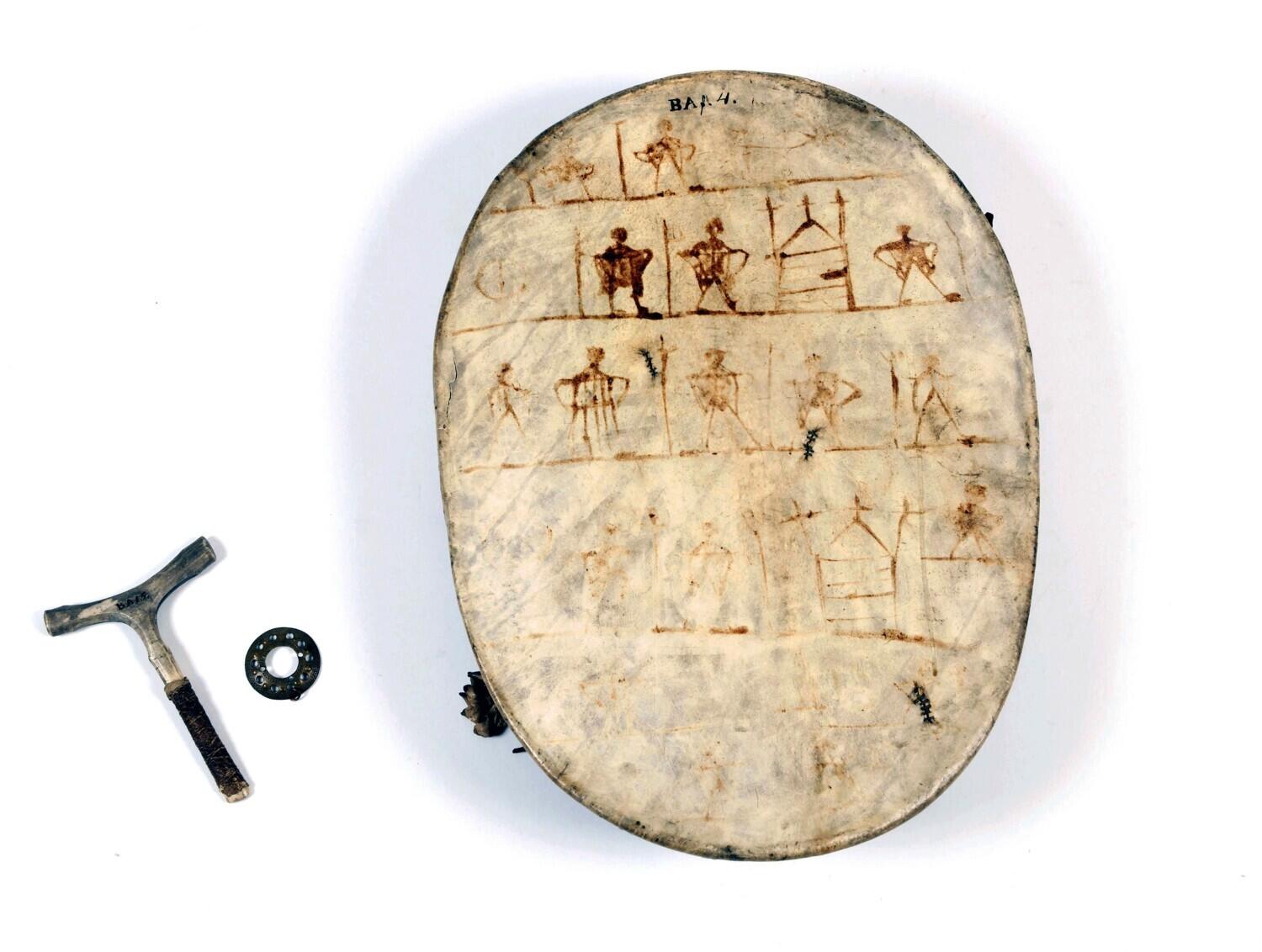
Sámi Parliament (Sámediggi), on long-term loan to RiddoDuottarMuseat (The Sámi Museums), Kárášjohka/Karasjok, Sápmi (Northern Norway)
Introduction: People, Place, and Sacred Instrument
The object known as a runebomme in Norwegian and goavddis in North Sámi, often referred to in English as a noaidi’s drum, is a sacred ceremonial instrument created and used by the Sámi people of northern Europe. The Sámi are the Indigenous people of Sápmi, a vast region that today extends across northern Norway, Sweden, Finland, and the Kola Peninsula of Russia. Archaeological and linguistic evidence indicates Sámi presence in the region for millennia. Traditionally, Sámi livelihoods have included reindeer pastoralism, fishing, hunting, small-scale agriculture, and intricate seasonal migrations structured around ecological rhythms. Sámi cosmology understands humans, animals, spirits, and landscapes as interdependent and relational. Mountains, rivers, winds, and reindeer are not inert matter but participants in a living world. Knowledge is transmitted through oral traditions, joik (a distinctive Sámi vocal form), storytelling, duodji (a Sámi philosophy including making practices), and ritual.
Within this cosmological framework, the noaidi was a ritual practitioner holding a central position in soceity --- the term is often mis-translated as “shaman”, a word originating in Central Asia that extended to the Indigenous people of Siberia. The noaidi mediated between different realms of existence: the everyday human world, the spiritual realm of deities and ancestral forces, and the underworld. These three worlds usually structure the drum itself. Through trance, chant, and drumming, the noaidi sought guidance for healing, divination, hunting success, weather prediction, and communal well-being. The drum was central to this practice. It was not a musical instrument in a modern aesthetic sense, but a sacred cosmological tool.
The seventeenth-century drum discussed here was constructed from reindeer hide stretched over a wooden frame, typically birch or pine. Its surface is painted with symbolic figures using natural pigments derived from soot, blood, and minerals. These motifs represent celestial bodies, animals, deities, human activities, and landscapes. During ritual use, the noaidi struck the drum with a hammer while a small brass or bone pointer moved across the surface, its trajectory interpreted as communication from the spiritual realm.
Approximately seventy historical Sámi drums survive today. Most were confiscated during the seventeenth and eighteenth centuries, when Lutheran missionary campaigns and expanding Scandinavian state power sought to Christianize and assimilate Sámi communities by persecuting the noaidi´s. Many drums were destroyed; others were stolen and sold off to royal collections and later museums in Copenhagen and Stockholm, amongst others. The drum examined here was held for centuries in the National Museum of Denmark. In 2022, following longstanding Sámi advocacy and negotiations between Danish authorities and Sámi representatives, it was formally transferred to the Sámi Parliament of Norway (Sámediggi). It is now held on long-term loan at RiddoDuottarMuseat in Kárášjohka (Karasjok), one of the principal Sámi museum institutions in Norway. This transfer marked a significant moment in ongoing processes of restitution and Indigenous self-determination in the Nordic region. Only after understanding this historical, spiritual and cultural grounding can we approach the broader epistemological, political, and art-historical significance of the drum.
This text expands on the cultural, political, and artistic significance of the noaidi’s drum through decolonial and Sámi critical thinking. It situates the object within Indigenous epistemologies of duodji (Sámi making), within the colonial history of Christianization and confiscation, and within broader global Indigenous struggles for cultural resurgence and rematriation. Drawing on Sámi scholarship (Gaski 1993; Kuokkanen 2007; Porsanger 2004; Guttorm 2018) alongside global Indigenous theorists (Smith 1999; Simpson 2017; Deloria 1994), the essay argues that the drum should not be viewed as an ethnographic relic but as a living, relational, and political object. By tracing the drum’s trajectory, we are compelled to rethink the very boundaries of European art history: no longer a story of metropolitan centers and “folk peripheries,” but a plural and contested terrain where Indigenous creativity and survivance (Vizenor 1994) form essential threads.
Materiality and Cosmology
The drum is an object of profound material intelligence. Reindeer hide forms its vibrating membrane, connecting the instrument directly to the animal central to Sámi livelihood and cosmology. The wooden frame, often carved from local birch or pine, situates the drum within northern boreal forests. The pigments bind together soot, blood, earth, and organic binders---substances drawn from the land itself. The painted motifs are not decorative. They form a cosmological diagram. While designs varied regionally, many drums depict a tripartite structure corresponding to upper, middle, and lower worlds. The sun often occupies a central position, reflecting its importance in Arctic seasonal life. Reindeer, fish, birds, sacred sites, dwellings, and ritual figures appear alongside deities and protective spirits.
Sámi scholar Harald Gaski (1993) has emphasized that Sámi symbolic systems articulate cyclical and relational temporalities rather than linear historical progression. The drum embodies this worldview. Its surface does not narrate events chronologically; instead, it maps relationships. Humans, animals, ancestors, and deities appear on a shared plane, interconnected rather than hierarchically ordered.
The drum must also be understood through the concept of duodji, an overarching philosophy often misunderstood as “craft.” As Sámi scholar Gunvor Guttorm (2018) explains, duodji integrates ethics, knowledge, aesthetics, and responsibility. Making is not separate from living; it is an enactment of relational obligations to land, animals, and community. The drum is therefore not merely a ritual device but a condensation of Sámi epistemology. It unites material skill, cosmological knowledge, and communal accountability. The Western division between “art,” “religion,” and “ethnography” cannot adequately contain such an object. The drum resists classification. It is at once artwork, sacred instrument, knowledge archive, and political symbol.
Christianization and Confiscation
The seventeenth and eighteenth centuries brought profound disruption to Sámi spiritual life. As Denmark-Norway and Sweden consolidated state authority in northern territories, missionary campaigns intensified. The noaidi and their drums became primary targets. Missionaries characterized the drums as instruments of pagan superstition or diabolic practice. Noaidi were accused of witchcraft; some were tried and punished. The infamous witch trials in Vadsø and other northern towns testify to the violence of this period. In the seventeenth century, Vadsø in northern Norway became one of the main sites of the Finnmark witch trials, during which dozens of Sámi and Norwegian women and men were accused of sorcery and executed, many by burning. Although not all those condemned were noaidi, Sámi ritual specialists were specifically targeted as embodiments of so-called “pagan” belief, and the persecutions formed part of the broader campaign to eradicate Sámi spiritual practices, including the use of the drum, aimed at replacing Sámi cosmologies with Lutheran orthodoxy.
This campaign was not only religious but epistemic. By destroying or removing drums, colonial authorities sought to sever the transmission of Indigenous knowledge. As Frantz Fanon (1961) observed of colonial regimes elsewhere, colonization attempts to empty the colonized of cultural memory and replace it with the colonizer’s worldview. The eradication of drums functioned precisely in this way. Surviving drums were transported south and incorporated into royal collections. There, stripped of sacred function, they were categorized as ethnographic curiosities---evidence of “primitive” belief systems. In this transformation, the drum was frozen in time, emptied of agency, and detached from living Sámi communities.
Imperial Archives and Museum Classification
For centuries, the drum remained in Copenhagen. Its classification within a national museum reflected what Māori scholar Linda Tuhiwai Smith (1999) has termed the “imperial archive”: the accumulation of Indigenous objects within European institutions as symbols of imperial reach and epistemic authority. In such archives, Indigenous artifacts were displayed as relics of vanishing cultures. Their presence confirmed narratives of European modernity and progress. The drum was no longer an active cosmological instrument but an object of study, categorized as ethnography rather than art. This classification had lasting consequences. European art history traditionally privileged metropolitan centers---Florence, Paris, Berlin---while relegating Sámi visual culture to the margins. The drum’s displacement reinforced the notion that Sámi cultural production belonged to anthropology, not art history.
Repatriation and Sámi Stewardship
The 2022 transfer of the drum to the Sámi Parliament marked a profound reversal. After decades of advocacy by Sámi cultural and political actors, Denmark agreed to return the drum to Sámi custody. Its placement on long-term loan at RiddoDuottarMuseat situates it within a Sámi institutional framework. This transfer signifies more than relocation. It represents recognition that authority over Sámi cultural heritage rests with Sámi institutions. As Rauna Kuokkanen (2007) argues, Indigenous self-determination is not solely political but epistemic: it includes the right to define, interpret, and steward cultural knowledge. Within RiddoDuottarMuseat, the drum is not framed as a relic of a vanished past. It exists within a living cultural landscape. It is accessible to Sámi researchers, artists, and community members. Its presence contributes to ongoing processes of cultural revitalization and intergenerational knowledge transmission. The concept of rematriation---emphasized by scholars such as Eeva-Kristiina Nylander (2024) ---extends beyond legal ownership. It involves restoring relational networks disrupted by colonial extraction. Rematriation foregrounds care, reciprocity, and community connection. The drum’s return enables renewed relationships between object, land, and people.
Rethinking European Art History
To include the noaidi’s drum within European art history is not to assimilate it into an unchanged canon. It is to challenge the canon’s foundations. Modern European art history emerged alongside colonial expansion. Its exclusions mirror colonial hierarchies.
Aníbal Quijano’s (2000) concept of the “coloniality of power” reminds us that modernity and colonialism are intertwined. The absence of Sámi art from canonical narratives reflects this entanglement. The drum’s recognition as a major work of European cultural history requires confronting these exclusions. If canonical narratives celebrate Goya for representing national trauma, or Duchamp for destabilizing artistic categories, then the runebomme demands equal attention. Long before avant-garde movements questioned the boundary between art and object, the drum embodied a unity of ritual, aesthetics, and knowledge that resists Western classification. Gerald Vizenor’s (1994) concept of “survivance”---active Indigenous presence beyond victimhood---aptly describes the drum’s continued existence. Despite suppression, it persists. Its return to Sápmi marks not closure but continuity.
Global Indigenous Resonances
The Sámi experience resonates globally. Indigenous sacred objects---from Hopi katsina figures to Māori taonga---were similarly confiscated and housed in colonial museums. Contemporary repatriation movements challenge these histories. These struggles centre on the question: who has the authority to interpret cultural objects? As Vine Deloria Jr. (1994) argued, control over narrative is inseparable from sovereignty. Objects such as the runebomme are not inert artifacts; they are repositories of cosmology and identity. The drum’s return aligns with broader international movements to decolonize museums and rethink cultural stewardship. It exemplifies a shift from state-centered possession to Indigenous custodianship.
Contemporary Relevance: Ecology and Relational Futures
In an era of climate crisis, the drum acquires renewed urgency. Its motifs encode a worldview grounded in reciprocity between humans and land, a perspective in which humans are a part of a much bigger dynamic between humans, lands and more than human entities. Sámi cosmology does not therefore treat land as extractable resource but as kin to which they have a duty of care. As Kuokkanen (2019) emphasizes, Sámi women’s philosophies of care and reciprocity offer alternatives to patriarchal and colonial models of extractivist development. As Arctic environments confront mining, wind power expansion, and global warming, Sámi communities continue to assert land rights and ecological stewardship. The drum’s cosmology offers an alternative to extractivist logics. It testifies to knowledge systems developed through long-term coexistence with fragile northern ecosystems. The drum thus functions as an ecological archive. Its rhythms echo interdependence. Its imagery affirms that survival requires relational accountability.
Conclusion: A Relational Art History
The seventeenth-century noaidi’s drum is at once sacred instrument, artwork, historical witness, and political agent. Its materiality embodies Sámi epistemologies; its confiscation testifies to colonial violence; its repatriation enacts resurgence. To honour the drum as central to European cultural history is to acknowledge that Europe’s story cannot be told without its Indigenous peoples. It is to accept that art history must expand beyond metropolitan narratives and secular frameworks. The drum invites a relational art history---one that understands creativity as inseparable from land, spirituality, and community. It speaks across centuries: from the noaidi who struck it, to the missionaries who condemned it, to the museum curators who classified it, to the Sámi Parliament that now stewards it and the new generations of Sámi who are rematriating it. Its journey reminds us that cultural objects are not static. They carry memory, resistance, and possibility. In listening to the goavvdis today, we hear not only the resonance of reindeer hide and wood but the persistence of Sámi presence, and the celebration of their worldviews. Its sound calls for accountability---to history, to land, and to plural futures.
Katya García-Antón
References (selected)
-
Vine Jr. Deloria, God Is Red: A Native View of Religion, Golden, CO 1994.
-
Frantz Fanon, The Wretched of the Earth, New York, NY 1961.
-
Harald Gaski, In the Shadow of the Midnight Sun: Contemporary Sámi Prose and Poetry, Kárášjohka 1993.
-
Gunvor Guttorm, “Duodji: A Sámi Art and Craft — Discourse”, in: Journal of Material Culture, 2018.
-
Rauna Kuokkanen, Restructuring Relations: Indigenous Self-Determination, Governance, and Gender, Oxford 2019.
-
Rauna Kuokkanen, Reshaping the University: Responsibility, Indigenous Epistemes, and the Logic of the Gift, Vancouver 2007.
-
Eeva-Kristiina Nylander, “Rematriation and Sámi Worldviews”, in: Outi Pieski Exhibition Catalogue, exh. cat., London 2024.
-
Ruth B. Phillips, Trading Identities: The Souvenir in Native North American Art from the Northeast, 1700—1900. Seattle, WA 1998.
-
Jelena Porsanger, “An Essay about Indigenous Methodology”, in: Nordlit 8 (2004), 105-121.
-
Aníbal Quijano, “Coloniality of Power, Eurocentrism, and Latin America”, in: Nepantla: Views from South 1 (2000), 533-580.
-
Audra Simpson, Mohawk Interruptus: Political Life Across the Borders of Settler States, Durham, NC 2014.
-
Linda Tuhiwai Smith, Decolonizing Methodologies: Research and Indigenous Peoples, London 1999.
-
Gerald Vizenor, Manifest Manners: Narratives on Postindian Survivance, Lincoln, NE 1994.
Illustration
 {width=“4.138888888888889in” height=“3.1041666666666665in”}
https://www.tandfonline.com/doi/full/10.1080/00233609.2023.2200763#d1e113
Sámi Drum c. 1650. 44 x 33 x 10 cm. RiddoDuottarMuseat — Sámiid Vuorká-Dávvirat, Kárášjohka. Photo © Liv Engholm/RiddoDuottarMuseat.
- Katya García-Antón