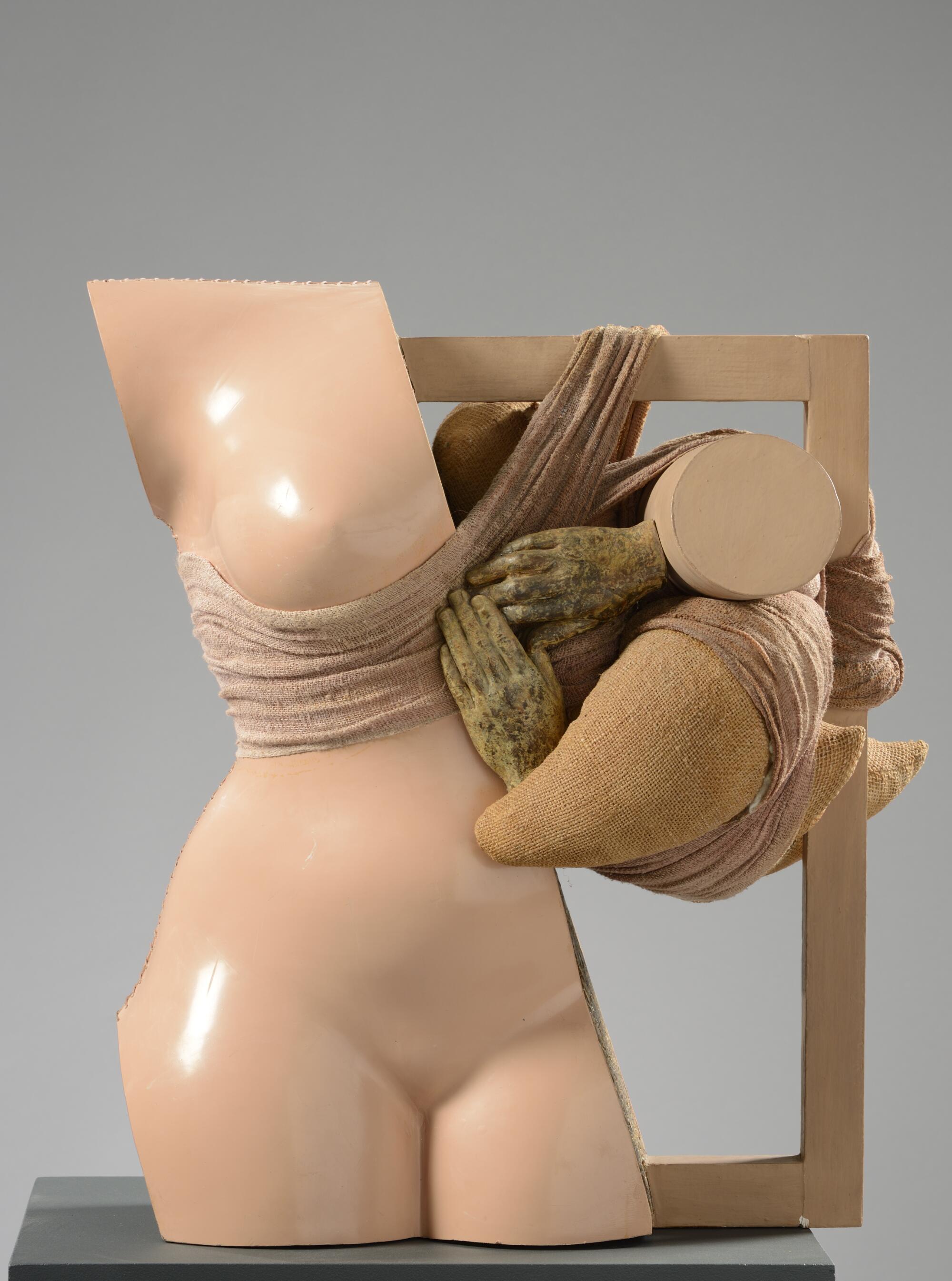
Anu Põder belongs to the history of Estonian art as one of the most original and controversial sculptors of the 1980s. While many of her contemporaries depicted social themes in the Soviet Union — agriculture, collective farm work, socialist living spaces — or created portraits of the Soviet elite and cast them in accessible bronze, Põder focused on the intimate side of the human soul and inner monologue, experimenting with mixed materials that were considered unusual in official sculpture.1Rebeka Põldsam, “Anu Põder. Be Fragile! Be Brave!”, in: Rebeka Põldsam, ed., Anu Põder. Be Fragile! Be Brave!, exh. cat., Tallinn 2017, 8. ↩ Although this was not necessarily the author’s intention, in the context of the late Soviet era, her work thus took a contrasting position. On the one hand, she broke away from the monumental tradition of the so-called “bronze age”,2Juta Kivimäe, “Lagoon Sculpture: Critical Pop, Romantic Symbolism, Hyperrealism and Surrealism in Estonian Sculpture of the 1980s,” in: Andreas Trossek, ed., The Lost Eighties. Problems, Themes and Meanings in Estonian Art of the 1980s, Tallinn 2010, 122-133. ↩ which was characterised by heavy materials and heroic forms, and created an alternative approach to form. On the other hand, her sculptures were characterised by socially “hidden” themes such as fragility, intimacy and vulnerability, which have lost their stigma in today’s free world, but were rather rare in Soviet art.
Anu Põder on the local art scene
Põder was born in 1947 in Kanepi, South Estonia. She studied at the Tartu Art School (1967—1970) and then at the State Art Institute of the Estonian SSR in Tallinn, specializing in sculpture (1970—1976). Until 1986, she worked as what we might today call a freelancer, then taught at the Tallinn Art School and the Estonian Academy of Arts.3“Anu Põder”, in: Kaasaegse Kunsti Eesti Keskus. Kunstnike andmebaas, s.a., https://cca.ee/kunstnike-andmebaas/anu-poder (accessed 10 September 2025). ↩ Her education began at a time when monumentalism and realistic figures dominated in the art of Soviet Union, but she found her own path early on, creating doll-like figures that played with elements of pop art, made of wire, cotton wool, plaster and textiles. In the early 1980s, she began using plastic in her work and created her first well-known pieces, such as Doll Which Was Made to Sit (1982; not preserved) and Figure Which Was Made to Walk (1984, Tartu Art Museum).4“Astuma pandud nukk”, in: Museums Public Portal, s.a., https://www.muis.ee/en_GB/museaalview/1464865 (accessed 16 September 2025). ↩
His most intense period began in the 1980s, both in terms of the number of works created and several other indicators. Soviet society at the time had little contact with the cultural developments in Western society. This technological backwardness and Brezhnev-era stagnation did not encourage the arrival of postmodernist discourse in the Estonian art world. Instead, Estonian sculpture developed according to its own path and each artist’s personal style, sometimes expressing existential anxiety and social criticism.5Juta Kivimäe, “Anu Põder’s Remembrance Projects in Sculpture,” in: Reet Varblane, ed., Anu Põder, Tallinn 2009, 8-9. ↩
The sculptures by Põder also consistently presented her personal view and experience of the world: her 1980s “dolls” appear as statements about being a female artist in Soviet Estonia. As such a determined authorial position, they are unique in this context. These works convey a powerful urge to fulfil oneself not only as a creative person, but also as a woman and a mother. At the same time, her works from this period refer to themes of (mental) violence, isolation and oppression: several of them, including Composition with Torso and Child’s Hands (1986), depict figures without arms, heads, breasts or other body parts.6Kivimäe (2009), 10. ↩ Art historian Mari Laanemets has pointed out that these bodies seem to be out of focus, amorphous and more reminiscent of dolls than classical human figures.7Mari Laanemets, “Dissected Bodies. An Insight into the Works of Sculptress Anu Põder”, in: Johannes Saar, ed., Estonian Artists, vol. 2, Tallinn 2000, 149. ↩
Between 1974 and 2012, Põder created over sixty works, most of which belong to the collections of the Art Museum of Estonia, Tallinn, and the Tartu Art Museum. A large part of her creative work dates from a period when heavy and permanent (bronze) sculptures, created by male artists, tended to marginalise female artists and their alternative forms of expression. Põder also started out with classical sculptural materials, but soon moved on to wax, textiles, glue and plastic. In the 1970s and 1980s, some opportunities began to open up for experimenting with applied art and installation, and also with less common materials. She found her way to “cheap” materials — a choice that was practical (bronze was still expensive), aesthetic as well as ideological, distancing herself from monumental aesthetics and its logic of power.8Rebeka Põldsam and Eha Komissarov, “About Anu Põder and the Feminists”, in: kunst.ee 1 (2017), http://ajakirikunst.ee/?c=magazine&l=en&t=about-anu-poder-and-the-feminists&id=1736 (accessed 8 September 2025). ↩ Põder’s “soft” and ephemeral materials thus sought to question the temporality of sculpture and shifted attention from the permanence and duration of form to the vulnerability of experience.
Composition with Torso and Child’s Hands represents Põder’s early period, when she worked with fragmentary representations of the human body, using plastic and textiles. Rather than offering recognisable figures or abstract geometry that dominated sculpture at the time, the piece rather depicts a broken female body to which several shapeless objects and a child’s hands have been added — a motif that evokes both intimacy and disturbance. The doll’s hands may refer to motherhood and care, but at the same time to the ephemerality of being: the child clings to its mother, whose body is anonymous, headless, without identity. The material — textile and plastic with visible seams — also emphasises the artificiality and vulnerable temporality of the body; the plastic surfaces resemble skin, while the stiches seem to refer to wounds and repairs, and the child’s hands are grotesquely small, not naturally belonging to the body.
The work simultaneously refers to care and restrictedness in that, although the child’s touch is gentle, it is also clinging. This formal solution confirms Põder’s interest in the fragmentation of the body (torsos, severed limbs, body parts associated with domestic or intimate objects and materials), differing radically from official Soviet art, where the depiction of the body was generally limited to heroic workers or idealised athletes.
Põder’s injured, broken and fragmented bodies function as a visual expression of trauma — not necessarily as a personal tragedy, but as an embodiment of broader cultural or social trauma. Yet, they are linked to the late Soviet culture centred around home, where an alternative, private life-oriented view gradually came to replace the ideological rhetoric of the public sphere. Her poetics can be summed up along the axis of home and trauma: instead of the grand national myth, the focus is on the immediate environment and its micro-shocks — be it the apathy of expectation in the plaster sculpture Traveller (1978, Art Museum of Estonia), or the visual anguish of everyday life in the Soviet-era mass-housing district Lasnamäe in Tallinn (where Põder lived) in some of her other works — which confirm that social space enters the body in small but permanent shifts.9Põldsam (2017), 14-15; Linda Kaljundi, “Anu Põder in the Moving Context”, in: Cecilia Alemani and Agnieszka Sosnowska, eds., Anu Põder: Space for My Body, exh. cat., Torino 2023, 51-52. ↩
Põder’s oeuvre bearing cultural memory
It is mostly literature that has played the leading role in preserving cultural memory in Estonia. However, Põder’s work, which addresses social issues, adds new layers to these realms of memory. One such example is the farm motif and a certain nostalgia for disappearing small-scale farming and traditional village life, which emerged against the backdrop of extensive agricultural industrialisation in the 1970s — such elements are noticeable throughout Baltic art of the era, being part of a broader rural revival and ethnographic interest throughout the Eastern Bloc.10Kaljundi (2023), 56. ↩ As evidence of this, Põder’s work contains several references to farming and her childhood home in southern Estonia, but not in a romantic key.
In Põder’s work, these themes are not raised solely as a manifestation of childhood memories, but as physical objects on the borderline between the living and the lifeless, the intimate and the industrial. A good example is Põder’s work Tongues (1998, Estonian Art Museum), which depicts tens of life-size animal tongues made of pinkish-grey soap,11Kivimäe (2009), 13-14. ↩ bringing to mind the slaughter of farm animals and the disposal of their carcasses. These are as if “frozen” tongues, both as organs of memory and speech — simultaneously representing voice and silence, desire and boundary. Yet, this installation is also an expression of the violence against fellow creatures and species. Many of Põder’s works depict life as a condition, rather than expressing a particularly affirming attitude towards life.
Today’s viewers connect with Põder’s works through post-humanist discussions about the agency and vulnerability of materials,12Kaljundi (2023), 56-57. ↩ which is one of the reasons why her work has recently begun to attract attention again. Estonian art history is not alone in emphasising the influx of progressive ideas from the West, and thus overshadowing the ways in which Eastern European artists in fact independently addressed similar critical issues, especially in the 1970s and 1980s. The turbulence after the regime change in the 1990s and its after-effects in 2000s did not make the younger generation of post-socialist artists and art scholars particularly eager to explore gender equality or environmental issues during the final period of socialism. Only now earlier layers of artistic practice and critical thinking on these topics have begun to be discovered. In this process, Põder is an ideal subject of study, as she vividly connects the two periods — coming from the late socialist era, she was conceptually well equipped to deal with the key issues of the transition period and post-socialist neoliberal Eastern Europe.
Põder’s oeuvre can be divided into two chapters in the main part: the early period (until Estonia regained independence in 1991) moves as if outward (from the inside), according to Juta Kivimäe and Rebeka Põldsam, dealing with the intimacy, motherhood and domestic space experienced by a young woman in late Soviet Estonia from a very personal perspective; the later period, however, moves inward in turn, commenting rather on broader social changes in newly re-established independent Estonia.13Põldsam (2017), 15. ↩ In 1985 and 1986, Põder created several works based on female torsos using pink plastic reminiscent of white skin; the body parts are glued together — the torsos appear sensual in a way, but nevertheless break with the norms of classical, traditional and erotic depictions of the body. The Composition with Torso and Child’s Hands falls into this periodisation neatly, whereas the 1990s witnessed a shift in her work: she began to create “shells” with a logic that worked “from the outside in”. During this later period, she began to create sculptures made from clothing, exploring the relationship between the body and its coverings,14Kivimäe (2009), 13-15; Põldsam (2017), 15. ↩ and in doing so, she also introduced male figures into her previously female-centric work. In the 2000s, Põder moved even further towards social themes: whereas she had previously depicted symbols that seemed to express inner life and personal reflections, she now began to observe the surrounding society — desires, food and consumption — reflecting the relationship between the commercial world and desires in newly independent Estonia.
Põder’s creative attitude is also expressed in her own texts and correspondence. Theoretical material and the contemporary art world were important to her — reading Herbert Read and Aldo Pellegrini’s treatises on modern art, listening to art historian Jaak Kangilaski’s lectures. Inevitably, however, much of her energy was divided between her family and teaching. Yet, Põder took seriously her desire to survive as an artist, art teacher as well as a mother of three children — and to remain honest, free and creative in the process. In an interview to painter Jaan Elken he emphasised: “I wanted to be an artist-scholar, not a bohemian.”15“Jaan Elken küsitleb Anu Põtra”, in: Varblane (2009), 23-28. ↩
Feminist discourse and Põder’s work
Feminist and queer interpretations arrived rather late in the Estonian art discourse. Curators Eha Komissarov and Rebeka Põldsam have pointed out that Anu Põder participated in the exhibition project Kood-eks (Code-ex), in which her textile figures were placed in a feminist context, as early as 1994. However, the artist herself did not define herself as neither a feminist nor an activist.16Reet Varblane, “Untold Backstories: Anu Põder (1947—2013) and Her Posthumous Rise to International Fame” [interviewed by Hedi Rosma], in: kunst.ee 3 (2022), https://ajakirikunst.ee/?c=magazine&l=en&t=untold-backstories-anu-poder-19472013-and-her-posthumous-rise-to-international-fame&id=4052 (accessed 8. September 2025). ↩ There are not that many artworks from the Soviet period that would address questions of femininity. Leonhard Lapin’s — one of the best-known Estonian artist of the era — print Woman-Machine (1973—1979) brought the tropology of visual pornography and the dismemberment of “fantasy women” to Estonian art,17Põldsam and Komissarov (2017). See e.g. “Naine-masin XIV”, in: Museums Public Portal, s.a., https://www.muis.ee/en_GB/museaalview/1492863 (accessed 16 September 2025). ↩ but Põder’s work corresponds to it with its quiet, yet consistent policy of dismantling the body, the goal being not victory or revenge, but the very semantics of vulnerability: to produce a temporary, visible, improved version of the body — in order to give it the ability to speak.
Juxtapositions in exhibitions have brought up interesting parallels with other artists of the era. Curator Adomas Narkevičius has analysed Põder’s works alongside those of Soviet Lithuanian photographer Virgilijus Šonta, emphasising both artists’ interest in bodies and intimacy that deviates from official discourses. The Composition with Torso and Child’s Hands is a prime example of this. Narkevičius shows how Põder’s and Šonta’s practice, both focusing on physicality and non-heteronormative visuality, openly disregarded the official expectations of the late Soviet era. As such, they could be said to have intentionally undermined the meanings of “delay” and “uniformity” in the Baltic States compared to the Western world, where there was no public censorship. Neither author’s work can be reduced to mere social documentation or placed on a conformist-dissident axis; rather, their works function as “untimely” art that shifts chronological and theoretical frameworks. Repetition, duplication, the simultaneous concealment and non-concealment of sensitive topics — and especially fragmentation in both form and material — reveal the possibilities of having a say in the international art world even in a situation of political isolation. Thus, Põder or others like her was not “belated”, but they simply took from time what it had to offer. From our present perspective, their important role was to provide tools for opening up global dialogues on post-war art history.18Adomas Narkevičius, “Latent Corporeal Dialogues from the Baltics: Anu Põder and Virgilijus Šonta”, in: Post Notes on Art in a Global Context. MOMA, 14 July 2021, https://post.moma.org/latent-corporeal-dialogues-from-the-baltics-anu-poder-and-virgilijus-sonta/ (accessed 8 September 2025). ↩
Even if the artist did not identify as feminist — few did so in late Soviet and 1990s’ Eastern Europe — Põder’s works nevertheless does resonate with international feminist art, linking Soviet Estonian art with the global body-centred discourse. Philosopher Julia Kristeva has written about motherhood as a state in which a woman is simultaneously productive and limited — motherhood is a kind of borderline experience — a place where identity is threatened and recreated; it is ecstatic and restless, sacred, passionate and physical, poetic and political — often all of these things at once.19Julia Kristeva, “Motherhood Today”, 28 October 2005, http://www.kristeva.fr/motherhood.html (accessed 8 September 2025). ↩
Põder’s Composition with Torso and Child’s Hands does not form a harmonious whole, the body parts rather remaining tense fragments. Taking Kristeva’s discussion of “maternal passion” as a starting point — a dual state in which the emotions of pregnancy and child-rearing (affection/aggression) are sublimated into caring, but at the same time remain permeated by the “negative” (the compulsion to separate and let go)20Kristeva (2005). ↩ — Põder’s work can be read as a visual model in which “distant closeness” is embodied in a fragmented torso with visible seams and the child’s hands “attached” to it: the separation of the mother-object and the child does not take place in harmony, but in tension, where tenderness and clinging, protection and restriction form a passionate destructiveness.
While Kristeva links contemporary motherhood with biopolitical and economic realities (children’s “immaturity”, difficulties in caring for them, the phenomenon of “heroic mothers”) on the one hand, and with the concept of “sacredness” evoked by the possibility of new life on the other hand, Põder’s works decisively reject both the image of the “perfect child” or the heroisation of motherhood. The abjection of her dolls, bags and torsos (visible seams, broken bodies, porous “shells”) rejects the fetish of purity and wholeness, and shifts the ethics of motherhood between the poles of care/restriction and separation/connection. Põder’s sculpture seems like an apt visualisation of Kristeva’s theses on the dialectic of passion and suffering in motherhood. No such discourse on motherhood existed in the Soviet Union, whereas Põder highlights it not as a slogan, but as a visible, tangible and thought-provoking form.
Material as a field of meaning
Material is at the core of Anu Põder’s artistic expression. Her sculptures did not use traditional noble materials such as bronze or marble — associated with power and permanence — but turned to temporary and perishable materials such as plastic, soap, textiles, tar and foil. Given Põder’s exceptional status in the Soviet Estonian art scene, this choice can be seen as a form of social resistance, all the more so because she consciously chose not to participate in official competitions and the monumental art tradition. In an international context, Põder’s self-positioning in a marginal and fragile position is comparable to the efforts of feminist artists such as Eva Hesse or Louise Bourgeois at bringing “feminine” materials into sculpture, but in a critical manner.21Põldsam (2017); Põldsam and Komissarov (2017). ↩
Põder has the ability to capture an impression of vulnerability, similar to that of the human body, in her works — a surface that ages, crumbles or decays, reminiscent of the finiteness of human life. Thus, in addition to the tense image of motherhood, Composition with Torso and Child’s Hands can be seen as a metaphor for the inevitable transience of life and the body; perforations and seams do not conceal, but reveal the interior. The “skin” of Põder’s object does not cover, protect or hide, but rather opens up — it reveals. 22See Varblane (2022). ↩
From today’s perspective, Põder’s practice can also be characterised by the concept of transgressive aesthetics: it transcends the usual boundaries of sculpture, bringing “low”, rapidly decaying everyday materials and objects into the territory of monumental art, and consciously violating the assumptions of “pure” form. Her torsos and “dolls” are brought to life on the fringes of abjection and the grotesque — where the sensual and the repulsive, the intimate and the public, motherhood and sexuality intertwine. It is precisely this transgression that makes her works both personal and universal: they do not offer confirmation, but ask where the boundaries of the body, subjectivity and social order lie. At the same time, transgression is also evident in her formal decisions — “corrections” and alterations are left visible as an aesthetic statement, not as functional concealment.
Anu Põder’s work has often been discussed in terms of ephemerality — her works do not strive for eternal preservation, but are consciously linked to decay, transformation and transience. This makes them particularly vulnerable, but also temporal, as they embody the inevitable cyclical nature of life. For example, the use of soap as a material directly refers to the temporality of bodies — soap dries out, cracks and dissolves with water, leaving behind only a trace or a fleeting contact with the body. Similarly, the textiles and plastics that Põder often used emphasise transience and easy decay, contrasting with the eternal permanence of bronze or granite that dominated Soviet art. It is precisely this ephemeral nature of materiality that reveals the authenticity of Põder’s works in a new light: they are not just objects that should be preserved in an unchanged form, but rather processes through which the works quietly transform. Authenticity here does not lie in static substance, but rather in constant transition, through which the work is able to preserve its conceptual core. For Põder, the value of sculpture thus depends not only on its form or material, but also on its transformation over time, through which a constant dialogue between the past and the present emerges. This leads us to ask whether, in Põder’s case, authenticity lies precisely in material fragility and constant decay — in the temporality that makes her works unique.
These same qualities make Põder’s works particularly challenging from the point of view of museological storage and restoration, however. While in more traditional artworks, a conservator would determine authenticity by the preserved original material — every stage or layer of paint must remain visible — in Põder’s work, this boundary is much more blurred. The materials she uses, such as soap, are inherently ephemeral, and therefore impermanence is a conceptual part of the work, not an anomaly. From a conservator’s point of view, with such works, it is quite a challenge to decide when repairing a work still preserves its authenticity and when it becomes a creative interpretation: in contemporary art, any physical intervention can change not only the materiality of the object, but its very meaning — by adding, removing or slowing down the process of decay, a new life is given to the work, which may no longer correspond to the artist’s original idea. Therefore, it can be said that in the case of Põder’s works, restoration is not only technical maintenance, but also part of their “life story”. In this way, even the conservator becomes part of the narrative of the work — their decisions can reveal new layers or, conversely, leave some layers hidden for the future. Authenticity thus lies not so much in preserving the original material, but in honestly acknowledging the nature of the work and its alteration.
Põder’s legacy and the international art scene
The reception of Anu Põder’s works shows a movement from a marginal position in even their original setting to a broader global canon, both from the perspective of Estonian and international art history. It cannot be said that her oeuvre was not recognised during her lifetime: Põder received the Young Artist Award in 1979, the Artists’ Union Award in 1990, the Riga Quadrennial Award in 2000, and the Kristjan Raud Art Award in 2008. Several solo exhibitions of Põder’s work have been held — Softly in the Light (1996, Tartu Art Museum, curated by Ahti Seppet), Super (2007, Tallinn Art Hall Gallery, curator Reet Varblane) and the retrospective Anu Põder. Be Fragile! Be Brave! (2017, Kumu Art Museum, Tallinn, curator Rebeka Põldsam) — which shaped the understanding of the scope and diversity of her work.23Anu Põder’s website, https://www.anupoder.com/cv.html (accessed 10 September 2025). ↩
International recognition came much later — but it did come. It is significant that in 2021, the Tate Modern in London acquired Põder’s work Tongues (1998).24Varblane (2022). Tate Modern actually acquired a copy made according to Põder’s written instructions and her own casting mold for a 2018 exhibition. The originals are since 2001 at the Art Museum of Estonia, Tallinn. Information from the Art Museum of Estonia’s head of sculpture collection Aleksander Meresaar, email to author, 6 October 2025. ↩ In 2022, her work was part of the Venice Biennale’s main exhibition, The Milk of Dreams (curated by Cecilia Alemani).25Varblane (2022). ↩ These events cemented Põder’s position not only in Estonian but also in international contemporary art. Her first retrospective outside Estonia took place in 2024 in Switzerland, at the Muzeum Susch, entitled Anu Põder. Space for My Body (curator Alemani). The exhibition brought together nearly 40 surviving works and presented Põder’s practice once again through its simultaneously strong and fragile aesthetic.26“Anu Põder. Space for My Body”, in: Muzeum Susch, 2024, https://www.muzeumsusch.ch/en/1795/Anu-Poder-Space-for-my-body (accessed 10 September 2025). I.e. Alemani and Sosnowska (2023). ↩ While the 2017 Kumu retrospective provided a comprehensive, context-based overview of her career, the exhibition in Susch articulated the global readability of her works, placing them in dialogue with international body-centred practices and broadening the understanding of Põder’s material politics as a social and poetic strategy.
Already the main exhibition of the 2022 Venice Biennale had framed Põder’s work in a global context, placing it in dialogue with post-humanist and bodily discourse: the body as an open system that is simultaneously biological, social and technologically mediated. These exhibitions, together with the Tate Modern’s acquisition, have made Põder’s international canonisation visible in real time — not only as an Eastern European exception, but as an important voice in contemporary sculpture, whose material politics, poetics of intimacy and body-political thinking extend the concept of sculpture beyond the traditional rules of durability, gravity and heroism. This confirms that her initial “marginal” position has proved to be a fruitful epistemological edge from which to view both the layers of local (late Soviet and post-socialist) history and the tensions of the global art field.
At the same time, it has become apparent that Põder’s legacy inspires a younger generation of artists, helping to redefine the role of sculpture per se: instead of eternal monuments, it might be enough to make temporary and fragile, yet conceptually precise objects.
Yet the late arrival of her international recognition does raise important historiographical questions. Why did her art remain in the shadows for so long? One of the key issues in the reception of Põder has been her position as a female artist in the Soviet and post-Soviet context. On the one hand, she considered her works to be very personal and created them rather privately. On the other hand, as Komissarov and Põldsam emphasise, Põder was often left out of major international projects in the 1980s and 1990s, not so much because of the quality of her work, but because of institutional preferences that favoured monumental sculptures by male artists.27Põldsam and Komissarov (2017). ↩ Amidst the Soviet bronze sculptures a climate had emerged by the early 1990s where Põder’s intimate, “feminine” and fragile art did not fit into the prevailing narratives. It was not until the 2010s that her work found a suitable interpretative framework — in the light of feminism, body politics and queer discourse.
Põder’s practice thus bridges the context of limitations during the Soviet era, and the global open art field of the early 21st century. Within only a short period of time, her fragile yet powerful approach to the body and everyday life has left a strong mark on Estonian contemporary art. It could even be said that Põder’s works combine the experience of the end of socialism with the key issues of post-socialist Eastern European neoliberalism, showing that she was conceptually well equipped to relate to both. Her torsos, dolls and “body shells” express a poetics of intimacy, vulnerability and endurance that is both personal and universal. Põder considered herself to be “relatively weak” as a person,28“Eesti nüüdiskunst 36: Anu Põder,” television show, ERR. Arhiiv, 1993, https://arhiiv.err.ee/video/vaata/eesti-nuudiskunst-anu-poder (accessed 10 September 2025). ↩ but she consistently turned this into creative strength.
- Triin Metsla