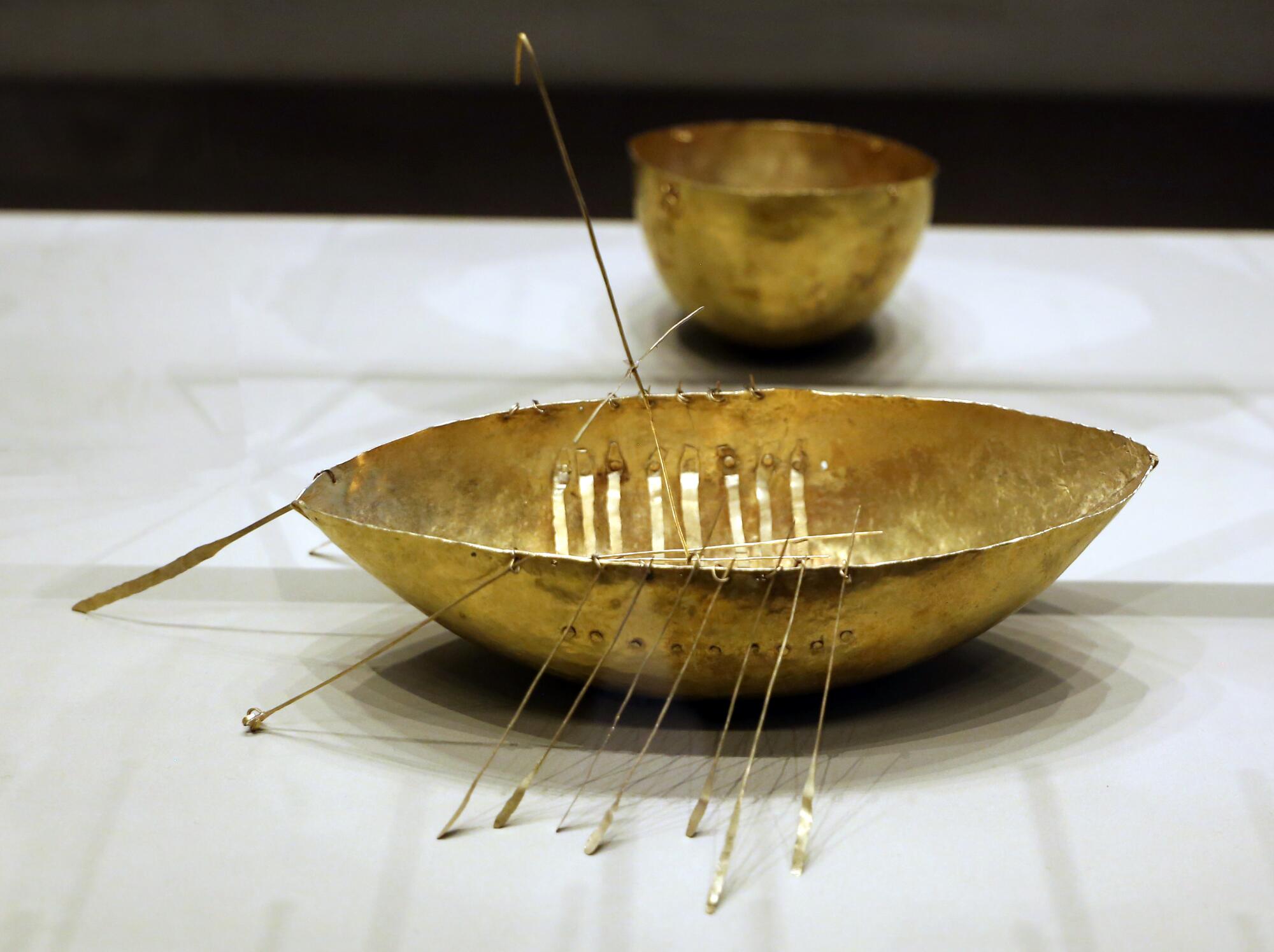
In 1991, the Palazzo Grassi Museum in Venice held an exhibition entitled The Celts: a reflection of one Europe. At the centre of this, displayed on its own darkened room, was the Broighter boat, a tiny gold model of the symbolic of the links between European cultures at the turn of the first millennium.
This miniature boat is made from a thin sheet of beaten gold. Miraculously, it and its delicate gold fittings have survived over 2,000 years. Apparently modelled on an ocean going-vessel of the period, it is an exceptional artwork and yields an important glance into marine culture at the dawn of the early historic period in north-western Europe.
Discovery and Ownership
The boat was discovered as part of a larger hoard of gold in 1896. It was unearthed during ploughing activities about 3kms from the marine inlet, Lough Foyle, at Broighter, near Limavady, Co. Derry. The hoard was buried between 18 and 38cms below the ground surface on what would formerly have been a shoreline saltmarsh.1R.A.S. Macalister, The Archaeology of Ireland, Dublin 1949, 240. ↩ In total, seven gold items were recovered as part of the hoard: the model boat, a small hanging bowl formed from a single sheet of beaten gold, two gold ‘wire’ bracelets, two twisted rod bracelets and a tubular collar decorated with raised snail-shell style bosses, linked by raised curvilinear forms.
Shortly after its discovery, the hoard was acquired by the antiquarian collector and dealer, Robert Day. Some objects in the hoard, including the boat, had evidently sustained damage because of their unearthing by a plough, so Day took them to a Dublin jeweler for repair. The jeweler in question, Edmund Johnson Ltd, specialized in the manufacture of replica and facsimile fine metalwork and was already well known to Day. A member of the firm, J.C. Wallace, repaired items in the hoard and moulds were taken, which were later (in 1902) used to create facsimiles for sale through Edmond Johnson Limited.2Tara Kelly, ‘Commerce and the Celtic Revival: The History of the Irish Facsimile Industry, 1840—1940’. 2 vols (Unpublished PhD dissertation, University of Dublin, Trinity College, 2013), i, 60-61; ii, fig. 26. ↩ It is possible that one of these is represented by the electrotype model of the boat at the Spurlock Museum of World Cultures, in the University of Illinois, Champagne- Urbana.3https://www.spurlock.illinois.edu/collections/search-collection/details.php?a=1916.06.0029AD. Accessed 20.8.2025 ↩
It is unclear exactly what restoration work was required. Robert Cochrane, in his 1902 account of the hoard, described the boat as ‘slightly injured’ by the plough, and noted that a ‘missing portion’ of the boat, a seat (or thwart), was later recovered at the find spot, but sold separately to a jeweler who melted it down.4Robert Cochrane, ‘On Broighter, Limavady, County Londonderry, and on the Find of Gold Ornaments There in 1896’, in: Journal of the Royal Society of Antiquaries of Ireland, 32 (1902), 211-44: 213, 215. ↩ E.R.C. Armstrong provided a little more detail on this, stating that the boat was crumpled beyond recognition on discovery, with the oars and other fittings discovered within.5E.R.C. Armstrong, Guide to the Collection of Irish Antiquities: Catalogue of Irish Gold Ornaments in the Collection of the Royal Irish Academy, Dublin 1920, 26-27. ↩ Although the illustration of the hoard facsimiles in Edmund Johnson’s 1902 catalogue show the boat without mast and oars, these are illustrated by Cochrane, confirming they were part of the original archaeological find.
Once repaired, Day brought the hoard to public attention, exhibiting it at the Society of Antiquaries, London in 1897. Shortly afterwards, the collection of gold objects was purchased by the British Museum for £600 and the first comprehensive description and analysis of them was published in the academic journal Archaeologia.6Arthur Evans, ‘On a Votive Collection of Gold Objects found on the North-west Coast of Ireland’, Archaeologia 55(1897), 391-408. ↩ This proposed a date for the hoard of around the time of Christ.
It was only after the hoard’s purchase by the British Museum that the Royal Irish Academy, learned of the hoard’s existence. Ireland was still under British Rule at the time, and the Academy protested the fact that the hoard had left the country without a treasure trove inquest, for which it was crown agent. The response from London was that the British Museum could not, without an act of parliament, deaccession objects from its collection. The Irish authorities duly petitioned the Westminster Parliament, and a royal commission was established to clarify the relationship between the British Museum, and the provincial museums in Edinburgh and Dublin. It was resolved that in circumstances such as these the British Museum should return, on loan, artefacts of specific ‘national’ significance to the area of origin. However, it refused to send the Broighter hoard to Dublin and in 1903 the attorney general, the agent with oversight of treasure trove legislation, took the British Museum to court over the matter.
What ensued was a long and complicated case. At its heart, the Irish side needed to prove that the hoard had been buried with the intention of recovery, making it treasure trove and the possession of the crown. On the other side, the British Museum needed to demonstrate that it had been either abandoned, ritually deposited or thrown away by its owner, and so was the property of the landowner who was free to sell it to whomever he wished.
Ultimately, the case came down to arguments as to whether the hoard find spot would have been below sea level at the time of its deposit or on the shoreline. The British Museum argued for the former, speculating that at the time of the deposit, the objects were dropped in the sea as a ritual deposit to a Celtic God, so there could have been no intention of recovery. Using arguments based on geological analysis of the find site, the Irish contingent countered that the hoard had been buried on land and was therefore most likely intended to be retrieved, so constituted treasure trove. Although the British Museum’s theory that the hoard represented a ritual deposit is probably true, the judge went with the science and ruled that the hoard should be returned to Ireland.7Law reports- Supreme Court of Judicature, Chancery Division, 1903, vol. 2, London 1903, 598-614; Aideen M. Ireland, ‘The Broighter Hoard: Mythology, Misrepresentation and Mystery’ in: Meg Boulton, Jane Hawkes, Heidi Stoner, eds, Place and Space in the Medieval World, London 2018, 87-102. ↩
The return of the hoard to Ireland in 1906, to the Dublin Museum of Science and Art, allowed for the Irish public to view this important group of ancient objects unearthed on Irish shores, at a time when resistance to British cultural imperialism was growing. The significance of this is not to be underestimated, with the then Director of the Dublin Museum claiming that accession of the objects finally confirmed the institution as a ‘national’ museum, the formal title that it was to adopt in 1908.8Patrick Wallace and Raghnall Ó Floinn, eds, Treasures of the National Museum of Ireland. Irish Antiquities, Dublin 2002, 8-9. ↩
Authenticity
Together with the initial controversy over ownership, the origins and date of the objects in the hoard, including the boat, have also been the subject of much debate. Although the first academic study of the objects had concluded a date for them of c. 100BC---AD100, this was later disputed. Robert Cochrane, writing in 1902 noted the names of two fields adjacent to the find site — ‘church field’ and ‘graveyard field’ — and used these and early medieval textual sources to suggest that the deposit was an early Christian one.9Robert Cochrane, ‘On Broighter, Limavady, County Londonderry, and on the Find of Gold Ornaments There in 1896’, in: Journal of the Royal Society of Antiquaries of Ireland, 32 (1902), 211-244. ↩ This theory was also posited during the court case.10Law reports- Supreme Court of Judicature, Chancery Division, 1903, vol. 2, London 1903, 609. ↩
Further controversy emerged in 1927, when Joseph Raftery, the Keeper of Antiquities at the National Museum of Ireland stated that based on recent investigations, only the collar and torques could be considered Irish. The remainder of objects, he suggested, were more likely to be of Indian origin.11Adolf Mahr, ‘New Aspects and Problems in Irish Prehistory’, in: Prehistoric Society Proceedings 3 (1937), 262-436: 410. ↩ For the next few decades other notable scholars, including the Director of the Museum, Adolf Mahr and art historian Françoise Henry, all concurred that new information confirmed that the hoard was not an authentic Iron Age assemblage.12Françoise Henry*, Irish Art in the Early Christian Period to AD 800*, London 1965, 11, n.2. ↩ The alternative explanation that gradually emerged was that they rather represented objects stolen from a local country house and had been ‘buried under an umbrella’ in the decades preceding its discovery. While no further explanation of this theory was given, the original source of this disclosure was later revealed to have originated from a friend and distant relative of the landowner, and the discovery of an unrelated old umbrella near to the find site.13Barry Raftery, La Tene in Ireland. Problems of Origin and Chronology, Marburg 1984. ↩
The working of gold in Ireland during the centuries before and after the turn of the first millennium was relatively unusual, certainly compared to the Bronze Age that preceded it. In 1970, the hoard was metallurgically tested as part of a wider survey of European pre-historic gold objects.14Axel Hartmann, Prahistorische Goldfunde Aus Europa, Berlin 1970, 98-99. ↩ This revealed that all the objects were made from the same alloy. The metal was 70% gold and 30% silver with small amounts of copper, tin and a trace of platinum. This coincides with other Iron age objects from Ireland and objects from the Rhineland but is different to Bronze Age ornaments. At the time of analysis, it was suggested that the gold was almost certainly imported. Although the potential of an Irish source was later posited, it is now generally agreed that the gold most likely originated from the Mediterranean, probably from Egypt.15S. Briggs, J. Brennan and G. Freeburn, ‘Irish Prehistoric Gold-Working; some Geological and Metallurgical Considerations’, in: Bulletin of the Historical Metallurgy Group 7, No. 2 (1973), 18-26; Richard Warner, ‘Irish Prehistoric Goldwork: A Provisional Analysis’, in: Archaeomaterials 7 (1993), 101-113; Richard Warner, ‘The Broighter Hoard — a Question of Ownership’ in: Gerard O’Brien, ed., Derry/ Londonderry. History and Society, Dublin 1999, 69-90: 81. ↩
Provenance
As the material is imported it begs the question as to where the objects were made. The wire bracelets are particularly unusual, and there is consensus that they are imports, most likely from Roman Egypt. The twisted gold torcs may be an Irish version of a type of Roman torc known in Britain. The collar is the most obviously Irish of the entire assemblage. The shape of the collar is one that is known across Europe in the 1^st^ century BC and is thought to have been used explicitly for ritual use, as an offering to the Gods. 16Barry Raftery, ‘Ireland: A World without Romans’, in: Miranda Green,ed.,The Celtic World, London 1995, 636-53: 644. ↩ However, the distinctive flowing style of the ornament, with curvilinear raised ribs linking snail-shell bosses is known as the ‘Irish boss’ style.
As both the boat and model caldron are unique objects their place of manufacture is harder to pinpoint, however, there is nothing to preclude them having been made of Ireland. It seems likely that they, together with the collar were specially made as part of a ritual deposit. Given that the wire bracelets are imported, and the presence of a boat, it has been suggested that the deposit was made by wealthy traders, possibly as an offering to the Celtic Irish sea-god Manannán mac Lir, either in thanksgiving for a safe return to Ireland, or as an offering to ensure a safe journey, although the possibility of it representing a war ship cannot be ruled out.17Richard Warner, ‘The Broighter Hoard — a Question of Ownership’ in Gerard O’Brien, ed., Derry/ Londonderry. History and Society, Dublin 1999, 69-90: 86-87. ↩
The boat
The boat is very unusual in the context of the Irish Iron Age in that it appears to be a realistic model in a culture in which realism in art was rare. It is made from a single, thin, beaten sheet of gold and measures 18.4 cm in length, 7.6 cm wide and 4.9 cm deep. The sheet was slit at either end to form the stern and bow of the boat by overlapping the slit sides and pinching them together. The structure of the boat was stabilised by eight, originally nine, thwarts — structural cross pieces that form seats for rowers. Small pieces of twisted wire at both ends of each thwart accommodated the delicate oars. The central thwart, which is slightly wider than the others, is pierced to accommodate the mast. There is also a loop of wire at the stern to accommodate a long steering oar. The minute beaten gold fittings found with the boat include the mast with yard (cross-piece to hold a sail taught), a smaller spar (horizonal piece below the yard), three forked bargepoles (poles used to propel a boat against a shoreline or bed of shallow water), a grapnel anchor, the steering oar and fifteen of the original eighteen oars.
Given the level of detailing, it is generally agreed that the model is the representation of a sea-going craft, albeit one interpreted through the eyes of a goldsmith, rather than a boat-builder. Perhaps, as Evans suggested, “a rough representation of the votive class”.18Arthur Evans, ‘On a Votive Collection of Gold Objects found on the North-west Coast of Ireland’, Archaeologia 55(1897), 391-408: 393. ↩ There has been much debate as to whether the hull is intended to represent hide or timber clinker construction (where the edges of planks or plates overlap each other), with current opinion favouring the idea of a hide-covered boat, a precursor to the traditional Irish currach. Based on the typical minimum spacing of thwarts, it is estimated that the model represents a boat of approx. 20m in length. 19Seán McGrail, ‘Celtic Seafaring and Transport’, in: Miranda Green, ed., The Celtic World, London 1995 254-284: 264 ↩ The craft would have been propelled by a square sail, with the spar used to bear out the sail for improved performance, in addition to eighteen oarsmen, nine each side. It was steered by the steering oar at the stern.
Comparative boats
Votive model boats were created by many ancient cultures, including the Egyptians, Phoenicians and Greeks. Typically models made from wood, lead or clay were included with grave goods, symbolic of assisting the deceased on their journey to the afterlife. Of significance in the context of the Broighter boat model, is a small votive golden boat found as part of the 4^th^ century BC grave goods of a Celtic ‘prince’ at Dürrnberg, close to the Celtic Hallein salt mines in the eastern Alps (Moserstein grave 44). Portraying a simple craft with just two paddles it has also been interpreted as a votive to help propel the deceased to the afterlife.20Fritz Moosleitner, ‘The Dürrnberg near Hallein: A Center of Celtic Art and Culture’, in: V. Kruta et al.,eds, The Celts, London, 1991, 167—173: 170-172. ↩
Celtic/ Iron Age boats of greater complexity than the Dürrnberg example are known through illustration. These include depictions on a 1^st^ century AD monument to Blussus, now at Mainz Museum and a 3^rd^ century AD altar from Colijnsplaat, Zeeland dedicated to the Celtic deity Nehalennia, who was believed to protect traders making the perilous journey across the North Sea to Britain. These, together with the archaeological discoveries of long wooden steering oars at Lake Neuchâtel in Switzterland (2^nd^/ 3^rd^ century AD) and Zwammerdam in the Netherlands suggest that the Broighter boat is indeed a bona fide representation of a Celtic vessel. 21Seán McGrail, ‘Celtic Seafaring and Transport’, in: Miranda Green, ed., The Celtic World, London 1995 254-284: 256-57 ↩
The boat as Irish artwork
Because the boat was found in archaeological circumstances and because of its age, it has traditionally been viewed as an archaeological artefact rather than an artwork. As such, it is displayed in a case together with the other hoard items in the National Museum of Ireland, and scholarship on it has tended to focus on what it tells us about seafaring in the Iron age, and the historiography of museology in Britain and Ireland.
Although we lack absolute certainty on what interventions were made in the 1897 restoration of the boat, the object is clearly the work of an exceptional goldsmith. The delicacy of the beaten gold and its pared back aesthetic is particularly appealing to modern sensibilities. As an island nation, Ireland has a long maritime history. This earliest representation of an Irish boat therefore has a resonance representing the feats of Irish seafarers, from St Brendan the Navigator in the 6^th^ century, to the missionary saints and scholars of the 8^th^ -10^th^ centuries; to the more recent mass immigration from Irish shores across the seas to Britain, Europe and latterly America and Australia.
These themes have provided inspiration for a whole generation of Irish artists working in the latter part of the twentieth and twenty-first centuries who have used the Broighter boat as inspiration for their work.
Kathy Prendergast’s Night Ship (1984) for example, is a bronze sculpture that was exhibited with two other Broighter boat-inspired pieces at ROSC 88, used to explore ideas of journey and exile.22Patrick J. Murphy, Rosc 88: The Guinness Hope Store, The Royal Hospital Kilmainham, exh. cat. Dublin1988; Campbell Bruce and Caterine Marshall, eds, Saor 50: Fifty years of Irish Art from the Collections of the Contemporary Irish Art Society, exh. cat.,Dublin 2006, 43, 78. ↩ Irish sculptor John Behan has created several pieces that also reflect the distinctive silhouette of the Broighter boat with its long, protruding oars. Early examples of his work with boat forms including Ghost Boat (2003, Ingram collection of Modern British Art), include themes related to political and economic exile from Ireland, while mor erecent work such as Celtic oar boat (2021) and Broighter boat I-V (2020-2004), provide more direct meditations on the Broighter boat form. Niamh Barry’s 10m long Vessel Scape (2017) which hangs in the lobby of the Irish Central Bank on Dublin’s river Liffey quayside alludes to the materiality of the Broighter boat, together with the idea of trade. 23Elenor Flegg, ‘Lightening Conductor’, Irish Arts Review (2002-), Vol. 34, No. 4, 108-11: 111. ↩
The theme of Barry’s sculpture is also pertinent as the Broighter boat was illustrated on the last IR£1 coin to be issued prior to Ireland switching to the Euro currency. Issued in November 1999 to commemorate the new millennium it was designed by Alan Ardiff and Garrett Stokes. The boat was also used to illustrate the 1990-91 Irish 50p and 52p postal stamps and again in 2017 as one of a series of stamps incorporating photographs of some of Ireland’s 100 best objects’.