Among the treasures of the Chester Beatty Library is the Beatty Rosarium (MS W.99), which is catalogued as a small illuminated codex Rosarium (12.4cm x8.4cm) and is a manuscript on parchment with 106 pages.1https://viewer.cbl.ie/viewer/image/W_099/109/ ↩ This Rosary prayer book made in Bruges c 1540-45, is decorated with thirty-three full page miniatures, attributed to the prominent master of European manuscript painting, Simon Bening (ca. 1483-1561) (fig.1.).2On Chester Beatty as a collector, see C. Horton, Alfred Chester Beatty: From Miner to Bibliophile (Dublin: Townhouse, 2003) and Charles Horton, ‘Illuminating Prayer’, Irish Arts Review Winter 2007, p 168. ↩ It is richly illustrated with the highest level of craftsmanship in miniature illumination and considered a crowning monument at end the long period of the decorated book in Western Europe.3For acquisition, Laura Cleaver “The Western Manuscript Collection of Alfred Chester Beatty (ca.1915-1930)”, Manuscript Studies A journal of the Schoenberg Institute for Manuscript Studies Volume 2 Number (2017), 445-483, p 486, presents information on the Rosary codex as follows: “Not listed in Millars catalogue ‘Rosarium. Acquisition unknown, now Dublin, Chester Beatty Library, W 099 (W MS 122/123/129)”. Eric George Millar TheLibrary of A. Chester Beatty. A descriptive catalogue of the westernmanuscripts., Volume 1 (Graz, T.Quaritch, 1927), 257 ff. ↩ Each of its full-page miniatures was originally captured in vivid colours and designed to appear opposite a prayer to the Virgin Mary.4Judith Anne Testa, The Beatty Rosarium: A Manuscript with Miniatures by Simon Bening, (Doornspijk, 1986), 42-52. ↩ This arrangement facilitated meditation on the proximate prayer and its corresponding image and was thus part of personal devotion. This collection of divine images illustrates the life of the Virgin and the Passion of Christ and except for a single miniature added later, the renowned miniaturist Simon Bening is associated with the execution of each of these images as one of his final surviving masterpieces.5For recent discussion on Simon Bening see Georges Dogaer, Flemish Manuscript Painting in the 15^th^ and 16th Centuries, (transl.AnnaSimioni, Amsterdam, 1987), 171-77. ↩
Revisions to the Beatty Rosarium indicate it was altered in the mid to late sixteenth century with additions of bifolio purple-dyed vellum containing a miniature of Christ and inscription in Spanish. The codex is bound in a Spanish gold-tooled leather binding closing with two brass clasps dated to the mid-late sixteenth century. The reworkings to the manuscript are linked to the period of Holy Roman emperor Charles V (1500-1558) and his son, Philip the II (1527-1598), king of Spain after 1556.6Judith Testa, ‘The Beatty Rosarium reconstructed: A manuscript with excised miniatures by Simon Bening’, Oud Holland, 98 (1984),189-236, points out that Rosarium is briefly noted in R. Dougan, Western Illuminated Manuscripts from the Library of Sir Chester Beatty (Dublin, r g55), no. z8, and in Selected Manuscripts from the Chester Beatty Library (Princeton, 1967), no. 34; and that in both of these catalogues the miniatures arc attributed to Simon Bening. 226. ↩. Added in not long after the completion of the manuscript, the dedication opens the prayer book, calling it a Rosarium which was the name given to such collections of prayers in the sixteenth century. The use of purple stained vellum and the quality of leather binding also implies an imperial patronage.7Horton, ‘Illuminated Prayer’, 168. ↩ Discussions about the text and whether it was written in Spain and if the images were then completed in Flanders, are some of the questions asked of this exquisite codex.
Religious and devotional use
The Rosarium or Rosary, took the form of a non-liturgical prayer in the Latin rite compiled in a particular form of ‘Our Dear Lady’s psalter, dating from 1483 compiled by the Dominican order, comprising prayers of 15 decades of a rosary and 15 mysteries centred on Christ’s life.8Franz William, The Rosary, Its History and Meaning (Benziger, New York, 1961), 56-63. ↩ Appealing to all stages and stations in the Church, the Rosary symbolises a ‘Crown of Roses’.9Eithne Wilkins, The Rosegarden Game:The Symbolic Background to the European Prayer Beads (Gollancz, London, 1969), 106. ↩ A ‘Psalter of Jesus and Mary’, also known as the Dominican Rosary is distinct from the Franciscan or Bridgettine Rosary. In the Beatty Rosarium, the Rosary prayer text and miniatures are interconnected thematically with devotion to the Virgin Mary following the Mysteries.10https://www.preces-latinae.org/thesaurus/BVM/Rosarium.html ↩ This book took the form of a scripture based prayerbook with illustrations meditating on the life of Mary and Jesus Christ. This textual genre refers to a garden or garland of roses, embodying the anthology of brief prayers. In this case a wooden frame, surrounds each miniature, as if a painting, and is a departure from the tradition of the rose garden garlanded surround. While Bening miniatures in other manuscripts often feature elaborate fictive architectural frames, and compare to the trompe l’oeil examples of Ghent-Bruges style borders strewn with flowers, here a simple painted frames surround the images and with this gesture, a purity of line is introduced.11Maryan W. Ainsworth,. “‘Diverse Patterns Pertaining to the Crafts of Painters or Illuminators’: Gerard David and the Bening Workshop.” Master Drawings 41, no. 3 (2003), 241—65. ↩ A version of this simpler frame is also seen in the Capitulary of Philip II of Spain and provides a visual connection to the patronage of the Spanish court and this sixteenth century prayer book.12For Capitulary of Philip II : Escorial Biblioteca del Monasterio , vitr. 2 Libro de horas Felipe II, s.XVI. (Valencia: Patrimonio Ediciones, 1996). 21.5x30.5 cm, 320 pp + commentary. ↩
Structure and thematic illustrations of the book
In Beatty Rosarium, the images were recorded as excised and mounted independently for ease of access and display during the ownership of Chester Beatty and the order of the miniatures are noted in the codex by Eric G. Millar in 1926 (67:f.48r). 13Testa, ‘Beatty Rosarium’, 191-192 and Judith Testa, ‘The Beatty Rosarium (Oud Holland 1984/4); Addendum’, Oud Holland , 1985, Vol. 99, No. 1 (1985), 76. ↩ The separation of the folios has led to some speculation of the arrangement of images of the Rosarium reflected in a thematic sequence. The sequence is accounted as the ‘Joyful, Sorrowful and Glorious Mysteries’ following an assemblage of thirty-one devotions to the Virgin Mary. The textual genre of the Mysteries represented images of Joyful themes: of Annunciation as fruits of mystery and humility; Visitation bringing reference to Love of thy Neighbour, the Birth of Jesus reflected in poverty, the Presentation in the Temple and finding of Jesus in the Temple linked to obedience. Representations of the Sorrowful Mysteries thematically drew on more detailed themes such as the Agony in the Garden, exposing sorrow for sins; Scourging at the pillar as a mortification; the Crowning with Thorns as contempt in the guise of Carrying of the Cross implying patience, with the Crucifixion and Death of our Lord indicating perseverance, leading to the Glorious Mysteries. These were represented as the Resurrection of the Faith, the Ascension giving hope, the Descent of the Holy Spirit bringing true devotion, with the Assumption of the Virgin Mary, as Virtue in the Coronation of the Virgin and finally Pentecost as glorious celebration reflected in Christ’s Resurrection.14https://www.preces-latinae.org/thesaurus/BVM/Rosarium.html ↩
Scholarly reconstructions have taken time to link text and images in an orderly sequence bearing in mind these themes in the Beatty Rosarium. The original text of the Beatty Rosarium consists of a long prayer to God and All Saints (ff.4r-11v) followed by thirty-one devotions each consisting of an Ave Maria or Pater Noster followed by a responsus and short prayer. The subsequent text pages have a facing miniature illustrating an event in the life of Mary or Christ. All the prayers are in Latin, and are found in liturgical books of the Roman Catholic Church and Books of Hours. An addition of a half page miniature Christ (7:f1r) appears to be added to the opening long prayer and provides a model for these kinds of prayer books with comparisons drawn with Prayer Book of King James IV of Scotland in Vienna (Österreichische Nationalbibliothek, Codex Vindobonensis 1897). 15Judith Anne, Testa, “A Book of Hours with ‘Micro-Miniatures’ by Simon Bening,” Oud Holland, 110, no. 1 (1996), 1—11. ↩
Following the added bifolio and the opening prayer, a series of four regular gatherings display a text page and a responsus and prayers to the Virgin (f.13r) which are linked thematically to images of the Immaculate Conception and the Infancy of Christ cycle. The following miniatures refer to Mary’s conception and Mary’s birth and subsequently it follows the miniature of the Annunciation (f.16r) and scene of the Visitation facing a prayer ‘ad visitationem Elisabeth inspirasti’. The image order is discussed by the Beatty scholar Testa, who matches image and text with biblical descriptions of Christ’s Nativity, Christ among the Doctors, the Octave of the Epiphany and coinciding commemoration of the Baptism. 16Testa, ‘Beatty Rosarium’, 193-197. ↩ Text and image are interleaved with prayers from first Sunday in Lent which offers resistance to Temptation. The following thirteen miniatures and facing prayers concerned Passion Cycle with the Entry into Jerusalem and the Last Supper and are linked to prayers from the Liturgy of the Feast of Corpus Christi. The references to suffering and agony of Christ naturally follow the text, and Judas and the Arrest of Christ are portrayed together, then Christ before Sinners and Bloody men. Subsequently it follows that Christ before Pilate, Christ before Herod, the Flagellation, the Crowning of thorns and Ecce Homo are celebrated in the Glorious phase with Pentecost to complete the series. Other texts are from Catholic liturgy are added in at the final stages.17Testa, ‘Beatty Rosarium’, 189-236, for full exposition on the order of the Rosary. ↩
Miniaturist Simon Bening (ca. 1483-1561)and Artistic Inspirations
The renowned miniaturist Simon Bening was part of the family of illustrators under the tutelage of his father, the illuminator Alexander Bening, identified with the Ghent—Bruges School producing manuscript illuminations with a distinctive style from about 1475 to about 1550. 18James Weale, ‘Documents inédits sur les enlumineurs de Bruges’, Le Beffroi. Arts, Héraldique, Archéologie, IV,(1872-1873), 253-257. ↩ Bening established a workshop in Bruges and became known by reputation and a member of the Guild of San John and Saint Luke in Bruges as an illuminator in 1508, serving as Dean on several occasions. 19Grove Dictionary of Art : Bening Simon https://www.oxfordartonline.com/groveart/search?siteToSearch=groveart&q=Bening&searchBtn=Search&isQuickSearch=true accessed August 12^th^ 2025. ↩ In a powerful depiction in his Self-Portrait (Robert Lehman Collection Met. Museum NY 1975.1.2487) dated to 1558, Bening is dressed as an intellectual rather than an artist with spectacles in hand, seated before a wooden easel. 20https://www.metmuseum.org/essays/the-book-of-hours-in-medieval-christianity accessed August 12^th^ 2025. ↩ The device of the view through a window depicts a lightly painted background of an urban scene of rooftops along a skyline. A drawing of the Virgin and Child is underway on the easel and Bening signs himself as son of Alexander linking himself to the illuminator of established lineage.
Bruges was a centre of book production widely circulated spurred on by growing international aristocratic book trade and collectors. Patrons included Cardinal Albrecht of Brandenburg for whom Bening produced his earliest known work in 1521 (Los Angeles, CA, Getty Mus., MS Ludwig IX, 19). 21https://www.getty.edu/art/collection/object/103RVF accessed 12 August 2025 and Alfons. W Biermann, ‘Die Miniaturenhandschriften des Kardinals Albrecht von Brandenburg,’ Aachener Kunstblätte 46 (1975): 15- 310. ↩ Bening specialised in Books of Hours in miniature on painted panels with illusionistic picture frames creating devotional panels. Books of Hours demonstrate considerable flourish in the detail: while Calendars in Books of Hours lent themselves to depictions of landscape illustrations such as in the Hortulus animae (Vienna Osterrich, Nbib., Cod, 2706). 22Judith Anne Testa, “A Book of Hours with ‘Micro-Miniatures’ by Simon Bening.” Oud Holland 110, no. 1 (1996), 1—11. ↩
Bening’s technique of refining the figures in his miniature illustrations styled with detailed borders is innovative. As was his use of the variation of pastel shades posed with strong colours, shades of greens and blues in contrast, created a verisimilitude in his figures. In his depiction of landscapes he defined depth, conveyed by overlapping motifs, from the skyline of a town to ranges of foothills and watercourses, giving an impression of a recession leading towards far away hills. His use of colour in the rich greens fields mirrored with dabbed blue skies created a wondrous atmospheric effect, which led him being mentioned by Vasari, who praised his ability to paint landscapes on the smallest scale.23Vasari 1927, 4:254. ↩
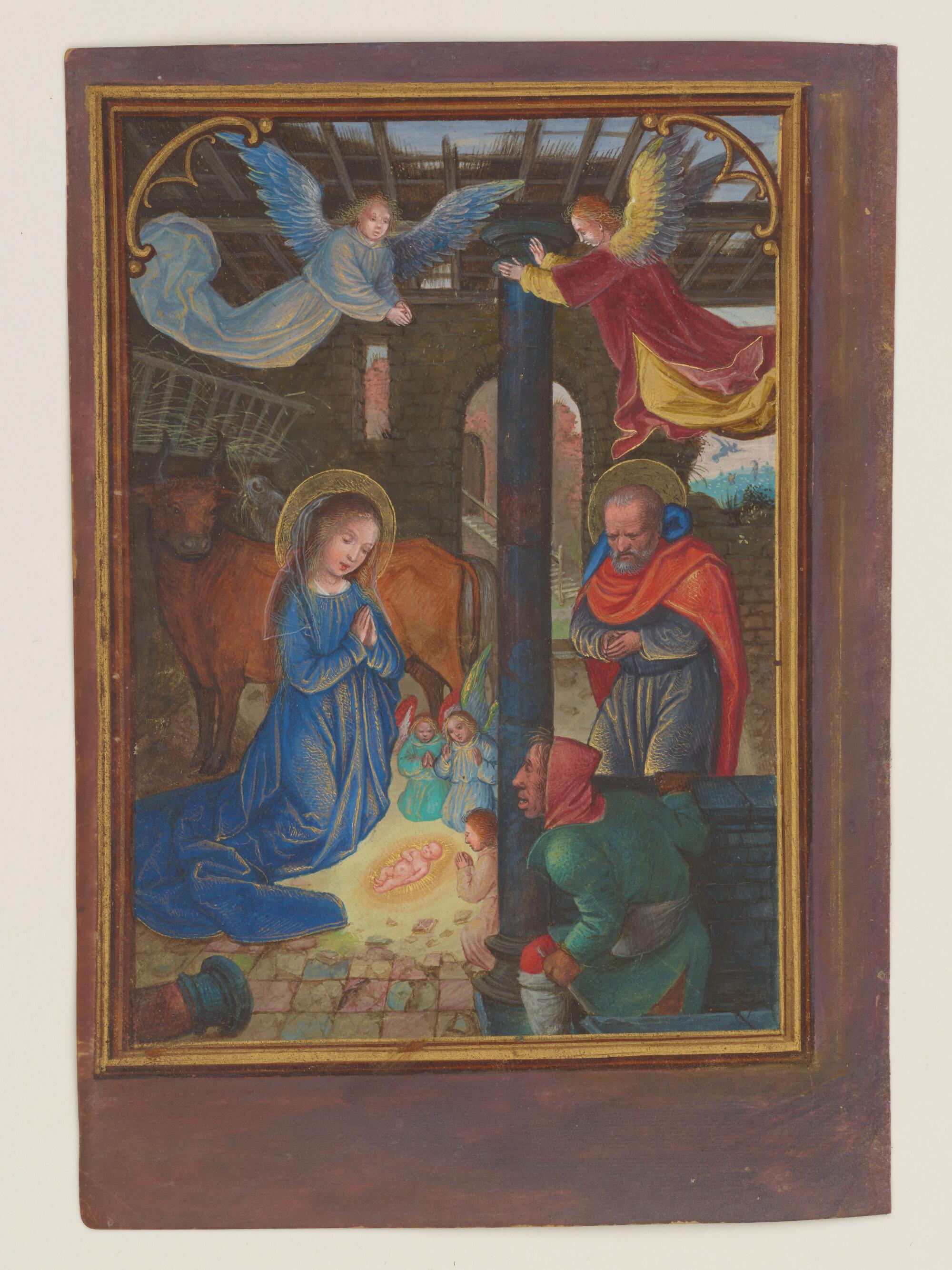
The Beatty Rosarium illuminations focus on the three Mysteries of the Rosary: examples cited here are the Birth of the Virgin (ff.13 v) contrasted with the Nativity of Christ (ff.18v) (fig.2). The close attention to detail and dramatic effect with an off-centre column in the Nativity divides the scene: the new born child is showered in a divine radiant light at the centre of the image, as the animals envelop the Virgin. The animals face opposite ways, an early Christian device, to depict both acceptance and rejection of faith. This contrasts to the scene of the Birth of the Virgin as Saint Anne reclines in an emerald green bed with three angels present clasping their hands in joy, signifying the religious aspect of the scene. The illuminations depict a peaceful scene of confinement in contrast to the imagery of a ruined stable with cracked tile floor which at the same time serves to draw the reader into the sacred atmosphere of divine framed miniature scene.
The Beatty Rosarium, depicts the Presentation in the Temple (1.22r) (fig.3), at the moment when Joseph and Mary brought the Infant Jesus to the Temple and Simeon devoted priest of Jerusalem, reaches out to accept the Christ Child. Joseph carries two turtle doves in a basket and a torch flares light onto the scene. Their robes contrast the deep blue of the Virgin’s tunic which is placed at the centre, as the priest Simeon kneels in a gesture of devotion. The background scene depicts a late Gothic chapel brightly lit with clear glass lancet windows, and draped with green draperies to create a setting viewed through a wooden frame. The lined tiled floor draws the reader into contemplate the scene. The purple painted boarder acting as a foil to the whole composition.
The Beatty Rosarium scene is compared to two other similar scenes modelled on the same moment in time, with certain adjustment and refinements in details of the settings: Presentation in the Temple c 1525-30, Getty Collection Ms. Ludwig IX 19 (83.ML.115) , fol 43v, depicts Joseph and Mary bringing Infant Jesus to the Temple where Simeon priest of Jerusalem reached out to accept the child.24https://www.getty.edu/art/collection/object/103S85 accessed 12 August 2025 ↩ The blue of the Virgin’s cloak is strongly contrasted by the pale blue of the robe of elder priest Simeon. Striking is the depiction of the Gothic cathedral behind reminiscent of St Salvator’s Cathedral, Bruges, which is a more clearly defined representation in architectural detail of the background setting. Joseph holds two turtle doves and the atmospheric scene is heightened by the blue smoke rising from a candle. The Holy Spirit is recorded in the inscriptions along the border as text and image are entwined together.
The Beatty Rosarium is also compared here to the Presentation in the Temple of the Bening Rosary Psalter in parchment folio from the collection of the Fitzwilliam Museum, Cambridge (MS 257a). The scene is set by a small red dog in the foreground. Here a strong blue is used for the robe of the Virgin is contrasted to the pale blue of the robe of the elder priest Simeon, and the backdrop setting is of a more generic Flanders type of Late Gothic church. The scene is situated between limestone columns, drapery and a wooden frame. The attention is centred on the diminutive figure of the Christ Child. Dated to c. 1525 it provides another variation and is a comparative stylistic composition for the Beatty Rosarium.
The Beatty Rosarium miniature of Pentecost (f 42 v) is the finely wrought and presents a close up of the momentous occasion of the Holy Spirit descended on the followers of Jesus Christ in form of a dove (fig.3). It is a study in luminosity, as gold leaf radiates from the dove as a crowd of haloed faces look aloft in wonder. Mary is at the centre of the picture with hands held up in prayer, her face is an exhibition of the sorrow of her loss, as her gaze faces forward. It is asserted Bening acquired his familiarity through prints and engravings of works of Renaissance artists. There is a noted inspirational approach from the art work of the miniatures from the Ghent-Bruges School and elements of naturalism of the Flemish panel painters such as Hugo van der Goes, with engravings by Albrecht Durer, Jacob Cornelist and Martin Schoengauer also providing source material for Bening.25Horton, ‘Illuminating Prayer’, 168. ↩ The oeuvre of Bening created a setting rendered with illusionistic space.26Elizabeth Leesti, ‘A depiction of Saint Sebald of Nuremberg by Simon Bening’, in Oud Holland, 105 (1991), 116-126. ↩ His figures were constructed with loosely flowing drapery and softly modelled facial features. The intimacy of the scene offset with late Gothic detailing combined with Renaissance naturalism is a signature of his style. In the Beatty Rosarium, he captures detail and compositional motifs in the spirit of Renaissance art, leading to speculation that he was familiar with and used motifs and imagery of the High Renaissance engravings rather than specific models in this commissioned work.27Judith Anne Testa, ‘Simon Bening and the Italian High Renaissance: Some Unexplored Sources’, in Oud Holland, 114 (2000),107-124. ↩
Comparative Analysis and Spanish-Flemish Artistic Connections
Sixteenth century Flemish artists workshops transmitted new models and compositions as the art market trade strengthened ties between Spain and Flanders, providing artistic commissions and exchange. Little correspondence about such commissions survive highlighting the importance of the additional visual evidence of the panel painted altarpieces correlated to manuscript illuminations, to provide contextual information about workshops and patronage.28Ana Diéguez-Rodríguez, ‘The artistic relations between Flanders and Spain in the sixteenth century: an approach to the Flemish painting trade’, Journal for Art Market Studies 2 (2019), 1-17. ↩ The Flemish influence and impact of miniature illumination is considerable and can be observed on certain altarpieces in Spain with Flanders connections. The example of Large Retable of Sant Francesc, Iglesia de Jesús del Mare de Deú, near Santa Eulària des Riu, Balearic Islands, Spain, is cited here (fig.4). 29Luis Ramoveres Blasco, ‘Los cuatrocentistas valencianos, el Maestro Rodrigo de Osona y su hijo del mismo nombre’,Cultura española, no. 9 (febrero 1908), 139-156. ↩ A visual devotion to the Virgin Mary, this was commissioned by the Dominicans, from the Valencian family of painters Don Rodrigo de Osona and his sons, Francisco and Jerónimo, in early sixteenth century.30A. V. D. P. “Notes on Some Early Spanish Masters.” The Burlington Magazine for Connoisseurs, vol. 13, no. 63 (1908), 155—56. ↩ The Virgin Mary’s portrait occupies the centre, painted with Flemish influences of the Ghent-Bruges School in the naturalistic stylistic renderings.31Luis Ramoveres Blasco, ‘Los cuatrocentistas valencianos, el Maestro Rodrigo de Osona y su hijo del mismo nombre’,Cultura española, no. 9 (febrero 1908), 139-156. ↩ As a devotional work of art for the Virgin, the predella, or lower edge, demonstrates the different stages in the life of the Virgin Mary: Annunciation, Nativity of Christ, the Adoration of the Three Magi, Resurrection, Ascension, Pentecost and the transition of Mary. The main subject is the Virgin Mary nursing her son and showing one breast, as a bird at her feet with a coral collar in its beak symbolises temptation.32The commission and detailing of this magnificent work is an example of this complex subject and the network it created Diéguez-Rodríguez, ‘The artistic relations between Flanders and Spain’, 16-17. ↩ Gothic-Flemish stylistic details appear in the elongated figures set within Renaissance innovations of naturalistic scenes of perspectival landscapes. Dominican iconography with Franciscan elements is notable in additional panels, depicting St Francis of Assisi’s dream of Jesus supported by four unusual, red-winged angels which is a departure in medieval iconography. Other panels feature St Anthony of Padua and the miracle of St Gregory, with St Mark and St Peter. The entire altarpiece is framed by the dust cover with a number of smaller panels, paintings of St Sebastian, St John the Evangelist, St Catherine of Alexandria, and St Roque.33 ↩
Such richly decorated altarpieces demonstrate the prevalence of text and prayer as the devotional model in the sixteenth century, as painted altarpiece panels, were infused with order of service from Books of Hours. The Rosary also provided a non-liturgical source for the portrayal of the devotion of the Virgin Mary. The portable nature of manuscripts provided details, copied to create panel painted altarpieces, representing a fusion of Netherlandish styles with a knowledge of Renaissance naturalism.
Patronage of the Spanish Court
After the Beatty Rosarium changed hands early in its history, the Spanish inscription points to an owner connected to the Iberian Peninsula: The leaves added at the beginning and the end of the book were written on purple-dyed parchment, complemented by an inscription in Spanish recording that the manuscript was once owned by a king. This has been linked to Charles V (1500-1558 reigned until 1556) and to Philip II of Spain (1527-1598). Unique margins painted in a regal purple, underline this connection (29:f.13r). The script is a large and elegant formal Gothic Rotunda particularly found in sixteenth century manuscripts of Spain and Portugal. 34Testa, ‘Beatty Rosarium’, 189-236. ↩ The Book of Hours of Philip II, highlights these elements of Spanish book illumination and the Capitulary, prayer book of Philip II, the script and collection of prayers, psalms, hymns was organised in the fashion of structured devotional practice of monastic orders.35James H.Marrow, ”Simon Bening in 1521:A Group of Dated Miniatures,’ Liber Amicorum Herman Liebaers, Brussels, 1984, 537-59, esp.557-595. ↩ The notable commission of the Bening master of miniature illuminations points to an imperial patron with Spanish- Flanders. Also added at that time were a miniature of Christ and a prayer in an Antigua script (Humanistic Minuscule). The binding, perhaps not original, is a wonderful example of sixteenth-century courtly Spanish bookbinding and features elaborate gilt tooling.36Frederick B Adams, ‘The Baltimore Exhibition of the History of Bookbinding’ The Burlington Magazine, Vol. 100, No. 658 (Jan., 1958), 22-25. ↩ The confluence of stylistic elements of formal Spanish script and sumptuous Flemish miniatures, with a profusion of symbolism embedded in each image, multi-textured layers depicting pictorial landscapes, balanced poses, shimmering embroidered robes, and richly articulated architectural interior details indicates the completion of the miniatures at the highest level of mastery at a Flemish artistic workshop, emphasising the global nature of these sixteenth century artistic practices between Flanders and Spain. 37Judith Anne, Testa, ‘Fragments of a Spanish prayerbook with miniatures by Simon Bening’, in Oud Holland, 105 (1991), 89-115 and Judith Anne, Testa, ‘Addendum: Fragments of a Spanish Prayerbook with miniatures by Simon Bening’, in Oud Holland, 106 (1992) , 32. ↩
Later Provenance and Chester Beatty Library
Later Provenance of the Beatty Rosarium is detailed by notes and glosses to the book (5:f.ii-r) in the frontispiece by seventeenth-century owner Corfitz Ulfeldt (1606-1664), who was a leading official at the court of King Christian IV of Denmark. An inscription commemorates his presentation of the book as a gift to Carl Gustav Wrangel (1613-1676), whose daughter’s marriage to Ernst Ludwig von Putbus (1649-1702) is recorded in the book (103:f.iii-r). The codex was secured later by the great bibliophile Alfred Chester Beatty (1875-1968) who bequeathed his substantial collection to the Irish nation and is housed in Dublin Castle in the Chester Beatty Library.38Cleaver, “The Western Manuscript Collection of Alfred Chester Beatty”), 486. ↩ The Beatty Rosarium is the posited as the last of this format of miniature manuscript illumination after a long tradition of book decoration, solely in the hand of the master illuminator Bening.39Sandra Hindman with Laura Light and Matthew J. Westerby, Simon Bening and the Enríquez de Ribera Prayerbook (Les Enluminures Paris, 2021), 13-31. ↩ All but one on the images are in a consistent style and are of extraordinarily fine quality, originating in Flanders (Belgium) ca. 1540.40https://www.metmuseum.org/essays/the-book-of-hours-in-medieval-christianity accessed August 12^th^ 2025. ↩ It is a unique combination of text and miniature image in of this art form which bridges the traditions of late Gothic artistic trends of representation in text and layout combined with artistic reference to Renaissance source material in the miniatures, which provide a connection to the Flemish artistic workshops and Spanish patronage and is a celebrated masterpiece of European art.41Testa ‘The Beatty Rosarium’, 197. Refers to Millar’s notation and original collation of the Virgin and Child miniature at the end of the book. ↩