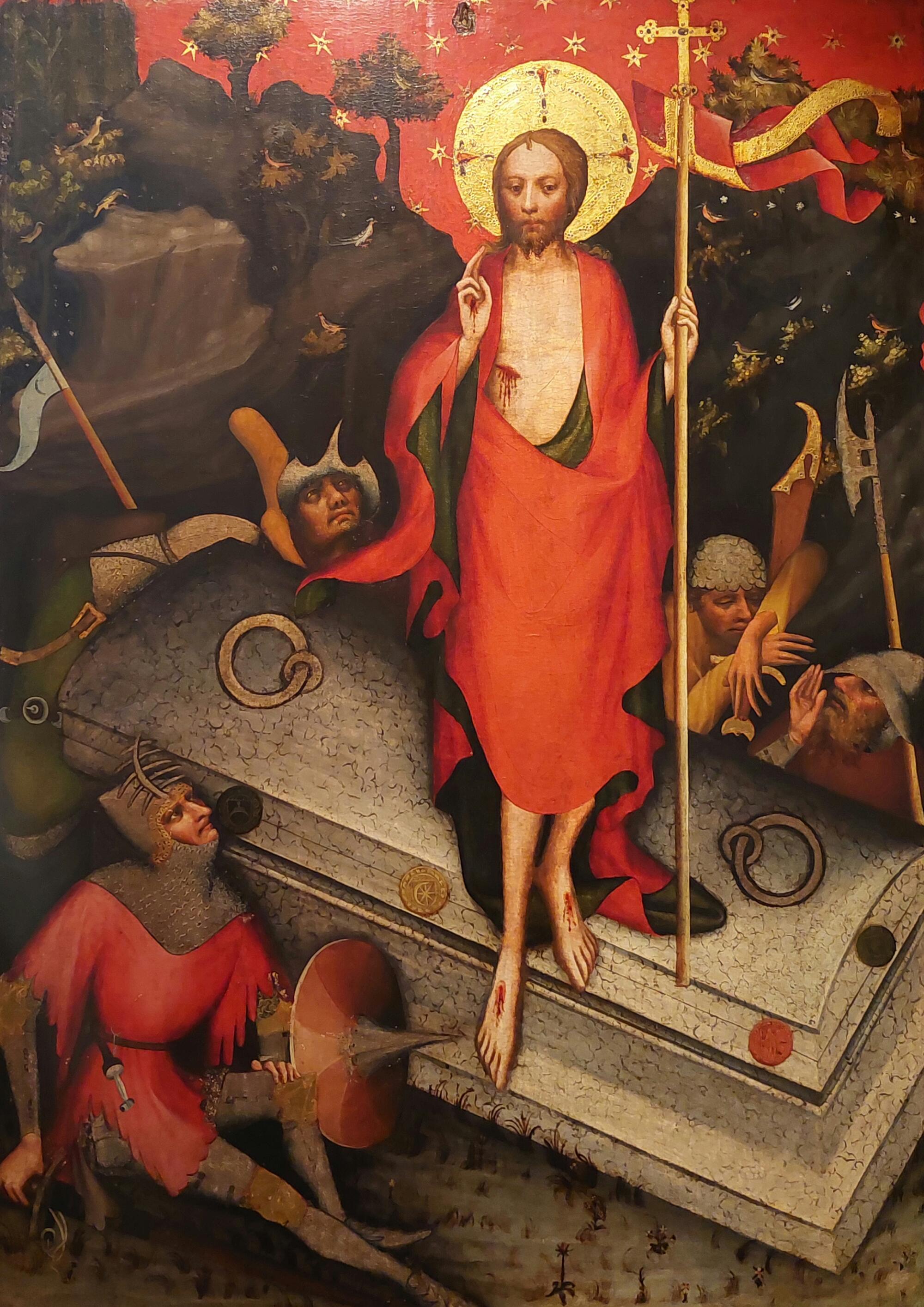
When in 1378 the Czech king and Roman emperor Charles IV died, he left to his son Wenceslas the lands of the Bohemian Crown in a state of economic, political, social and cultural consolidation. Thanks to Charles’s skilful domestic and foreign policy, and a fortunate concurrence of circumstances (for example, the Czech lands had been spared the devastating plague of the mid-century as well as serious climatic fluctuations and the accompanying crop failures), a long period of relative peace had enabled the flourishing of significant architectural and artistic projects.1The reign of Charles IV, with an emphasis on hispatronage of the arts, has been thoroughly examined since 2000, particularly intwo major exhibitions curated by Jiří Fajt: Barbara D. Boehm and Jiří Fajt, eds.,Prague: the Crown of Bohemia 1347–1437,New York, New Haven and London 2006; Jiří Fajt, ed., Karl IV.: Kaiser von Gottes Gnaden: Kunst und Repräsentation des HausesLuxemburg 1310–1437, München 2006; Jiří Fajt and Markus Hörsch, eds., Kaiser Karl IV.: 1316–2016, Prague 2016. ↩ Favourable conditions for the development of culture and art were also supported by a cooperative relationship between secular and ecclesiastical power. Prague archbishops Arnošt of Pardubice and Jan Očko of Vlašim were close collaborators and partners of Charles, especially in the building and decoration of the Prague cathedral and coronation church dedicated to the country’s patrons St. Vitus, St. Wenceslas and St. Adalbert.2Prague bishops and archbishops as patrons of the artsin the Middle Ages are presented collectively (with extensive references toolder literature) in: Jiří Kuthan: Pražštíbiskupové a arcibiskupové: zakladatelé, stavebníci a objednateléuměleckých děl (973-1421), Praha 2023. ↩
As a consequence, the final quarter of the 14th century belongs among the most remarkable periods in the history of art in the Czech lands. Wenceslas IV did not follow in his father’s footsteps in supporting grand public representational projects—he did not, for instance, substantially engage in the continuation of the cathedral’s construction. His artistic patronage was instead expressed above all in the spheres of castle architecture and, especially, book illumination. Shortly after Wenceslas’s accession to the throne, Jan of Jenštejn, nephew of his predecessor Jan Očko, Charles’s last chancellor and close collaborator of the new king, was elected archbishop of Prague. The symbiosis between secular and ecclesiastical authority, however, began to unravel by the mid-1380s and culminated in open rupture, ending with Jan of Jenštejn’s abdication and his departure into Roman exile in 1396.3Jaromír Homolka, “Johannes von Jenczenstein undder Schöne Stil”, in: Anton Legner, ed., Die Parler und der schöne Stil1350–1400: europäische Kunst unter den Luxemburgern. Vol. 3. Ein Handbuchzur Ausstellung des Schnütgen-Museums in der Kunsthalle Köln, Köln 1978, 35-39. ↩
Jan of Jenštejn was among the foremost patrons of the Augustinian Canons, who in the Luxembourg era enjoyed a prominent position in the Bohemian lands and favour not only from the ecclesiastical hierarchy and the monarch, but also from leading noble families. The order had been introduced into Bohemia by the last Prague bishop, Jan IV of Dražice, who in 1333 founded an Augustinian monastery in the episcopal town of Roudnice nad Labem. This became the mother house of further canonries: the archiepiscopal foundation of Arnošt of Pardubice in Kłodzko, and the imperial foundation at Prague’s Karlov. From Roudnice, too, came the community for the monastery founded in 1367 by the brothers Jošt, Petr, Oldřich and Jan of Rožmberk beside the older parish church of St. Giles in Třeboň.4Jaroslav Kadlec, Klášteraugustiniánských kanovníků v Třeboni, Praha 2004. ↩ Since the 13th century, the Rožmberks had belonged to the most powerful noble families in the kingdom, administering vast estates in southern Bohemia. Although family members frequently held high ecclesiastical or courtly offices (of the brothers mentioned above, Jošt served as High Chamberlain of the realm, while Petr was provost of the All Saints’ chapter at Prague Castle), their relationship with the ruling Luxembourgs was marked by rivalry and competition, even leading to minor local wars with Charles IV in the 1360s. The establishment of an Augustinian canonry in one of their residential towns thus had symbolic and representational significance, affirming the Rožmberks’ relevance politically, socially and spiritually. Alongside the cultivation of modern spirituality, focused on interiorising the experience of personal faith and private devotion, the Augustinian Canons also excelled in their support for progressive artistic forms. Their Roudnice monastery, in close cooperation with the archbishop, became one of the epicentres of artistic innovation in the Bohemian lands throughout the 14th century. The daughter house in Třeboň likewise favoured the most up-to-date architectural forms (its new monastic church was built as a two-aisled hall with an impressive vault employing tripartite radial motifs) and sculpture (the church still preserves one of the sandstone statues of the so-called Beautiful Madonnas, whose origins lie in the cathedral workshop led by Peter Parler).5Taťána Petrasová and Rostislav Švácha, eds., Art inthe Czech Lands 800–2000, Praha 2017, 214–216, no. I/57 (authors KláraBenešovská – Kateřina Kubínová). ↩ It is therefore no surprise that in these two Augustinian monasteries we encounter the work of one of the greatest painters ever active in the Bohemian lands: the Master of the Třeboň Altarpiece, an anonymous artist identified by art history with the help of the name of his most highly valued work.6The last monograph devoted to the painter was writtenby Jan Royt, whose publication contains references to all relevant olderliterature in Czech, Germany, and—unusually—English: Jan Royt, The Master of the Třeboň Altarpiece,Prague 2015. ↩
The ensemble known in the literature as the Třeboň Altarpiece now consists of three tall-format panels measuring c. 132 × 92 cm. On one side they feature Passion scenes against a red starry ground (Christ on the Mount of Olives, the Entombment and the Resurrection), and on the other, set against a gold ground with architectural framing, three groups of figures representing saintly categories: the virgin martyrs Catherine, Mary Magdalene and Margaret; the confessors and patrons of the monastery and order—St. Giles, Augustine and Jerome; and the apostles James the Less, Bartholomew and Philip. The paintings were discovered in the second half of the 19th century in two small chapels in the woods around Třeboň: the panels with the Mount of Olives and the Resurrection in the chapel of Mary Magdalene called “Na poušti” (“In the Desert”, originally a hermitage), and the panel with the Entombment in a chapel in Domanín. All three paintings were successively donated to the Picture Gallery of the Society of Patriotic Friends of Art, predecessor of today’s National Gallery in Prague, where they are preserved as key works in the Collection of Old Masters.7Štěpánka Chlumská, ed., Bohemia & Central Europe 1200–1550: the Permanent Exhibition of theCollection of Old Masters of the National Gallery in Prague at the Convent ofSt Agnes of Bohemia, Prague 2014, 43-48, 146, no. 41. ↩ Given their dimensions, iconography, composition and colouring, it is beyond doubt that they represent three panels from the original double-sided wings of a single altarpiece, of which the fourth panel (from the right wing) and the central section have not survived. The latter might originally have been a painted panel—either a large square or two elongated panels one above the other, as in later altarpieces from Rajhrad or from Graudenz (Grudziądz) in Prussia. Another possible form would have been a carved shrine, with either life-size or smaller figures in two tiers.8Other configurations are also conceivable, such as alarge statue of the Virgin Mary in the centre and smaller statues of saints intwo rows above each other on the sides (the Silesian Viereraltar type), or arow of reliquary busts and a row of carved figures, as is the case with thecontemporary “Czech” altar in Brandenburg. Possible reconstructionsare examined in detail by Royt (2015), 132-149. ↩ Alongside individual saints, the most probable subject would have been a Calvary.
The earliest literature from the late 19th century had already concluded that such a precious, supremely accomplished and large-scale altarpiece could not have been intended for any of the small chapels where the panels were found (in the case of Domanín demonstrably of early modern origin),9The oldest references to the Třeboň tablets arereliably recorded and summarized by Antonín Matějček and Jaroslav Pešina, Gothic Painting in Bohemia 1350–1450,Prague 1956, 39–44, 55–56, no. 169-174. ↩ but must have come from the Augustinian monastery in Třeboň.10A more vocal opponent of the existing hypothesesregarding the location and reconstruction (and dating) of the altar, or altars,is Eva Kolářová, whose opinions are based on a thorough analysis of sources anda critical reading of older authoritative texts. However, her ownart-historical conclusions are highly debatable: Eva Kolářová, “Třeboňskýoltář: dva retábly Třeboňského mistra”, in: Jihočeský sborník historický 77–78 (2008–2009), 137-191. ↩ During the radical Baroque transformation of the monastery church interior at the beginning of the 18th century, an inscription was found in one of the altars stating that relics of Mary Magdalene and other virgin saints had been placed in an altar consecrated in 1378 in honour of Mary Magdalene and St. Augustine.11Anno Domini MCCCLXXVIIIconsecratum est hoc altare a venerabili fratre Wenceslao Nycopolensi episcopo,et hae reliquiae, videlicet sanctae Mariae Magdalenae et aliarum ss. virginumet viduarum, continentur incluse; titulus vero s. MariaeMagdalenae et s. Augustini annotatur. Joseph Neuwirth, Geschichteder Bildenden Kunst in Böhmen,I.Band, Prag 1893, 462, note 2. ↩ Linking this report with the surviving parts of the altarpiece is not without difficulties: among them the fact that the titular saints would then not have appeared in the central section but on the wings, and the presumed size of the reconstructed altarpiece would suggest a high altar, where we would expect the church’s patron saint, St. Giles, to occupy a more prominent position than on a wing with the Entombment.
A distinctive feature of the painter’s style—closely connected with the departure from the narrativity, monumentality and objectivity of mid-14th-century art under Charles IV—is that the Passion scenes on the outer sides of the wings have a strongly devotional and cultic character. The subject matter is extracted from the continuous story of the Passion and presented to the viewer with powerful emotional immediacy, inviting meditation, shared experience and imitation of the Saviour in his exemplary life, suffering and death. To this purpose the expressive means are adapted: large, yet ethereal human figures seem to float before backgrounds of tonally subdued, dramatic landscapes. Their individual architectural elements, always composed on a pronounced diagonal, frame and highlight the positions of the depicted figures. The dynamic tension is further heightened by the interplay between the otherworldly, sensuous ideal beauty of the saintly figures, and the observed realistic detail that animates the landscape (vegetation, rock formations, even the precisely rendered individual species of birds). Alongside the grandeur and meaning of the compositions, the Master of the Třeboň Altarpiece’s most consummate artistic means is undoubtedly colour, which he employed formally and expressively to the very limits of perfection. Exceptionally refined are the dramatic colour combinations and harmonies, often exploiting the vivid “Passion” red of cloaks, echoing the background colour and contrasting with the muted brown-grey tones of the surroundings. Equally fascinating is the handling of light, which dematerialises both figures and volumes. Technically, the demanding and sophisticated method of layered painting is here exploited to its fullest, with the final chromatic effect—in flesh tones as well as in draperies—achieved through multiple superimposed layers of differently translucent pigments bound in varied media.12The originality of the Třeboňmaster’s approach is evidenced, for example, by the fact that some of the lowerlayers of pigments are bound with oil, while the upper layers are tempera,which completely reverses the usual practice of applying the most-oily pigmentas the top layer. Adam Pokorný, “Appendix: The Master of the TřeboňAltarpiece’s painting technique”, in: Royt (2015), 241. ↩ The resulting colour and its optical properties—sfumato, luminosity, inner radiance—are thus the cumulative outcome of as many as seven layers in some areas, as technological analysis has revealed.13Jan Klípa, “Třeboň Altarpiece”, in: HelenaDáňová and Štěpánka Chlumská, eds., What theEyes Cannot See: Underdrawing in 14th–16th Century Panel Paintings from the Collectionsof the National Gallery in Prague, Prague 2017, 94-99, no. 9; Adam Pokorný, “Appendix:The Master of the Třeboň Altarpiece’s painting technique”, in: Royt (2015),237-247. ↩
The impression of gazing into the heavenly sphere is heightened on the panels with saintly figures by the abundant use of decorative techniques. In addition to gilding and the lavish, minutely executed punchwork applied on all three panels, the painter’s mastery and imagination are displayed above all in the richly adorned, luxurious cope of the order’s patron, St. Augustine. Its ground is made of so-called Zwischgold (“part-gold”), produced by beating out a gold leaf onto a thicker silver foil. This is then covered with a layer of lead-tin yellow. Using the sgraffito technique, a profuse floral ornament was scratched freehand into this layer, without the aid of a stencil. The modelling of the cope and the folds of the drapery were finally completed with a translucent glaze of greenish and brownish lazure.14Jan Klípa, “Třeboň Altarpiece”, in: HelenaDáňová, Štěpánka Chlumská and Radka Šefců, eds., For the Eyes to Admire: Decorative Techniques in Medieval Painting andSculpture, 14th-16th centuries, Prague 2017, 100-105, no. 9. ↩
The panel with the Resurrection of Christ ranks among the best-known works of Czech art as a whole, and it is regularly reproduced even in surveys of European art history. It is, indeed, the very essence of the painterly virtuosity of the anonymous master. The composition, which directs the viewer’s attention naturally yet unfailingly towards the central figure of the Risen One, is framed by two rocky outcrops that leave just enough of the Passion-red ground visible to reflect the iconographic heart of the scene – the vera icon of Christ’s face, set against a richly decorated cruciform nimbus. The diagonal of the tomb chest is here subdued in favour of the strong vertical of Christ’s figure, positioned on the golden section, which stands like an exclamation mark that punctuates all (originally four) Passion panels. The radiant victorious purple of Jesus’ robe corresponds to the background and reverberates against the muted palette of the upper half, as well as against the lightened lower part of the image. Through this modulation the painter intuitively mastered a light-based perspective, and by bringing the space of this profoundly symbolic scene closer to natural realism (in addition to numerous perfectly observed details), he achieved a remarkable effect. Standing out from this realism, however, is the ethereal central figure, as if floating in another dimension, bound to the earthly realm only by the corner of the robe which, unlike the Saviour’s feet, naturally comes to rest upon the marble tomb chest. Conversely, the impression of the here-and-now, in which eternity breaks through at the very moment of the Resurrection, is deliberately accentuated by the ring of guards who look on uncomprehendingly at the salvific event. This ring is interrupted in its foreground, drawing the viewer into its space. In this way the beholder becomes a direct participant in the miraculous scene depicted.
The Master of the Třeboň Altarpiece was, of course, well equipped to respond artistically to iconographic innovations reflecting the wishes of the patrons and formulated by a theologically trained conceiver. In the Resurrection panel this is evident above all in the detail of Christ rising from a closed, sealed tomb—a motif rare in earlier art, but which from the late 14th century onwards became widespread, a development in which the Třeboň Altarpiece clearly played a part. The origin of this motif can be sought specifically in Augustinian spirituality—not only in St. Augustine himself, but also in contemporary Bohemia in an Easter sermon by the Augustinian reform preacher Konrad Waldhauser, who drew an analogy between Christ’s emergence from the sealed tomb “without breaking the seal” and his birth from the virgin womb of Mary. Attempts to interpret the recognisable images on the seals as the coats of arms of the patrons (and thus as evidence for dating), or as references to pagans rejecting Christ, seem overly speculative. By contrast, the suggestion of inspiration from ancient glyptics—gem carving—is entirely apposite, given its presence also in high mediaeval goldsmiths’ work, which must have been visually available both in Prague’s St. Vitus Cathedral and in the church of St. Giles of the Augustinians in Třeboň.15Cf.: Friedrich Adolf Martens, “Wann ist derWittingauer Altar entstanden? Ein Beitrag zur böhmischen Frage”, Zeitschrift des Deutschen Vereins für Kunstwissenschaft1 (1934), 176-193; Barbara Brauer, “The Třeboň Resurrection: Retrospectionand Innovation”, in: Umění 31(1983), 150-158. ↩
The work of the Master of the Třeboň Altarpiece is exceptional in quality, not only within the context of Czech but also European art. A central question has therefore always been the sources of his artistic formation and training. According to the most recent research, the roots of his work must be sought in the workshop of Master Theodoric, the painter who decorated the Chapel of the Holy Cross at Karlštejn Castle for Charles IV with 130 panel paintings. The Master of the Třeboň Altarpiece probably worked directly on this commission. His individual contribution may be discerned in a group whose core is formed by four panels with the Church Fathers, stylistically distinct from the manner of the leading master, Theodoric.16Jiří Fajt, ed., MagisterTheodoricus, Court Painter of Emperor Charles IV: the Pictorial Decoration of theShrines at Karlštejn castle, Prague 1998, 360-365. ↩ At the same time, the Master of the Třeboň Altarpiece developed his own personal synthesis with older layers of Czech painting, enlivening the calligraphic linearity of draperies in favour of an inner rhythm permeating the whole composition. To this, however, one must add clear impulses from the West, above all from French court painting of the 1360s and 1370s. From this environment the painter could have derived the new conception of pictorial space based on compositional diagonals, the symbolic use of red grounds, or the sensitivity to realistic detail, integrated within a wholly symbolic and ideal whole and placed in the service of heightened emotional intensity and depth of religious experience. Certain technological features point in the same direction—for instance the use of black bole (poliment) under the gilding, instead of the red normally employed in Bohemia.17Jiří Fajt, ed., KarlIV.: Kaiser von Gottes Gnaden: Kunst und Repräsentation des Hauses Luxemburg1310–1437, München 2006, 502-504, no. 168 (author Jiří Fajt). Black boleappears on most of the panels attributed to the workshop of the Master of the TřeboňAltarpiece, with the sole exception of the surviving fragments of the Třeboňaltarpiece itself, where the gold—also in a technologically innovativemanner—was applied directly onto the chalk ground without a bole. Cf.: AdamPokorný, “Appendix: The Master of the Třeboň Altarpiece’s Painting Technique”,in: Royt (2015), 240. ↩ How exactly the Master acquired this Western experience can only be answered hypothetically. An important clue may be Charles IV’s celebrated last journey to France at the turn of 1377/78, to the court of his nephew King Charles V.18František Šmahel, The Parisian Summit, 1377–1378: EmperorCharles IV and King Charles V of France, Prague 2014. ↩ we know that besides diplomatic negotiations the emperor also visited the Sainte-Chapelle, where he admired its relics and the French royal treasury, as well as the royal necropolis at Saint-Denis Abbey. The Master of the Třeboň Altarpiece may have been a member of the large imperial retinue—either accompanying Charles to France and remaining there for some time, or, conversely, joining him on the return journey after a longer stay in France. His familiarity with the traditions of French painting, traceable in analogies with celebrated works of Franco-Flemish court painting of the 1380s and 1390s (Jean de Beaumetz, Melchior Broederlam), in all likelihood required an experience longer than the few weeks that the old and ailing emperor himself spent in France.
Although the discussion so far has centred on the altarpiece from the monastic church in Třeboň, the workshop of this painter was in all probability based in Prague.19Albert Kutal, Gotische Kunst in Böhmen, Prag1971, 126-128. ↩ This is so despite the fact that two further South Bohemian works attributed to the Master’s workshop were likewise found near Třeboň: the Adoration of Christ, from the Schwarzenberg family collections (later the owners of Třeboň, and in the nineteenth century part of the furnishings of Hluboká Castle), and the Crucifixion from the chapel of St. Barbara. While we lack evidence of the Master’s work for the immediate circle of the ruling court, it is certain that his workshop worked for the Archbishop of Prague. From the cathedral comes a remarkable Marian painting paraphrasing the famous Roman icon of the Madonna Aracoeli, a replica of which had been brought to Prague by Charles IV. That it is the work of the Master’s workshop is evident from a comparative analysis of the surviving original frame, decorated with gilding and paintings of female saints and prophets which—apart from the very different scale—are closely related to the saintly figures on the Třeboň Altarpiece. The Master’s relatively earliest work is a painted half-figure of the Madonna, discovered in the mid-twentieth century in the Capuchin monastery at Roudnice, but originally intended either for the Augustinian Canons there or for the local archiepiscopal residence. In any case, it demonstrates the closeness of the Master to the highest ecclesiastical circles, and also indicates the route by which his work passed from Prague to the South Bohemian monastery—evidently through the Augustinian order and on the recommendation of the mother house to the daughter convent. The choice was in the end logical also from the side of the Rožmberks, who must directly or indirectly have contributed to financing this costly commission. In this way, to the foundation of the canonry of an exclusive order they added the commissioning of a workshop that in its own time must have been synonymous with the most select and exclusive painting, reflecting the splendour of Prague’s metropolitan and royal church, and confidently and originally fusing local artistic traditions with the most up-to-date currents from Western Europe.
On this basis the Master of the Třeboň Altarpiece has been accorded, by Czech and non-Czech art history alike, a significant place in the artistic development that in the last decades of the 14th century culminated in the style known as the “International Gothic”.20Regarding the relationship between the “internationalstyle” and its local Central European variant, known as the “beautifulstyle”, cf.: Jan Klípa, “Der Schöne Stil in Böhmen. Sinnlicher Realismus und idealeSchönheit”, in: Das Konstanzer Konzil.Katalog, Darmstadt 2014, 42-44; JanKlípa, “Beau style”, in: Marie-Madeleine de Cevins, ed., Démystifier l’Europecentrale: Bohême, Hongrie et Pologne du VIIe au XVIe siècle; Passés composés /Humensis 2021. Gerhard Schmidt, “TheBeautiful Style”, in: Barbara D. Boehm and Jiří Fajt, eds., Prague: The Crownof Bohemia 1347–1437, New York, New Haven and London 2006, 105-111. ↩ In Central Europe the work of the Třeboň Master enjoyed wide reception: repeated were not only facial types and the rich pleating of voluminous draperies, but also entire compositions. This transmission took place through sketchbooks21Braunschweig, Herzog AntonUlrich-Museum, Kupferstichkabinett, No. 63. ↩ and workshop model books and copybooks. A knowledge of the Master’s work is thus evident not only in the Braunschweig Sketchbook, but also in the later model book from Ambras, which is undoubtedly of Prague origin.22Wien, Kunsthistorisches Museum –Kunstkammer, Nos. 5003, 5004. ↩
The exceptional position of the Třeboň Master within Central European art around 1400 is underscored by the fact that no works have yet been identified which, in their technique, colouring and form subordinated to intense emotional expression, can convincingly be shown to derive directly from artists active in or trained by his workshop.23Some older literature attempted todefine the contribution of workshop assistants in the eponymous work itself.Given today’s knowledge of mediaeval workshop practices, such efforts can bedeemed futile. Cf.: GerhardSchmidt, “Malerei bis 1450: Tafelmalerei – Wandmalerei – Buchmalerei”,in: Karl M. Swoboda, ed., Gotik in Böhmen,München 1969, 225. ↩ The closest comparable work thus remains the remarkable altarpiece with the Crucifixion on the central panel and St. Barbara and St. John the Baptist on the wings, originating from the chapel of Pähl Castle in Bavaria and today in the collections of the Bavarian National Museum in Munich.24München, Bayerisches Nationalmuseum,No. MA 2377. ↩