Introduction
Aron of Kangeq (1822—1869), hunter, storyteller, and watercolourist, occupies a singular position in the cultural history of Kalaallit Nunaat (Greenland) and in the broader histories of nineteenth-century art. Emerging in a period when Inuit worlds were being reshaped by colonisation, missionary activity, and shifting ecological conditions, his body of work constitutes a rare corpus of Indigenous self-representation in a century otherwise dominated by European images of the Arctic. His practice unfolds at the intersection of lived experience, mythological cosmology, and visual imagination, refusing the binary of “ethnographic document” and “fine art” that European categories imposed.1For context on Aron’s life and historical positioning, see Bodil Kaalund, Aron fra Kangeq: Grønlandsk Kunstner og Historiefortæller, Copenhagen 1990. ↩
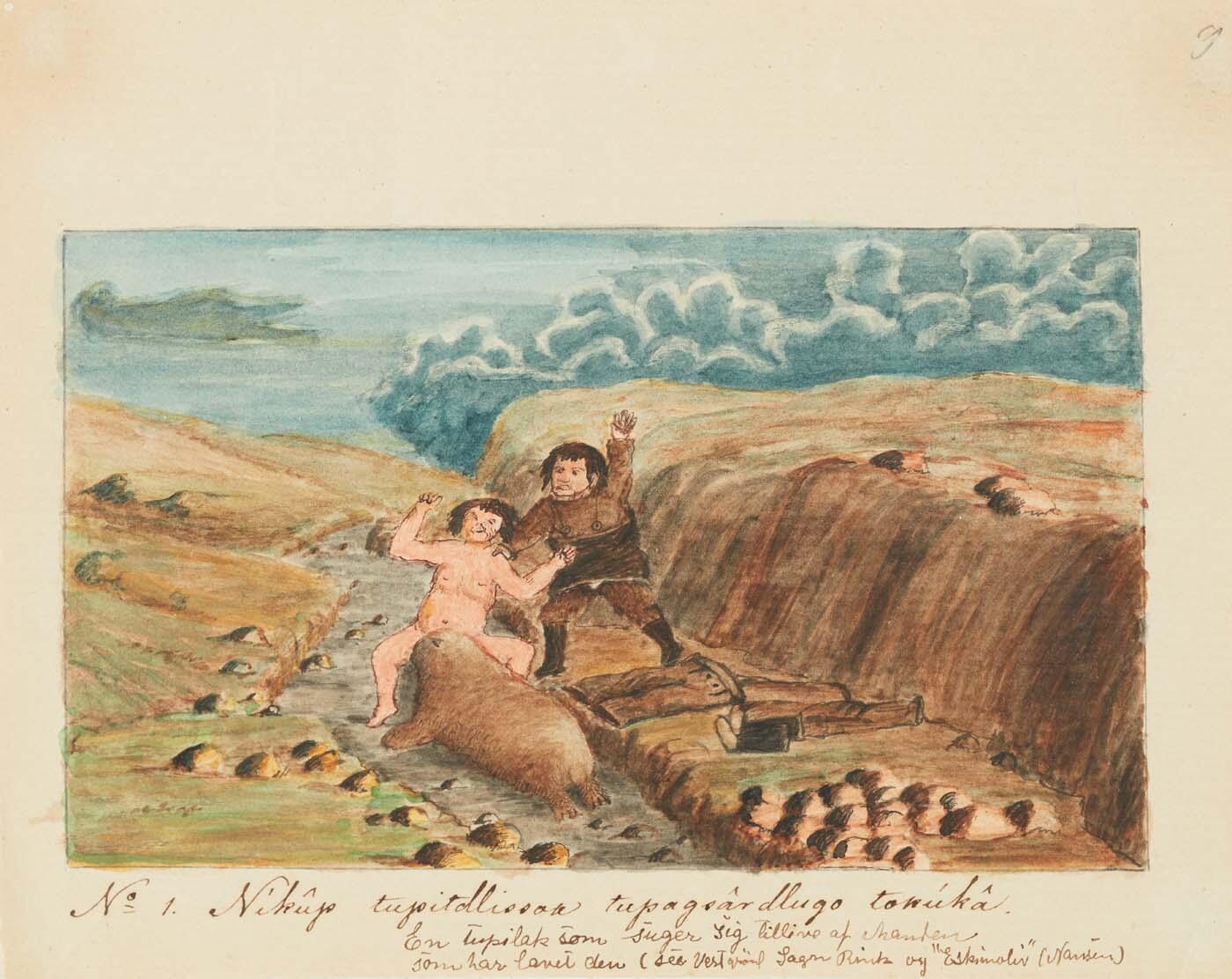
The watercolour Mythological Scene from Greenland (or: A Greenlander Defending his Wife from an Attacking Walrus) (c. 1850—69, Museum of Cultural History, University of Oslo) exemplifies Aron’s ability to translate Inuit oral traditions and social experience into a medium introduced through colonial contact. In this scene, the walrus is not merely a zoological specimen, as in the taxonomic endeavours of naturalist plates by European explorers, but a powerful agent in a network of human—animal relations charged with danger, reciprocity, and spirit. The defender and his wife embody social and familial obligations, reminding us that survival in Inuit cosmology is always relational.2On relationality in Inuit cosmology and hunting ethics, see Frédéric Laugrand and Jarich Oosten, Inuit Shamanism and Christianity: Transitions and Transformations in the Twentieth Century, Montreal 2010. ↩
From a decolonial perspective, Aron’s work may be read as a counter-archive---an Indigenous corpus that unsettles the epistemic monopoly of European accounts. As scholars of decolonial thought such as Argentine scholar Walter Mignolo and Maori scholar Linda Tuhiwai Smith argue, colonial modernity sought to overwrite Indigenous knowledge systems by classifying, disciplining, and appropriating them into European frameworks.3Walter Mignolo, The Darker Side of Western Modernity: Global Futures, Decolonial Options, Durham, NC 2011; Linda Tuhiwai Smith, Decolonizing Methodologies: Research and Indigenous Peoples, London 2012. ↩ Against this, Aron mobilised a hybrid visual language---European watercolour techniques, Inuit cosmology, oral narrative---to assert what Sámi theorist Rauna Kuokkanen calls “epistemic sovereignty”. 4Rauna Kuokkanen, Reshaping the University: Responsibility, Indigenous Epistemes, and the Logic of the Gift, Vancouver 2007. ↩ His works anticipate contemporary Indigenous art by over a century: they are both records of lived experience and acts of cultural self-determination.
The following reflections consider the significance of Aron’s oeuvre through seven interconnected perspectives: the politics of medium; narration and counter-archives; Inuit cosmology and myth; colonial mediation and circulation; comparative Indigenous frameworks; Aron’s legacy for Inuit and global Indigenous art histories; and the challenge his works pose to European art historical canons. Through this, I argue that Aron from Kangeq must be recognised as a central figure in nineteenth-century art, not as an exception, but as a voice whose creativity fundamentally reshapes what counts as art in that period.
Embodied Medium: Watercolour Between Colonial and Indigenous Worlds
Aron’s medium---watercolour on paper---was not native to Kalaallit Nunaat. It was introduced through colonial trade and missionary presence, with the Danish governor at Godthåb (Nuuk) reportedly supplying him with paper and paints.5Kaalund (1990), 42—44. ↩ Yet, the adoption of this medium was neither passive assimilation nor simple mimicry. Instead, Aron appreciated the possibilities of watercolour to reactivate the material into a carrier of Inuit epistemologies that could also be “legible” to the colonial eye.
European art history often relegated watercolour to the status of sketch or illustration, particularly in the nineteenth century when oil painting dominated “high art.” For Indigenous artists like Aron, however, watercolour was a pliable medium that allowed for speed, intimacy, and narrative density. Its portability mirrored the mobility of Inuit life, while its fragility paralleled the precarious conditions of colonial encounter.6Kaalund (1990), 45. ↩
Inuit scholar Heather Igloliorte has argued that Indigenous artists frequently use materials of colonial provenance in ways that “Indigenise” them---embedding them into Indigenous epistemic frameworks rather than submitting to European categories.7Heather Igloliorte, “The Art of Indigenous Materiality”, in Charlotte Townsend-Gault ed., Contemporary Art and Indigenous Culture, Vancouver 2015, 23—45. ↩ Aron’s watercolours exemplify this dynamic: they carry cosmologies and oral traditions into visual form, asserting Inuit presence within and against colonial modernity.
From a decolonial feminist angle, Aron’s shift from hunting to art due to ill health resonates with what Mississauga Nishnaabeg scholar Leanne Betasamosake Simpson calls “constellations of co-resistance”---ways of reconfiguring agency when traditional pathways are disrupted by colonial or personal circumstance.8Leanne Betasamosake Simpson, As We Have Always Done: Indigenous Freedom through Radical Resistance, Minneapolis 2017, 55—67. ↩ His art practice was not a departure from Inuit lifeways but a transformation of embodied knowledge into new material expressions. To paint was to continue hunting, but on another register: his brush tracked not animals but stories, cosmologies, and survivals. In this sense, the materiality of watercolour itself becomes a metaphor for the Inuit ethic of relationality and adaptability: liquid, impermanent, yet capable of preserving memory and cosmology across time.
Narrating Counter-Histories: Oral Tradition in Visual Form
Central to Aron’s practice is the translation of oral tradition into visual imagery. His works depict mythological beings, hunting scenes, and social rituals, yet always within the framework of Inuit cosmology. Rather than freezing oral narratives into static “illustrations,” he creates what could be termed a visual storytelling, where image functions as an extension of narrative performance.9Betasamosake Simpson(2015), 55—67. ↩
The Mythological Scene from Greenland exemplifies this. A Greenlander defends his wife from a walrus attack: on the surface, a survival encounter; beneath, a layered articulation of Inuit mythologies where animals are kin and antagonists simultaneously. The walrus embodies both ecological danger and spiritual potency, recalling what Inuit call tuurngait---spirits that dwell in animals and landscapes.10Laugrand and Oosten (2010), 88—92. ↩
Walter Mignolo’s concept of the “decolonial archive” is instructive here. While colonial archives sought to discipline Indigenous peoples into objects of study, Indigenous counter-archives preserve histories, cosmologies, and relationships in ways illegible to colonial epistemologies.11Walter Mignolo (2012), 114—118. ↩ Aron’s watercolours constitute precisely such a counter-archive: assembled from oral tradition, embodied knowledge, and myth, they assert a history of Inuit presence from within, rather than about.
Sámi literary scholar Harald Gaski has emphasised that Indigenous storytelling traditions are not relics but living epistemologies.12Harald Gaski, Sámi Oral Traditions and Storytelling, Tromsø 2010. ↩ In Aron’s case, the watercolours allow storytelling to circulate in new material forms, extending oral culture without surrendering to the linear temporality of European historiography. His works fold myth and lived experience together, destabilising the separation of “history” and “myth” that European thought insists upon. They transform the act of recording into one of relational ethics, where the image itself is a participant in knowledge transmission, rather than a static object for observation.
Inuit Cosmologies: Relational Worlds and Mythic Beings
To appreciate Aron’s imagery requires entering Inuit cosmological frameworks. Inuit worlds are structured through relational ontologies where humans, animals, and spirits are bound by reciprocity, respect, and danger. As Inuit scholar Rachel Qitsualik-Tinsley notes, Arctic stories are not allegories but cosmological maps: they articulate the conditions of survival and ethics in a harsh environment.13Rachel Qitsualik-Tinsley, Stories of the Far North: Inuit Cosmology and Ethics, Toronto 2009, 15—19. ↩
In the Oslo watercolour, the walrus is more than prey; it is a being with agency. Inuit hunting cosmologies insist that animals must consent to be taken, and improper conduct risks ecological imbalance.14Laugrand and Oosten (2010), 91—93. ↩ The depicted struggle thus dramatizes not simply domination but a negotiation of relational ethics.
The wife’s presence is equally significant: Inuit women held crucial roles in maintaining social cohesion, spiritual practices, and knowledge transmission. Her centrality in Aron’s scene unsettles colonial depictions that erased Inuit women from narratives of outdoor life and Arctic survival.15augrand and Oosten (2010), 77—79. ↩ Here, Aron’s imagery acts as a carrier of ancestral presence and ecological ethics, producing works that simultaneously narrate survival and cosmological depth. In a broader sense, the scene offers a visual pedagogy: ethical, social, and spiritual lessons encoded in dynamic imagery.
Colonial Mediation and Circulation
Aron’s art emerged within structures of colonial mediation. The materials came from the Danish governor; the works circulated in colonial institutions in Copenhagen, Nuuk, and Oslo. His images were sometimes valued as ethnographic curiosities rather than as art. This mediation cannot be ignored: Aron’s oeuvre bears the imprint of colonial structures even as it resists them.
Peruvian decolonial theorist Aníbal Quijano’s concept of the “coloniality of power” clarifies this tension: Indigenous creativity was colonially permitted (or legible) only insofar as it fit colonial epistemic categories, whether as “folklore” or “ethnography.”16Aníbal Quijano, “Coloniality and Modernity/Rationality,” in: Cultural Studies 21, no. 2—3 (2007), 168—178. ↩ Aron’s watercolours thus navigated a double bind---circulating through colonial channels while carrying Indigenous sovereignty.
By producing images that unsettled ethnographic confinement, Aron disrupted the colonial perspective that art history in Kalaallit Nunaat begins with colonial artifacts, erasing Inuit self-representation. His works insist that Inuit art was not derivative but contemporaneous with European developments. The afterlife of his works---in Nuuk’s collections, in Copenhagen’s museums, in Oslo’s holdings---marks both dispossession and survival. These institutions, once complicit in colonial erasure, now have the potential to serve as sites where Aron’s counter-archive can be reactivated for Indigenous futures. They demonstrate the enduring relevance of Indigenous epistemologies, asserting continuity against the historical violence of erasure.
Comparative Indigenous Frameworks
Aron’s oeuvre resonates with broader Indigenous artistic practices of survivance globally. Like the ledger drawings of Plains Indigenous artists in nineteenth-century North America, his works adapt colonial-introduced materials to Indigenous storytelling purposes.17Richard L. Brettell, Ledger Art of the American Plains, New York 1995, 32—45. ↩ Both disrupt the ethnographic gaze by producing images from within Indigenous worlds.
Similarly, the woodblock prints of twentieth-century Inuit artists in Cape Dorset (Kinngait), such as Kenojuak Ashevak, extend storytelling into hybrid visual media.18Charlotte Townsend-Gault et al., Kenojuak Ashevak: A Retrospective, Vancouver 2003. ↩ These practices show continuity rather than rupture: Indigenous artists consistently translate oral traditions into visual media that negotiate colonial structures while maintaining epistemic sovereignty.
These comparative frameworks underscore that Indigenous artists across the Arctic and globally have long mobilised hybrid forms to assert sovereignty and resilience. In this sense Aron rejected ethnographic confinement and established his own terms of Indigenous visual storytelling, despite only being recognised as such a century and a half later. His work anticipates strategies of hybridity seen in contemporary Indigenous art: ethical negotiation, relational imagery, and performative transmission of knowledge.
Aron’s Legacy: Resilience, Continuity, and Contemporary Resonances
Aron’s works are not only artifacts of the past; they continue to shape Inuit cultural memory and global Indigenous art histories. His role as both storyteller and artist upholds knowledge practices rooted in land and relationality that persist despite colonial disruption. His images are invoked in Greenlandic cultural discourse as touchstones of resilience, embodying both continuity and innovation. 19Bodil Kaalund, Aron fra Kangeq: 1822—1869: Om 47 tegninger og akvareller der befinder sig på Etnografisk Museum under Oslo Universitet. Copenhagen 1997, 53—55. ↩
Today, exhibitions of Aron’s works in Nuuk or Oslo resonate differently than in the nineteenth century. They are reclaimed as Indigenous art, not as ethnographic relics. This recontextualisation parallels global Indigenous movements of rematriation and cultural sovereignty, where ancestral works are reframed as living presences, active in society, rather than colonial possessions.20Andrea Smith, Conquest: Sexual Violence and American Indian Genocide, Cambridge 2005, 112—118. ↩
For young Inuit artists---such as Laakkuluk Williamson Bathory, Jessie Kleemann, Maria Paninguaq Hjorth, and other emerging visual and performance artists---Aron’s example resonates strongly. They too experiment with hybrid media, interweaving oral tradition, performance, contemporary art languages, and activism.21See Laakkuluk Williamson Bathory, Jessie Kleemann, Maria Paninguaq Hjorth, respective exhibition catalogues, Nuuk Art Museum, 2018—2023. ↩ While Aron worked with colonial watercolours, today’s artists mobilise video, installation, and performative interventions to address colonial histories, ecological crisis, and Indigenous futurities. Aron’s work establishes a transgenerational dialogue in which art is not simply representation but a mode of cultural survival, ethical negotiation, and relational sovereignty.
Challenging the Canon of European Art History
To include Aron in nineteenth-century European art history is not token inclusion but structural and epistemological correction. His works force the canon to confront its exclusions and its inability to read epistemological polyphony: that European modernity was built on Indigenous erasure, and that Indigenous creativity has always been contemporaneous, not belated.22T.J. Demos, Decolonizing Art History, London 2016, 25—40. ↩
As T.J. Demos has argued, the decolonial turn in art history requires not only adding marginalised voices but rethinking the categories and linguistic span of art itself.23T.J. Demos, Decolonizing Art History, London 2016, 41—56. ↩ Aron’s watercolours do precisely this. They challenge the binary of “ethnography vs. art,” “myth vs. history,” “craft vs. fine art.” They insist that Indigenous epistemologies must be taken seriously as aesthetic and philosophical systems.
From this vantage, Aron is not peripheral but central. His works are among the few nineteenth-century bodies of art that articulate ecological ethics, relational cosmologies, and decolonial archives---concerns that are urgent in the twenty-first century. They demonstrate that Europe’s art history is radically incomplete without Indigenous perspectives.
Conclusion: Towards Decolonial Futures
Aron from Kangeq’s watercolours embody a profound act of sovereignty in a time of colonial encroachment. They narrate Inuit worlds from within, for community but also for the colonial eye to read, mobilising hybrid materials to carry oral tradition, myth, and social experience into new forms. They disrupt colonial hierarchies of art, challenging European art history to expand its frameworks.
From the perspective of global Indigenous scholarship, Aron stands as a precursor to the contemporary Indigenous art renaissance: a figure who anticipated by over a century the strategies of hybridity, counter-archival practice, and cosmological storytelling that define Indigenous art today. His Mythological Scene from Greenland is not only an artwork of its time but a decolonial vision of relational futures.
In an era of ecological and political crisis, revisiting Aron’s works is more than historical recuperation. It is an invitation to learn from Inuit cosmologies of reciprocity, to recognise Indigenous sovereignty in art, and to expand our collective imagination. An expansion not only of what art history might be, but also an acknowledgement of the epistemological entente required for our collective planetary future to survive its current dystopic outlook.
- Katya García-Antón