Article
Laocoön and his sons
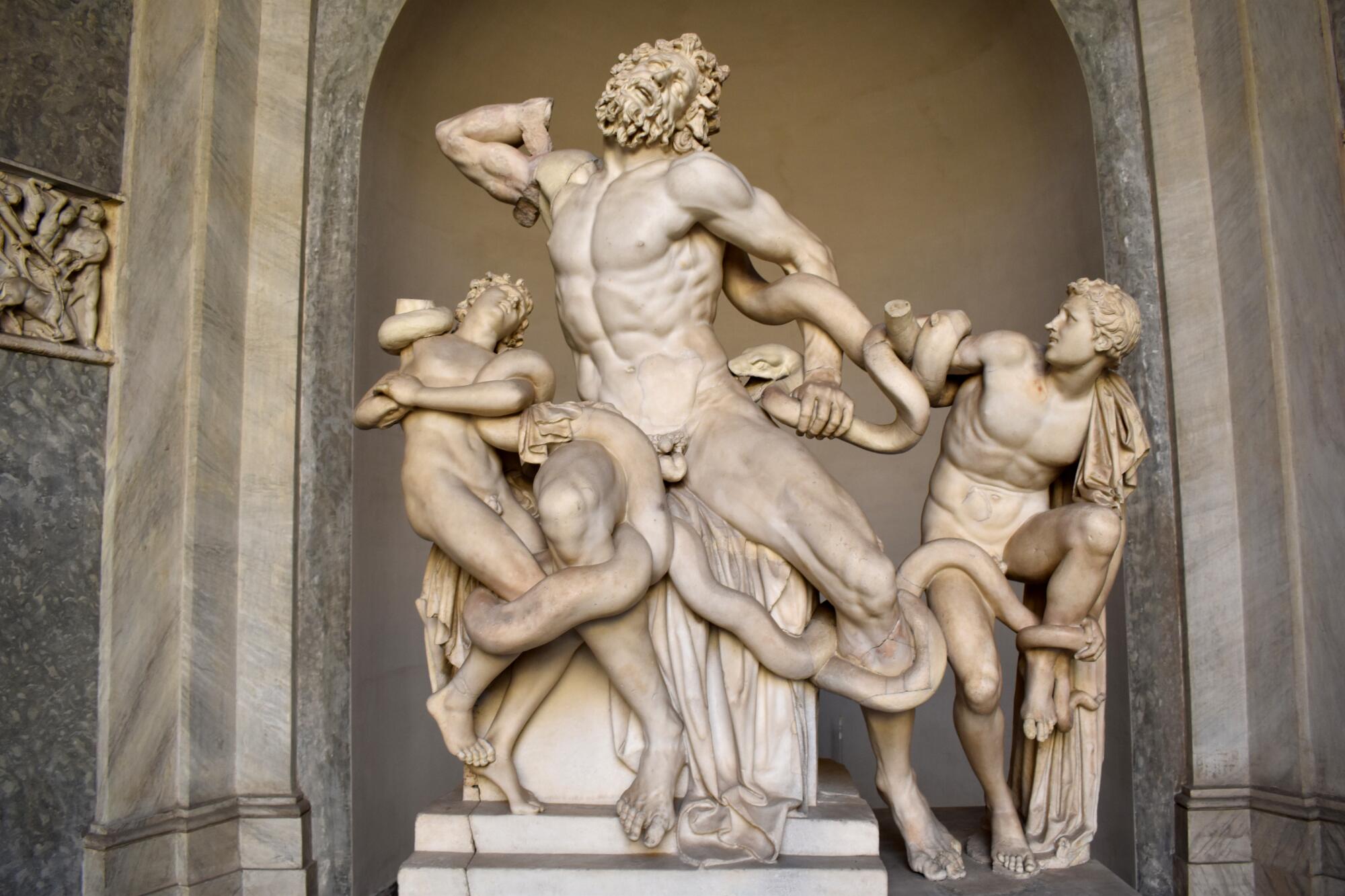
Since its discovery in Rome on the Esquiline Hill, in a vineyard belonging to Felice de Fredis (14??–1519), on 10 January 1506, the marble group Laocoön and His Sons has established itself as one of the most famous works of art in the Western world1Salvatore Settis, ed., Laocoonte. Fama e stile, Rome 1999; Francesco Buranelli, Paolo Liverani and Arnold Nesselrath, eds., Laocoonte. All’origine dei Musei vaticani, exhibition catalogue, Rome 2006; Rita Volpe and Antonella Parisi, ‘Alla ricerca di una scoperta: Felice de Fredis e il luogo di ritrovamento del Laocoonte’, in: Bollettino della Commissione Archeologica Comunale di Roma 110 (2009), 81–110; Luca Calenne and Alfredo Serangeli, ‘A New Dating for the Discovery of the Laocoön from an Incunabulum Preserved in Segni’, in: Studi Romani, LXI (2013), 77–98; Francis Haskell and Nicholas Penny, Taste and the Antique. The Lure of Classical Sculpture 1500–1900: Revised and Amplified Edition by Adriano Aymonino and Eloisa Dodero, Turnhout 2024, I, 372–384 and II, 206–229. Unless otherwise stated, the translations are my own. ↩. Its composition as a group, the quality of its execution, its state of preservation and, more generally, the depiction of this profound suffering have continually captivated artists and scholars. The work of three great sculptors from Rhodes—who had left their island following its sacking by Brutus and Cassius in 42 BC and who are also the creators of the sculptural groups discovered at Sperlonga, in southern Latium, in 1957—the Vatican statue is mentioned by Pliny in his Natural History, XXXVI, 37 as being kept ‘in Titi imperatoris domo’. In fact, it had probably once adorned a nymphaeum in Maecenas’s gardens, near the ancient Servian walls, where Emperor Tiberius resided upon his return from exile in Rhodes in the year 4. Just as in the so-called Cave of Tiberius at Sperlonga, where the sculptural groups depict various episodes from the story of Odysseus, in Maecenas’s gardens the Laocoön must have formed part of a complex decorative scheme illustrating episodes from the Trojan War. It depicts, in fact, the death of the high priest who had dared to oppose the will of Athena, the protector of the Greeks, and of his two sons. The excellent state of preservation – only the father’s right arm, the younger son’s right arm and the fingers of the elder son’s right hand were missing – in which it was found at a depth of 3.50 metres in January 1506 suggests that it had never been moved prior to its discovery. Indeed, it was at a stonemason’s workshop in this very neighbourhood of Rome that, in 1905, Ludwig Pollack (1868–1943) identified the missing arm of the Trojan priest, which was reintegrated into the statue between 1957 and 1959 under the direction of Filippo Magi (1905–1986)2Ludovico Rebaudo, Il braccio mancante. I restauri del Laocoonte (1506–1957). Nuova edizione aggiornata, Trieste 2007, 77–78. ↩.
News of the discovery of the Laocoön spread very quickly throughout Rome and to other states on the Italian Peninsula. Two letters, dated 24 and 31 January 1506, tell us that once the work had been removed from the hole (in its current state, it weighs 2,300 kg), it had been placed in the bedroom of the owner, who was then living near Piazza Branca, in the rione of Regola, and thus far from the Esquiline Hill 3Sonia Maffei, ‘II. Documents and letters concerning the discovery’, in Settis, ed. (1999), 101–105; and Volpe and Parisi (2009), 87–88. ↩. Both the Vice-Chancellor Giovanni Franciotti Della Rovere (c. 1477–1508), nephew of Pope Julius II, and the Pope himself were keen to acquire it. There was also talk of placing it on the Capitoline Hill, where the ancient bronzes of the She-Wolf and the Thorn-Puller—which Pope Sixtus IV had donated to the city in 1477—were already housed; however, by 7 March 1506, the Laocoön was already in the pontiff’s gardens at the Vatican4Arnold Nesselrath, ‘Laocoon Alive’, in: Buranelli, Liverani and Nesselrath, eds. (2006), 69. See also Maffei (1999), 112–113. ↩. Initially housed in a niche in the Belvedere Gardens5Maffei (1999), 108 and 173. ↩, it became one of the major pieces in the octagonal courtyard of the Museo Pio Clementino in 1772. In 1798, following the signing of the Treaty of Tolentino between Pope Pius VI and General Napoleon Bonaparte, it was transported to Paris along with around a hundred other works of art from various periods and in various styles, and exhibited on the ground floor of the Louvre, in the eponymous room of the Galerie des Antiques at the Musée Central des Arts, which became the Musée Napoléon in 1803. Upon the fall of the First Empire in 1815, it returned to the Vatican, to its ‘cabinet’ in the octagonal courtyard of the Belvedere, where we can still admire it today.
Movement, fury, pain
The first precise and comprehensive description of the Laocoon is found in a letter dated 14 February 1506 sent to Florence to Luigi Guicciardini (1478–1551) by a member of the Accademia Platonica, Giovanni de’ Cavalcanti (c. 1444–1509), who saw the work at de Fredis’s house6Maffei (1999), 106–107. ↩. Within the following three months, the statue’s merits began to be extolled in poems, including one by Jacopo Sadoleto (1477–1547), who celebrated the talents of the three Rhodian artists, ‘extraordinary in their ability to bring inert stone to life with living figures and to imbue the pulsating marble with living emotion; one sees movement, fury, pain, and one almost believes one can hear the groans’7‟[…] vos rigidum lapidem vivis animare figuris / eximii et vivos spiranti in marmore sensus / inserere: aspicimus motumque iramque doloremque, / et paene audimus gemitus”: Maffei (1999), 120. These verses were already known in May 1506, but were not printed until 1532. ↩. If we are to go by the much later account of Francesco da Sangallo (1484–1576), Michelangelo is said to have been one of the first artists to visit the site where the block was found, accompanied by one of his friends, the Florentine architect Giuliano da Sangallo (c. 1445 or 1452–1516) —Francesco’s father—, who, for his part, is said to have been sent there by the Pope himself8Maffei (1999), 110, letter from F. da Sangallo to Vincenzo Borghini dated 28 February 1567. ↩. Be that as it may, Buonarroti and Gian Cristoforo Romano (c. 1465–1512) —another renowned sculptor of the early 16th century9Chiara Pidatella, ‘Gian Cristoforo Romano e Laocoonte’, in Giorgio Bejor, ed., Il Laocoonte dei Musei Vaticani 500 anni dalla scoperta, Milan 2007, 179–216. ↩ — immediately realised that, contrary to what is stated in Pliny the Elder’s Natural History, the group had not been carved from a single block of marble, but from several10Letter from Cesare Trivulzio to Pomponio Trivulzio, in Milan, dated 1 June 1506, in Maffei (1999), 108. On the literary topos ex uno lapide, see Settis (1999), 41–50 and 79–81. ↩. As for the impression Michelangelo gained upon seeing the ancient group, this is revealed in his Saint Matthew (fig. 2) for Florence Cathedral. The saint’s head turned to his right, his torso leaning forward in the opposite direction, and his left knee bent and completely drawn out from his left leg are allusions to the ancient Laocoön 11Michelangelo had been commissioned to create twelve Apostles for Florence Cathedral in 1503, whilst he was still working on the marble David for the Signoria, which was completed in April of the following year. It was therefore not until 1504–1505 that work began on carving the blocks of marble, but everything came to a sudden halt when Julius II demanded that the sculptor come to Rome to work on his tomb. The contract with the Arte della Lana (the wool merchants’ guild) was thus terminated on 18 December 1505. At that point, Saint Matthew was the only statue to have been roughly shaped. Michelangelo was still working on it in late November 1506: [[https://catalogo.beniculturali.it/detail/HistoricOrArtisticProperty/0900281985]{.underline}](https://catalogo.beniculturali.it/detail/HistoricOrArtisticProperty/0900281985) (accessed 27 November 2025). ↩. The artist also references the figure of the Trojan priest in one of the young nude figures populating the background of his Tondo Doni (Florence, Uffizi Gallery, inv. 1890, no. 1456), painted around the same time. At the beginning of the 16th century, the depiction of movement did indeed become one of the central features of the painted and sculpted compositions of the new art of central Italy. It is therefore no coincidence that the young Raphael (1483–1520), having arrived in Florence in the autumn of 1504, immediately sketched Buonarroti’s colossal statue of Saint Matthew (London, British Museum, inv. 1855,0214.1verso), even though it was [‘dir=‘rtl’]unfinished, nor that, a few decades later, in the middle of the century, in the introduction to the third part of his Lives of the Most Excellent Painters, Sculptors and Architects, Giorgio Vasari regarded the Laocoön as one of the ancient works that lay at the origin of the renewal of Italian art.
Copies, references, interpretations
In 1505, the young Jacopo Tatti (1486–1570) had also arrived in Rome from Florence with Giuliano da Sangallo; he was later nicknamed Jacopo Sansovino after his master, the sculptor Andrea Contucci dal Monte Sansavino (c. 1467–1529). Impressed by the ancient sculptures housed in the Belvedere Gardens (in addition to the Laocoön, the Apollo and the Venus Felix had arrived there between 1508 and 1509), Jacopo began to sketch them12One of these drawings, in red chalk on beige paper, depicting the son standing to the right of the Laocoön group with his right arm fully rendered, is held in the Department of Graphic Arts at the Louvre Museum, inv. 2712 recto: [[https://collections.louvre.fr/ark:/53355/cl020003568]{.underline}](https://collections.louvre.fr/ark:/53355/cl020003568) (accessed 4 December 2025). ↩, thereby attracting the attention of Julius II’s chief architect, Domenico Bramante (1444–1514), who then asked him to “make a large-scale wax copy of the Laocoön13“ […] ritrar di cera grande il Laocoonte”: Giorgio Vasari, “Descrizione dell’opere di Iacopo Sansovino scultore fiorentino (1568)” in Idem, Le Vite de’ più eccellenti pittori scultori e architetti nelle redazioni del 1550 e 1568, ed. Rosanna Bettarini and Paola Barocchi, vol. VI, Florence 1987, 178. ↩” as part of a competition to find the best model for a bronze cast based on the ancient group. Zaccaria Zacchi of Volterra (1473–1544), the Spaniard Alonso Berruguete (1488–1561) and the Bolognese Domenico Aimo, known as Varigana (born between 1460 and 1470–1539), were the other competitors. Raphael, the judge appointed by Bramante, awarded first prize to Jacopo Tatti. The resulting bronze casting, now lost, was acquired by the Venetian cardinal and antiquities collector Domenico Grimani (1461–1523), who later placed it in the Convent of Santa Chiara in Murano, near Venice, where it remained at the time of his death in 1523. Bequeathed along with the rest of his collection of antiquities to the Most Serene Republic of Venice, it was subsequently gifted by the Republic to Cardinal Jean de Lorraine (1498–1550), one of the favourites of King Francis I of France, in 153414It is now lost: Michel Hochmann, ‘Laocoon in Venice’, in: Revue Germanique Internationale 19 (2003), 92. ↩. Cardinal Grimani also commissioned a small, partially gilded silver plaque depicting the Flagellation of Christ (Vienna, Kunsthistorisches Museum*,* Kunstkammer, 1105), executed by the Veronese artist Galeazzo Mondella, known as Moderno (1467–1528), in which the figure of Christ at the column is a reference to the figure of Laocoön with his right arm incorporated. It was between 1520 and 1524 that, at the request of Cardinal Bernardo Dovizi da Bibbiena (1470–1520), Baccio Bandinelli (1493–1560) — another Florentine sculptor — produced the first life-size marble copy of the Laocoön group (Florence, Uffizi Gallery, inv. Sculture 284), incorporating all the missing elements. The work was intended for King Francis I of France, who had requested the ancient original from Pope Leo X. However, the deaths of Cardinal Bibbiena on 9 November 1520 and of the Pope on 1 December of the following year had delayed the proceedings, and as the political situation had changed in the meantime, the new Pope Clement VII sent Bandinelli’s copy to Florence, to the garden of the Medici Palace, where it remained until 1621, when Cardinal Carlo de[’]{dir=‘rtl’} Medici had it transferred to the northern garden of the Casino di San Marco15It arrived at the Uffizi Gallery in 1671: Gabriella Capecchi, ‘Superare l’antico: il Laocoonte perfetto’ in: Detlef Heikamp and Beatrice Paolozzi Strozzi, eds., Baccio Bandinelli scultore e maestro (1493–1560), exhibition catalogue, Florence 2014, 129–155 and cat. no. V, 571. ↩. It was not until 1543 that a life-size bronze cast by Primaticcio was installed at the Château de Fontainebleau (Galerie des Cerfs, inv. MR 3290) of the poignant composition of the Belvedere group and the recent integration into the figure of the priest of the right arm in terracotta, created by Brother Giovanni Angelo Montorsoli (1507–1563) — a collaborator of Michelangelo — between the autumn of 1532 and the following spring16Rebaudo (2007), 42–53. ↩.
In the 1520s, smaller bronze copies had begun to circulate, such as the one attributed to Jacopo Sansovino, documented in the secret wardrobe of Duke Cosimo I de’ Medici as early as 1553 (Florence, Bargello National Museum, inv. 477 Bronzi). At the same time, the image of the Vatican group spread thanks to the engravings by Giovanni Antonio da Brescia (c. 1490–c. 1525, a reverse-engraved print produced c. 1510–1520) and Marco Dente da Ravenna (before 1500–1527) (after Marco Antonio Raimondi, c. 1520–1523). In private residences, it appears in frescoes such as the one painted by Tommaso Bernabei, known as Maso Papacello (c. 1505–1559), in the drawing room of the Palazzone in Cortona (1527), on faience objects produced by the Urbino workshop in the 1530s–1540s, and even, beyond the Alps, on small panels painted in oil (Anonymous French artist, c. 1540, Digne-les-Bains, Musée Gassendi, inv. 904.32.10). It is also engraved in editions of poems celebrating the dramatic intensity of the ancient marble, in which the three Rhodian sculptors succeeded in conveying the pathos of Virgil’s verses (Aeneid, II, 199–231), in guidebooks to the Eternal City, and in the earliest illustrated collections reproducing the ancient sculptures preserved there. The Laocoön also became the subject of caricatures, as in the woodcut that Niccolò Boldrini (1510–1570) engraved around 1540–1545 after Titian, in which the three figures of the group have been transformed into monkeys. And by the end of the century, there was no longer any hesitation in reinterpreting the ancient group. This is evidenced by the marble group (Rome–London, Galleria del Laocoonte) that Vincenzo de’ Rossi (1525–1587) created in Florence for Senator Giovanni da Sommaia around 1584, in which the three protagonists, carved from three separate blocks, writhe to free themselves from the snakes’ grip 17Detlef Heikamp, Il Laocconte di Vincenzo de’ Rossi, Florence 2017. ↩. As for El Greco (1541–1614), around 1610–1614, he transposed *Laocoön and His Two Sons* to Toledo and separated the three bodies (Washington, National Gallery of Art, inv. 1946.18.1). Pale and elongated, they struggle in vain under the gaze of a few onlookers, who are themselves naked and pale18Jacques Le Ridder, ‘Breaks with tradition in the interpretation of the Laocoon, from El Greco to Winckelmann, Lessing and William Blake’, in: Revue Germanique Internationale 19 (2003), 181–194. ↩.
A paragon
The plaster casts of the figure of Laocoon, and in particular of his head, which had begun to circulate outside Rome and the Papal States from the 1540s onwards, established the statue as the pinnacle of ancient art. This was confirmed some fifty [‘]{dir=‘rtl’}years later by Federico Zuccaro (1539 or 1540–1609), then Prince of the Accademia di San Luca in Rome, in the posthumous portrait of his elder brother Taddeo (1529–1566, Fig. 3) for the cycle of frescoes depicting the latter’s life in one of the rooms of the palace that Federico had just had built on the Pincio. Over the following two centuries, generations of artists, from Rubens (1577–1640) and Bernini (1598–1680) to Giovanni Battista Foggini (1652–1725) and Filippo Tagliolini (1745–1809), never ceased to engage with this ancient masterpiece by drawing it — either in its entirety or focusing solely on the head or torso —, by copying it in small-scale terracotta and bronze, and, from the mid-18th century onwards, in porcelain and biscuit. In the academies, the body of the Vatican Laocoön became a reference point for anatomical studies, and remained so until the mid-19th century. Thus, when, in 1650–1652, Michael Sweerts painted his Mars Destroying the Arts (private collection), he depicted the god of war triumphing over a bust of the Laocoön lying at his feet 19Haskell and Penny (2024), vol. II, 219, fig. 28. ↩.
By the mid-17th century, European sovereigns felt obliged to own a life-size copy of the ancient Laocoon. This was the case for Philip IV of Spain, who commissioned Velázquez to create one in 1651, and for Louis XIV, who, at the start of the following century, could boast of owning three: in addition to Primaticcio’s bronze, under the direction of François Girardon (1628–1715), the Keller foundry produced another bronze version for Versailles in 1687, and Jean-Baptiste Tuby (1629–1700), a sculptor of Roman origin, completed a marble copy for the Trianon gardens in 169620Versailles, Musée national des châteaux de Versailles et Trianon, MR 2102 inv. 1850.9124: [[https://sculptures-jardins.chateauversailles.fr/notice/notice.php?id=229]{.underline}](https://sculptures-jardins.chateauversailles.fr/notice/notice.php?id=229) (accessed 11 December 2025). ↩. A few years later, a replica of the Kellers’ bronze was acquired by Robert Walpole (1701–1751), the Prime Minister’s son, during his visit to Paris. It went on to adorn the great hall of Houghton Castle in Norfolk. Around 1699, a life-size lead Laocoön could also be admired at Polanen Castle in the Southern Netherlands. All these copies imply that several casts were made from the original, which consequently became damaged. Consequently, between 1712 and 1719, the Florentine sculptor Agostino Cornacchini (1686–1754) restored the missing parts (the sons’ hands, one of the younger son’s feet, and a snake’s head), without altering the appearance the work had acquired from the 1530s onwards21Rebaudo (2007), 53–59. ↩. It was later, probably during its display in the new octagonal courtyard of the Pio Clementino Museum, that Montorsoli’s terracotta arm was detached and not replaced.
Yet these issues relating to the maintenance of the ancient group had no bearing on how it was perceived during the Age of Enlightenment. Just as at the time of its discovery and throughout the sixteenth century, when reflecting on the terrible death of the Trojan priest and his two sons as described by Virgil, the sense of wonder at the successful feat of the three Rhodian sculptors, who depicted this tragedy without compromising the beauty of the forms, remains as strong as ever. In the second half of the century, the Vatican statue was at the centre of new aesthetic debates in the German-speaking world, where figures such as Winckelmann, Lessing, Herder and Goethe were particularly prominent. In his Laocoon, or On the Limits of Painting and Poetry (1766), Lessing laid the foundations for a new aesthetic in which poetry is contrasted with the visual arts22Wilfried Barner, ‘Lessing’s Laocoon: Deduction and Induction’ in: Revue Germanique Internationale 19 (2003), 131–143. ↩.
The display of the group at the Louvre, featuring a new plaster arm modelled on that of François Girardon, cemented its reputation as a universal masterpiece. Alongside the Apollo of the Belvedere, it was indeed the most highly prized work in the Inventory of Antiquities compiled in 1810. Its status as a paragon has not been called into question in the two centuries that have followed, even though its image is very often used in parodies or political satires evoking situations of individual or collective crisis23Salvatore Settis, ‘The Reception of Laocoon in the 20th Century’ in: Revue Germanique Internationale 19 (2003), 277–301. ↩. Thus, during the Watergate scandal on 28 January 1974, Richard Nixon appeared on the front cover of Newsweek as Laocoön writhing amidst the magnetic tapes that led to his resignation as President of the United States.
Bibliography
Francesco Buranelli, Paolo Liverani et Arnold Nesselrath, éd., Laocoonte. All’origine dei Musei vaticani, cat. exp., Rome 2006.
Luca Calenne et Alfredo Serangeli, « Una nuova datazione per il ritrovamento del Laocoonte da un incunabolo conservato a Segni », dans : Studi Romani, LXI (2013), 77-98.
Élisabeth Décultot, Jacques Le Rider et François Quérel, éd., Le Laocoon : histoire et réception, Revue Germanique Internationale 19 (2003).
Francis Haskell et Nicholas Penny, Taste and the Antique. The Lure of Classical Sculpture 1500-1900 Revised and Amplified Edition by Adriano Aymonino and Eloisa Dodero, Turnhout 2024, I, 372-384 et II, 206-229.
Ludovico Rebaudo, Il braccio mancante. I restauri del Laocoonte (1506-1957). Nuova edizione aggiornata, Trieste 2007.
Salvatore Settis, éd., Laocoonte. Fama e stile, Rome 1999.
Rita Volpe et Antonella Parisi, « Alla ricerca di una scoperta : Felice de Fredis e il luogo di ritrovamento del Laocoonte », dans : Bollettino della Commissione Archeologica Comunale di Roma 110 (2009), 81-110.