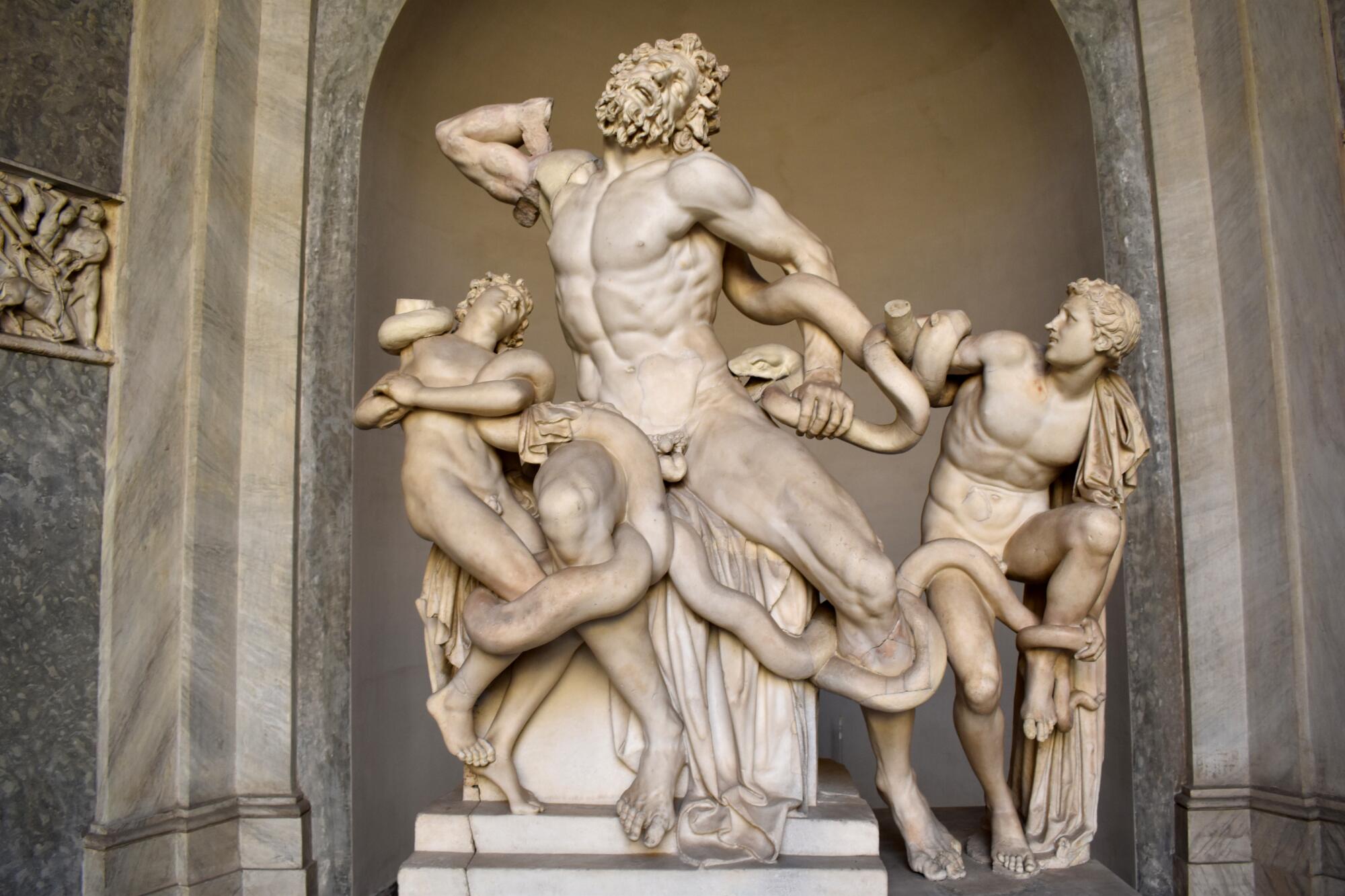
Canaan (Wikimedia Commons), Re-use in accordance with the terms and conditions of the Creative Commons licence (CC BY SA 4.0), CC BY SA 4.0
Laocoön and his sons
Creator(s)
Title(s)
Date of creation
ca. 200 BCE
Materials and techniques
Marble
other_information
Place of conservation
Rights
External links
Discovered on 10 January 1506 in a private vineyard in Rome, on the Esquiline Hill, the marble sculpture Laocoön and His Sons is one of the most famous works of art in the Western world. It depicts the death of the Trojan priest Laocoon, who had dared to [‘dir=‘rtl’]oppose the goddess Athena, protector of the Greeks, and that of his two sons. It was carved in Rome and once adorned a nymphaeum in Maecenas’s gardens. Pliny the Elder mentions it in his Natural History. Upon its discovery, the group’s composition, the quality of its execution, its state of preservation and, more generally, the depiction of such intense suffering immediately captured the attention of artists and scholars. Pope Julius II acquired it for the Belvedere Courtyard in the Vatican, and Michelangelo, who was among the first to rush to the site of the discovery, drew inspiration from it for his Saint Matthew for Florence Cathedral (fig. 2) and for his large panel of the Tondo which he was in the process of painting for Agnolo Doni (Florence, Uffizi Gallery, inv. 1890, no. 1456). Celebrated in numerous poems, copied time and again in both small and large formats and on a wide variety of media, the Laocoön became, in the 17th century, a key reference (fig. 3) in art academies for the study of anatomy. In the second half of the following century, its expressiveness gave rise to significant stylistic and aesthetic considerations amongst German antiquarians and philosophers such as Winckelmann and Lessing. In 1798, it was transported to Paris and exhibited at the Louvre, in the Gallery of Antiquities, from where it returned to the Vatican following the fall of the First Empire in 1815. Laocoon’s original right arm was discovered in 1905 and reattached to the statue between 1957 and 1959.