Article
Book of Kells
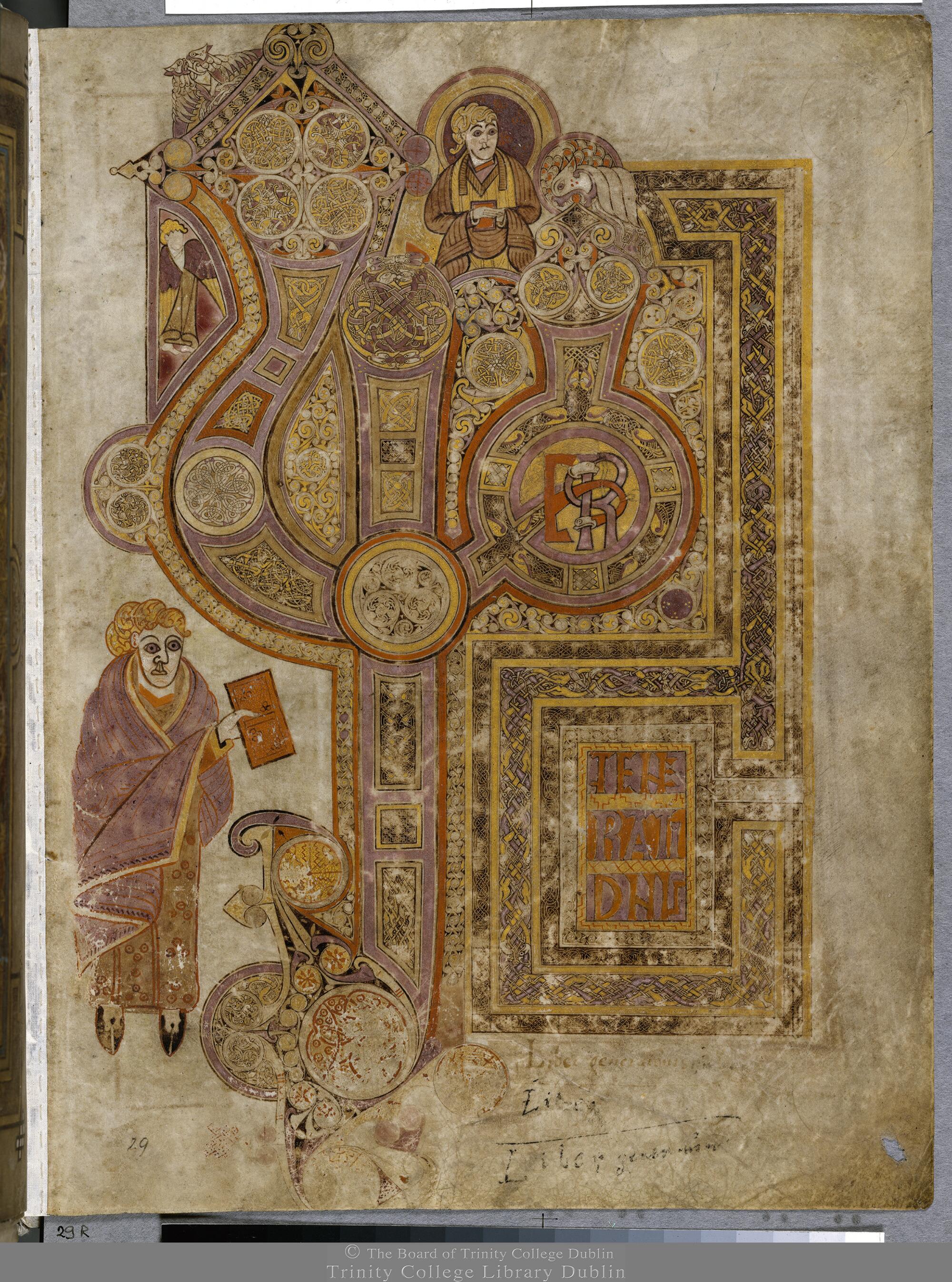
Every year, almost one million visitors make the pilgrimage to the Library of Trinity College Dublin to view the Book of Kells (Dublin, TCD MS 58). Since the late nineteenth century, it has been regarded as Ireland’s greatest cultural treasure. Its distinctive artwork has been reproduced on all manner of souvenirs as being instantly and universally recognised as ‘Irish’. In 2011 it was inscribed into the UNESCO Memory of the World Register.
The Book of Kells is a gospel book, containing the four gospels of the Christian New Testament with some prefatory texts. There is no colophon recording the patron(s), scribe(s), place of making or any other provenance.. It is one of the few precious survivals of an influential tradition of manuscript book production that flourished in the milieu of the Irish Church in the eighth and ninth centuries. This was a period during which Ireland’s fame for learning attracted scholars from across Europe, and Irish churchmen travelled across the Continent as pilgrims, teachers and evangelisers, bringing their books and scribal skills with them. Manuscripts such as the Echternach Gospels, Lindisfarne Gospels and St Gall Gospels all attest to the impact of this tradition beyond Irish shores, with their distinctive form of script and illustration that since the early twentieth century has been called ‘Insular’ (of the islands). However, it is the Book of Kells, a manuscript that has remained in Ireland for most of its existence, which illustrates the real apogee of the artistry and learning inherent in this tradition.
The name of the manuscript derives from the monastery at Kells, Co. Meath. The monastery was founded c. 807CE by monks fleeing Viking attacks on the Columban monastery of Iona, off the Western coast of Scotland. Although it is impossible to date the manuscript with certainty, it is generally agreed that it was probably started in the late eighth century. As such, its provenance is uncertain, with suggestions for its place of manufacture ranging from Northumbria, to north-eastern Scotland to Iona or another Irish monastery.1Julian Brown, ‘Northumbria and the Book of Kells,’ in: Anglo-Saxon England 1 (1972), 219—46; Isabel Henderson, ‘Pictish Art and the Book of Kells’, in: Dorothy Whitelock, Rosamund McKitterick, and David Dumville, eds, Ireland in Early Mediaeval Europe, Studies in Memory of Kathleen Hughes, Cambridge, UK 1982, 79-105; Paul Meyvaert, ‘The Book of Kells and Iona’, in: Art Bulletin, 71 (1989), 6-18; Victoria Whitworth, The Book of Kells. Unlocking the Enigma, London 2025. ↩
The manuscript was certainly in Kells by the eleventh century, when it was reported that the ‘great gospel book of Colum Cille [/Columba]’ there had been stolen for its precious binding. Following its recovery, some of its pages were used to record local land transactions.2W.M. Hennessy and B. McCarthy, eds and trans, Annála Uladh, Annals of Ulster; Otherwise Annála Senait, Annals of Senat: A Chronicle of Irish Affairs, 431—1131, 1155—1541, 4 volumes, Dublin 1887—1901, i, 439. ↩ It remained in Kells until 1653 when it was transferred to Dublin and was subsequently accessioned to the collections of Trinity College Dublin Library, where it is first referenced in 1668.3Charles McNeill, ‘Copies of Down Survey Maps in Private Keeping’, in: Analecta Hibernica, 8 (1938), 419-427: 426; Aubrey Gwynn, ‘Some Notes on the History of the Book of Kells’, in: Irish Historical Studies, 9.34 (Sep., 1954), 131-161; William O’Sullivan, ‘The Donor of the Book of Kells’, Irish Historical Studies, 11 (1958), 5-7. ↩ There it was used primarily for biblical study until the mid-nineteenth century, when advances in chromolithographic printing and photography publicised its extraordinary artwork and demand rose to have it placed on public display.4J.O., Westwood, Paleographia Sacra Pictoria: A Series of Illustrations of the Ancient Versions of the Bible, London 1843, section C, 16. ↩ Its distinctive artwork has since become a shorthand for ‘Irishness’ and has been reproduced on everything from national currency to socks. It became, according to early twentieth century writer James Joyce, ‘The most purely Irish thing we have’.5Richard Ellman, James Joyce (London, 1959), 558-559. ↩
The book has suffered some damage and loss and now comprises of 680 pages. It has been estimated that when complete, provision of the vellum would have required the skins of at least 185 calves.6Denis Casey, ‘How many Cows did it take to make the Book of Kells?’, in: Rachel Moss, Felicity O’Mahony and Jane Maxwell, eds, An Insular Odyssey: Manuscript Culture in Early Christian Ireland and Beyond, Dublin 2017, 76-85. ↩ The difficulty and expense of procuring this amount of material is evidenced in the uneven quality of the vellum, and the presence of several holes and patches. The scribes and artists were also apparently restricted in their access to high quality pigments but demonstrated great skill in making do with what they had to hand. There is no gold in the manuscript, instead golden effect is achieved with orpiment, a naturally occurring mineral of dense yellow colour. Equally, the vibrant blue found throughout the pages of the book is not lapis lazuli as one might expect, rather it was made from indigo, derived from the woad plant, mixed with gypsum. In fact, nearly all the pigments identified so far could have been sourced locally, whether in Scotland or Ireland.7Susie Bioletti, R. Leahy, J. Fields, Bernard Meehan and Werner Blau, ‘The Examination of the Book of Kells using Micro-Raman Spectroscopy’, in: Journal of Raman Spectroscopy, 40 (2009), 1043—1049; Susie Bioletti, ‘A Fresh look at the Pigments used on the Book of Kells’ in William E. Vaughan, ed., The Old Library, Trinity College Dublin 1712—2012, Dublin2013, 28-32. ↩
Measuring 33cm x 25cm, the scale and lavish decoration, together with numerous textual errors, suggest that it was created principally for display or use on principal feast days rather than for daily liturgical use.8Éamonn Ó Carragáin, ‘“Traditio Evangeliorum” and “Sustantio”: The Relevance of Liturgical Ceremonies to the Book of Kells’, in: Felicity O’Mahony, ed., The Book of Kells: Proceedings of a Conference at Trinity College Dublin, 6-9 September 1992, Aldershot 1994, 398-436. ↩ By the early eleventh century, and probably earlier, the manuscript was regarded as a relic of St Columba, who, according to hagiographical sources was a prodigious scribe.9Benjamin J. Tilghman, ‘Placing the Book of Kells’, in: Eolas: The Journal of the American Society of Irish Medieval Studies, 14 (202270-85; Raghnall Ó Floinn, ‘Insignia Columbae I’, in: Cormac Bourke, ed., Studies in the Cult of St Columba, Dublin 1997, 136-161: 150-54. ↩ It was still being venerated as such in 1639, when Archbishop Ussher noted its presence in Kells.10Charles R. Elrington, ed., The Whole Works of the most Rev. James Ussher, D.D., Lord Archbishop of Armagh, and Primate of all Ireland, 17 vols, London 1864, iv, 232. ↩ It is this understanding of the manuscript that most likely contributed to its survival through the turbulent later Middle Ages.
The manuscript comprises a mixed Old Latin and Vulgate text of the four Gospels with prefatory material. This is written in a clear majuscule text, of a style unique to the milieu of the Irish church.11E.A. Lowe, Codices Latini Antiquiores, 11 vols, Oxford, 1934—72, ii, 43. ↩ The manuscript’s fame, however, lies in its lavish decoration. In contrast to nearly all surviving gospel books of the period, every page is decorated with a breath-taking complexity and minuteness. The achievement is even more astonishing when one considers the lack of known magnifying lenses or artificial light at the time of its making.
The most elaborate pages are mostly used to punctuate the book, announcing the start of a new section or a text of particular significance. Pages bear the winged symbols of the evangelists (Matthew-man; Mark-lion; Luke-ox; John-eagle) — one preceding the decorated canon tables (folio 1r), the other four introducing the individual Gospel texts (folios 27v, 129v; 187v; 290v). This motif was an effective visual reminder of the harmony of the four Gospel texts. This harmony is also emphasised by the presence of ten canon tables — decorative arched and grid diagrams designed to cross reference gospel passages.12Patrick McGurk, ‘The Canon Tables in the Book of Kells’, in: Paul Binski and William Noel, eds, New Offerings, Ancient Treasures: Studies in Medieval Art for George Henderson, Stroud 2001, 40-60; Nancy Netzer, ‘The Origin of the Beast Canon Tables Reconsidered’, in: Felicity O’Mahony, ed., The Book of Kells: Proceedings of a Conference at Trinity College Dublin, 6-9 September 1992, Aldershot 1994, 322-332; A.M. Friend, ‘The Canon Tables of the Book of Kells’, in: Wilhelm R.W. Koehler, ed., Medieval Studies in Memory of A. Kingsley Porter, Cambridge, MA 1939, 611-666. ↩ Although in the Book of Kells complementary cross-referencing in the margins of the text is absent, so rendering the canon tables decorative rather than functional.
In addition, the Gospels of St Matthew (folio 28v) and St John (folio 291v) are preceded by full-page portraits of their authors (those for Mark and Luke are lost). Both address the reader with a penetrating stare. The figure of John is shown as a seated scribe, holding his Gospel in one hand and pen in the other, with his ink horn at is feet. The pose of the figure demonstrates a clear knowledge of contemporary iconographic conventions in continental Gospel books. But contrary to the Carolingian trend towards naturalism, the Book of Kells saint is executed with confident abstraction and a riot of pattern and colour contained within its generous frame.
The portrait of John, as would have been the case text of each gospel, occupies the verso (left side of the opening) facing the opening words (incipit) of his text on the recto (right side of the opening) (folio 292r). The whole page is occupied by the phrase In principio erat verbum (in the beginning was the word). The opening initials IN occupying nearly the entire length of the page, decorated with writhing nests of tiny, intertwined animals snakes and birds contained within a rigid geometric framework. Subsequent letters become decreasingly elaborate as the eye scans down the page, but they are still hard to make out as they are formed from contorted animals and then a type of display capital more common to timber epigraphy. A true celebration of the Word of God.
In common with most Insular gospels, the opening of Matthew 1:18 in the Book of Kells is also given prominence with a sequence of portrait of Christ (folio 32v), decorated cross page (folio 33r) and incipit page (folio 34r). The cross page is the only surviving ‘carpet’ page — a page filled purely with ornament and no figures. It bears the unusual form of a double armed cross with circular terminals. This form, it has been suggested, is redolent of the True Cross (the actual cross on which Chrit was crucified), the second arm representing the titulus, ‘Jesus Christ King of the Jews’, hung over Christ’s head.13Martin Werner, ‘The Cross-Carpet Page in the Book of Durrow: The Cult of the True Cross, Adomnán and Iona’, in: The Art Bulletin 72.2 (June, 1990), 174—223. ↩
The opening words of verse 18, announcing the nativity of Christ, are presented as the Greek χρι monogram engulfed by dense patterning, with tiny figures of angels, men and animals gradually revealing themselves as the viewer scrutinises the page.14Suzanne Lewis, ‘Sacred Calligraphy: the Chi Ro Page in the Book of Kells’, Traditio, 36 (1980), 139-159. ↩ The artistry of this page is considered a tour de force of the manuscript. Coloured predominantly in orcein purple and orpiment yellow, it, like the cross-carpet page that precedes it, recalls the purple parchment and gold decorated imperial manuscripts of the court of Charlemagne. However, this is where the similarity ends, as the artist(s) of this page set themselves the challenge of drenching the lettering in ornamentation that reflects a range of sources. For example, the taught interlocking spirals and whorls that create the background of the upper portion of the XPI trace their ancestry to pre-Christian, Celtic art of the type current in Ireland from c. 300BCE. In contrast, the main body of the monogram is filled with a menagerie of tightly intertwined human, animal, snake and bird forms barely perceptible to the human eye. These equally appear lacking in obvious Christian symbolism, their origins being in the abstract zoomorphic decoration of northwestern Europe that ultimately reached the islands of Britain and Ireland through the settlements of the Angles and Saxons in post-Roman Britain.
Other Gospel manuscripts made within the milieu of the Irish Church incorporate pages with the four Evangelists, Evangelist portraits and enhanced the opening letters of the Gospels, albeit in a more modest fashion.15George Henderson, From Durrow to Kells, the Insular Gospel-books 650—800, London, 1987. ↩ Unique to the Book of Kells though are three pages of quite unusual imagery. The first of these miniatures features the Virgin and Child (folio 7v), seated on a bejewelled throne and dressed in the manner of an empress, with purple gown and sheer silk skirt.16Helen Rosenau, ‘The Prototype of the Virgin and Child in the Book of Kells’, in: The Burlington Magazine for Connoisseurs, 83:486 (Sep, 1943), 228-231; Carol A. Farr, ‘Bis per chorum hint et inde : The “Virgin and Child with Angels” in the Book of Kells’, in: Alastair J Minnis and Jane Roberts, eds, Text, Image, Interpretation: Studies in Anglo-Saxon Literature and its Insular Context in Honour of Éamonn Ó Carragáin, Turnhout 2007, 117-134; Martin Werner, ‘The ‘Madonna and Child’ Miniature in the Book of Kells’, in: Art Bulletin, 54 (1972), 1-23, 129-39; Niamh Whitfield, ‘Brooch or Cross. The Lozenge on the Shoulder of the Virgin in the Book of Kells’, Archaeology Ireland, 10:1 (1996), 20-23. ↩ She is flanked by four angels bearing fabellae, liturgical fans of eastern origin that hint at a Byzantine origin for this icon-like image. This is a very early rendition of the Virgin and Child in a Western manuscript, and marks the genisis of the spread of the cult to north-western Europe from the Eastern Church.17Jane Hawkes, ‘Columban Virgins: Iconic Images of the Virgin and Child in Insular Sculpture’, in: Cormac Bourke, ed., Studies in the Cult of Saint Columba, Dublin 1997, 107-135. ↩ The image is placed facing the passage relating to the birth of Christ in the Breves Causae (summary) of Matthew’s Gospel.
Another miniature on folio 114r presents the stark image of Christ, flanked by two smaller men who seize his arms.18Carol A. Farr, ‘Cosmological and Eschatological Images in the Book of Kells: Folios 32v and 114r’ in: Elizabeth Mullins and Diarmuid Scully, eds, Listen, O Isles, unto me: Studies in Medieval Word and Image in Honour of Jennifer O’Reilly, Cork, 2011, 291-301; Daniel P. McCarthy, ‘The Illustration and Text on the Book of Kells, folio 114rv’, in: Studies in Iconography, 35 (2014) 1-38; Jennifer O’Reilly, ‘The Book of Kells folio 114r: A Mystery Revealed yet Concealed’, in: R. Michael Spearman and John Higgitt, eds, The Age of Migrating Ideas: Early Medieval Art in Northern Britain and Ireland, Edinburgh and Stroud 1993, 106-114. ↩ This scene was traditionally in interpreted as the Arrest of Christ, however, it is more complex than that. It appears in the manuscript a full five pages before the relevant passage (Matt 26: 47-52), and words written into the arch above Christ’s head ‘when they had sung a hymn, they went out to the Mount of Olives’, concludes the passage that deals with the Last Supper and pre-empts the arrest episode in the Garden of Gethsemane. Christ’s arms are depicted in a strange, wooden fashion that alludes to the cross of the Crucifixion. A further allusion to the Crucifixion is found incorporated into the arched framework that surrounds the figures. Above these are chalices sprouting vines, and peacocks that appear to have small cross inscribed Eucharistic hosts on their wings. Peacocks were believed to have incorruptible flesh, so the combination of bird, host and chalice recall the Eucharist. This image is not a narrative, but rather a conflation of ideas that invites the viewer to dwell on Christ’s Passion.
Another image on folio 202v depicts the second temptation of Christ and shows him perched atop a simple church regarded by a crowd of onlookers. Beneath him, an inky black figure of the devil gestures at him. Depictions of this scene at such an early time are rare, and it is something of a mystery as to why this, over so many other Bible stories might have been picked out for special attention. Like the ‘Arrest’ page this illustration appears a couple of pages before the textual account (Luke 4:9-11).19Cormac Bourke, ‘The Book of Kells: New Light on the Temptation Scene’, in: Colum Hourihane, ed., From Ireland Coming: Irish Art from the Early Christian to the Late Gothic Period and its European Context. Princeton 2001, 49-59. ↩ At some point in its history, one viewer took exception to the Devil’s presence in the manuscript, stabbing it multiple times with a slender blade, one of the many small historical interventions that mark the manuscript to this day.20Bernard Meehan, ‘Looking the Devil in the Eye: The Figure of Satan in the Book of Kells folio 202v’, in: Rachel Moss, ed., Making and meaning in Insular Art, Dublin 2007, 268-274. ↩
Elsewhere in the Book of Kells script and illumination are closely entwined, with passages of liturgical significance often singled out for additional embellishment.21Heather Pulliam*, Word and Image in the Book of Kells*, Dublin 2006. ↩ A good example of this is folio 311r, a passage from the gospel of John where Christ is in conversation with the Apostles. The page is punctuated by five enlarged and coloured initials. The first four are used to signal speech — ET DICEBAT, ‘and he said’;DIXIT, ‘said’; RESPONDIT, ‘answered’ and RESPONDIT, ‘answered’. The final enlarged word on the page P of POST (after), indicates the start of a new gospel chapter (John 7.1). This is done in a beguiling manner, with coloured letters formed from the contorted bodies of men and animals ensnared by twisting vines or writhing snakes or adorned with dynamic whorls and spirals.
Obvious visual references to the Eucharist — vines, chalices and cross inscribed wafers — are scattered throughout the text, and recurring lions, snakes and peacocks may have been incorporated for their Christological interpretations. Patterns of dots or spirals are often made in groups of three, suggesting a possible Trinitarian interpretation. However, the lines of text are also inhabited by a menagerie of other creatures whose role in the manuscript is less clear. Cats, for example, are shown hunting down mice or sitting staring out at the viewer. In one example the cat’s prey is making off with what looks like the Eucharistic host. Was this simply a scribe’s reflection of the importance role of cats in protecting the monastery from unwanted vermin?
Opinions are divided on the meaning of much of the decoration. While the canon tables, author portraits and miniatures demonstrate a clear familiarity with the iconography of Byzantine and Carolingian exemplars, this imagery is blended with the dynamic abstract spirals and whorls of the pre-Christian, Celtic, art of Britain and Ireland and abstracted interlaced animals that have their origins in the similarly pagan Germanic tradition. Although made at the edge of the known Western world, the scribes and artists of the Book of Kells were worldly wise, and adopted and adapted art styles to suit their needs.
In the 1190s a Welsh cleric, Gerald de Barry visited Ireland and related what he saw in a travelogue. On visiting the monastery of Kildare, about 90km south of Kells he encountered a great Gospel book on display there which he described in detail. He then went on to implore the viewer to
‘take the trouble to look very closely, and penetrate with your eyes the secrets of the artistry, you will notice such intricacies, so delicate and subtle, so close together and well-knitted, so involved and bound together, and so fresh still in their colourings that you will not hesitate to declare that all these things must have been the result of the work, not of men, but of angels’.22Gerald of Wales, The History and Topography of Ireland, John J. O’Meara, ed. and trans., London 1951, 84. ↩
This passage is as relevant to the viewer of the Book of Kells today as it was to the viewer of the Book of Kildare in the twelfth century. In concordance with the practice of lectio divina — prayerful rumination on scriptural texts — it is most likely that these multivalent images were intended to present a visual catalyst for the meditative reader. The imagery in the Book of Kells is meant to be studied and meditated upon. Only then do the intricacies and many possible meanings of the images really begin to reveal themselves.