Article
The night
The Early Years
Ferdinand Hodler, born in Bern in 1853, grew up in poverty. He attended primary school for only the first few years and, whilst still a boy, moved to Thun to work in the studio of a postcard artist, where he copied pictures for tourists. Following a row, he left the studio and tried his hand at working as an independent painter. A friend urged him to undertake a proper education, perhaps at the Academy in Munich. For the penniless Hodler, however, the only option was the École des Beaux-Arts in Geneva, the only art school in Switzerland, as he hoped to be able to copy paintings by Alexandre Calame and François Diday at the Musée Rath for sale. Barthélemy Menn, the finest teacher in Geneva, took him on as a private pupil, demanded that he forget everything he had learnt so far, and taught him drawing and painting from scratch. Menn gave the talented and inquisitive pupil access to important literature, including Albrecht Dürer’s treatise on proportions. Hodler read everything that came his way, learnt French, studied paintings and diligently painted portraits and landscapes. He successfully entered the numerous competitions organised in Geneva, some of which offered substantial prizes. 1Paul Müller, “Competitions in Geneva”, in: Oskar Bätschmann and Paul Müller, eds., Ferdinand Hodler. Catalogue raisonné of the paintings, 6 parts in 4 vols., Zurich: Swiss Institute for Art Research and Scheidegger & Spiess, 2008–2018, vol. 4, 55–66. ↩ For instance, he shared first prize with another entrant at the Société des Arts in Geneva for a design for a figure painting with a local or historical theme. Although his teacher’s efforts to secure public funding for the execution of the painting failed, Hodler invested the prize money of 750 francs and produced the Gymnasts’ Banquet, his first major figure composition. The ambitious student and his teacher would have liked to take the work to the 1878 World’s Fair in Paris, but Hodler was unable to complete it in time due to its large scale and the many figures, for whom his fellow students posed. It was not until the autumn of 1878 that he was able to exhibit his painting at the Swiss Turner Exhibition in Geneva. It marked the beginning of an extraordinary career, to which the painter devoted all his ambition, further developing his remarkable talent and combining it with an irrepressible drive to work. Moreover, he quickly grasped how the institutions – the art societies, exhibitions and museums – as well as the financially powerful upper classes and the political powers that be, operated. It was above all through his landscapes and patriotic themes that he won over both the general public and the institutions and collectors in Switzerland. Yet Hodler looked beyond the country’s borders, initially towards the destination of his artistic longing: Paris, the capital of art. He gained entry there with a work that tackled a challenging subject and featured a masterful composition – the painting Die Nacht.
The subject
Like most artists of his generation, Hodler worked on commissions as well as for exhibitions. Only a few painters were able to work for exhibitions in complete freedom, albeit not entirely free from all constraints. Conventions of propriety and political opposition were always restrictive. For his new exhibition painting, Hodler was not required to follow a call for entries nor adhere to any regulations regarding technique, format or size. He chose the theme Night without any predefined guidelines, but he had to cater to the tastes of audiences in Geneva and Paris in terms of both content and form. As night and nocturnal scenes had already been depicted many times before, Hodler’s theme presented no mystery to the public. The risk lay rather in the fact that the theme offered nothing new. Interest had to be stimulated in other ways. One effective means was to stir up a scandal through an unconventional painting style or an offensive depiction. The most prominent example of both had been provided by Édouard Manet with his painting Olympia in 1863 at the Paris Salon des Refusés. The Parisian public – that is to say, the daily critics who presumed to speak on the public’s behalf – were by no means receptive to offensive images or painting styles, but rather fanned the flames of public outrage.
The visual arts offered a number of striking examples for the depiction of night: allegories, mythological representations, nocturnal landscapes and sleeping figures. Michelangelo placed the allegorical figures of Night and Day opposite one another on one of the Medici tombs in Florence. The Dane Jakob Asmus Carstens presented the project Night and Her Children to the public in Rome in 1795. An outline etching of this work was circulated in Karl Philipp Moritz’s successful Götterlehre from its first edition in 1791.2Werner Busch, “Perceived Antiquity: Asmus Jakob Carstens’ Illustrations for Karl Philipp Moritz’s Götterlehre”, in: Bertram Kaschek, Teresa Ende, Jan-David Mentzel and Frank Schmidt, eds., Das subversive Bild. Festschrift für Jürgen Müller, Berlin 2022, 323–335. ↩ Carstens drew on mythology to adopt the concept of Night as the primordial deity and her children Thanatos (Death) and Hypnos (Sleep). In 1869, Carstens’ works were reproduced in engravings and published. Night and her Children was accompanied by a quotation from Hesiod’s Theogony: “Night – who now gave birth to dark Fate and the gloomy Ker and Ferner, Death, – followed by Sleep and the generations of Dreams […]”. 3Carstens’ Works in Selected Line Engravings by Wilhelm Müller,* ed. by Herman Riegel, Leipzig: A. Dürr, 1869, plate 22, text. ↩ An encyclopaedia such as the Real-Encyklopädie für die gebildeten Stände informed its readership in the 1878 edition, under the entry ‘Night’, first of the astronomical definition, and subsequently of the mythological conceptions according to which Night was the daughter of Chaos and, together with her brother Erebus, had begotten Day and the Aether. From this, it is said, arose an unending series of the greatest evils: “Everything unknown, dark and terrifying belongs to her offspring, namely death and sleep, dreams, fates, illnesses and plagues; furthermore, quarrels, strife, discord, war, murder, deceit and a penchant for censure.”4Article “Night”, in: Allgemeine Deutsche Real-Encyclopädie für die gebildeten Stände, 12th ed., Leipzig: F.A. Brockhaus, 1878, Vol. 10, 733–734. ↩
This new depiction of light and darkness in nature was taken up by painters in the 16th century. In their landscapes bathed in moonlight and starlight, they initially wished to have nothing to do with the horrors of darkness and the eerie nature of the night propagated by the scholars. The genre of the nocturnal landscape reached its zenith with the ‘Starry Nights’ and ‘Winter Nights’ of Vincent van Gogh and Edvard Munch. Van Gogh’s ‘Starry Nights’ over Arles depict the grandest and most mysterious celestial spectacle. Munch’s ‘Winter Nights’, with their shimmering snow, are still and sublime; they glow in a mystical light. Around 1881, Hodler painted three or four small-scale versions of Lake Geneva in the moonlight – small studies of the moon and its reflection in the calm water, with sailing boats in the foreground on the shore. 5Hodler, Cat. rais.,* Nos. 93–95 ↩ He did not create sublime night scenes in the high mountains until around 1908, such as Eiger, Mönch and Jungfrau in Moonlight from 1908 or Moonlit Night with Eiger, Mönch and Jungfrau from 1909. 6Hodler, Cat. rais.*, Nos. 366, 405. ↩ Hodler’s interest in capturing the ‘play of light’ on mountains, lakes and clouds at different times of day was enduring; it is still evident in his final works depicting the majestic morning light over Lake Geneva and the Savoy Alps.7Hodler, *Cat. rais.*, nos. 589–598. ↩
Hodler only sporadically depicted ordinary people asleep at night. An early small painting, dating from around 1885, was dedicated to his partner Augustine Dupin (Fig. 1). A young woman dressed in white sleeps on the bed beneath a light sheet, which appears white in the light but takes on a pale blue-grey hue in its folds. The painter adds a touch of humour – the black cat at the sleeper’s feet, sitting there as an allusion to Manet’s famous Olympia. With this witty reference, Hodler simultaneously reveals his ambition. His interest in sleep led him, via Puvis de Chavannes’ depiction of slumbering harvest workers, to the creation of The Night. Puvis de Chavannes’ large, landscape-format painting Le sommeil, now in the Palais des Beaux-Arts in Lille, was exhibited several times in Paris. Around 1867–1870, the painter produced a smaller-scale replica, which is now in the Metropolitan Museum in New York (Fig. 2). Compared with the original version, the replica is characterised by a more pronounced nocturnal atmosphere in the landscape and figures.8Aimée Brown Price, Pierre Puvis de Chavannes, vol. 2: A Catalogue raisonné of the Painted Work, New Haven and London: Yale University Press, 2010, 125–128, no. 151; Replicas 125–129, no. 151; oil sketches 122–125, nos. 148–150. ↩
Puvis de Chavannes exhibited the large version at the Salon in Paris in 1867, then again in Paris in 1881 and 1887, and in Brussels in 1888. He favoured this work over his others. The exhibition history of the replica has not been fully documented. Photographic reproductions of Puvis de Chavannes’ works have not yet been recorded. Hodler spent an extended period in Paris for the first time in 1889 – a full nine months – on the occasion of the World’s Fair, at which his major work The Schwinger Procession was presented. 9Hodler, Cat. rais.*, no. 1178. ↩ There is no direct evidence that he was aware of Puvis de Chavannes’ monumental work, as no relevant notes or sketches exist. No graphic reproductions are known to exist, with the exception of the drawing of the reclining couple embracing, which was published in the Gazette des Beaux-Arts in 1888. 10Gazette des Beaux-Arts* 37 (1888), 41. ↩ In Hodler’s Night of 1890, this reclining couple and the nude woman seen from behind appear, as in Puvis de Chavannes’s work; however, there are no sketches that could have been made prior to the painting Le sommeil or its replica.
Hodler always used carnets – pocket-sized notebooks with blue covers – for his notes, sketches, figurative notes and observations. Some bear dates; others allow conclusions to be drawn about the date on the basis of notes, timetables and similar items; in most cases, presumed dates have been noted in retrospect. Ideas for pictures usually first appear in the carnets and are then abandoned, forgotten or developed further in drawings. Carnet 12 contains, on pages 1 to 3, four compositional sketches for Die Nacht and, on the following three pages, rudimentary drawings of reclining figures and a reclining couple. On the inside front cover, within a drawn picture frame, seven figures sit in a row, with a stooped figure crouching beneath them. In the sketches on pages 2 and 3, she is found either amidst the reclining figures or at the right-hand edge; she is always completely wrapped in a cloth, revealing no details of her face or body. The veiled figure is the unsettling enigma in Hodler’s painting Die Nacht. Carnet 01 contains several sketches in which such a veiled figure sits upon a reclining figure who is unable to defend himself against it.
No actual preparatory studies for the painting The Night are known to exist. From this, the erroneous conclusion was drawn that Hodler had executed the painting without further preparation, ‘alla prima’, so to speak. This would contradict the conventional approach that Hodler still followed at that time. His practice is well documented in many other cases through figure studies and compositional sketches. For Die Nacht, the services of a male and a female model have been confirmed on the basis of invoices. These show that, at the time the painting was executed, Hodler engaged two models – Giuseppe Simondi and Mlle A. Deruaz – for sessions lasting between half an hour and four hours. It cannot be ruled out that Giuseppe Simondi was also engaged for other paintings at the same time; however, Hodler had no further use for a female model at that time, as none of these projects featured female figures. Why the studies based on the models are missing cannot be explained. Quite a few pages in the sketchbooks have been blacked out, and so one may assume that these drawings, too, were affected by post-mortem clear-outs.
The Composition
Johann Heinrich Füssli, known in England as Henry Fuseli, attracted both great interest and sharp criticism for his 1872 composition The Nightmare. The work fitted perfectly into the ‘Gothic fiction’ genre popular at the time. The Nightmare is a hideous, grotesque goblin perched on the chest of a sleeping woman in a white nightgown. To heighten the audience’s terror, a ghostly horse’s head with dead, white eyes peers through a gap in the curtain at the scene. Füssli’s horror painting attracted crowds of visitors at the 1782 exhibition of the Royal Academy in London. Through further versions and reprints, his Nightmare became widely known. It is the incubus, the nightmare, the cauchemar, the alb (also known as an alp) or the night terror, which sexually assaults sleeping women and constricts their throats, threatening to suffocate them. 11Christopher Baker, Creator of Nightmares: Henry Fuseli’s Art and Life, London: Reaktion Books, 2024; Werner Busch and Petra Maisak, eds., Fuseli’s Nightmare: Dream and Madness, Petersberg: M. Imhof Verlag, 2017. ↩ This monster of the night became more prevalent than ever in literature around the turn of the 19th century and, through Füssli’s painting, entered the visual lexicon of European cultural consciousness. In 1822, the young Victor Hugo published the ode Le cauchemar, the opening lines of which read: “Sur mon sein haletant, sur ma tête inclinée // écoute, cette nuit il est venu s’asseoir // posant sa main sur mon âme enchaînée.” In 1886, Odilon Redon published an album of six lithographs entitled La Nuit. In five of the six plates, he depicted the uncanny nature of the night: a landscape with a petrified man, an angel with black wings, a chimera, three priestesses and an explorer of the infinite. Less well known than the incubus is its female counterpart, the succubus; whilst the incubus torments women, the succubus is responsible for the sexual harassment of sleeping men. In keeping with her lesser fame, the succubus was depicted less frequently and features less prominently in literature than the incubus. In 1889, Auguste Rodin created a Succubus (Musée Rodin, Paris), which he modelled on an earlier sphinx.
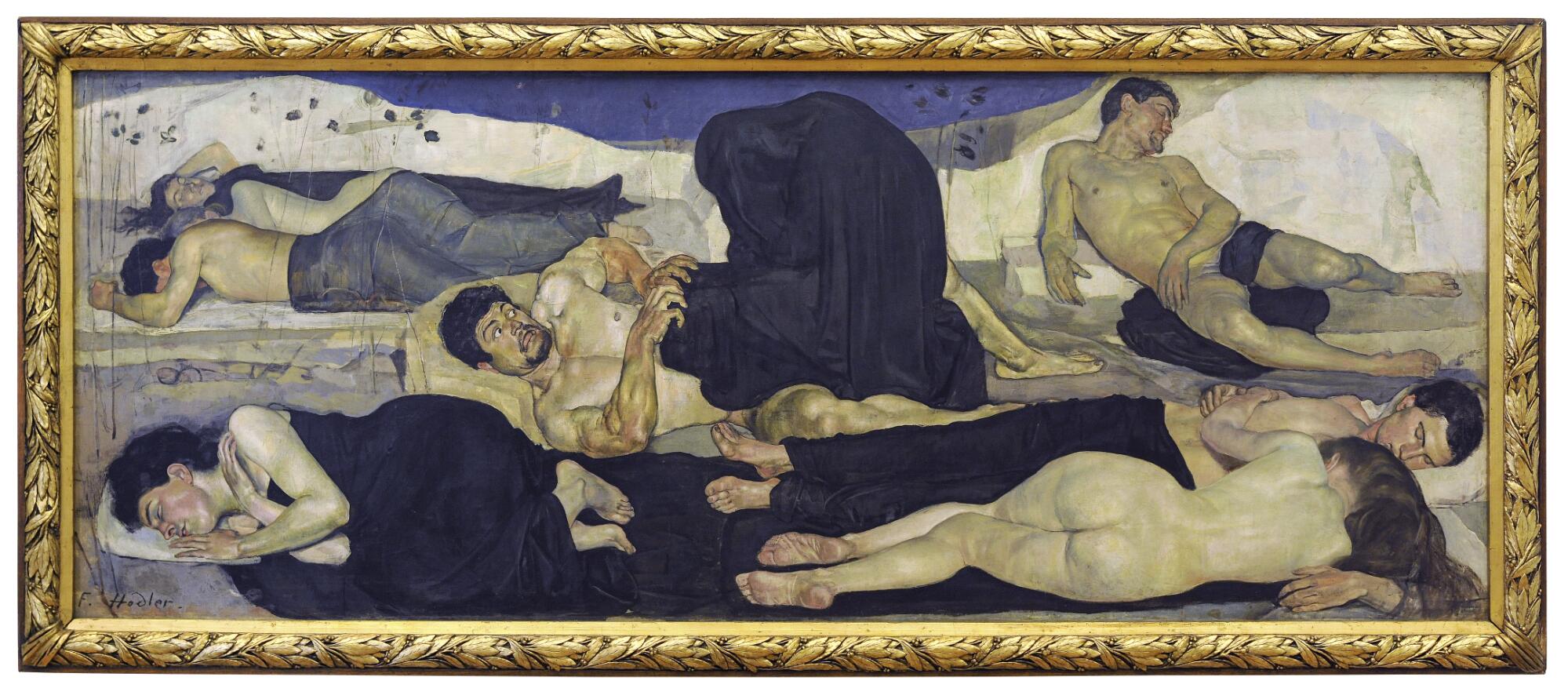
In the painting The Night, Hodler placed a naked, reclining man at the centre of the composition and a succubus, shrouded in black, upon his lower abdomen and thighs. The sleeper startles in utter terror, clawing at the knees or paws of the nightmare to fend it off. None of the surrounding sleepers take any notice of what is happening. Hodler used himself as the model for the terrified figure, which gave rise to many psychoanalytical interpretations – all the more so as people recognised his wife in the sleeping woman from whom he had turned away and suspected the naked woman to be a mistress, rather than seeking out professional models.
Around the centre of the painting, where the painter depicted himself with sheer horror etched on his face, he arranged further figures in a loose balance upon black cloths. The young woman on the left, sleeping in a childlike posture and reminiscent of the sleeping Augustine (Fig. 1), is compositionally mirrored on the other side by the embracing couple. Hodler painted the woman as a nude seen from behind, with a wonderfully luminous complexion and flowing hair. He could thus have rivalled Diego Velázquez’s nude seen from behind in The Rokeby Venus, had this work not been in the art trade in England from 1813 onwards, and subsequently in private hands; it was not until 1906 that it entered the National Gallery in London. By contrast, the Musée Rath in Geneva had, since 1875, held a reclining female nude by Jean-Baptiste-Camille Corot, which, whilst not serving as a model for the pose of Hodler’s *Sleeping Woman*, could well have provided inspiration or posed a challenge in terms of the flesh tones. The reclining male nude, which remained in private hands in Geneva until 1912 and is attributed to Corot or Menn, must be considered as an inspiration for the pose of Hodler’s reclining male figure, not merely the Diogenes in Raphael’s School of Athens, which has been mentioned in this context. The flesh tones of the reclining figure, like those of Hodler’s self-portrait and that of Augustine, are painted with the utmost delicacy; the light makes the curves gleam. The group of three reclining figures at the back left shows only a pale flesh tone without the decorative highlights.
The setting is a dune landscape, with a whitish dune forming the rear boundary of the composition of figures. In front of the horizon, a narrow strip of sand in the hollow grows darker. The night sky is a wonderfully deep sapphire blue. The dune and the figures on the black cloths appear to be bathed in cold moonlight. Between the groups and at the back in front of the dune, thin dark grasses – which Hodler painted with a fine brush – form the only vertical lines in the picture. The curved back of the succubus breaks through the horizontal line of the dune.
In Hodler’s landscape paintings featuring meadows, created around 1900, a similarly delicate line work with a fine brush can be seen, as with the grasses in Die Nacht.12Hodler, Cat. rais.,* no. 220. ↩ A small painting such as Die goldene Aue, dating from around 1890, displays this finely drawn rendering of the grasses. Hodler was an admirer of Dürer; however, it is not known whether he ever saw Dürer’s Large Piece of Grass from 1503, either in the original or as a reproduction. Hodler abandoned the exceptionally fine brushwork that characterises the nude back and the grasses in The Night during the course of the 1890s.
The 1891 Exhibition
Hodler submitted his painting to the Exposition municipale in Geneva in 1891, and the jury accepted it for the annual exhibition at the Musée Rath. However, at the request of the Mayor, Théodore Turrettini, the Geneva City Council had the painting removed before the exhibition opened. Hodler protested against this arbitrary overturning of the jury’s decision in the newspaper Le Genevois on 18 February. A series of articles in the Geneva daily newspapers mocked the authorities for their prudishness, but they cited their duty to maintain public order. As ever, the censorship aroused public interest, and Hodler quickly organised a paid exhibition at the Palais électoral, using the exhibition poster to denounce the authorities’ arbitrary actions. In three weeks, he took in admission fees of nearly 1,200 francs, of which he spent 18.50 francs on transporting his painting to Paris. In mid-April, he submitted his work to the jury of the Salon du Champs-de-Mars. Mathias Morhardt, one of Hodler’s friends in Paris, reported in La Revue du Dimanche on 21 June: “Mr Hodler’s painting was unanimously accepted by the Champs-de-Mars jury.” Edouard Rod, a professor at the University of Geneva, published an essay on the Salon featuring a lengthy review of Hodler’s painting in the influential journal Gazette des Beaux-Arts.
The painting’s success story is a long one, as Hodler exhibited his work throughout Europe; the only setback came in 1896, once again in Geneva. The commission for the 1896 National Exhibition, chaired by Turrettini, prevented the exhibition of Night, which infuriated the artist. In the same year, however, Hodler won the competition for the murals in the new National Museum in Zurich. Opponents used persistent polemics to prevent the painting from being carried out, until the Federal Council finally ordered the frescoes to be executed. In 1901, a year after the work in Zurich was completed, the Cantonal Government of Bern purchased four large paintings by Hodler for the Kunstmuseum, including The Night and its counterpart, The Day, which celebrates the joy of light.