Article
Naval Bathhouse
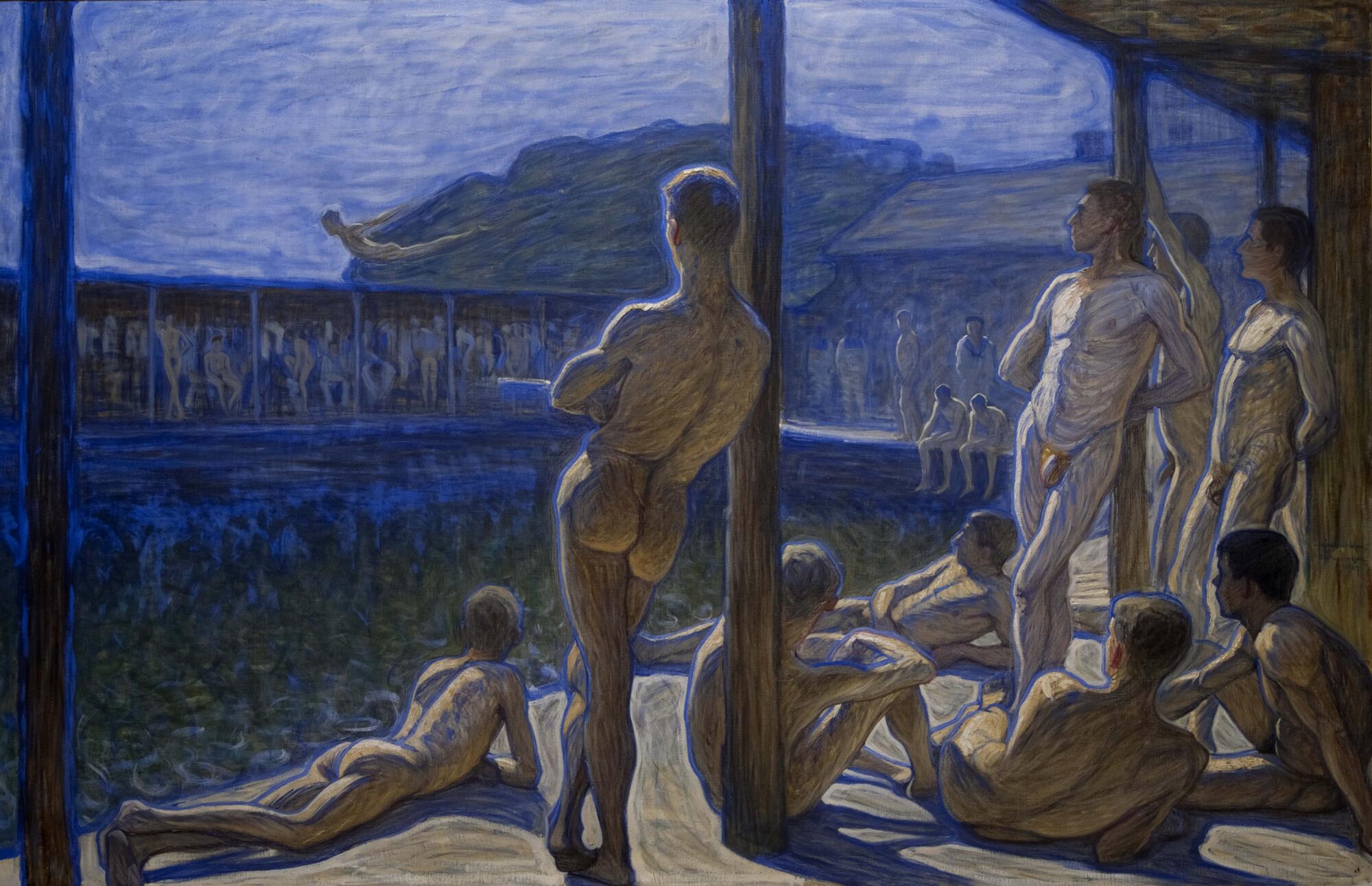
Eugène Jansson was born in Stockholm into a relatively well-established lower-middle-class family. His mother and at least one uncle had artistic inclinations, so there is every reason to believe that the young Eugène was encouraged to develop his own talents. Having been born frail and sickly, his family may have sensed that his best prospects lay in some form of creative pursuit. 1Inger Zachau, *Eugéne Jansson. The Painter of the Blue City*, Lund, 1997, 12. ↩ However, a childhood marked by illness resulted in mediocre school grades, and the family’s circumstances did not allow for an expensive private school. Instead, Jansson received his first artistic training at the Slöjdskolan and took private lessons in drawing and painting with the older artists Edvard Perséus and Zackarias Blackstadius. From them he learnt the Munich School’s meticulous approach to drawing, and several of his early works from his youth are still lifes and skilful studies of old armour and pots – the sort of historical props that the history painter Perséus would likely have had in his studio. It was precisely with such a study that he was admitted to the Royal Academy of Fine Arts in 1882. His time as a student there, however, was short-lived and he never graduated. His biographer, Inger Zachau, speculates that financial reasons may have been decisive. For a few years, he earned a living as an assistant to Perseus and, perhaps under the influence of his friend, the painter Karl Nordström, he discovered new sources of inspiration in the natural surroundings of Stockholm.2Birgit Rausing, ‘Painting’, in: *Signum’s History of Swedish Art*. Art 190–1915, Lund, 2001, 244. ↩
On Mariaberget, south of the city centre, he found views over Lake Mälaren that proved decisive for the development of his style and use of colour. 3Zachau (1997), 26, 56. ↩ At dusk, Stockholm is bathed in a distinctive blue light, perhaps an effect of the city being entirely surrounded by water. The colour blue gradually became prominent in Jansson’s paintings during the 1890s, as did his fascination with twilight. One can imagine him setting up his easel early in the day, but that gradually, as the sun set, the entire landscape was suddenly transformed as pink and red clouds gave way to indigo and cobalt. In his paintings from this period, one sees many different shades of blue, ranging from light sky blue to violet and almost black-blue. “He anchored his own painterly experience in space, the atmosphere itself and the lights over Stockholm,” writes art historian Birgit Rausing.4Rausing (2001), 246. ↩
The Blue Painter
Throughout the 1890s, Jansson devoted himself to depicting his hometown at dusk. These atmospheric twilight landscapes gave way to nocturnes, in which the dark Stockholm night in parks and alleyways is illuminated by the glow of gas lamps.
During these years, Eugéne Jansson became increasingly established on the Swedish art scene. As early as 1885, he had been invited to exhibit at the Opponents’ Salon, which brought together the younger and more progressive contingent of Stockholm’s art scene. The following year, he joined the Artists’ Association, which had been formed in reaction to what was perceived as the conservative spirit of the Royal Academy of Fine Arts. The participating artists here (who, alongside Jansson, included Richard Bergh, Nils Kreuger, Ernst Josephsson, Bruno Liljefors and Carl Larsson, to name but a few) championed the new impulses in French painting, with plein air painting, Symbolism and Realism as the leading trends. Jansson exhibited within these circles, coming into contact with the art collector Ernst Thiel and his namesake, Prince Eugène – the ‘painting prince’ – who was also a key driving force behind the new wave of painting in Stockholm.
Jansson painted increasingly bold cityscapes, with vigorous brushwork that was undoubtedly strongly influenced by Edvard Munch’s expressionist style. Munch’s exhibition in Stockholm in 1894 appears to have made a great impression, although Jansson was, of course, already familiar with the Norwegian painter’s earlier works.5Zachau (1997), 88. ↩
It is often pointed out that Jansson’s series of urban night scenes from the late 1890s, his *Nocturnes*, was inspired by Chopin’s piano pieces of the same name, and friends testified that Jansson often played these pieces on a piano in his studio. The English painter Whistler’s Nocturnes are another reference frequently cited. He was certainly also well acquainted with both the writer Oscar Wilde and the Symbolist painter Arnold Böcklin.6Göran Söderlund, ‘Visionary in Blue – Eugène Jansson’s Atmospheric Painting’, in: Söderlund & Meister (eds.), Eugène Jansson – Blue Twilight and Naked Athletes, Prince Eugen’s Waldemarsudde, 2012, 55 ↩ But Jansson’s interest in the urban landscape after dark may also have been linked to the artist’s exploration of erotic spaces. Several of the alleys and parks that Jansson depicts as desolate places were, in fact, teeming with activity that was not permitted in the light of day. Places such as Humlegården and the area around Nybrohamnen were meeting places for men seeking sexual encounters with other men. This was a form of cruising, in the modern sense of anonymous encounters between ordinary men of all ages and social backgrounds. But another extremely common phenomenon was so-called ‘soldier prostitution’, with guardsmen supplementing their meagre incomes by selling sexual services. 7Greger Eman, ‘Café Frisk Luft. The Homosexual Infrastructure in Stockholm 1880–1920’. In: Fredrik Silverstolpe et al., The Secret Power of Sympathy: Stockholm’s Homosexuals 1860–1960, Borås, 1990, 104–124. ↩ Among others, the art critic Carl Johan Malmberg has pointed out that the blue atmospheric landscapes possess erotic qualities, and it can be argued that several of the late landscapes are encoded in a queer vocabulary.8Patrik Steorn, ‘The City’s Men and Models – Eugène Jansson’s Figure Painting’, in: Söderlund & Meister (eds.), Eugène Jansson – Blue Twilight and Naked Athletes, Prince Eugen’s Waldemarsudde, 2012, 79. ↩
Naked men
Several art historians with a queer perspective have noted that Eugène Jansson appears to have undergone a homosexual awakening, which was expressed through a comprehensive lifestyle transformation after the turn of the 20th century.
Eugène Jansson became a prominent figure in the bohemian artistic culture that emerged in Stockholm at the turn of the 20th century. He was elected to the board of the Artists’ Association and was a frequent guest at social gatherings, although he is also often described as a loner. But having previously had a more ‘proletarian’ demeanour, with openly socialist sympathies, he suddenly underwent a transformation and cultivated a more vain appearance. He was now regarded as something of a dandy, always very well-dressed and downright dashing, ‘with calculated refinement’, as a contemporary lady described him. Together with his friends Carl Larsson and Bruno Liljefors, he was often seen at parties and dinners, always sporting eye-catching accessories such as flamboyant jewellery and colourful scarves and socks.9Göran Söderlund (2012), 46. ↩ He also became very interested in his own physical appearance and was seen with a tan at several of the city’s bathhouses. He painted less and less, and had completely abandoned landscape painting. Instead, he turned to figure painting, recruiting models from among the young sailors at the bathhouses.
Art historians have often highlighted the ideals of vitalism as a motivation for Jansson and the series of depictions of nude gymnasts and bathing youths that would characterise his final years as an artist. Outdoor life, health food and sport – as well as the life-giving power of the sun – were integral parts of a health-promoting lifestyle philosophy that became popular amongst many artists after the turn of the century. 10Eman (1999), 218. Rausing (2001), 247. ↩ In the Nordic region, it is particularly Munch, JAG Acke, the Danish artist J. F. Willumsen, and to some extent the Norwegian Thorvald Erichsen who are associated with vitalism. There was undoubtedly a strong idealistic driving force behind Jansson’s interest in the male body in motion, but perhaps it can also be seen as an expression of his own personal quest for liberation. The fact that Jansson was not ashamed of his increasingly strong interest in young men is borne out by the accounts of several of his friends.11Steorn (2012), 91. ↩ In particular, his relationship with Knut Nyman, known as Knutte. Knutte modelled for several of Jansson’s paintings, such as *Naked Youth* (1907, Prince Eugen’s Waldemarsudde), and their relationship was so strong that they lived together for periods. In Jansson’s studio, several young men would often walk about naked and do gymnastics whilst the artist made sketches, a working process documented in several photographs from the period.
After a few years’ absence from the Stockholm art scene, Jansson exhibited a number of nude studies in 1907. This was the artist’s first public showing of this new style of figure painting.
The painting Flottans Badhus, signed 1907, is a monumental composition that synthesises Jansson’s meticulous figure studies with his experience of rendering shifts in light from his earlier atmospheric paintings. The sun casts blue shadows over muscular male bodies standing, sitting or lying along the jetty at the bathhouse. A particularly well-built young man stands with his back to the viewer and appears to be watching a bather who is throwing herself into the water from one of the roofs. It is a daring, powerful and highly painterly composition, which marks the transition from experimentation to a fully realised form.
There has been speculation that the man jumping is the artist himself, and a photograph that originally belonged to the artist seems to support this view; however, it is also reasonable to assume that the painting is not based on a single event, but perhaps on several different studies. A second photograph shows a dark-haired young man who can hardly be mistaken for the artist.12Steorn (2012), 113–114. Several photographs from the bathhouse depicting Eugene Jansson and his young models appear to have been in his brother’s possession and passed on by him to Nils Santesson, an openly gay art caster who found himself embroiled in several legal cases and persecuted on account of his sexuality. ↩ Jansson also painted a variant, Badtavla, in 1908, in which the diver is depicted from behind, just as he has jumped from the springboard.
Despite a certain interest at the time in the ideals of vitalism, many members of the public were shocked by Eugene Jansson’s unabashedly sensual male bodies. They were perceived as far too raw and sexualised. However, several of the era’s key patrons supported Jansson’s new direction, and the leading art collector Ernst Thiel, a close friend of Jansson’s, purchased *Flottans Badhus*. It was given a prominent place in Villa Thiel on Djurgården, which later became the Thiel Gallery, one of Stockholm’s foremost public museums. Yet society’s rejection of homosexuality continued to haunt Jansson, and his later, body-celebrating paintings were more or less hidden away in favour of his atmospheric landscapes, right up until the present day. It was not until the exhibition Blue Twilight and Naked Athletes, held at Prince Eugen’s Waldemarsudde in 2012, that the artist and his athletes were finally able to come out of the closet. Since then, the Thielska Gallery has highlighted *The Navy’s Bathhouse* as one of the most important paintings in its permanent collection.