Article
Dance of Death
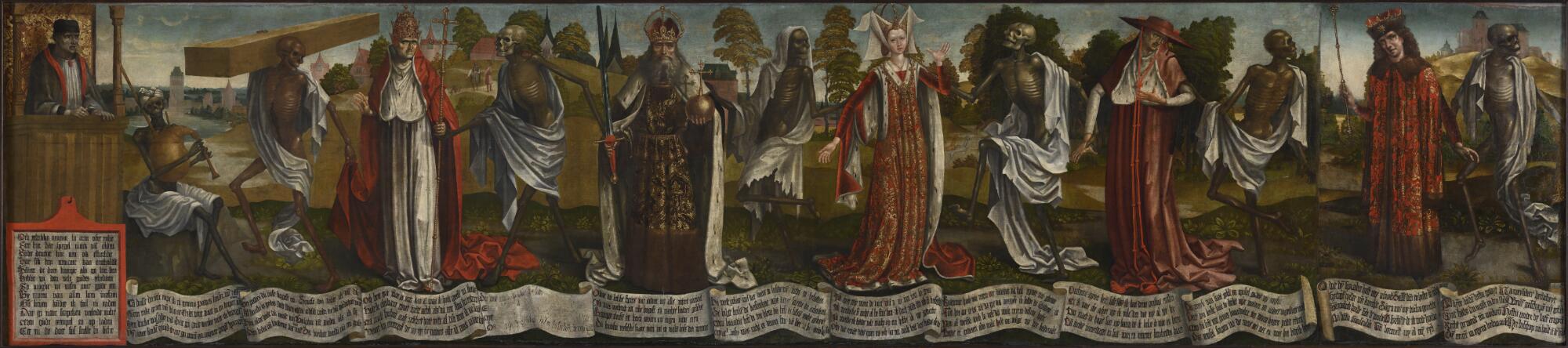
The Dance of Death in the former St Nicholas’ Church (Nikolaikirche, Niguliste, now a museum) in Tallinn (German Reval), is one of the most striking and monumental interpretations of the memento mori theme in late medieval Europe. At the same time, it is the most internationally renowned medieval artwork in Estonia.
The Dance of Death (Danse Macabre) motif symbolically depicts the universality and inevitability of death. Its narrative structure — where personified Death calls all members of society to dance — was widespread in late medieval European art and literature. The iconographic type that developed in the High Middle Ages generally showed a hierarchical line of living people dancing alternately with Death, depicted as a skeleton. The sequence began with the powerful of the world — the pope and emperor — and usually ended with a peasant, a jester, or an infant in a cradle. Between the highest dignitaries, and the weakest and poorest were representatives of various social estates: canons, mayors, merchants, and artisans. These Dance of Death images are therefore performative. The visual representation of the dance between the living and Death was often accompanied by a moralising text, most often in verse form, presenting a dialogue between Death’s call to dance and the responses of its victims.
The Dance of Death in European culture
The iconography of the Dance of Death originated from medieval literature and liturgical drama. One of its earliest sources was the legend of the Three Living and the Three Dead. The popularity, meaning, and significance of the theme in medieval literature and art was greatly influenced by the Black Death — the wave of plague that ravaged Europe in the mid-fourteenth century.
The pictorial image of the Dance of Death emerged in the fourteenth century and invited reflection on the transience of life. Images and texts showing the joint dance of Death and mortals carried the message memento mori — “[remember (that you have) to die]{.mark}”. The theme was closely tied to the question of what happens to a person after their earthly life — signalling the need to prepare for the afterlife. The images emphasised the universality of death and its eternal triumph over the living: before death, all were equal; status, office, wealth, and age were irrelevant. The fate awaiting people after death depended above all on how they had lived: their deeds determined whether they would end in heaven, hell, or purgatory. Despite Death’s supremacy, in these images it is more a messenger — a guide to the other world — than a brute executioner.
The first known Dance of Death cycle (now destroyed) was painted in 1424—1425 on the outer wall of the charnel house at the Cemetery of the Innocents (Cimetière des Innocents) in Paris. Based on these frescoes, woodcuts were made and published in Paris in 1485, which contributed to the widespread dissemination of the already popular motif throughout European art, including in England, Germany, Switzerland, Italy, and Croatia.1Elina Gertsman, The Dance of Death in the Middle Ages. Image, Text, Performance, Turnhout 2010, 3-13. ↩
As works of monumental art intended for public space, Dances of Death were aimed at a broad audience and accessible to diverse viewers. Surviving examples in fresco form were usually painted on the walls of chapels at church entrances or beneath towers, on cemetery walls, and sometimes even on church exteriors. In monastic complexes, Dance of Death frescoes could run as friezes along cloister walks. The Dance of Death in Tallinn’s St Nicholas’ Church is one of the few monumental works on canvas on this theme, and the only one to survive — albeit only in part.
In addition, Dances of Death were performed in the Middle Ages in cemeteries, churchyards, or churches as moralising and didactic plays, often with a preaching component. The Tallinn Dance of Death likewise begins with a preacher in a pulpit and his introductory text. The structure of the verse text is close to that used in contemporary sermons, and it is possible that such paintings were used as part of preaching.2Susanne Warda, Memento mori. Bild in Text in Totentänzen des Spätmittelalters und der Frühen Neuzeit, Cologne 2011, 319-321. ↩
Bernt Notke’s Dances of Death in Tallinn and Lübeck
The Tallinn Dance of Death was probably painted in the late fifteenth century in Lübeck, in the workshop of the German artist Bernt Notke.3Mai Lumiste, Tallinna Surmatants, Tallinn 1976. The discussion on Notke’s authorship has been summarised by Krista Andreson, “Research on Tallinn’s Dance of Death and Mai Lumiste. Questions and Possibilities in the 20th Century”, in: Kunstiteaduslikke Uurimusi / Studies on Art and Architecture 22, no. 3/4 (2013), 96-109; Jan Friedrich Richter, “Bernt Notke — Revisited”, in: Zeitschrift des Deutschen Vereins für Kunstwissenschaft 72/73 (2018/2019), Berlin 2021 (Sonderdruck), 297-346. ↩ Notke was one of Lübeck’s most important masters at the time. His large workshop produced paintings, sculptures, altarpieces, and other works for patrons in what is now Germany, Denmark, Sweden, and Estonia. Even among those works documented as originating from his workshop (such as the high altar retables of Aarhus Cathedral in Denmark or the Holy Spirit Church in Tallinn), there is noticeable variation in quality and style, indicating that the workshop comprised several masters of differing skills and levels. The particularly high quality of the Tallinn Dance of Death has been linked to the involvement of Notke himself or his closest collaborators.4Kerstin Petermann, Bernt Notke. Arbeitsweise und Werkstattorganisation im späten Mittelalter, Berlin 2000; Anu Mänd, Bernt Notke — Between Innovation and Tradition, Tallinn 2010. ↩
Of the monumental work, only the beginning survives — a canvas 7.5 meters long and 1.6 meters high. Originally consisting of several (four or five) large sections, only the first panel (with 11 figures) and the beginning of the second (with 2 figures) remain. This surviving portion — about a quarter of the whole — may once have been about 30 meters long. It is unknown what happened to the missing parts, or when the two surviving fragments were joined. The painting is on a canvas of three horizontally stitched strips (from top to bottom: 67 cm, 66/67 cm, and 29/30 cm) executed in a mixed tempera and oil technique. The canvas, impregnated with animal glue, lacks a traditional ground layer.5Mai Lumiste, “Mõningaid täpsustusi Tallinna Surmatantsu kohta”, in: Kunst 1 (1964), 45-52; Mai Lumiste and Svetlana Globatschowa, “Der Revaler Totentanz von Bernt Notke. Forschungsergebnisse im Lichte einer neuen Restaurierung”, in: Zeitschrift des Deutschen Vereins für Kunstwissenschaft 23, no. 1/4 (1969), 122-138. ↩
The Tallinn painting is a thematic repetition of an earlier Dance of Death attributed to Notke, created in the 1460s for the confession chapel in St Mary’s Church (Marienkirche), Lübeck. By 1701 the Lübeck painting was in such poor condition that painter Anton Wortmann made a copy, but neither original nor copy survives: the copy was destroyed in a fire following the bombing of Lübeck in spring 1942. Wortmann’s copy showed 49 figures, though two were later cut out. It began with two Death figures — one playing a flute, the other carrying a coffin — followed by the alternating dance of mortals and Death, headed by the pope and ending with an infant in a cradle. In the early eighteenth century, the Low German verses at the bottom of the Lübeck painting were also transcribed.6Hartmut Freytag, ed., Der Totentanz der Marienkirche in Lübeck und der Nikolaikirche in Reval (Tallinn). Edition, Kommentar, Interpretation, Rezeption, Cologne 1993. ↩
The surviving part of the Tallinn painting shows 13 figures, including the Pope, Emperor, Empress, Cardinal, and King, alternating with Death figures. Unusually, the sequence begins with a Preacher in a pulpit. The first Death plays bagpipes, the second carries a coffin, and the rest dance. At the far right is the start of the next figure — a Bishop, identified by his robe, the dialogue text, and the Lübeck model. Between the King and Death is the seam between two canvas panels. As in the Lübeck version, the Tallinn work may originally have had around 50 figures.
The background depicts a hilly early autumn landscape with bodies of water, interspersed with views of Lübeck and smaller scenes of daily life and hunting. Unlike the Lübeck painting’s copy or, for example, the high altar retable of St Nicholas’ Church (made in Lübeck in Hermen Rode’s workshop in the 1470s),7Hilkka Hiiop and Merike Kurisoo, eds., Rode Altarpiece in Close-up, Tallinn 2016. ↩ the Tallinn work does not show a panorama of Lübeck. Recognisable, however, are Lübeck’s churches and wall towers — Mühlentor, St Mary’s Church, Kaiserturm, Blauer Turm, Absalomsturm, Hexenturm, St Gertrude’s Chapel, and probably also Olafsburg.8Hildegard Vogeler, “Zum Gemälde des Lübecker und des Revaler Totentanz”, in: Freytag (1993), 73-108. ↩ The dance is thus set against the idyllic backdrop of a Hanseatic town — one familiar and recognisable to a late medieval Tallinner.9Elina Gertsman, “The Dance of Death in Reval (Tallinn): The Preacher and His Audience”, in: Gesta 42, no. 2 (2003), 144. ↩
The message of the painting
At the bottom of the Tallinn painting runs a verse dialogue in Low German Gothic minuscule script. It is not a copy of the Lübeck version but is a different, independent translation. In both paintings, the model for the text was the same original source, adapted here in accordance with the wishes of Tallinn’s patrons: the text of the Tallinn Dance of Death is in traditional Low German, whereas the Lübeck text shows the influence of a Netherlandish dialect. 10Robert Damme, “Zur Sprache des Lübeck-Revaler Totentanzes”, in: Freytag (1993), 59-71; Warda, (2011), 319-321; Susanne Warda, “Bernt Notke’s Dance of Death. Word and Image and Their Repercussions in Art and Literature”, in: Anu Mänd and Uwe Albrecht, eds., Art, Cult and Patronage. Die visuelle Kultur im Ostseeraum zur Zeit Bernt Notkes, Kiel 2013, 81-95. ↩ The language of the Tallinn text has also been dated slightly later, to the final decades of the fifteenth century.
The dialogue is introduced by the words of a preacher standing in a pulpit, presented on a text panel framed in red below him. In the image, the preacher addresses the dancers and the viewers thus instructing the latter — pointing out what is important and inviting the viewer to take part in the journey that awaits the dancers:
O, reasonable creature, whether poor or rich!
Look here into this mirror, young and old,
and remember all
that no one can stay here
when death comes as you see here.
If we do good deeds
we can be together with God.
We will get the reward we justly deserve.
My dear children, I want to advise you
not to lead your sheep astray,
but to be to them a good model
Before death suddenly appears at your side.11Translation from the painting here and in the following quotes by Elina Gertsman: Gertsman (2003), 154-155. The original text: “Ochredelike creatuer sy arm ofte ryke / Seethyr dat spegel junck vñ olden / Vnde dencket hyr aen ok elkerlike / Dat sik hyr nemant kan ontholden / Wanneer de doet kumpt als gy hyr seen / Hebbe wi den vele gudes ghedaen / So moghe wi wesen myt gode een / Wy moten van allen loen vntfaen / Vñ lieven kynder ik wil ju raden / Dat gi juwe scapeken verleide nicht / Mengude exempel en op laden / Eer ju de doet sus snelle bi licht” ↩
The Low German dialogue between Death and the figures is painted on a broad, undulating white text band running along the bottom of the image. Addressing the dancers, Death satirically mocks the futility of mortal ambitions, disregarding the torment and distress of those compelled to join the dance. Death to All:
I call all and everyone to this dance:
pope, emperor, and all creatures
poor, rich, big, or small.
Step forward, mourning won’t help now!
Remember though at all times
to bring good deeds with you
and to repent your sins
for you must dance to my pipe.12“To dussem dantse rope ik al gemene Pawes keiser vñ alle creatu[…] / Arm ryke groet vñ kleine Tredet vort went iu en helpetnen truren / Men dencket wol in aller tyd Dat gy gude werke myt iubringen / Vñ iuwer sunden werden quyd Went gy moten na myner pypenspringen” ↩
Death to the Pope:
Pope, now you are the highest,
let us lead the dance, me and you!
Even though you may have been God’s representative,
a father on earth, received honor and glory
from all men in this world, you must
follow me and become what I am.
What you loosed was loosed, what you bound was bound,
but now you lose your great esteem.13“Her pawes du byst hogest nu Dantse wy voer ik vñ du / Al heuestu in godes stede staen Een erdesch vader ere vñwerdicheit vntfaen / Van alder werlt du most my Volghen vñ werden als ik sy / Dyn losent vñ bindent dat was vast Der hoecheit werstu nueen gast” ↩
Pope:
O Lord God, of what use is it to me —
even though I reached a high position
I must here and now
become a handful of earth just like you.
Neither esteem nor wealth can be of any use to me
for I have to leave it all behind.
Let this be an example to you, you who will be pope
after me as I was in my time.14“Och here got wat is min bate al was ik hoch geresen in state / Vndeik altohant moet werden gelik als du een slim der erden / Mimach hocheit noch rickheit baten wente al dink mot ik nalaten / Nemet hir excempel de na mi sit pawes alse ik was mine tit” ↩
Death to Pope, then to the Emperor:
[…]
Emperor, we have to dance!15”[…] / herkeiser wi mote d[…]” ↩
Emperor:
O death, you ugly figure,
you completely change my nature.
I was rich and powerful,
the most powerful one without compare.
Kings, dukes and noblemen
had to bow before me and honor me.
Now you come, horrible apparition,
to make worm feed of me.16“O dot du letlike figure vor andert my ale myne natture / Ikwas mechtich vñ rike hogest van machte sunder gelike / Koningevorsten vñ heren mosten my nigen vnde eren / Nu kumstu vreselike forme van mi to maken spise der worme” ↩
Death to the Emperor, then to the Empress:
You were chosen — ponder it well! —
to protect and guard
the holy church of Christendom
with the sword of justice.
But haughtiness has blinded you,
you didn’t know yourself.
My coming you did not expect.
Turn you to me now, empress!17“Du werst gekoren wil dat vroden to beschermen vnde to behoden / Dehilgen kerken de kerstenheit myt deme swerde der rechticheit / Menhouardie heft di vor blent du heft di suluen nicht gekent / Mine […] kumste was nicht in dinem sinne […] u[…]er […]h [f]row [k]eiser[inne?]” ↩
Empress:
I know it’s me death means.
I’ve never been so terrified before.
I thought he was not in his right mind,
for I am so young and an empress, too!
I believed I had great power,
but of death I never thought
or that someone else would hurt me.
Oh, let me live a little longer, I pray you!18“Ich wet my ment de doet was […] ny vor vert so grot / Ikmende he si nicht al bi sinne bin ik doch junck vñ ok ein keiserinn(e) / Ikmende ik hedde vele macht vp em hebbe ik ny gedacht / Oftedat jement dede tegen mi och lat mi noch leuen des bidde ik di” ↩
Death to the Empress, then to the Cardinal:
Utterly insolent empress,
it seems to me that you have forgotten me.
Come here! It’s time now.
You believed I would spare you?
Not at all, however great you may be,
you have to follow me to this roundelay
and all you others as well!
Stop, follow me, cardinal!19“Keiserinne hoch vor meten my duncket du hest myner vor gheten / Tredhyr an it is nu de tyt du mendest ik solde di schelden quit / Nenal werstu noch so vele du most myt to dessem spele / Vndegi anderen alto male holt an volge my her kerdenale” ↩
Cardinal:
Have mercy on me Lord, now that it has to happen!
There is no way for me to escape from you.
Whether I look before or behind
I always sense death close to me.
Of what use can the high rank be to me
which I attained? I have to leave it behind
and instantly become less worthy
than a foul stinking dog.20“Ontfarme myner here salt schen ik kan deme gensins entflen / Se ik vore efte achter my ik vole den dot my al tyt by / Wat mach de hoge saet my baten den ik besat ik mot enlaten / Vi werden vnwerdiger ter stunt wen en vnreinestinckende hunt” ↩
Death to the Cardinal, then to the King:
You were esteemed
like an apostle of God on earth,
that you may support the Christian faith
with words and other virtuous deeds.
But in your great haughtiness
you sat on your high horse.
Therefore now you have to worry even more!
Step forward now, noble king!21“Du werest van state gelike en apostel godes vp ertry[k]e / Vmme den kersten louen to sterken myt worden vñanderen dogentsammen werk[en] / Men du hest mit groter houardichit vp dinen hogen perdenreden / Des mostu sorgen nu de mere nu tret […] vort herkonnink here” ↩
King:
Oh death, your words have scared me!
This dance I haven’t learned.
Dukes, knights, and squires
serve me precious dishes
and everyone took heed
not to speak the words I disliked to hear.
Now you come unexpectedly
and rob me of my entire kingdom!22“O dot dyn sprake heft my vo[r]uert Dussen dans en hebbe ik niht gelert / Hertogen rydder vñ knechte D[r]agen vor my durbargerichte / Vñ jwelick hodde sick de worde To sprekende de iknode horde / Nu koms[t]. vnuorsenlik Vñ berouest my al myn ryk” ↩
Death to the King, then to the Bishop:
All your thoughts were about
worldly splendor.
How does that help you now? You have to sink into the earth
and become like me.
You let bent and perverted laws
prevail during your kingship,
you wrought violence on the poor as if they were slaves.
Bishop, give me your hand!23“Al dynne danken heftu geleyt Na werliker herlicheyt / Wat batet du most in den slik Werden geschapen myngelik / Recht gewent vñ vorkeren Heftu vnder dy latenreigeren / Den armen […] egene bedwank Her bischop nu holt ande hant’ ↩
Although Dance of Death paintings are often associated with monastic orders, the preacher’s attire does not point to any specific order. However, certain characteristically Franciscan features have been identified in the verses of both the Tallinn and Lübeck versions. One possible original location for Tallinn’s Dance of Death has been considered to be the Dominican friary in Tallinn (dissolved in 1524, with the church in ruins since 1531).24Petermann (2000), 30—36. ↩
Both the Death and the mortal figures are painted with exceptional mastery. This large-scale work was clearly executed in a workshop setting: the “handwriting” of different painters can be recognised. Notably, the face of the emperor in Tallinn’s Dance of Death resembles that of God the Father depicted on the altarpiece of the Schonenfahrer (Johannesaltar der Schonenfahrer, c. 1475, Lübeck, St. Annen-Museum), one of the works attributed to Notke. Similar facial features can also be found in the triumphal cross of Lübeck Cathedral (1477), whose origin in Notke’s workshop is documented.25Petermann (2000), 38; Richter (2021), 302-304; Anu Mänd, “Surmatants”, in: Kersti Markus, ed., Eesti kunsti ajalugu, vol. 1: 1100—1520, gen. ed. Krista Kodres, Tallinn 2023, 401. ↩
The nearly life-size dancers in Tallinn’s Dance of Death are characterised by movement and repetition. The skeletons are shown as highly dynamic, grinning, and in striking dance poses, whereas the mortals, arranged in hierarchical order, are more static, with sombre or startled expressions. Particularly striking are the faces of the Pope and the Emperor, both at the top of the social hierarchy.
The costumes of the Dance of Death characters and the insignia of power bearers follow contemporary Habsburg and Burgundian traditions and fashions, demonstrating the workshop’s high level of awareness. The most powerful of the mortals, the Pope, is clad in a red cappa (cappa rubea) lined with ermine, wears a triple-tiered tiara (triregnum), and holds a ferula in his left hand. The Emperor wears a surcoat (surcot) of gold brocade edged with wide sable fur, over which is draped a splendid mantle with an ermine collar. In his left hand he holds the orb of state, in his right a sword. On his head is the so-called mitre crown characteristic of the Habsburgs, rulers of the Holy Roman Empire. The Empress is dressed according to the height of fashion of the time: in an ermine-trimmed surcoat with “devil’s windows” and an impressive headdress, which combines the double-horned Burgundian hennin and ornate metal bands of the imperial crown. The Cardinal is clad in a crimson cappa magna and wears the cardinal’s hat (galero) appropriate to his rank. The King wears a brocade houppelande with fur-trimmed headgear surmounted by a small crown; a notable accessory is his distinguished jewellery, including a brooch referring to the Burgundian court.
The Emperor, Empress, and King wear luxurious garments appropriate to their status and are depicted together with the symbols of authority proper to their office. The Empress’s gown and headdress in particular reflect the fashions of the high nobility of the Burgundian Netherlands. Some details of the splendid rulers’ attire derive from fashions of the 1460s, but the pomegranate pattern of the Empress’s dress dates from the late fifteenth century, and the Emperor’s pomegranate rosettes and pinecone pattern date from century’s final quarter.26Kerttu Palginõmm, Asjade võim / The Power of Things, Tallinn 2019, 78-93. ↩
The original context and restoration history of the painting
The commissioner of Tallinn’s Dance of Death is unfortunately unknown. Given the monumental scale and costly nature of the work, it was most likely funded by wealthy donors. From other surviving artworks, we know that the merchant community of Tallinn had both the means and the expertise to commission expensive and splendid church art from major European centres. Medieval Tallinn was a prosperous Hanseatic city whose merchants maintained close ties especially with the cities of northern Germany.
Since the painting is not mentioned in the medieval account book of St Nicholas’ Church (1465—1520), it is possible that it was donated either by a wealthy private individual (most likely a merchant), a guild, a confraternity, or the Tallinn Town Council. St Nicholas’ was one of the city’s two parish churches, and its late medieval interior was particularly rich. (It has also been speculated that the work may not have originally been located in St Nicholas’ Church at all, but in the Dominican Church of St Catherine in Tallinn, though no evidence for this has survived.) In any case, the painting was in St Nicholas’ Church by the early seventeenth century at the latest. It is first mentioned in written sources in 1603, when the churchwarden of St Nicholas’ paid the woodcarver Thomas for earlier works he had carried out on the Dance of Death. In 1623, an anonymous painter was paid for renovating and cleaning the Dance of Death. By the mid-seventeenth century, the painting’s location was recorded as the Chapel of St Anthony (known in the Middle Ages as the Chapel of St Matthew).27Lumiste (1976), 26. ↩ The commissioning of the Dance of Death has also been associated with the renovation of this chapel in the 1480s.
The original location of the complete monumental painting within St Anthony’s Chapel is unknown. The work, about 30 metres long and composed of several sections of framed canvas, could have fit along the chapel’s walls. The chapel’s grand south portal opened onto the cemetery surrounding the church. In the east wall of the chapel, a simple pulpit opening — accessible via a stone staircase — has survived to this day, leading both into the chapel and out to the cemetery. Similarly, Lübeck’s Dance of Death was located in a relatively small chapel of St Mary’s Church. At least Anton Wortmann’s copy was framed in sections and placed above the backs of large pews on all walls of the chapel.
The Tallinn painting was likely partially overpainted as early as the seventeenth-century refurbishments, but the most extensive restorations and overpainting occurred in the second half of the nineteenth century. It was probably also at that time that the canvas was lined; to remove air bubbles between the canvases, incisions were made directly into the original paint layer — although no written records of this intervention have been found.
During the Second World War, in 1943, a large-scale evacuation of artworks from Tallinn’s churches and museums was organised, during which many medieval works — including the Dance of Death — were removed from the city. In March 1944, Soviet forces bombed Tallinn, and St Nicholas’ Church caught fire and was left in ruins. The church’s rich early modern interior and much of its sixteenth—seventeenth-century Lutheran artworks were destroyed.
As part of the Art Museum of Estonia (then State Art Museum of Estonian SSR) collection after the war, the painting was examined and conserved between 1962 and 1965 at the I. E. Grabar Art Conservation Centre in Moscow. During the work, later overpaintings and the nineteenth-century lining were removed, and the painting was re-lined, securing the original paint layer, which had survived in excellent condition. Comprehensive technical investigations were carried out, including infrared and X-ray imaging. According to conservation reports, the painting had been almost completely covered with later overpainting from subsequent centuries.
The conservation of the Dance of Death in the 1960s should be regarded as an exceptionally high-level and early example of technical art history project in both the Soviet and Western European contexts. Infrared studies revealed a freehand underdrawing, which in places did not correspond to the painted image, indicating changes made by the artist during the painting process. Chemical analysis determined the technique of the original painting (a mixture of tempera and oil on canvas impregnated with animal glue) and the pigments used.28Lumiste and Globatschowa (1969); Svetlana Globatschowa (С. И. Глобачева), “Реставрация таллинского полотна Бернта Нотке ‘Пляска Смерти’”, in: Вестник реставрации музейных ценностей 2 (2008); Svetlana Globatschowa, “Restaurierung des Tallinner Gemäldes von Bernt Notke “Der Totentanz” (XV. Jh)”, in: Die Kunst Nordeuropas und der Baltenländer (Homburger Gespräch 7), Bad Homburg 1985, 97-107. ↩ The original work proved to be significantly lighter in tone and richer in detail than the nineteenth-century overpainting. The conservation offered a new perspective for interpreting the work, including confirmation that the Lübeck and Tallinn Dances of Death were two distinct works from Bernt Notke’s workshop.29Lumiste (1964); Lumiste (1976), 35-43. ↩
After the conservation, the painting was displayed in the then main building of the Art Museum of Estonia, the Baroque Kadriorg Palace. The reconstruction of St Nicholas’ Church as a museum of medieval art took nearly forty years. The Tallinn Dance of Death returned to the Chapel of St Anthony in the newly opened Niguliste Museum in 1984. Today, the work is part of the museum’s permanent display and has not undergone further conservation since the 1960s, although in 2018 it was given a new display arrangement.
Conclusion
The Dance of Death in St Nicholas’ Church, Tallinn, is an exceptionally high-quality monumental artwork of the late Middle Ages and the only surviving painting on canvas on this theme in Europe. The work masterfully combines memento mori iconography and moralising dialogue with dynamically rendered figures, a hierarchically arranged sequence of characters, and detailed views of both cityscapes and natural landscapes. The artistic quality, thematic complexity, and preservation history of this rare work make it an important source for the study of late medieval death culture, contemporary visual rhetoric, and the artistic connections of Northern Europe. In addition, the Dance of Death offers valuable insights into the use of materials and techniques, conservation practices, and the work’s reception and afterlife.