Article
View Outside the North Gate of the Citadel
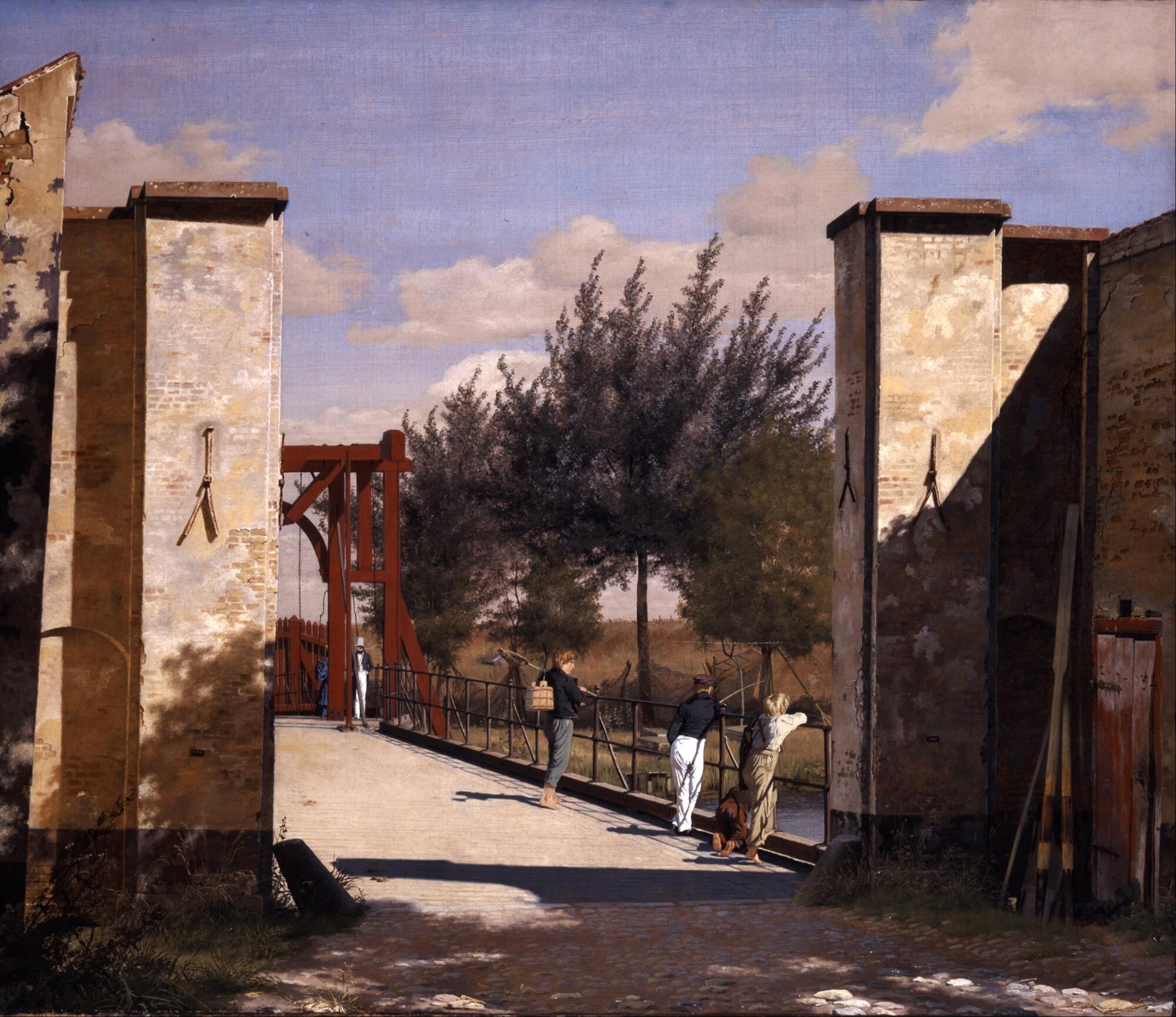
View Outside the North Gate of the Citadel (fig. 1), by Christen Købke (1810—1848) has become a central work of the Danish Golden Age. The triumph of this painting seems perhaps unlikely, for its painter, who was only active for a period of ten years, was not especially celebrated in his lifetime, and was characterised by his biographer, Emil Hannover, as naïve and unimaginative.1Indeed, Købke was denied membership to the Royal Academy of Art in 1846. ↩ He was, Hannover relates, “by nature, quite without the ability to construct anything, he himself had not seen…he became empty and barren as soon as he closed his eyes”.2Emil Hannover, Maleren Christen Købke; Et Studie I dansk Kunsthistorie, Copenhagen 1893, 22-23. Original quote: “Købke af Naturen var Ganske uden Ævne til at konstuere noget, han ikke selv havde set. Han var født uden skabende Fantasi, og han manglede Kløgt til at stille noget sindrigt sammen. Han blev tom og gold, saasnart han lukkede sine Øjne og vilde tænke sig et Billed uden at have Naturen for sig. Saadan var han I sin Ungdom, og saadan blev han ved at være.” ↩ Far from disqualifying Købke from greatness, this lack of imagination comes to be understood, as the art historian David Jackson makes explicit, as an unimpeachable “frankness” of gaze.3David Jackson, Christen Købke; Danish Master of Light, New Haven 2010, 18. ↩ As View Outside the North Gate of the Citadel reveals, this holds the key to Købke’s embodiment of the Danish Golden Age.
Købke’s life falls within what has come to be known as the Danish Golden Age. While the time frame of this period has been disputed, it is now broadly recognised as bookended by the 1801 defeat against the British at the Battle of Copenhagen, and the 1864 loss of the territories of Schleswig and Holstein.4Previously, a shorter period, from 1810—1848, as well as a broader periodisation of the first half of the century have been referenced. Following the 2019 exhibition at Statens Museum for Kunst, titled Danish Golden Age - World-class art between disasters, the period between 1901 and 1864 has been broadly accepted. See Kasper Monrad, and Frederikke Kirsmeier Preskou, Cecilie Høgsbrø Østergaard, ed., Dansk Guldalder, exh. cat., Nationalmuseum, 2019; See also, Kasper Lægring, “The (Re)birth of Genre Painting during the Danish Golden Age; The Case of the Studio “Portrait” in MDCCC 1800 11 (2022), 53-80: 53. ↩ This was a cultural flourishing set against political and economic turmoil for the Kingdom of Denmark; a period that saw fire, famine, inflation, mass unemployment and death. This contradiction reveals the inherent tension of so-called “Golden Ages” as explored by Peter Nørgaard Larsen and Magnus Olausson, for the term obscures the misery that confronted regular people during this period, whose labour sustained this flourishing at the upper echelons.5Peter Nørgaard Larsen and Magnus Olausson, “Inledning” in Monrad, Preskou, Østergaard (2019), 19-24. ↩ Whatever the reality, the period has become known for its intellectual experimentation across disciplines, including the philosopher Søren Kierkegaard (1813—1855), the writer Hans Christian Andersen (1805—1875) and the scientist and discoverer of electromagnetism, Hans Christian Ørsted (1777—1851).
In the artistic realm in particular, the Golden Age was driven by a scientific or natural romanticism, attentive to the order imposed by God on the natural world. This would, later in the century, drive a Nationalism rooted in, amongst other things, attention to the everyday lives of “real” Danes, with the aim to repair the national psyche. As Karina Lykke Grand discusses, while other similar European cultural revivals of the period have been termed “Romantic” movements, the Danish Golden Age operates as more of an “umbrella term”, allowing for the great variation in the work produced during this time, from the observed and naturalistic worlds of Købke’s paintings, to Eckersberg’s scenes of Norse mythology, that might, in another national context, be considered part of a National Romantic movement.6Karina Lykke Grand, “Guldåldern som Tidsperiod,” in Monrad, Preskou, Østergaard (2019), 27-63. ↩ Købke’s frank gaze allowed him to negotiate the tensions of the age; tensions between scientific observation and idealisation, between feeling and seeing.
View Outside the North Gate of the Citadel was the first commissioned work Købke undertook, and it was a prestigious one, having been ordered by Kunstforeningen, The Art Association, in January 1834.7Christen Købke, letter to Jen Wilken Hornemann, Board of the Art Association, 14.01.1834, receipt confirming details of the commission. [[https://kunstforeningen.ktdk.dk/d/mMU9]{.underline}](https://kunstforeningen.ktdk.dk/d/mMU9); The Art Association had been established in 1825, by C. W. Ekersberg. This organisation provided an innovative alternative to the Parisian salon model, supporting artists through commissions, rather than exhibitions and sales, and then distributing the works through a raffle amongst its members. ↩ He approached the task with seriousness, creating several sketches, including one in oil. The artist described in a letter to his sister that the painting of the final work became a “true battle”, where he had to “fight with [the painting] everyday…for three whole months.”8Christen Købke, letter to his sister Conradine Feilberg, dated 27.10.1834, transcribed in ‘Breve 1834—38’ in H.P. Rohde ed., Kune en maler — Christen Købke, bre og optegnelser, Copenhagen 1993, 34. Original quote: “Jeg har som overfor sagt mut Maleri færdigt, duk kan troe kjære Søster, det har kostet mig en ordentlig Kamp; I tre samfulde Maaneder har jeg hver Dag slaas med den, og sommetider har Kampen rigtignok været svær, men saa er det kommet heldigere Øieblikke igjen.” ↩ We see scars of this battle on the canvas, in the painstakingly observed detail, and the disciplined adherence to the rules of perspective. The commission marked a new phase in Købke’s career, an achievement he had been working towards since he was first enrolled as a student at the Royal Danish Academy of Fine Art aged twelve, in 1822. Købke finished his official studentship the year before this commission, in 1833, having trained under J.L. Lund (1777—1867), and, most influentially, C.W. Eckersberg (1783—1853). Under the guidance of these pioneers of the Danish Golden Age, Købke was ideally placed to absorb the conventions they set out and make them his own.
To Paint the Truth
Having been jointly appointed professors in 1818, Lund and Eckersberg introduced a radical new model of teaching, based on the Parisian example they had both experienced. This included, for instance, introducing life drawing from the male nude in 1824 and the later, the female nude in 1833.9Jackson (2010), 26. ↩ Most radical was Eckersberg’s privileging of what would come to be known as en plein air painting, that is, painting not in the studio, but in dynamic observation of the real world. Eckersberg became famous for his roving lectures, bringing his students all over Copenhagen to paint.10Jackson, (2010), 26. ↩ As Philip Coinsbee evidences, this was singular among the professors of art academies across Europe at the time and not simply an echo of the Parisian centre.11Philip Coinsbee, et al., Christopher Wilhelm Eckersberg 1783—1853, exh. cat., Washington, 2003, 21. Quoted in Jackson (2010), 26. This was inspired by Eckersberg’s training with Jacques Louis Davide in Paris for a year between 1810—1813. ↩ The ethos of Eckersberg’s instruction was simple, a worthy subject was any that an artist should be drawn to, as long as “nature alone should be his model, which he should strive to reproduce.”12C. W. Eckersberg, Forsög til en Veiledning i Anvendelsen af Perspectivelæren for unge Malere, Copenhagen 1833, 14. Original quote: ”…Naturen bör ene være hans Mönster, some han bör stræve et gjengive…” ↩
Adhering to Eckersberg’s dictum, to “choose and make the things that most appeal,” Købke depicts a little corner of the Citadel, or Kastellet, a Military fort to the north of Copenhagen where his father had been head baker.13Eckersberg (1833), 14. Original quote: “Kunstnerens aandelig Virksomhet, hans Individualitet, tilhörer ham selv. Han kan Ganske efter egen Tilböielighet vælge og gjöre de Ting, som meest tiltale, gibe eller interessere ham, til Gjenstand for sit Blledværk…” ↩ Købke lived in this enclosed community between the ages of about nine and twenty-three. He and his family moved away to Blegdammen in 1833, just a year before the completion of this painting. Købke painted scenes from the Citadel several times, including View of the Castle Rampart from the Ceiling of the Granary at the Bakery, 1830, and Part of the Farm at the Bakery in Kastellet, c. 1830. Despite the institutionalised and brutal realities of life for the soldiers and convict labourers living within the Citadel, for Købke, these are intimate views of the world of his childhood. While likely influenced by Eckersberg’s vision of the artistic subject, this inclination to stay close to home, Købke’s “attachment” to the “comfort zone” as Jackson describes it, was also entirely in keeping with his personality. 14Jackson (2010), 20. ↩ Købke’s intimacy with the scene is made clear in the detail of the painting. Each brick, each flaking piece of plaster, each snail crawling over each leaf, seems to have been faithfully recorded.
While Købke purports not to invent, as Mikael Wivel suggests, the artist “is remarkably present in the picture, as the one who sees and the one who chooses what we shall see.”15Mikael Wivel, Christen Købke, Copenhagen 2005, 20. ↩ Here too, Købke exemplifies the age, his personal experience of the subject is crucial in its selection but does not bleed into the painting. Rather, the painting embodies the combination of a scientifically inflected desire for visual objectivity and a concurrent, enduring romantic subjectivity that characterised the Danish Golden Age. Købke’s inability to invent rendered him the perfect instrument for the expression of this temperament; he sought his subjects from the heart but recorded them only as his eye found them.
Playing with Perspective
View Outside the North Gate of the Citadel is painted with a specificity not limited to the observation of detail, but extending to the representation of perspectival space.16As Gry Hedin describes, uniquely, he employed mathematical perspective while painting from nature, marrying these two innovations. See, Gry Hedin, “Image Construction: A Singular Point of View” in: Kasper Monrad ed., Christoffer Wilhelm Eckersberg, exh. cat., Copenhagen, 2015, 153-172. ↩ Eckersberg’s commitment to painting the world as it appeared, was translated into a commitment to the mathematics of perspective, expressed in his 1833 publication, An Attempt at a Guide for Young Artists in the Use of Theory of Perspective, in which he instructs the young artist on the necessary calculations of distance from the picture, the angle of orthogonals, the relationship of shadows and light to pictorial space.17C Eckersberg (1833). Also published a subsequent, more complex publication; Linearperspectiven, anvendt paa Malerkunsten: En Række af Perspectiviske Studier med tilhørende Forklarginer, Copenhagen 1841. For an in-depth analysis, see Roberta J.M. Olson, “Balancing the Real and the Ideal” Preparatory Studies for Eckersberg’s Treaties on Perspective”, in: Master Drawings: Danish Drawings 6 (2023), 140-180. ↩ Eckersberg offers a textbook example of his teachings with his painting Langebro in Moonlight with running figures, 1836, (fig. 2). Similarly to Købke’s 1834 painting, the railings of the bridge and the shadows they cast act as useful orthogonals in establishing perspective. These lines run through into the depths of the picture plane, where, in accordance with Albertian perspective, they converge at a vanishing point that, while not explicitly delineated, remains legible to us.
View Outside the North Gate of the Citadel has all the hallmarks of a similarly satisfying view. The symmetry of the gate posts provides an instructive frame within the frame, clearly directing our attention. The red beams of the drawbridge on the other side of the moat provides a further frame for us to see through. The carefully considered architectural orthogonals lead our eye through the painting towards a vanishing point on the horizon line. However, this point of resolution is denied us. We are left with an impossible desire to glimpse the “real” composition, hidden just out of sight, a few steps to the right of our frustrated viewpoint. While Eckersberg’s painting serves as an exemplar of the deployment of perspective, Købke toys with the conventions his teacher held so dear, respecting the fact of them, without allowing perspective to be the point of his picture. With his characteristic honesty of gaze, Købke’s painting reflects our true experience of the world, caught in glimpses and obstructed views.
Genre and the Danish Golden Age
For all of Købke’s commitment to paint this scene as it appeared to him, the figures in this painting seem like types dropped in from another painting. Their vagueness is evocative of genre painting, a “lesser” style of painting in the context of the French Academy, which, through the example of Dutch Golden Age painting, rose to prominence in Denmark at this time. The Art Historian Niels Laurits Høyen (1798—1870), appointed the first professor of Art History in Denmark in 1856, and a defining voice of the Danish Golden Age, characterised the rise of genre painting in an 1828 review. Høyen directed that “the more successfully the artist here knows how to choose such motifs from his surrounding life that are more easily understood by…the spectator, the greater the effect will be…”18N. L. Høyen, quoted in Lægring (2022), 54. Original quote: “Historiemaleriet, anvendt paa Scener af det daglige Liv i Arbejder af mindre omfang, har i den senere Tid faaet Navn af Genre - Maleri. Jo heldigere Konstneren har véd at vaelge saadane Motiver af det af ham omgivende Liv, som lettest forstaaes af of vække Deltagelse hos Beskueren, desto større vil virkningen være, som han frembringer.” ↩ Again, Købke’s straightforward artistic eye seems tailormade to this ambition, reflecting his unvarying choice of subjects from his “daily path” as Hannover described. 19Hannover (1893), 23. Original Quote: “Det Eckersbergse “Ligemeget hva det er” har gaat ham over i Blodet, og han valgte sine Æmner mellem sine daglige Emgivelser og paa sin dalige Vej.” ↩
View Outside the North Gate of the Citadel contains within it, a genre scene reflecting the pleasant rhythm of everyday life from Købke’s “surrounding life”. Art historian Mikael Wivel has suggested, in the context of Købke leaving his childhood home the same year, that this painting might be seen as a “farewell’ painting.”20Wivel (2005), 20. Købke painted another, similar scene for his mother in 1837, which is far more nostalgic and rose-tinted. Christen Købke, The Northern Drawbridge to the Citadel in Copenhagen, 1837, oil on canvas, 44.2 x 65.1 cm, the National Gallery of Art, London, NG6507. ↩ In this light, the figures can be read as composing a timeline of boyhood. The youngest fisher leans with childlike wonder over the drawbridge. Further down the bridge, a boy, taller still, stands engaged in play, but in the pose of a labourer, practicing perhaps, for fishing as work, indicated by the drying nets on the banks of the river beyond. On the far side of the bridge, we see a young, formally dressed man turning his face to his companion, a woman dressed in luxurious blue. Matrimony, civility and status awaits. Thus, the bridge between boyhood and manhood has been crossed.
As is typical of genre scenes, this vignette is both realist and idealised. Harmony pervades to a fault, most clearly evidenced by the gentle light that illuminates the painting. As Jackson notes, the everyday of the Danish Golden Age rejoiced in a perpetual summer, indicative of the idealisation inherent in the project.21Jackson (2010), 58. ↩ Idealisation was one way art could be useful towards the aim Høyen set out of rebuilding a national self-esteem in the wake of the humiliations of the early part of the century. 22While these sentiments had been circulating, they were formalised in Høyen’s March 1844 lecture “Om Betingelserne for en skandinavisk Nationalkonsts Udvikling” (“On the conditions for the development of a Scandinavian National Art”). ↩ However, Købke’s painting predates the crescendo of Høyen’s calls for national art in the 1840s, and, most importantly, any message to be drawn from the genre scene within the painting, is thwarted, compositionally, by the obstructions of the “real” world. The girl in blue, the coveted prize of manhood, is concealed by the red beams of the drawbridge. Besides, the figures are at an awkward distance, beyond the gates in the midground, not in the prime position of a typical composition. The narrative we might construct is secondary to the workings of this real space. In this painting, the old mode of picturing is set within a new mode of picturing; genre meets naturalism, narrative meets the momentary, the specific meets the type.
A Proto-Photographic Vision?
In her analysis of travel pictures of the Danish Golden Age, the art historian Karina Lykke Grand posits that the artists of the time were engaging with a new optics driven by technological change.23Karina Lykke Grand, “De nye blik: optik, mobilitet og teknologi” in Dansk Guldalder: Rejsebilleder, Aarhus 2012, 171-189. ↩ From the blurred vision accessed from the window of the locomotive to the innovations of the panorama, artists were responding to, and at times anticipating, the changing limits of perception. Indeed, Lykke Grand quotes Købke’s own wish to capture more than his eye and his hand were capable of recording, longing for the freedoms of the photographic process before it had come into public hands.24Lykke Grand (2012), 178. ↩ Extrapolating from Lykke Grand’s analysis, we might understand Købke’s frank vision as a proto-photographic one. With his “[in]ability to construct anything, he himself had not seen,” Købke’s eye functions like the photographic lens, he points us to a view, and reproduces it as it appeared, in all its compositional imperfections. This sharpens our understanding of the remarkable character of Købke’s subjectivity, so indicative of the character of the Danish Golden Age; his frank gaze is both observational and personal, and above all, remarkably modern, pointing to the shifting relationship between representation and truth.