Article
Holy Savior Cathedral
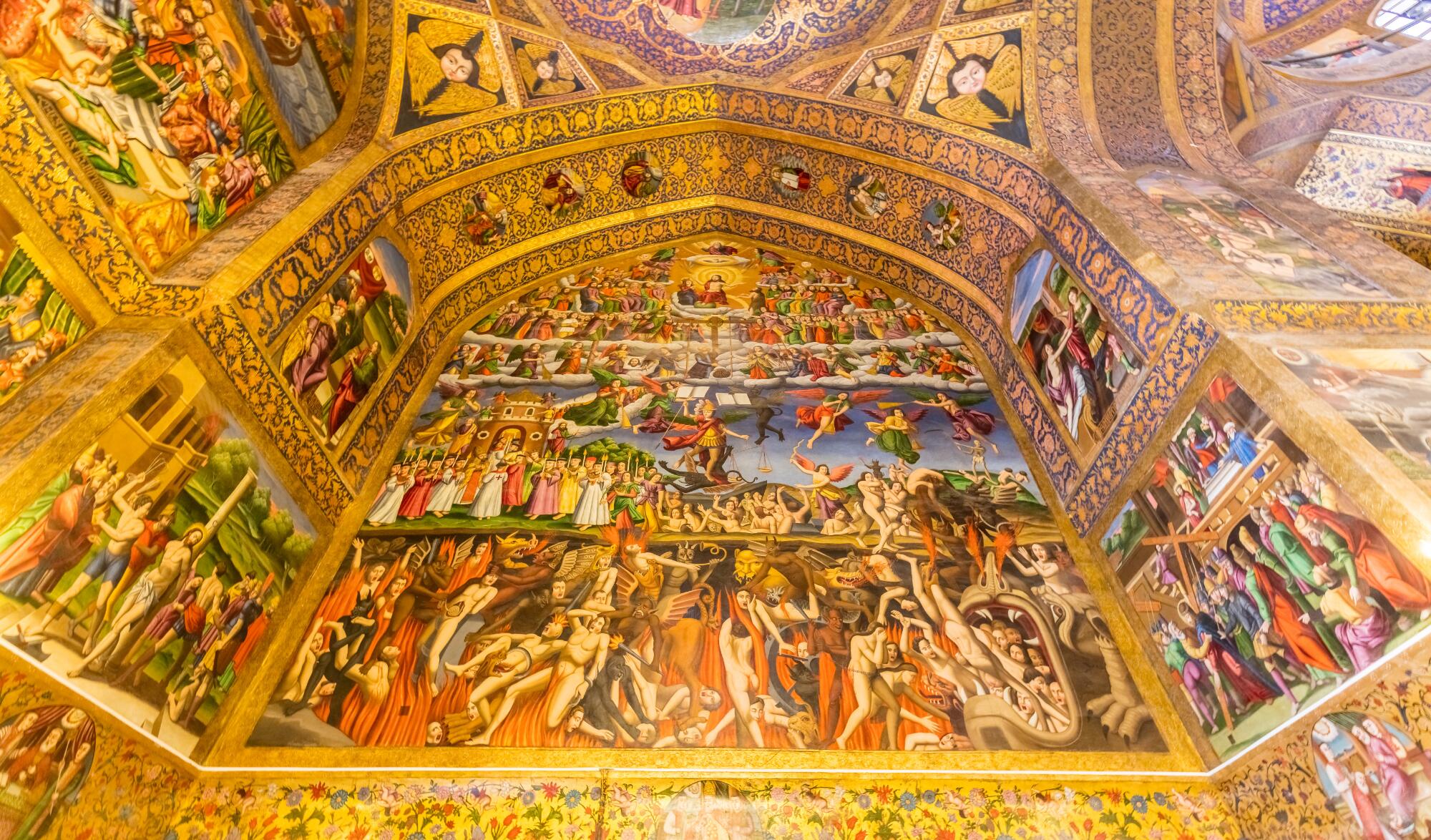
At the beginning of the 17th century, as a result of the forced relocation of Armenians organized by Shah Abbas I, the ruler of Safavid Persia, thousands of Armenians were resettled in Iran, particularly in Isfahan, where they established an Armenian quarter called New Julfa. Shah Abbas aimed to strengthen the Iranian economy by encouraging Armenian merchants, who served as a commercial bridge between Iran and both the East and West.
The Armenian merchants quickly seized this exceptional opportunity, establishing a robust trade network connecting Iran to the rest of the world.
In their travels to various countries, the Armenians brought back to Iran a wealth of manuscripts, icons, and other artworks. Armenian merchants brought back a variety of European artworks from their travels, which had a significant influence on the development of a new visual language and artistic style among Armenian painters1Ina Baghdiantz McCabe, “Merchant capital and knowledge, The financing of early printing presses by the Eurasian Silk trade of New Julfa ”, in Thomas F. Mathews and Roger W. Wieck, eds., Treasures in Heaven. Armenian Illuminated Manuscripts, cat. exp. New York, Pierpont Morgan Library, 4 May-7 August, 1994; Princeton, N.J., 1994, 59-71. ↩. The first complete Armenian-language Bible, printed by Voskan Yerevantsi in Amsterdam between 1666 and 16682Bezalel Narkiss and Michael E. Stone, eds., Armenian Art Treasures of Jerusalem, New Rochelle,1979, fig. 145. ↩, included European engravings that strongly impacted the visual aesthetics of mural and miniature painting in New Julfa3Thomas Sherrer Ross Boase, “A Seventeenth-century Typological Cycle of Paintings in the Armenian Cathedral at Julfa ”, in Journal of the Warburg and Courtauld Institutes, 13, No. ¾, 1950, 323-327. ↩.
The period from the 17th to the 18th century is considered the golden age of manuscript illumination and mural painting due to this Armenian diaspora community. Among the richly decorated churches of New Julfa4Armen Hakhnazaryan, “The Architecture of New Julfa”, in*։ Hay arvest, Mshakut’ayin handes*, (Armenian Art. Cultural Magazine), 2, Yerevan, 2004, 10-11[in Armenian]; Murad Hasratyan, “The Churches of New Julfa”, in: Hay arvest, vol. 2, Yerevan, 2004, 12- 15[in Armenian]. ↩, the Church of St. Joseph of Arimathea (1655—1664) within the All Saviour Cathedral, and the Bethlehem Church (1628)5Onnig Avedissian, Peintres et sculpteurs Armeniens du 19eme siècle a nos jours précédé d’un aperçu sur L’art ancien, Le Caire 1959, 112; John Carswell, New Julfa, The Armenian Churches and Other Buildings, Oxford 1968, 26—32; Sarah Laporte-Eftekharian,“Genealogy of some Ornamental and figurative Motifs in Armenian Visual Arts from Armenia to New Julfa and lands of Polish-Lithuanian Commonwealth”, in Art Culture of Armenian Communities in the Lands of Polish-Lithuanian Commonwealth, Minsk, 9—11 October, 2012, Minsk,2013, 158—163. ↩, stand out for their particularly complete and cohesive artistic decoration.
Architecturally, these churches exhibit a blend of Armenian and Persian styles. Armenian influence is evident in the ground plans and extensive use of brick-building techniques, while Persian influence is reflected in certain stylistic elements. Externally, the churches are relatively plain, with onion-shaped brick domes that, unlike Persian mosques, lack the typical blue tile covering.
This external simplicity contrasts sharply with the interiors of St. All Saviour’s Cathedral and the Bethlehem Church, where every surface is richly decorated with gilded stucco ornaments and tile friezes. These decorations feature floral motifs in dominant shades of yellow and blue, exemplifying the decorative art of the Safavid period. The tile friezes are considered among the finest surviving examples from that era.
Inside the Church of St. Joseph, two impressive half-columns elegantly divide the space into two distinct areas. The western section is roofed by a small dome, while the eastern area is crowned by a large dome set atop a drum.
The magnificent decoration of the cathedral was created by painters Minas and Hovhannes Mrkuz (along with Astvacatur and Simon), all of whom had studied under European masters. They became renowned artists not only in Isfahan but throughout Iran. Fortunately, Hovhannes Mrkuz left his self-portrait in one of the wall paintings, appearing in the scene titled “The All —Seeing Eye”.
The interior decoration of the church presents a complex iconographic program that integrates scenes from both the Old and New Testaments6Boase, (1950), 324-326. ↩. These biblical narratives are complemented by Persian ornamental motifs and thematic representations from the life of St.Gregory the Illuminator, articulated through distinctly Armenian iconography7Satenik Chookaszian, “The Decoration of St. All Saviour Cathedral of New Julfa”, in Series Byzantina, Studies on Byzantine and Post Byzantine Art, XVI, Warszawa, 2019, 67-73. ↩. Together, these elements coalesce into a cohesive visual ensemble characterized by stylistic and cultural synthesis. Additionally, floral motifs---deriving from Islamic artistic traditions---adorn the ceiling of the entrance and are distributed throughout various architectural elements of the church, contributing to its richly layered aesthetic.
The most striking stylistic feature of these murals is the influence of European art, particularly visible in the biblical scenes. This Western influence is attributed to the close contact Armenian merchants maintained with European cities such as Venice and Amsterdam.
A particularly notable aspect of the cathedral’s murals is the depiction of scenes from the life and ministry of St.Gregory the Illuminator, which are among the rarest examples in Armenian art. The earliest known mural cycle on this theme appears in the Church of St. Gregory the Illuminator in Ani, commissioned by the merchant Tigran Honents in 1215.
In the upper registers of the cathedral’s interior are scenes from the Old Testament, while the lower registers depict episodes from the New Testament.
One of the most dynamic Old Testament scenes is the moment when Jonah is cast into the sea. The artist portrays the ship tossed in a stormy sea, with stylized waves and a massive fish poised to swallow Jonah. Some sailors are shown throwing Jonah overboard, while others struggle against the violent storm. Unusually, the ship is adorned with a carved elephant figurehead —an atypical and striking detail. It is quite possible that the painter had seen such a vessel belonging to an Isfahan-based merchant who sailed the Indian Ocean, trading between India, Singapore, and Indonesia.
Among the New Testament scenes, the Annunciation stands out as the most spectacular in terms of beauty and composition. It is divided into two parts by clouds, which act as a natural frame for the angel, shown descending gracefully while holding a flower —a symbol of both spring (as the Annunciation occurred in spring) and the Virgin Mary’s purity. Starting in the 18th century, Italian painters often depicted the angel among clouds, and this composition appears to anticipate that stylistic trend. The artist skillfully conveys not only the angel’s gentle movement, but also sharper, more dynamic gestures in various scenes from both the Old and New Testaments.
Another remarkable detail appears in the scene of Pentecost, where all the figures---including the Virgin Mary —are depicted with flames above their heads. This imagery captures the moment the Church was founded. Interestingly, the figures resemble burning candles, emphasizing the divine inspiration and spiritual awakening associated with Pentecost.
Across all the biblical scenes, the painter uses a consistent facial style: large round eyes, broad foreheads, long noses, and small mouths. In depictions of women and children, the artist adds full cheeks for softness. These faces are rendered with proportional accuracy, particularly in scenes where nude figures appear. The artist skillfully models the bodies using light and shadow, giving them a three —dimensional quality.
The other figures are dressed in heavy, brightly colored garments, often richly decorated with floral motifs. Movement is a dominant feature throughout the compositions —each figure is captured in an expressive pose. Notably, the painter deliberately avoids portraying facial emotions, choosing instead to communicate mood and atmosphere through body language and gesture, enhancing the theatrical quality of each scene.
The Crucifixion stands out not only for its use of darker tones and subtle color transitions but also for the emotional depth conveyed through the figures, which express a profound sense of sorrow. Christ is the only figure depicted with open eyes and without signs of suffering — a symbolic representation of His victory over death and an indication of His divine nature.
Flanking Christ are two allegorical figures representing death and evil. Remarkably, two angels are shown battling these demonic forces: a skeleton wielding a sickle on the left, and a winged devil on the right. These elements are highly unusual within traditional crucifixion iconography. As noted by Sarah Laporte, similar imagery appears in a Crucifixion drawing by Peter Paul Rubens, which was later engraved by Paul Pontius in 1631. The inclusion of such figures here reflects the influence of Western prints on Armenian artists in New Julfa.
Another exceptionally rare image in Armenian art is the depiction of God the Father, seen in a composition above the altar with Christ and the apostles. Between the Father and the Son appears a dove, symbolizing the Holy Spirit —the final element of the Holy Trinity. A similar representation can be found in the 18th-century Armenian Church of St. George in Tbilisi (Georgia), where Christ appears in a Mandylion image.
Also noteworthy is the composition of the Tree of Jesse, a genealogical representation of Christ. The tree emerges from the body of Jesse, an ancestor of Christ, and culminates in the image of the Virgin Mary holding the Christ Child. This scene first appeared in Armenian art in Cilician manuscript illumination, specifically in the Gospel of the Freer Gallery of Art (No.32.18), attributed to painter Toros Roslin (13^th^ century) and his colleagues. At the top of that miniature, one can see either Christ or God the Father. The inclusion of the Virgin and Child in this version of the Tree of Jesse is highly unusual in Armenian art and represents a unique reinterpretation of the traditional scene.
The entire northern wall is covered by one of the cathedral’s most impressive and dramatic compositions: The Last Judgment. The monumental image of the Last Judgment stands out among the monastery’s murals not only for its scale but also for its compositional solutions. The mural is placed within a pointed arch, and the scene can be conventionally divided into four horizontal sections.
At the top, we see the depiction of God the Father —a figure that is not only rare in Armenian art but also uncommon even in global representations of the Last Judgment. In the New Julfa mural, God the Father is shown within a radiant halo, dressed in a green robe and a crimson cloak, set against a background of golden semicircles. Below Him, in the center of the clouds and within golden rays, is the Holy Spirit in the form of a dove. Further below is Christ.
The depiction of the Holy Trinity in a Last Judgment scene is unprecedented in Armenian examples, making this representation truly unique. In this mural, Christ is depicted nude, with a muscular torso, arms extended to the sides, revealing the wounds of His Passion.
It is noteworthy that in most Armenian representations of this scene, Christ appears in the Byzantine iconographic tradition — enthroned on a jeweled or four-sided throne, portrayed as the divine judge. However, in both the mural of the All Saviour Monastery and the mural in the Church of St. Minas (built in New Julfa in 1659), Christ is shown seated upon a rainbow—an iconographic variation rarely encountered in Armenian art.
The image of Christ in our mural corresponds to Western iconography. A similar depiction is found in the 1657 engraving Christ in Paradise by the 17th-century Dutch artist Christoffel van Sichem the Younger. Notably, van Sichem’s engravings appear in the Armenian Bible printed between 1666 and 1668 in Amsterdam by Voskan Yerevantsi8Aldo Ferrari, “Places of Armenian Cultural Rebirth in the Seventeenth and Eighteenth Centuries”, in Armenia, Imprints of a Civilization, ed. by G. Uluhogian, B. L. Zekiyan, V. Karapetian, Milan, 2011, 276-277, fig. 98; Alice Taylor, Book Arts of Isfahan: Diversity and Identity in Seventeenth-Century Persia, exh. cat., The J. Paul Getty Museum Malibu, California, 1995, 69-77. ↩. This Bible was published at the St. Etchmiadzin and St. Sargis the General printing house, established through the initiative of Catholicos Hakob of Julfa and funded by wealthy merchants of the Julfa Armenian community9Baghdiantz McCabe, (1994), 59-71; Vardan Devrikyan, Voskan Vardapet Yerevantsi: Life and Printing Activities, Yerevan, 2015, 37-38․[in Armenian]. ↩.
According to preserved sources, engravings from the Christoffel van Sichem family were already known to New Julfa’s artists nearly two decades before the Voskanian Bible was printed. The influence of these engravings —as well as those by other European artists, notably the Spanish Jesuit Jerónimo Nadal, whose Natalis Bible engravings were widely circulated —extended beyond mural painting to impact New Julfa’s manuscript illumination and embroidery traditions as well10Sarah Laporte-Eftekharian, “Transmission et metamorphose de modeles iconographiques occidentaux, principalement flamands, dans les églises de la Nouvelle-Djoulfa (Ispahan)”, in Revue Belge d’Archeologie et d’histoire de l’Art, LXXIII, Bruxelles, 2004, 63-80; Armenian Art Treasures of Jerusaliem (1979*), fig. 145-147; Sarah Laporte-Eftekharian, “Art de la diaspora arménienne. L’évolution des arts visuels au XVIIe siècle á la Nouvelle-Djoulfa)”*, in Series Byzantina, Studies on Byzantine and Post Byzantine Art, IX, Warsaw 2011, 89-98. ↩.
In our mural, the Virgin Mary is portrayed crowned, presented as the Queen of Heaven (Regina Caeli in Latin). This iconography is rare in Armenian art, with the earliest known example appearing in the 1289 Gospel (Matenadaran manuscript 197), in the scene of the Annunciation. It is evident that all the artworks featuring this iconography originate from Western European art, where it was widely popular.
In the second register of the mural, within a border formed by clouds, thirteen angels are depicted. Most are playing various musical instruments, while two of them are holding the Mandylion---the sacred image of Christ’s face imprinted on a cloth. Remarkably, this same image, the Lord’s Mandylion, also appears in another mural within the same church: The All-Seeing Eye.
At the center of this mural’s second register, the artist has included a portrait of the patron, Khoja Avetik Stepanos Martirosyan —placing him within one of the composition’s most visually impactful sections. Directly below the image of Christ, Khoja Avetik is shown bearded, wearing a blue robe and a long, sleeveless brown fur coat, kneeling with eyes raised toward the heavens and embracing a tall processional cross. This represents a distinctive approach to the portrayal of patron or donor in Armenian mural art11Satenik Chookaszian, “The Last Judgement frescoe of the St. All Saviour’s cathedral in New Julfa and its analogues in Armenian and world art”, in Bulletin of Matenadaran, 31, 2021, 203-204. ↩.
In the third section of the mural, the scene of the Judgment unfolds —featuring the Archangel Michael weighing souls. In the deep blue background of the sky, angels are seen playing wind instruments. At the center stands Archangel Michael, triumphant over a horned, black devil —symbolizing the defeated Satan. In his hand he holds a set of scales with two pans. Above him, to his right, stands an angel, while to his left is the black demon.
One of the essential elements of Last Judgment iconography is the Resurrection of the Dead. Below Archangel Michael, the resurrected are shown emerging naked from the cracked earth. Some are depicted mid—transformation — first appearing as skeletons and then gradually regaining their flesh. This process is even more explicitly portrayed in the equivalent scene in the Church of St. Minas in New Julfa.
That version differs from the All Saviour mural in several notable details, including the absence of both the donor portrait and the Holy Trinity. At the top of the St. Minas mural appears a Deesis composition, where the Virgin Mary is depicted without a crown, her hands crossed humbly over her chest.
Interestingly, in rendering this scene, the artists devoted the largest portion of the mural to the central field illustrating the Judgment itself.
Paradise occupies the left side of the mural, where the righteous souls are shown joining clergy who hold long candles. On either side of the clergy stand Saints Paul and Peter, recognizable by their traditional attributes —keys and a book.
The fourth section of the mural depicts Hell, presented in meticulous detail. Sinners are shown burning in fire or being tormented by demons and evil forces. The devils are portrayed dragging them by their hair or driving them toward eternal damnation through various forms of torture.
Compared to the figures depicted in other sections of the mural, the characters in the fourth register are not only significantly larger in scale but also more dynamic and expressive. Of particular note is the open-mouthed sea monster of Hell — Leviathan — depicted as a terrifying beast with red flames shooting from its nostrils. Inside Leviathan’s gaping jaws are the terrified faces of the damned, while other sinners are being driven toward it under torture.
One of the figures moving toward the monster is shown covering their face with both hands, reminiscent of Masaccio’s Adam in The Expulsion from the Garden of Eden, while the open-mouthed, screaming figures in our mural evoke Masaccio’s Eve. Their anguished, contorted bodies and expressions of horror, set against a stark black background, are heightened by the dramatic color contrasts of flesh tones, chestnut brown, and vivid red — making this scene intensely emotional and theatrical.
My research into the Last Judgment mural of Saint All Saviour Monastery in New Julfa suggests that its model was a 1606 engraving of the same subject by the French artist Philippe Thomassin (1562 — 1622)12https://www.helmutrumbler.com/artworkdetail/847501/0/the-last-judgment (accessed July 31, 2025). ↩. Since Thomassin spent much of his life in Rome13https://www.khanacademy.org/humanities/art-americas/new-spain/viceroyalty-peru/a/diego-quispe-tito-last-judgment-1675 (accessed July 31, 2025). ↩, it is likely that Armenian merchants brought his print to New Julfa from there. Nearly all elements of his composition are reimagined in the mural, reflecting a sophisticated translation that preserves the conceptual integrity while allowing for artistic reinterpretation. We see the same division into iconographic registers, similar spatial arrangement of the figures, and even the depiction of Leviathan and the expressions of the tormented souls closely mirror Thomassin’s version. However, the Armenian masters contributed significant iconographic innovations, notably the inclusion of the Mandylion and a crowned depiction of the Virgin Mary enthroned. Also the figure of St. Francis of Assisi is replaced by the patron, Khoja Avetik, underscoring the localized adaptation of the work.
Although the artists of New Julfa followed contemporary artistic developments and based this mural on a Western European prototype, they nonetheless enriched it with new details and additions of their own. They succeeded in creating a Last Judgment scene that stands out for its vivid, richly varied palette and its complex, dynamic portrayal of figures. This mural can rightfully be considered one of the most impressive and powerful representations of the Last Judgment in Armenian art.
These paintings, with their lavish use of gold and vivid colors, leave a lasting impression on visitors, who feel as though they have stepped into a magnificent gallery. The cathedral’s plain exterior stands in striking contrast to its richly adorned interior, yet it is widely regarded as one of the most beautiful Armenian religious structures.