Article
Fifty Images from the History of the German Baltic Provinces of Russia, vol. 1-2
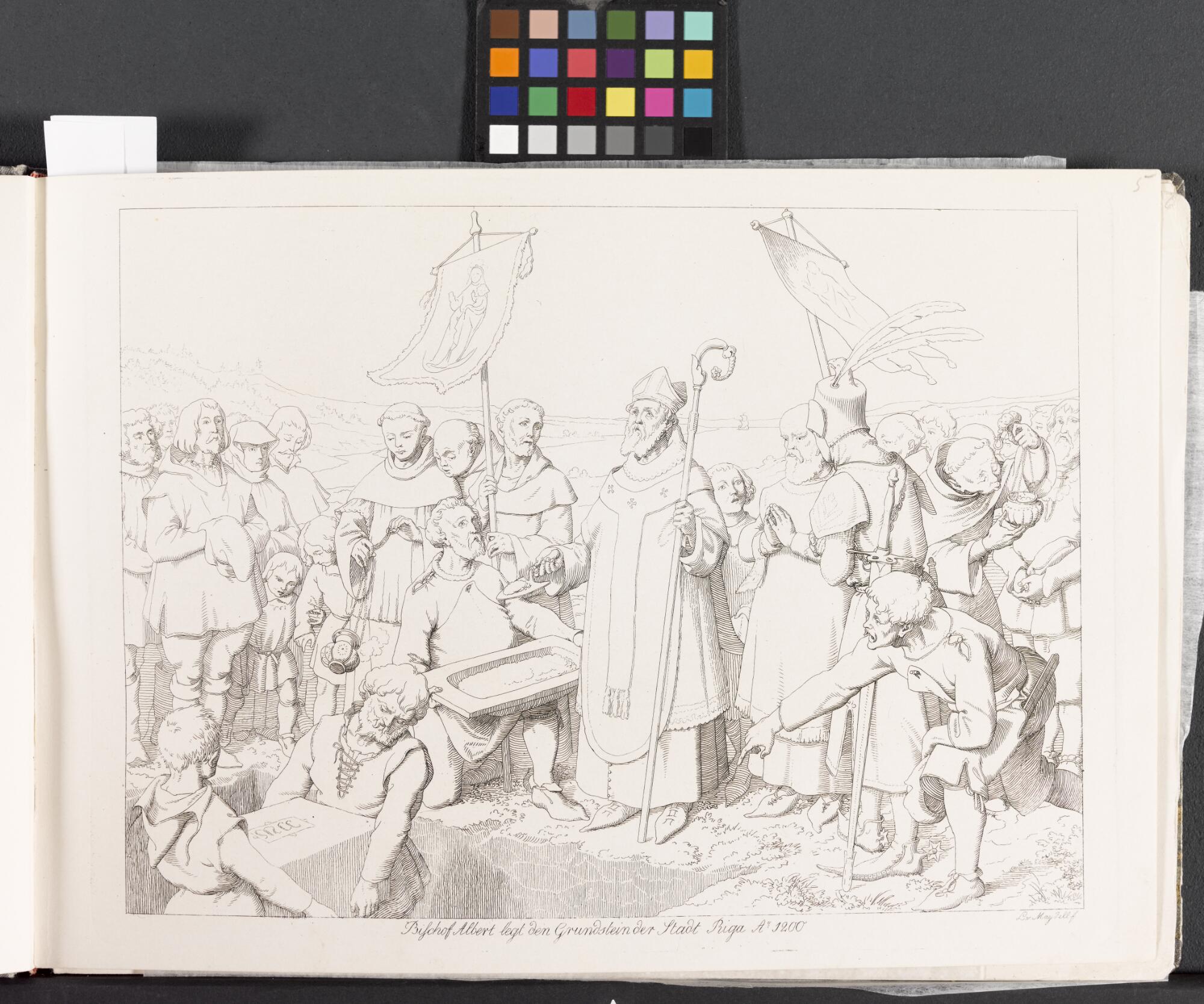
Artist Friedrich Ludwig von Maydell is regarded as the founder of the Baltic German tradition of historical imagery. Before the publication of the first two volumes of his album Fifty Images from the History of the German Baltic Provinces of Russia,1Ludwig von Maydell, Fünfzig Bilder aus der Geschichte der deutschen Ostsee-Provinzen Rußlands, vol. 1—2, Dorpat 1839 and 1842. ↩ only a few visualisations of specific historical events from modern-day Estonia and Latvia — then parts of the Russian empire — were known. In a broader context, his series clearly reflects a much larger shift: the surge of romantic nationalism that swept across Europe in the wake of the Napoleonic Wars, along with a growing interest in (national) history. Of the album, originally planned in five volumes, only the first two were completed, containing 20 images in total and covering the years 1156—1291.
Maydell’s black-and-white engravings are also significant in terms of form: they are among the earliest compositions in Baltic history of art to be created using contour lines. He learned this technique during his travels in Germany and Italy, where he befriended German Nazarene artists. Among the German national romantic artists who greatly influenced him were Ludwig Richter, Julius Schnorr von Carolsfeld, Peter von Cornelius, and Johann Friedrich Overbeck, several of whom remained his close friends for the years to come.2Moonika Teemus, “Friedrich Ludwig von Maydells Brief aus Rom vom Jahr 1823”, in: Baltic Journal of Art History 12 (2016), 111-122. ↩
Maydell also studied woodcutting in Germany, and later established a woodcut workshop in Tartu (German Dorpat). The city was developing rapidly following the reopening of the university in 1802. Maydell had hopes for the Russian market, which proved to be unreliable. The uncertainty of the local Baltic market was demonstrated not least by the discontinuation of his own album, which likely stalled due to financial difficulties and lower-than-expected interest from subscribers. That the artist continued planning the series is indicated by the titles for the third volume (intended to reach up to the Reformation) printed on the cover of the second volume, as well as two surviving print proofs of images that were intended for the third and fourth volumes.
The print run of the album is not known even for the volumes that were published. However, given the large number of surviving copies, it can be assumed that the edition was relatively substantial. The series of prints, either bound or as loose sheets, can be found among others at the Art Museum of Estonia, the Estonian History Museum (both in Tallinn), Tartu City Museum, and Pärnu Museum, as well as in museums or libraries of Latvia, Finland, Germany and Russia. The original printing plates for the series are held in the collection of the Estonian History Museum.
The historical context of the series
Maydell’s oeuvre has often been seen as typical of its time. In many respects, the album, too, is representative of the age. Since the Renaissance, historical painting had been on the rise, and by the nineteenth century — the age of nationalism — it had become a characteristic art form of its own, regarded as the noblest and most demanding genre. While historical imagery is often associated with grand murals, reproducible media such as printmaking — that enabled much wider dissemination — were no less influential. Similar albums were published elsewhere at the time, highlighting the growing importance of visual culture, and especially graphic art, in the formation of modern nations. In the same 1839, Fyodor Bruni’s album Descriptions of Events from Russian History was published in St Petersburg, for instance.3Фёдор Бруни, Очерки событий из российской истории, St Petersburg 1839. ↩
At the same time, Maydell’s album also illustrates the local distinctiveness of the region —being a multi-ethnic and multicultural space, the Baltic region had a complex relationship with its past. While the historical narratives of the various national groups living there were in fierce conflict with one another, they were also closely intertwined. Maydell’s series presents Baltic history from the perspective of its German-speaking elite, reflecting the growing importance of the past for this privileged community. Maydell himself came from an old Baltic German noble family.
The Baltic Germans formed a particularly intriguing group in terms of historical memory and identity formation. Their history in the region stretches back centuries, yet they remained a small (under 5% of the population) and somewhat colonial elite, clearly distinct from the local Estonian- and Latvian-speaking population. In what are now Estonia and Latvia, the Germans had ruled since the Crusades at the turn of the twelfth to thirteenth centuries, gradually acquiring most of the land and privileges. This led to ethnic and social segregation from the local “non-German” population, which consisted mainly of Estonian- and Latvian-speaking peasants and labourers. During the Middle Ages, no strong central authority developed in the region; instead, different areas were governed by bishops and the Livonian branch of the Teutonic Order. In the Early Modern period, several wars were fought over control of the Baltic territories, with dominance repeatedly shifting. In the early eighteenth century, these lands were conquered by the Russian Empire. However, the German-speaking upper class retained its ruling position, and many of its members enjoyed distinguished careers in the imperial administration, military, academia, and elsewhere. Meanwhile, the local peasants had been subjected to serfdom since the late Middle Ages and Early Modern period. By Maydell’s time, serfdom had recently been abolished (1816 in Estonia, 1819 in Livonia), but its legacy persisted, resulting in the continuation of social hierarchies and inequality within Baltic society.
The politics and aesthetics of selection: The artist as a historian
As with all historical images, Maydell’s series primarily refers to the present — that is, the time and context in which it was created — while also being influenced by developments within the genre of history painting. The events, figures, and phenomena he chose to depict reflect the significance of history in shaping Baltic German identity, as well as the themes, heroes, and periods they deemed important.
The majority of Maydell’s images focus on the period of conquest and colonisation, as well as the struggle against the local pagan peoples (the Estonians, Livs and Lettgalians), and also against the Russians and Lithuanians. The artist highlights key moments in the establishment of the colony, such as in the print Bishop Albert Lays the Cornerstone of the City of Riga. AD 1200 (this, in fact, happened in 1201). Particular attention is given to the institutions and heroes that laid the foundations for the German settlement: the Teutonic Order, the Hanseatic League, priests, Crusading knights and merchants.
The main themes of the unrealised fourth and fifth volumes are unknown, but in any case, the medieval period would have formed a predominant part of the series. In the first half of the nineteenth century, the Middle Ages held an important place in German Romantic nationalism, as well as in Baltic German historical memory. The identity of the Baltic Germans was shaped by a complex interplay of loyalties to the Russian empire, ties to German culture and nationalism, affection for their Baltic homeland as well as power struggles with the local population. The difficulty of balancing these different aspects of self-identification is clearly reflected in Maydell’s album.
In the Middle Ages, the identity of the Germans in this region was significantly shaped by the idea of the Baltic lands as the last outpost of Christianity — including in opposition to the Orthodox Russians. Maydell therefore had to find ways to represent this conflict visually. A good example is the image depicting the so-called Battle on the Ice: Alexander Nevsky Defeats the Teutonic Order on the Ice of Lake Peipus. AD 1244 [1242]. On the one hand, the artist idealises the Teutonic knights, while on the other, the Russian prince Nevsky is also portrayed in a romanticised manner characteristic of the age. Had Maydell continued his series through to the bloody campaigns of the Livonian War (1558—1583) and the Great Northern War (1700—1721), depicting the struggle between the Germans and the Russians would likely have posed increasing challenges.
Maydell also wrote a longer explanatory foreword for the album, which draws heavily on chronicle texts and reflects the spirit of the early nineteenth century, when academic study of history was beginning to take shape. Professional historical scholarship was closely intertwined with several more popular forms of historical culture back then. General overviews of the Baltic region were still scarce — so Maydell’s foreword can be considered one of the very first modern overviews of Baltic history. He relies heavily on the authority of written sources — indeed, both the text and the album’s images are based on medieval and Early Modern chronicles.
Nevertheless, the album reveals interesting contrasts between image and text. At times, these even relate to themes central to the author himself, such as the import of German culture into the Baltic region. For instance, in the foreword, Maydell writes at length about the flourishing of Hanseatic trade and medieval urban life (topics that, by the second half of the nineteenth century, were to become popular subjects in historical narratives and novels). Maydell views the medieval trade as a sign of German cultural superiority and of the successful civilisation of new territories. Yet, medieval urban life does not find a place in his images. Instead, the album is dominated by battle scenes (ten images, i.e. half of the completed works) — the most traditional subject matter of the historical image genre.
Maydell’s historical images are characterised by a great number of figures, as well as a certain structure based on repetition. This allows him to depict historical events as clashes between opposing forces — even as negotiations or forms of collusion. This approach is typical not only of the battle scenes, but also of images dealing with the establishment of new settlements and power structures, the conversion of the local population, and the process of civilisation through conquest. At the same time, Maydell consistently distinguishes between “us” and “them”, in order to emphasise the Germans’ role as the sole bearers of culture and civilisation.
The attention to material culture and richness of detail, characteristic of historical imagery in general, enables Maydell to depict cultural difference with great specificity — distinctions are conveyed through clothing, weaponry etc. To portray these accurately, the artist drew not only on chronicle texts, but also on a range of visual and material sources found in contemporary art collections, churches and castles. However, the costumes and weapons shown in the images reflect, above all, his own era’s understanding of medieval material culture. In fact, many of the costumes intended to represent the thirteenth century resemble those of the late Middle Ages or the Early Modern period instead. Far more material and visual sources survived from those later centuries, and, in the early days of historical research, it was easy to project these — often mistakenly — back onto earlier eras.
Such a selection of objects, again, successfully allowed to distinguish between the civilised and the barbaric. In Maydell’s images, it is only the local peoples of the region who wear fur. Even though fur was very much in fashion and served as an important symbol of status in the Middle Ages, in his interpretation, animal skins thus symbolise something uncivilised and pagan.
Another distinguishing feature between the ethnic groups is also the men’s hairstyles: the Germans have neatly styled hair and trimmed beards, while the indigenous peoples wear their hair dishevelled and beards bushy. This is vividly shown on the page How the Estonians’ Assault on the Latvian Fortress of Beverīna Is Repelled. AD 1207 [1208].4Art Museum of Estonia, Tallinn, EKM G 20790, https://opendata.muis.ee/object/1481792 (accessed 20 August 2025). ↩ Among the neighbouring peoples, the Lithuanians, those feared enemies of the Germans in the Middle Ages, stand out in appearance. In Maydell’s interpretation, they are depicted as strikingly foreign, with shaved hair above the ears and at the back of the neck, and long, unkempt hair, giving them a Mongol-like appearance. Additionally, various symbols and signs play an important role in his images, designating different parties, while also commenting on the course of events. It is through these pictorial means that Maydell is able to create and reinforce the idea of cultural difference, helping to establish and perpetuate the opposition between the “wild” and the “civilised” in countless details.
The Enlightenment, Romanticism, and colonialism interpreting the Middle Ages
Maydell’s series, focused on conquest and the establishment of the colony, engages in a lively dialogue with both Baltic German and German nationalist ideas. It is also an early example of colonial fantasies that began to circulate within German nationalism. Since the German states had no colonies before unification (1871), the German conquests in Eastern Europe took on a symbolic role within their colonial discourse — medieval settlements were understood as examples of internal European colonisation. This allowed to represent Germans as the first and most successful colonisers.5Ulrike Plath, Esten und Deutsche in den Baltischen Provinzen Russlands. Fremdheitskonstruktsionen, Lebenswelten, Kolonialphantasien, 1750—1850, Wiesbaden 2011. ↩
It deserves to be stressed this was not the only narrative out there. Emphasising the success of colonisation and the Germans’ mission to bring culture, Maydell tacitly engages in a debate with Enlightenment thought. Around 1800, Baltic Enlightenment thinkers had sharply criticised both the Crusades and the still continuing serfdom of the local peoples, which they directly associated with German conquest.
The importance of colonial fantasies in Maydell’s album is well illustrated by the opening image of the series: The First Landing of Bremen Merchants at the Mouth of the Daugava River. AD 1156. This is based on an Early Modern legend, according to which the merchants from Bremen landed at the mouth of the Daugava river in today’s Latvia in 1156 (a story only disproved in the late nineteenth century). Maydell depicts the meeting between German merchants and the indigenous peoples in the style of the Age of Discovery, items such as mirrors, scissors and fabrics evoking colonial trade in the New World. The Baltic local peoples, at the same time, contribute to the exchange with natural resources, especially animal skins. Like the scene itself, the costumes are imaginary: the German merchants actually wear Early Modern clothing, while the indigenous peoples’ garments resemble nineteenth-century folk dress. The image is constructed around contrasts typical of Maydell’s work: it is divided into what might be called the ‘right’ and the ‘wrong’ side, visually distinguishing Christianity (civilisation) from paganism.
The focus on colonial history is unsurprising, as it centred on questions regarding Baltic Germans’ land ownership, privileges, and the justification of the local population’s serfdom. Debates initiated by Enlightenment authors increasingly sharpened the question, which Maydell also quotes: “Where did outsiders even take the right to settle here and interfere in the affairs of the indigenous peoples?”6Maydell, vol. 1 (1839), 2. All translations by L.K.. ↩ The Enlightenment thinkers condemned the Crusades, interpreting them as the clearest manifestation of the darkness of the Middle Ages. Maydell refers to the doubts about the legitimacy of the Crusades and colonial conquest as “misunderstood philanthropy”,7Maydell (1839), 1. ↩ and argues that the Enlightenment approached past events in “an equally ignorant and ahistorical manner”.8Maydell, vol. 2 (1842), 9. ↩ By heroising the Crusades, Maydell thereby justifies the establishment of the colony and, with it, the continuing position and rights of the German-speaking elite in his own day.
Yet, Maydell — who came from a family with a Moravian (Herrnhuter) background — was a deeply religious person, a trait further reinforced by his connections with Nazarene artists. In his album, too, Christianity and the Church form the very core of culture. The series is framed by the conversion of the local peoples (from the baptism of the first Livs to the Christianisation of the last Estonians9Accordingly, The Baptism of the First Pagans at the Church of Üxküll near Riga. AD 1186; and Bishop Albert Baptises the Saaremaa Islanders at Valjala. AD 1225 [1227]. ↩) — the contrast between Christianity and paganism is strongly emphasised throughout. The distinction between culture and barbarism is underscored through images such as Livs sacrificing a monk to their idols, or Christian missionaries cutting down the Estonians’ ancient sacred trees.10 The Monk Theoderich Threatened with Sacrifice to Pagan Idols. AD 1192 [1191]; and Missionaries Cutting Down the Sacred Groves of the Estonians. AD 1220, respectively. ↩
By contrasting Christianity with unbelief, Maydell once again places local history within the broader context of world history, himself drawing repeated comparisons in his foreword. He parallels the Crusades to Livonia and Estonia with the Crusades to the Holy Land, as well as with the (re)conquest of Spain from the Muslims. For him, world history is above all a story of civilisation, culture and the triumph of Christianity — and, not less significantly, also a story of colonisation and settlement. The colony established by the Germans in Livonia was, in his eyes, undoubtedly the final bastion of culture against the threat from Russia:
Of all these settlements of Western culture in the East, perhaps only the northernmost ones here in our Baltic Sea provinces have endured, withstanding centuries of fierce storms to this day […] — having faithfully safeguarded their palladium and the very seed of true culture, of living faith — they may continue to hope that, by remaining tied to European learning, they can advance with confidence toward the eternal goals of the human spirit.11Maydell (1839), 1. ↩
Maydell goes on to interpret the opposition between culture and barbarism in broader terms. This contrast becomes his main argument for justifying the German conquest and settlement in history, as well as the contemporary privileges of the Baltic German nobility: “Culture not only has the right, but even the duty to fight barbarism, and to destroy it.”12Maydell (1839), 2. ↩ German colonialism is thus in his eyes legitimised by a civilising mission. This view of history is aptly summarised already in the promotional announcement for Maydell’s album from 1838: “A wild land, inhabited by pagan and warlike tribes […] is nonetheless joined to European civilisation through the bold trading spirit of the Hanseatic League. […] This bond is sanctified by the Gospel.”13Ea Jansen, “Fünfzig Bilder aus der Geschichte der deutschen Ostseeprovinzen Rußland”, in: Anne Lõugas, ed., Vier deutschbaltische Künstler: Carl Siegismund Walther, Friedrich Ludwig von Maydell, August Georg Wilhelm Pezold, Gustav Adolf Hippius, Tallinn 1994, 34. ↩
The Enlightenment and Romanticism took fundamentally different approaches to the Middle Ages, of course. Romanticism was marked by the heroisation of the medieval period, including the Crusades, closely tied to nationalism and to the importance of the Middle Ages in shaping the identities of many nations and (nation-)states. The medieval era became especially significant in German Romantic nationalism: for a nation without a unified state, the Middle Ages represented not only their roots and ancient greatness, but also served as a projection of the idea of national unity. For the Baltic Germans, too, the medieval period held key significance — it allowed them to trace the origins of their rights and identity back to that time and to interpret “Old Livonia” as a period of their own political autonomy.
However, when comparing Maydell’s attitudes with those of the Enlightenment era towards folk culture, the picture becomes more nuanced. In the Enlightenment thinkers’ criticism of serfdom and the nobility’s dominance, the idealisation of the pre-conquest culture of the indigenous peoples had played a significant role. This also fuelled interest in contemporary folk culture and language. At the time, several authors influenced by National Romanticism came to study the folk culture and language of Estonians and Latvians. As a member of the Learned Estonian Society (Gelehrte Estnische Gesellschaft) in Tartu, Maydell himself engaged in the collection of local material remains of that ancient culture, organising e.g. the visual documentation of Estonian folk costumes. It is hence not perhaps surprising that, in his historical illustrations, he incorporated into the local peoples’ clothing elements that he recognised from the peasant dress of his own time (jewellery, brooches, patterns etc.). He even illustrated figures from Estonian mythology in his other works during those same years: Maydell was among the first artists to depict Kalevipoeg, the titular hero of the Estonian national epic,14Friedrich Ludwig von Maydell, The Battle of Kalevipoeg and Sarvik, c. 1840, pen drawing. The lost work is known through a reproduction: Irina Solomõkova and Helmi Üprus, eds., Kalevipoeg kunstis, Tallinn 1962, 9. ↩ and he also produced a well-known image of Vanemuine, the god of song.15Friedrich Ludwig von Maydell, The Song of Vanemuine. Illustration for Friedrich Robert Fählmann, “Esthnische Sagen”, in: Verhandlungen der Gelehrten Esthnischen Gesellschaft zu Dorpat 1, no. 1 (1840), 38-47. ↩
Yet, all this does not prevent him from making a fundamental distinction between the inferior culture of the Estonians or Latvians, and the civilised culture of the Germans or Europeans — not least because unlike German romantic nationalists, who could idealise the German lower-class peasantry with a clear conscience, for Baltic German authors the local peasant culture represented a national “other”.
The afterlife of the series in art, historical education and scholarship
Maydell’s historical images remained more or less without precedent within the Baltic German tradition. Up until the early twentieth century, the Baltic German community was actively engaged in shaping its identity and history, yet this did not give rise to a tradition of grand history painting. After Maydell, only a few historical artworks of significance were created. One possible reason for this may be the inherent tension between the Baltic German interpretation of history and the Russian empire’s vision of the region’s past — something that may have discouraged the nobility from commissioning large-scale works. The Russian empire itself was not particularly eager to commission grand images of Baltic history either.
Maydell’s prints, however, did serve as a notable source of inspiration for a mural in Germany. In the hall of Bremen’s Neo-Gothic stock exchange building (Neue Börse, destroyed during World War II), a wall painting by Peter Janssen was completed in 1872, depicting the Bishop of Livonia giving instructions to the citizens of Bremen for the construction of the city of Riga, with Maydell’s image of the founding of Riga likely serving as the model. This vividly illustrates the importance of the story of medieval colonisation in Eastern Europe to German national history.16Ulrike Plath, “Das Bremer Börsenbild als Allegorie. Planwagen, Konquistadores und der ‘deutsche Benjamin’”, in: Tiina-Mall Kreem, ed., Eesti Kunstimuuseumi Toimetised / Proceedings of the Art Museum of Estonia 5 (2015; special issue The Artist and Clio. History and Art in the 19th Century), 359-380. ↩
Even after the establishment of the Baltic nation-states in 1918, Baltic German historical imagery continued to engage with Maydell’s tradition. In 1930, a series of illustrations by Dora von Arronet appeared in a collection of excerpts from Baltic historical chronicles, in which Maydell’s influence is evident — both in the choice of events and figures, and in the selection of visual motifs.17Juhan Kreem and Tiina-Mall Kreem, “Dora von Arroneti kaheksateist pilti Baltimaade ajaloost. Kohaliku ajaloopilditraditsiooni unustatud verstapost”, in: Kunstiteaduslikke Uurimusi / Studies on Art and Architecture 33, no. 3/4 (2024), 179-205. ↩
The colonial complexity of interethnic relations depicted on his images was reflected not only in the Baltic Germans’ attitude towards the peasantry, but also in the way Estonians and Latvians later appropriated the visual representations created by the Baltic Germans — at times continuing or imitating them, and at others positioning themselves in strong opposition to the German interpretation of local history. As a result, adaptations of Maydell’s images found in Latvian and Estonian visual culture are far more numerous.
The Estonian and Latvian national movement that began in the 1860s sparked an active interest in national history and a desire to interpret it from native perspectives. Drawing on the Enlightenment, local nationalists idealised the ancient, pre-conquest era and its culture, and blamed the Germans for the establishment of serfdom over them. The period of conquest, however, became a focal point for all sides — Estonian, Latvian and Baltic German historical memory each engaged with it, albeit from different angles.
Even when creating a new historical narrative, much was curiously adopted from the Baltic Germans, including the very tradition of historical imagery. In 1883—1884, the Latvian artist Jānis Staņislavs Roze (1823—1897) produced three paintings based on Maydell’s first album, all of which focus on key moments in the establishment of German rule: The First Landing of Bremen Merchants at the Mouth of the Daugava River, 1156; then The First Baptism of Pagans at the Church of Üxküll near Riga, 1186; and finally Bishop Albert Lays the Foundation Stone of the City of Riga, 1200 [1201].18Latvian National Museum of Art, Riga, VMM GL-1096, GL-1097 and GL-851. ↩
A more complex relationship with Maydell’s example can be seen in the painting The Horse of Destiny (1887) by Artūrs Baumanis (1867—1904), one of the key figures in the development of Latvian national art.19Latvian National Museum of Art, VMM GL-1419. ↩ The painting was inspired by Maydell’s engraving Theodoric the Monk Threatened with Sacrifice to the Pagan Gods. AD 1192 [1191]. While Baumanis adopts both the motif and composition from Maydell, he presents a distinctly different, nationally idealised vision of ancient Latvian history: in his painting, the Livonians are depicted wearing togas, resembling ancient Romans or Germanians.
In Estonian visual culture, Maydell’s work has circulated primarily through book illustration. In 1861—1862, an overview of the Christianisation of the region was published in an Estonian-language peasant calendar, accompanied by four woodcuts adapted from Maydell’s images.20“Kuida rahwas meie Maal risti-usulikuks saanud, I—II”, in: Maa-rahwa Kasuline Kalender ehk Täht-raamat. Tartu 1861, 4-32; and 1862, 1-30. ↩ In the 1920s, history textbooks published already in the newly founded Estonian nation-state repeatedly featured illustrations based on Maydell.21Mihkel Kampmann [Kampmaa], ed., Eesti ajalugu: Piltide kujul rahwakoolidele, Tallinn 1919. Reprints in 1921, 1924, 1927. ↩ Although these new textbooks promoted a distinctly anti-German interpretation of local history, there were few examples of truly “Estonian” historical imagery to choose from. The continued use of visual models created under German domination hence reflects the complex relationship of Estonian national historical memory with the Baltic German tradition — even in opposing the coloniser, it was difficult to avoid quoting it.
Reproductions of Maydell’s original works, however, have only been used in history textbooks since Estonia regained its independence in 1991. The recent attention Maydell has received from curators, researchers and artists is linked, on the one hand, to renewed interest towards Baltic German culture and art, and on the other, to recent research of historical imagery in the context of memory studies more broadly.
Maydell’s return to art historical research is largely owed to several initiatives by the Art Museum of Estonia. The exhibition Four Baltic German Artists (curated by Anu Allikvee and Anne Lõugas (Untera), 1993) chose Maydell’s oeuvre as one of its central cases.22Jansen (1994), 29-38. ↩ His significance was particularly reshaped by two major research projects. Maydell’s works played a central role in the exhibition at the Kadriorg Art Museum of the Art Museum of Estonia, When the Artist Met Clio: History Paintings in the 19th Century (curators Allikvee and Tiina-Mall Kreem, 2013—2014),23Kreem (2015). ↩ during which a commented edition of his historical images was published.24Kaljundi and Kreem (2013). ↩ In 2018, the exhibition “History in Image — Image in History” at Kumu Art Museum of the Art Museum of Estonia (curators Kreem and Linda Kaljundi) opened, presenting Maydell already as a pioneer of local historical imagery, as did the accompanying monograph.25Linda Kaljundi and Tiina-Mall Kreem, Ajalugu pildis — pilt ajaloos: rahvuslik ja rahvusülene minevik Eesti kunstis, Tallinn 2018. ↩ Since 2021, his album is also on display in Kumu’s permanent exhibition (curators Kaljundi and Kadi Polli).26Linda Kaljundi and Kadi Polli, Landscapes of Identity: Estonian Art, 1700—1945, ex. cat., Tallinn 2021. ↩
Maydell’s continued relevance in today’s Baltic cultural space is, furthermore, reflected in the way his visual legacy has entered the sphere of interest of contemporary artists. Tanel Rander’s video installation Chronicle of Alienation from the Eastern Shore of the Baltic Sea (2019) is inspired by Maydell’s The Arrival of the Bremen Merchants, aiming to reinterpret the image from a decolonial perspective. The same artwork also serves as a starting point for Kristina Norman’s installation Reperforming the Hansa (2023), which explores cultural imaginaries associated with the Hanseatic League and reflects on this legacy against the backdrop of today’s neocolonial power and economic relations.
This new wave of research has helped to clarify, on the one hand, Maydell’s role in local art history, and on the other, the broader importance of visual culture in shaping cultural memory. For a long time, historical imagery was considered of minor significance in Estonia, while greater emphasis was placed on texts — such as historical novels — as the primary shapers of historical memory. The studies above have highlighted the impact of these images in their own time and their role in later identity formation alike. Just as historical novels spread widely in their day due to mass circulation and portable formats — making them accessible and easy to carry along — Maydell’s albums of prints likewise circulated broadly. These albums dealt with key themes such as conquest and cultural difference. Their continued use further demonstrates their relevance, while also pointing to the very potential of visual culture to engage with and process a complex colonial past.