Article
Norwegian Landscape with a Pine Tree
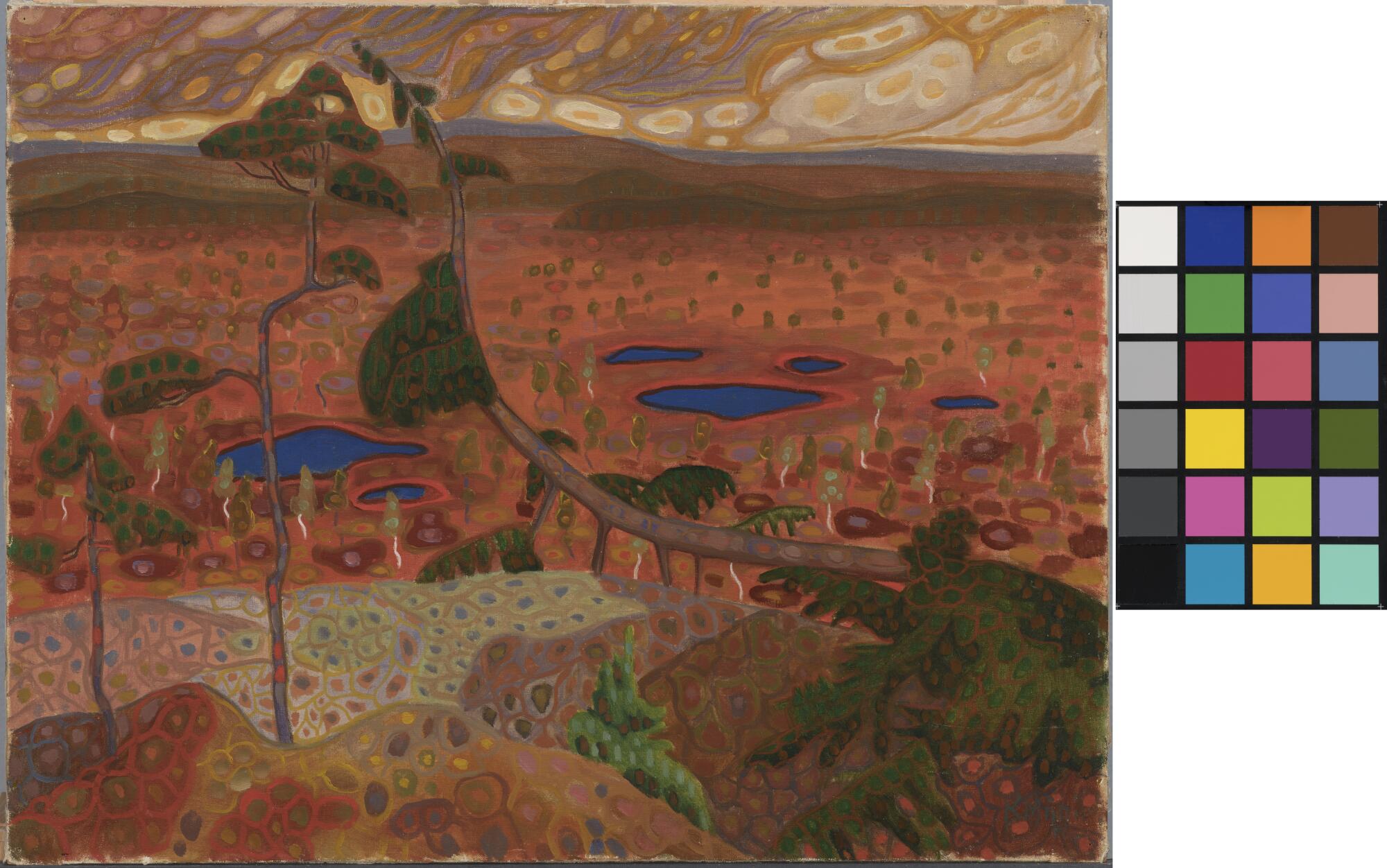
This painting dates from between summer 1908 and autumn 1910, when artist Konrad Mägi lived in various places in Norway, also holding an exhibition in Oslo. Today Mägi is the most celebrated painter of Estonian Modernism.
Associated primarily with Symbolism due to its intense colours, rather dream-like atmosphere and strong emphasis on affectiveness, the painting depicts an unreal-looking place, where the actual landscape has become distorted with the imaginary, even if we were to associate the red bog with evening light of a sunset.
Konrad Mägi’s artistic development
Until the early twentieth century, when Estonia still formed part of the Russian empire, its art scene belonged largely to the German-speaking elite: nearly all artists were Baltic Germans. Although a few Estonians had made a career for themselves as artists in tsarist Russia since the latter nineteenth century already (e.g. academicist painter Johann Köler, and sculptors Amandus Adamson and August Weizenberg), it was not until 1906 that the First Exhibition of Estonian Art was held in Tartu (German Dorpat).
Mägi belonged to the second generation of professional artists of Estonian descent. Several young men became interested in pursuing a career in visual art in the early years of the twentieth century. As there were no professional art schools in Estonia (though art courses were offered), they mostly went to study in St Petersburg, whose extensive collections gave many of them a first insight into the variety of world art history. This first generation of Estonian Modernists was quite reluctant to adjust to a certain style, but they were rebellious and clearly distanced themselves from realism. Disappointed in its conservatism, Mägi and several of his fellow Estonian students left the Stieglitz art school before graduation.
Some of them took up months-long trips to paint the nature of Finland, the Åland islands, others travelled to Germany, and soon they found themselves in Paris, adopting different Modernist modes. They choose to work primarily with landscapes, not least because most of them were born and raised in the Estonian countryside, in simple farm houses. Being unable to make a thrilling career in European metropoles, many young artists soon returned home.
Mägi’s education was fragmentary. During his work as a carpenter, he began taking drawing classes from Rudolf von zur Mühlen (1845—1913) in Tartu. Since 1903, Mägi studied sculpture and applied arts in St Petersburg. He took active part in the strikes during the Russian Revolution of 1905, including as an author of satirical drawings. In 1906 he moved to Helsinki, where he briefly attended the Ateneum drawing school, while already giving private lessons of his own. A year later, in autumn 1907, Mägi arrived in Paris, where he participated in occasional art courses at the Académie Colarossi, and Académie de la Grande Chaumière. Mägi was particularly inspired by Impressionism, Symbolism and Fauvism at the time. He went back to paint in Paris and Normandy in 1910—1912.
After returning to Estonia in 1912, Mägi became one of the protagonists of the Modernist movement. In 1919 he was elected the director of the newly established Art School of the Pallas Arts Association in Tartu. Along many other artists, he took part in the activity of the South Estonian art protection committee (Lõuna-Eesti kunstikaitsetoimkond) during the Estonian War of Independence, rescuing artworks from rural manors etc. He died being only 46 years old, declared mentally ill shortly before (possibly as a repercussion of uncured other illnesses). Yet, he managed to author c. 400 paintings, nearly a third of whose location is unknown, some were destroyed by himself, and many of Mägi’s paintings burned in World War II. Most of his oeuvre depicts nature, but he was also a prolific portraitist and made a handful of still lives.
The Norway period
In 1906—1910, Norway was for several Estonian artists a place to visit and explore. Mägi arrived there in spring 1908 and stayed for two years. His expressive works, with their intense colours, attracted attention both back home and in Norway.
Mägi’s Norwegian landscapes are generally undated, but it is hard to believe that he would have started with such sweeping, grand paintings immediately after arrival. Mägi was very poor at the time, working only in small formats, with relatively few colours. In an undated letter from Oslo, Mägi writes to his friend and agent Anni Vesanto in Helsinki, his language half Estonian, half Finnish:
I am sending You 35 studies; they are not real paintings, just preparatory pieces. Seven pcs are framed and something should be paid for the frames. I thought that I could sell them here, but the public here is not fond of this style of painting. The works do not contain any particularly interesting motifs — I only wanted to practice. […] I have not been well the whole time here, and even in this very moment I am feeling extremely lousy. I could not paint anything large, because I did not have money for that kind of work, and with my current (living) arrangements, I do not own a lot of furniture. I painted using different techniques and I did learn a lot though. They were all painted really quickly, in just one or two hours, so they are unfinished. I have quite a few more […].1“Letters”, in: Konrad Mägi, s.a., https://konradmagi.ee/en/letters (accessed 27 August 2025). Translated by Kadi Sutter. Originals in the Vesanto family archive, Finland. ↩
Gradually Mägi gained more resources by selling some of his works in Norway, Finland, Denmark, France as well as Estonia. He also took occasional jobs. Based on all this, it seems logical to date the smaller, more impulsive and laconic paintings to the second half of 1908 and 1909, while the bigger formats seem to be made in 1909 or 1910.
Mägi’s painting trips within Norway took him inland — mainly around Oslo, but also to the east. There are reports that he painted in the surroundings of Eidskog — including in the small town of Skotterud near the Swedish border, about 80 kilometres from Oslo — in summer 1910. On 9 June, he wrote: “Today I came to the countryside. Nature does not offer that much; the air is a little sharp, but living here at least is cheap.”2“Letters” (s.a.). ↩
Mägi might have been invited to Eidskog by Norwegian painter Erik Werenskiold (1855—1938) who was from Skotterud. They may have met through the fact that Werenskiold’s sister-in-law was married to the uncle of Norwegian politician Adam Egede-Nissen, whose daughter Ada Mägi portrayed (Portrait of a Norwegian Girl, 1909, Tartu Art Museum).3It is known that Krohg was connected with the commission. It remains unclear, why the portrait did not stay with the familiy. In 1942 Adalbert Luiga deposited it to the Tartu Art Museum, his widow Käthe-Erika Luiga donated it to their collection permanently after his death. ↩ The contact with Werenskiold is nevertheless speculative, neither is there any evidence that his work would have influenced Mägi.
In May 1910, Mägi and Christian Krohg (1852—1925) held a joint exhibition in the Blomqvist Gallery of Oslo, also featuring Leon Aurdal (1890—1949). The gallery was a striking venue: a large exhibition of European avant-garde art had been held there in 1908, with works by Ernst Ludwig Kirchner and Max Pechstein among others.4See “Max Pechstein, Keitelkähne, 1918”, in: Sparebankstiftelsen DNB, s.a., https://sparebankstiftelsen.no/en/artworks/keitelkahne (accessed 27 August 2025). ↩ Unfortunately the gallery archive is missing documentation about the 1910 exhibition, but it did earn a brief review, where the richness of colour in Mägi’s works was highlighted.5Ørebladet, 12 May 1910, 2. ↩
Mägi participated in the Oslo exhibition with 22 works. The initiative for it apparently derived from Krohg, a recognised Norwegian painter by then — the first professor and director of the Norwegian Academy of Art since 1909. They had cursorily come into contact in Paris in 1907 or 1908, when Krohg briefly taught Mägi at the Colarossi Academy.6Maie Raitar, Konrad Mägi: Kunstnik. Looming. Aeg, Tartu: 2011, 325. ↩
The painting in close inspection: The magical bog
One cannot forget the fact that Mägi was not an established author, when he painted the Norwegian Landscape with a Pine Tree. Although he was already in his late twenties, he was still a beginner as an artist. Before arriving in Norway, Mägi had limited painting experience, having created probably only a handful of works and not yet participating in exhibitions.
Although he saw lots of Modernist art in Paris, in his letters Mägi expresses disappointment in modernity and rather longs for timeless atmospheres. Having very different inspirational impulses — from modern art to childhood experiences, medieval churches etc. — Mägi never developed a style of his own, instead mixing various approaches and being in a constant state of flux throughout his oeuvre. The focal point for him was nature, which he saw not as a means for aesthetical pleasure, but rather as a toolbox with which to open up the irrational, the hidden, the sub-levels of the rational mind.
The painting depicts three pines in the forefront, a bog glowing in red, with small blue lakes in the back, and far-away mountains under a dramatic sky filled with hallucinatory clouds. It is not realistic, instead seemingly dissecting the landscape into small cell-like fragments. The colours are powerful and the overall atmosphere mystical, which rhymes with Mägi’s dramatic character. Also his portrait, made by his close friend Nikolai Triik (1884—1940), shows a rather grim Mägi, who sits on a chair with his body tense and an unfriendly look in his eyes.7Nikolai Triik, Portrait of Konrad Mägi, 1908, Tallinn, Under and Tuglas Literature Centre, UTKKK13, https://www.muis.ee/en_GB/museaalview/1367755 (accessed 27 August 2025). ↩
Mägi often emphasised a certain dream-like, psychedelic quality of art. He tested a number of novel ways of depicting landscape here — selecting an intense general tone (red), reducing forms as if to tiniest units — but he would only do it a couple of times, and not return to these devices later.
The painting seems to analyse the bog as a magical place. Describing bogs as a source of experiences that were far from the everyday reflects Mägi’s broader interest in esoterics and affective experiences based on them. Mägi does not openly attribute any sacral features to landscape, neither is he concerned with the aesthetisation of botanic forms. Knowing that he had a pantheistic world view, the painting could, however, be associated with the stories from Estonian pagan folklore about the mysterious and supernatural character of bogs, of the will-o’-the-wisp, intoxicating vapours, spirits that lead travellers astray and so on.
More broadly, this ties in with his principle of animating nature in his paintings, giving it a framework that cannot be fully apprehended by the human mind. That could be seen to reflect most disparate phenomena: not only being jaded with his experiences of modernity in Paris in 1907—1908, but also Mägi’s childhood memories whilst growing up in the South Estonian countryside, extreme sensitivity to external irritants, existential borderline situation (he experienced severe hunger at least once in Norway), an array of physical illnesses and depression, escapist strategies, and the desire for liberation through the irrationality of the art experience.
In addition to that piece, Mägi depicted a bog in another large-scale painting: Norwegian Landscape (1908—1910, also known as Bog Landscape, Art Museum of Estonia). In both works, Mägi introduces rhythm to the surface with colourful bubble-like shapes, giving the work a hallucinatory atmosphere, the irreality further highlighted by the right-most pine that seems to be growing as if upside down. All of the Earth’s creation is visualised as pulsating, writhing, perhaps even making wet sucking sounds. The Art Museum of Estonia archive also has a black-and-white reproduction of a third Norwegian painting by Mägi (now lost), where we can discern a similar segmentation of the landscape into cell-like fragments.
Bogs in Estonian culture
Apparently Norway is the only place, where Mägi painted bog landscapes. Although c. 8 percent of Estonian mainland is covered in bogs, his childhood home was not in a wetland area, and it is unlikely that he had experienced bogs around St Petersburg or Paris. Wetlands were in fact not considered a valuable part of Estonia’s identity landscape back then — this is a later phenomenon.8See Linda Kaljundi and Kadi Polli, Landscapes of Identity: Estonian Art, 1700—1945, ex. cat., Tallinn 2021. ↩ In the early twentieth century, it was all about draining the bogs and converting them into fertile cropland — which did not mean artists could not have found a certain romanticism in them.
The bog motif is not uncommon in Estonian folklore: due to the tricky landscape, bogs have been a place to hide against the many foreign oppressors Estonian past has witnessed. But in the fine arts, wetland themes are rare and Mägi’s foray into this theme in Norway was a one-off. He generally preferred to depict lush and fertile vegetation, not relatively barren bogs and mires.
Even if it is not known, why Mägi chose to paint a wetland in Norway, an interesting parallel can be brought with a poem written by Gustav Suits (1883—1956), one of the leading Estonian literary Modernists and a friend of Mägi’s, in 1908. It was published in the Noor-Eesti (Young Estonia) cultural movement’s third album:
Out on the Bog Ponds
The bogs are brimming with deep ponds.
Is the water, so dark and voiceless, rusty
Or is it the pain looking up from underground, full of wild blackness?
The bogs are brimming with deep ponds.
Bubbles rise up through the water all silvery.
Oh yearnings, secret desires within the mires,
Oh dreams that suddenly vanish into nothingness!
Bubbles rise up through the water all silvery.
The dwarf birch is gnarled, bent over to the ground.
The deceptive peaty sod shifting underfoot,
With stagnant flows buried in mud.
The dwarf birch is gnarled, bent over to the ground.
A thousand mosquitoes press forward across the mires.
They fall on to the face, into the mouth, they suck into the blood,
They penetrate the will, they creep into the heart.
A thousand mosquitoes press forward across the mires.9Gustav Suits, “Soolaugastel”, in: Noor-Eesti album, vol. III, Tartu 1909, 213-214. Translated by Kristopher Rikken. ↩
Mägi and his fellow Modernist artists were frequent contributors to Noor-Eesti albums. Not only is the bog theme actualised in the works of both him and Suits around the same time, but they similarities also occur content-wise: Suits likewise describes the bog as a mysterious place with yearnings, secret desires and painful gazes from underground. A bog is indeed an extremely striking place visually: it can have silvery or rust-coloured water, sometimes bubbly, and stunted trees. Rather than a place of refuge, the poem depicts the bog as a deceptively stable terrain, one that yields under the feet. Much remains enigmatic and unexplained there, and it is hardly coincidental that Suits, too, mentions the dream-like qualities of bogs.
Comparing it to Mägi’s painting, we can find a number of parallels on the visual level already: the painting indeed has a number of silvery bubbles rising from a dark bog pond. There are also similarities in the way they both associate the bog with visionary, indefinite states of mind, where forms keep changing and firm footing can disappear in an instant. The synchronous appearance of bog themes in Modernist literature and art, and the resulting mystification of nature, is thus noteworthy. It may signal a certain generational attitude that is sustained by nature and placelore, but it also makes bog themes a sounding-board for personal psychological tensions and a proving ground for the Modernist search for form.
Provenance and exhibitions
It is not known, when the Norwegian Landscape with a Pine Tree was first exhibited. It may have already been part of Mägi’s Oslo exhibition of 1910. It is reasonable to assume that it was exhibited in Estonia in December 1910, when the Third Estonian Art Exhibition was held in Tartu, Tallinn and Pärnu (organised by the same Noor-Eesti movement). Almost 40 paintings by Mägi were exhibited in the latter, but the catalogue lists most of them simply as a “Landscape”, making the identification of the exact selection difficult.
The painting later belonged to the family of Peeter Kann (1882—1943), a Supreme Court justice. Mägi soon became one of the best-known artists in Estonia, and his works were remarkably expensive — yet, lawyers and judges often purchased contemporary art in 1920s and 1930s. It is not known, when exactly Kann acquired the work though; he was arrested by the Russians in 1940 and killed three years later.
In 1946, the Norwegian Landscape with a Pine Tree was acquired by the Art Museum in Tallinn (given to them by the Council of Arts of the Estonian Soviet Socialist Republic). According to an expertise in 1947, there was a small tear on the right side of the painting, also signs of fly speck. Only small restauration works have been necessary in the later years. Due to the heavy exhibition load, some of Mägi’s paintings have become extremely fragile and thus lent for display only in rare occasions.10Darja Jefimova, “Konrad Mägi’s Oeuvre in the Light of Technical Studies”; and Alar Nurkse, “Conserving the Oeuvre of Konrad Mägi: Experiences and Technical Studies”, in: Eesti Kunstimuuseumi Toimetised / Proceedings of the Art Museum of Estonia 14 (2024), 116-135 and 151-184. ↩
Under Soviet occupation, until 1960s, Mägi’s oeuvre was condemned by the regime and hardly ever displayed. In the following decades, however, his heritage was celebrated by several exhibitions (e.g. 1978, Art Museum of Estonia) and publications, most notably the monograph by Evi Pihlak.11Evi Pihlak, Konrad Mägi. Monograafia, Tallinn 1979. ↩ In 2018 Konrad Mägi Foundation was established, which has published Mägi’s biography12Eero Epner, Konrad Mägi, Tallinn 2017. Parallel editions in English (trans. Peeter Tammisto, 2017), Italian (trans. Daniele Monticelli, 2017), Finnish (trans. Jouko Vanhanen, 2018), French (trans. Jean Pascal Ollivry, 2018), Norwegian (trans. Øyvind Rangøy, 2022). ↩ and catalogue,13Eero Epner and Lola Annabel Kass, Konrad Mägi, trans. Kristopher Rikken, cat., Tallinn 2022. ↩ plus released several documentaries (2018, 2020, 2022) etc.
Since the 1990s the early-twentieth-century Estonian Modernists went through a rediscovery abroad. In early 1920s, Mägi came to be interested in Expressionism and made several urban views in those lines during his trip to Italy. After 2017—2018 when Mägi had a solo exhibition in Rome (Galleria Nazionale d’Arte Moderna e Contemporanea), large exhibitions have been held also in Turin (Musei Reali, 2019), and also in Finland (EMMA Museum, Espoo, 2021—2022) and Norway (Lillehammer Art Museum, 2022—2023).
Norwegian Landscape with a Pine Tree was part of the long-time permanent exhibition of the Art Museum of Estonia (1993—2020). It has participated in all of Mägi’s retrospectives (1978 and 2019—2020 Art Museum of Estonia; 1998—1999 Tartu Art Museum; 2022 GL STRAND, Copenhagen; and the ones listed above). The painting has also been shown in several group exhibitions, e.g. Norway in Estonian Art, or Estonian Artists in the Nordic Countries (1995 and 2014, both Adamson-Eric Museum, Tallinn),14Kersti Koll, ed., Estonian Artists in the Nordic Countries, Tallinn 2007. ↩ Classics of Estonian Art from Eighteenth Century til 1940, and Music and Modernity in Estonian Art (2004—2005 and 2016—2017, both Art Museum of Estonia), and Wild Souls: Symbolism in the Baltic States (2018 Musée d’Orsay, Paris, later exhibited in Tallinn, Vilnius, Riga).15Rodolphe Rapetti, ed., Âmes sauvages. Le symbolisme dans les pays baltes, ex. cat., Paris 2018; Liis Pählapuu, ed., Wild Souls: Symbolism in the Art of the Baltic States, ex. cat., Tallinn 2018; Alge Andriulyte and Egle Mikalajune, eds., Laukinės sielos: Baltijos šalių simbolizmo dailė, ex. cat., Vilnius 2020; Ginta Gerharde-Upeniece and Laima Slava, eds., Nepieradinātā dvēsels: symbolisms Baltijas valstu mākslā, ex. cat., Riga 2020. ↩
Norwegian Landscape with a Pine Tree has become one of the cornerstones of Estonian early-twentieth-century Modernism, being exhibited and reproduced over and over again. A pine tree also features on the plaque which marks the former studio of Konrad Mägi in Tartu.