Article
Piatto di ciliegie con rose e ape legnaiola (Plate of cherries with roses and carpenter bee)
Dr Birutė Kabašinskienė
Lithuanian Institute for Culture Research, Vilnius
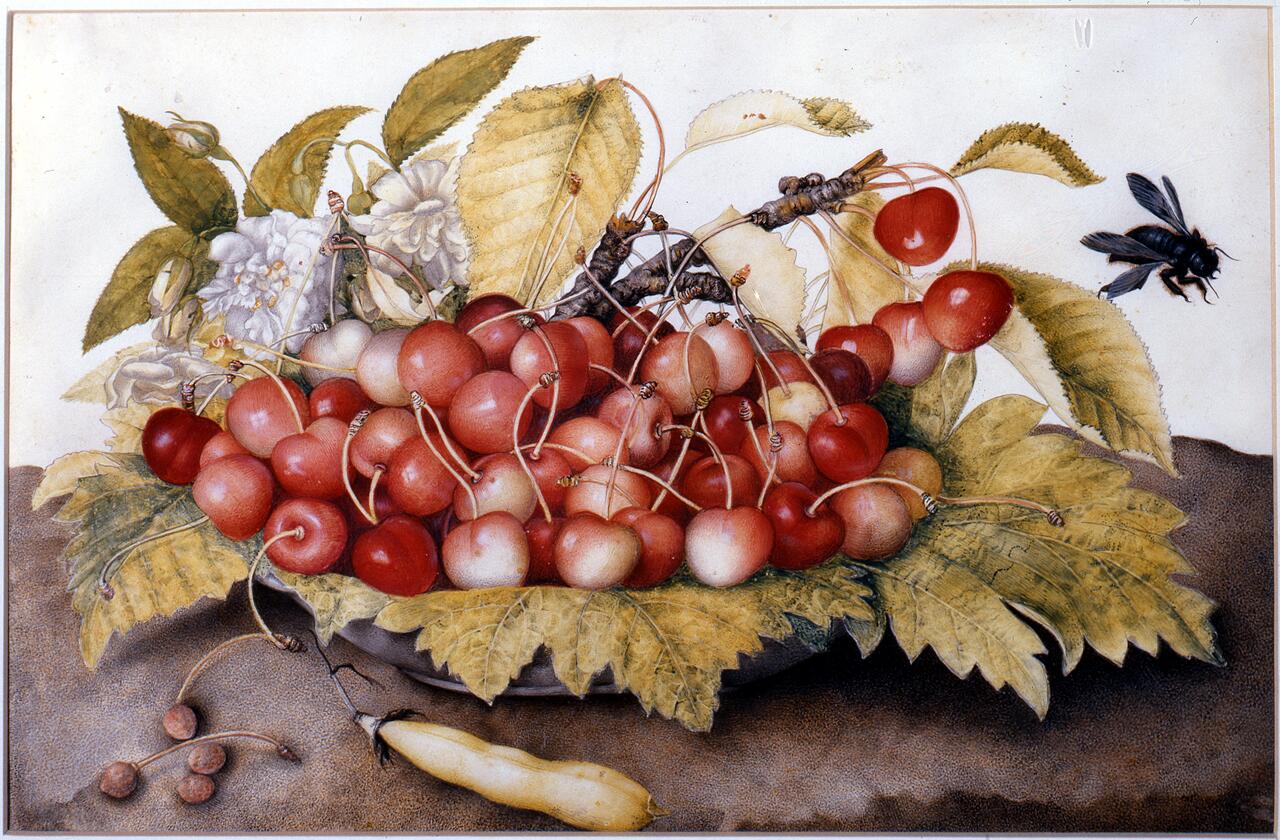
Giovanna Garzoni’s Still Life with Cherries, a Bean and a European Hornet (Natura morta con ciliegie, baccello e calabrone) is a still life painted in the mid-seventeenth century, datable to the years 1640—1660. The work belongs to the Galleria Palatina in the Pitti Palace and is currently exhibited at the Still Life Museum (Museo della Natura morta), established in 2007 at the Medici villa of Poggio a Caiano (province of Prato, Tuscany), where it forms part of a collection of approximately two hundred still lifes, bearing witness to the importance of Medici family patronage in fostering the development of the genre and in promoting the close interweaving of art and the natural sciences.1catalogo.beniculturali.it/detail/HistoricOrArtisticProperty/0900644514, accessed February 9, 2026. ↩ The term still life (French nature morte, Italian natura morta — “dead nature”) acquires a paradoxical resonance in Garzoni’s case. Her paintings — by an artist regarded as one of the most significant women in the history of Italian art — are marked by remarkable vitality and an astonishingly lifelike rendering of plants and animals. This effect derives not only from a highly refined painting technique but also through the inclusion of unexpected details that arrest the viewer’s gaze and create an illusionistic, deceptive visual experience.2Tongiorgi Tomasi, Lucia (2002). The Flowering of Florence: Botanical Art for the Medici, in: Tongiorgi Tomasi, Lucia & Gretchen A. Hirschauer, eds., The Flowering of Florence: Botanical Art for the Medici. Washington: National Gallery of Art, 77. ↩ These qualities are fully evident in the work under discussion.
Attention to Nature and Its Depiction
An increasing interest in plants and their symbolism can be traced from the Late Middle Ages into the Early Renaissance. During this period, the growing realism of artistic representation corresponded with the rise of the devotio moderna movement in the Netherlands, which emphasized direct religious experience and private devotion. The desire to comprehend the divine order of creation encouraged close observation of the physical world. At the same time, the great geographical discoveries expanded European knowledge of previously unknown plant and animal species, while the burgeoning interest in the natural sciences in the first half of the sixteenth century brought about a transformation of medieval iconographic traditions: from around 1530 onward, botanical treatises began to depict plants based on direct observation rather than on the repetition of established visual models. The earliest of these was Living Images of Plants, Created in Imitation of Nature with the Greatest Care and Skill (Herbarum vivae eicones, ad naturae imitationem summa cum diligentia et artificio effigiatae) by Otto Brunfels (1488—1534), published in Strasbourg between 1530 and 1539 and illustrated by the German artist Hans Weiditz (1495—1537).
Thus, in the first half of the sixteenth century, the depiction of nature came to be regarded as a noble subject worthy of the attention of highly skilled artists. This view was shared by natural scientists, who increasingly turned their attention not only to rare species but also to common plants and animals, for whose illustration they demanded high standards and offered generous remuneration. The close relationship between artistic practice and scientific documentation fostered the emergence of a new genre of natural illustration, which soon attracted the interest of Europe’s wealthiest aristocrats and rulers. Among the most influential patrons in this field was the Medici family of Florence, who had supported the study of nature and the practice of gardening since the first half of the fifteenth century. By attracting intellectuals from a wide range of disciplines to their residences, they cultivated a cultural milieu that encouraged the exchange between the arts and the sciences. On the initiative of Cosimo I de’ Medici (1519—1574), Duke of Florence and, from 1569, Grand Duke of Tuscany, the first botanical garden in Europe was founded in 1544 at the University of Pisa for the study of the medicinal properties of plants; a botanical garden in Florence followed a year later. Cosimo’s son and successor, Francesco I de’ Medici (1541—1587), together with his wife Joanna of Austria (1547—1578), invited the Veronese artist Jacopo Ligozzi (1547—1627) to the Medici court in 1577. Ligozzi produced botanical and zoological images and later became head of the artists’ workshops under Medici patronage, as well as of the Florentine Academy of Drawing (Accademia delle Arti del Disegno).3Tongiorgi Tomasi (2002), 38—39, 57, 58; Barker, Sheila. L’universo di Giovanna Garzoni. L’arte, i viaggi e un immaginario geografico senza confini, in: id. (2020) ed., “La grandezza del’universo” nell’arte di Giovanna Garzoni, cat. Firenze: Galleria degli Uffizzi, 16. ↩ His oeuvre attests both to the patrons’ interest in natural illustration and to the high status accorded to the artist at the grand-ducal court.
A few decades later, Giovanna Garzoni likewise became one of the favoured artists of the Medici court, owing to her outstanding reputation as a still life painter. She resided in Florence from 1642 to 1651, during the reign of Grand Duke Ferdinando II de’ Medici (1610—1670). At this time, still life painting enjoyed exceptional popularity, a phenomenon closely associated with the Dutch Golden Age. From the 1620s onward, early masters of the genre such as Ambrosius Bosschaert (1573—1621) and Jan Brueghel the Elder (1568—1625) were succeeded by a new generation of artists, whose success was marked by the emergence of dynasties devoted almost exclusively to still life painting. Ferdinando II’s envoys actively sought works by renowned Dutch and Flemish masters across Europe, and artists from these regions, including Willem van Aelst (1627—1683) and Otto Marseus van Schrieck (1619—1678), worked in Florence. At the same time, local painters such as Agnolo Gori (1610/1620—1678), Bartolomeo Ligozzi (1620—1695), and Carlo Dolci (1616—1686) adapted their practice to the genre. Continuing the Medici tradition of patronage, the grand duke supported both the arts and the sciences, as did his brothers, Cardinals Leopoldo (1617—1675) and Giancarlo (1611—1663). The latter, in particular, was deeply engaged in botany and horticulture: he assembled a collection of rare flowers and established a drawing room in the left wing of the Pitti Palace known as the Paradiso dei Fiori (Paradise of Flowers). Cardinal Giancarlo became Garzoni’s principal patron, although Cardinal Leopoldo, Grand Duke Ferdinando II, and his wife Vittoria della Rovere (1622—1694) also commissioned works from the artist.4Tongiorgi Tomasi (2002), 75—77. ↩
After leaving Florence, Garzoni maintained close ties with her former patrons and continued to fulfil their commissions. It is therefore unsurprising that the Picture Gallery of the Pitti Palace (Galleria Palatina) preserves a series of twenty of her still lifes, painted for Grand Duke Ferdinando II during her later Roman period (1650—1662).5Barker (2020), 197—199. ↩ These works depict plates of fruit and vegetables, encompassing both rare delicacies prized by the aristocracy and more common produce consumed across different social strata. The Medici collections also included a painting closely related to this series, Still Life with Cherries, a Bean and a European Hornet.
Giovanna Garzoni and the Phenomenon of Her Success
Giovanna Garzoni was born in 1600 in Ascoli Piceno, in the Marche region of Italy, into a family of goldsmiths and craftsmen.6Damioli, Carol (2025b). Giovanna Garzoni: A Life of a Still-life Expert, in: Daily Art Magazine, 2025-04-28, www.dailyartmagazine.com/giovanna-garzoni-still-life-expert/ (accessed October 22, 2025). ↩ Her artistic talent was recognized early, most likely by her maternal uncle Pietro Gaia, an engraver and painter7Sharma, Mahima (2023). Giovanna Garzoni: Story of the Venetian Still Life Master, in: Simplykalaa, 2023-03-07, simplykalaa.com/giovanna-garzoni/ (accessed October 22, 2025). ↩ who played a formative role in her education and introduced her to oil painting. As a teenager, Garzoni accompanied him to Venice, where between around 1616 and 1620 she studied in the workshop of Palma il Giovane (Jacopo Negretti, c. 1550—1628) and subsequently worked in the city for nearly a decade.8Damioli (2025b). ↩ From this early period, two works of religious iconography are known: The Holy Family, painted when Garzoni was only sixteen (1616, private collection), and Saint Andrew (1620, Gallerie dell’Accademia, Venice).9Sharma (2023). ↩ At the same time, she received a broad artistic education, studying calligraphy, miniature painting, singing, and the playing of string instruments.10Truong, Alain R. (2020). The Natural Universe of Giovanna Garzoni Brings Palazzo Pitti Back to Life, in: Canalbloo (2020-06-21), www.alaintruong.com/archives/2020/06/01/38337664.html (accessed October 22, 2025). ↩ Her later career was thus shaped by a combination of innate talent and comprehensive training, supported by her family. Equally significant was Garzoni’s own determination: some scholars have interpreted her Self-Portrait as Apollo (c. 1618—1620; ill. 2) as a conscious statement of artistic ambition and an assertion of her place within a male-dominated artistic field.11Barker (2020), 124; Damioli (2025b). ↩
Garzoni never established a conventional family life. According to contemporary accounts, she took a vow of chastity in her youth after a fortune-teller predicted that she would die in childbirth. Nevertheless, while living in Venice, she married the portrait painter Tiberio Tinelli (1587—1639) in 1622. The marriage was annulled two years later, after Garzoni’s father accused Tinelli of having coerced his daughter into marriage through deception12Damioli (2025b). ↩ — an episode that further attests to her family’s active support of her autonomy. Unlike many gifted women of her time, Garzoni was able to dedicate herself fully to her artistic practice and the refinement of her techniques. She led a life more typical of male artists of the period, traveling between aristocratic courts and estates, often accompanied by her brother Mattio.
In 1630, following her brother’s advice to seek greater personal freedom, Garzoni travelled with him to Naples. There she entered the service of the Duke of Alcalá and formed a friendship with the artist Artemisia Gentileschi (1593—1653). Garzoni subsequently moved to Rome, where she received commissions from the Barberini family and became integrated into the intellectual circles associated with the Accademia dei Lincei,13Tongiorgi Tomasi (2002), 77. ↩ a centre of innovative scientific thought. Among its members was the Dutch pharmacist and botanist Enrico Corvino (Hendrik de Raeff, 1567/1568—1639), who encouraged Garzoni to pursue the study and illustration of nature. He advised her to examine botanical engravings in the herbal by Pietro Andrea Mattioli (1501—1578), particularly the richly illustrated edition published in Venice in 1565.14Commentarii in sex libros Pedacii Dioscoridis Anazarbei de medica materia. Venezia: Vincenzo Valgrisi, 1565, in: BEIC: Biblioteca Europea di Informazione e Cultura, preserver.beic.it/delivery/DeliveryManagerServlet?dps_pid=IE4612670 (accessed October 22, 2025). ↩ The practice of botanical illustration proved formative for Garzoni’s later still life painting. At the same time, she closely studied the works of other masters of the genre, especially the Dutch painters Ambrosius Bosschaert and Balthasar van der Ast (1593/1594—1657), as well as the French artist Louise Moillon (c. 1610—1696), and copied the zoological drawings of Albrecht Dürer (1471—1528).15Tongiorgi Tomasi (2002), 81. ↩
In 1632, fleeing the plague epidemics, Garzoni arrived in Turin at the invitation of Duchess Christina of Savoy (1606—1663). There she painted portraits of the ruling family as well as still lifes and religious, mythological, and allegorical compositions, for which she received an impressive annual stipend of 1,000 scudi.16A miniature painted by Garzoni in 1635 survives from this period, depicting Zaga Christ (c. 1616—1638), who resided at the court of the Dukes of Savoy and sought to reclaim the throne of the Ethiopian Empire. See Damioli (2025b); Damioli, Carol (2025a). Masterpiece Story: Portrait of Zaga Christ by Giovanna Garzoni, in: Daily Art Magazine (2025-02-20), www.dailyartmagazine.com/portrait-of-zaga-christ-giovanna-garzoni/ (accessed October 22, 2025). ↩ In 1637, she travelled to London, where she was received by Christina’s sister, Queen Henrietta Maria of France (1609—1669). Two years later, in 1639, Garzoni stayed at the Parisian court of their brother, King Louis XIII of France (1601—1643), executing commissions for Cardinal Richelieu (1585—1642) and other prominent members of the nobility.17Damioli (2025b); Truong (2020). ↩ In August 1642, Garzoni returned to Rome18Sharma (2023). ↩ and later that same year moved to Florence, where she remained for nine years. She spent the final two decades of her life in Rome, becoming a member of the Academy of Saint Luke (Accademia di San Luca). She was also the first woman to be buried in the Church of Santi Luca e Martina,19Truong (2020); Sharma (2023); Damioli (2025b). ↩ which was closely associated with this prestigious artistic institution.
Beyond her innate talent and the opportunities afforded by education and a cosmopolitan seventeenth-century artistic life, Garzoni’s success rested on a highly sophisticated creative technique, marked by exceptional precision and well suited to conveying the specific qualities of the natural world. She almost invariably worked in water-based media — watercolour, gouache, and tempera — applied to parchment. After laying out a preliminary drawing in pencil, she reinforced it with gouache, at times mixed with acacia resin (gum arabic). Garzoni’s style is characterized by the interplay of firm, decisive strokes with lighter, more delicate touches and finely arranged dots of varying hues. The process was slow and labour-intensive, and the artist herself described her works as “the result of a huge work.”20Tongiorgi Tomasi (2002), 78, 82. ↩ This meticulous method of combining strokes and dots is already evident in her early miniatures. Such painstaking execution ensured an exceptionally high degree of realism — one of the principal criteria by which still life painting was judged in the seventeenth century.
Still Life with Cherries, a Bean and a European Hornet: Composition and Symbolism
Giovanna Garzoni’s Still Life with Cherries, a Bean and a European Hornet belongs to a group of still life compositions characteristic of her oeuvre, depicting plates laden with fruit and vegetables. Lucia Tongiorgi Tomasi has identified sweet cherries as Garzoni’s favoured motif, pointing to the earlier Chinese Porcelain Plate with Cherries and Bean Pods,21Tongiorgi Tomasi (2002), 82. ↩ painted in gouache on parchment around 1620. In both works, a plate heaped with reddish-yellow fruit occupies the centre of the composition, while bean pods appear in the foreground on the left. In the later painting, however, only a single pod remains, now more mature and unpeeled. A comparison between the two works reveals an increasing density of detail that heightens the sense of lived, transient reality. In the later still life, a European hornet (Vespa crabro) hovers on the right; in the lower left corner, the pits of four already eaten cherries lie scattered beside the plate; above them, several white rose blossoms shed their petals; and a branch bearing unpicked cherries and leaves appears to have been hastily brought in from the garden and placed atop a plate prepared for serving. The plate itself plays a deliberately diminished role: only its glazed base remains visible, largely obscured by overlapping grape leaves. By contrast, in the 1620 work, the form and ornamentation of a luxurious Chinese porcelain plate are rendered with particular care. The backgrounds of both paintings are neutral: all elements rest on an uneven brown stone ledge set against a light ground, its rough texture and shadows constructed through fine stippling — a technique executed with particular mastery in the later work. The two compositions appear at once closely related and deliberately distinct.
As scholars of Garzoni’s work have noted, she frequently reused motifs in varying configurations, yet never simply replicated earlier compositions. Instead, she enriched them through additional elements and unexpected details designed to engage the viewer’s senses — sight, touch, and even taste or smell — and thereby to evoke the very essence of nature through painting.22Tongiorgi Tomasi (2002), 87, 89. ↩ One such detail in the still life with cherries is the remarkably lifelike depiction of the European hornet as it takes flight.
The hornet in the painting may also carry symbolic significance. At first glance, the insect resembles a fly, a motif that in still life painting often functions as a symbol of decay, death, and sin. Visual cues underscoring the passage of time and the onset of deterioration include the cherry stones scattered beside the plate and the white roses shedding their petals — flowers traditionally associated with chastity.23Tongiorgi Tomasi (2002), 19. ↩ The presence of a flying insect may thus prompt reflection on loss, withdrawal, and the fragile residue of once-present abundance. The “perishable good” depicted here — the sweet cherry or, in other cases, cherry — was associated in medieval iconography both with the joy of Paradise, owing to its sweetness, and with the blood of Christ, due to its red colour; as such, it frequently served as a symbol of Christ’s sacrifice and the Redemption that restored paradisiacal joy. While it would be inappropriate to seek direct quotations of medieval symbolism in Garzoni’s still lifes, certain religious connotations and details that subtly invite contemplation of the transience of such goodness can be discerned.
Scholars have noted that Garzoni’s paintings, distinguished by their vitality and precision, maintain a deliberate yet understated balance between scientific realism and decorative refinement, symbolism and naturalistic representation.24Tongiorgi Tomasi (2002), 82. ↩ This observation is fully applicable to Still Life with Cherries, a Bean and a European Hornet. Preserved in the Medici still life collection, the painting attests to elite patrons’ interest in the arts and botanical science and to their intersection in Garzoni’s exceptionally meticulous and exacting practice. The work initially captivates the viewer through its striking realism and precision of detail; only subsequently, in keeping with Baroque modes of viewing, does it invite reflection on the transience of earthly pleasures and the sweetness of life.
Illustration
Giovanna Garzoni
Still Life with Cherries, a Bean and a European Hornet (Natura morta con ciliegie, baccello e calabrone)
1651—1662
Gallerie degli Uffizi, Galleria Palatina, inv. 1890 no. 4779
Museo della natura morta, Villa Medicea di Poggio a Caiano