Article
Epitaph of the Prague Goldsmith Nikolaus Müller
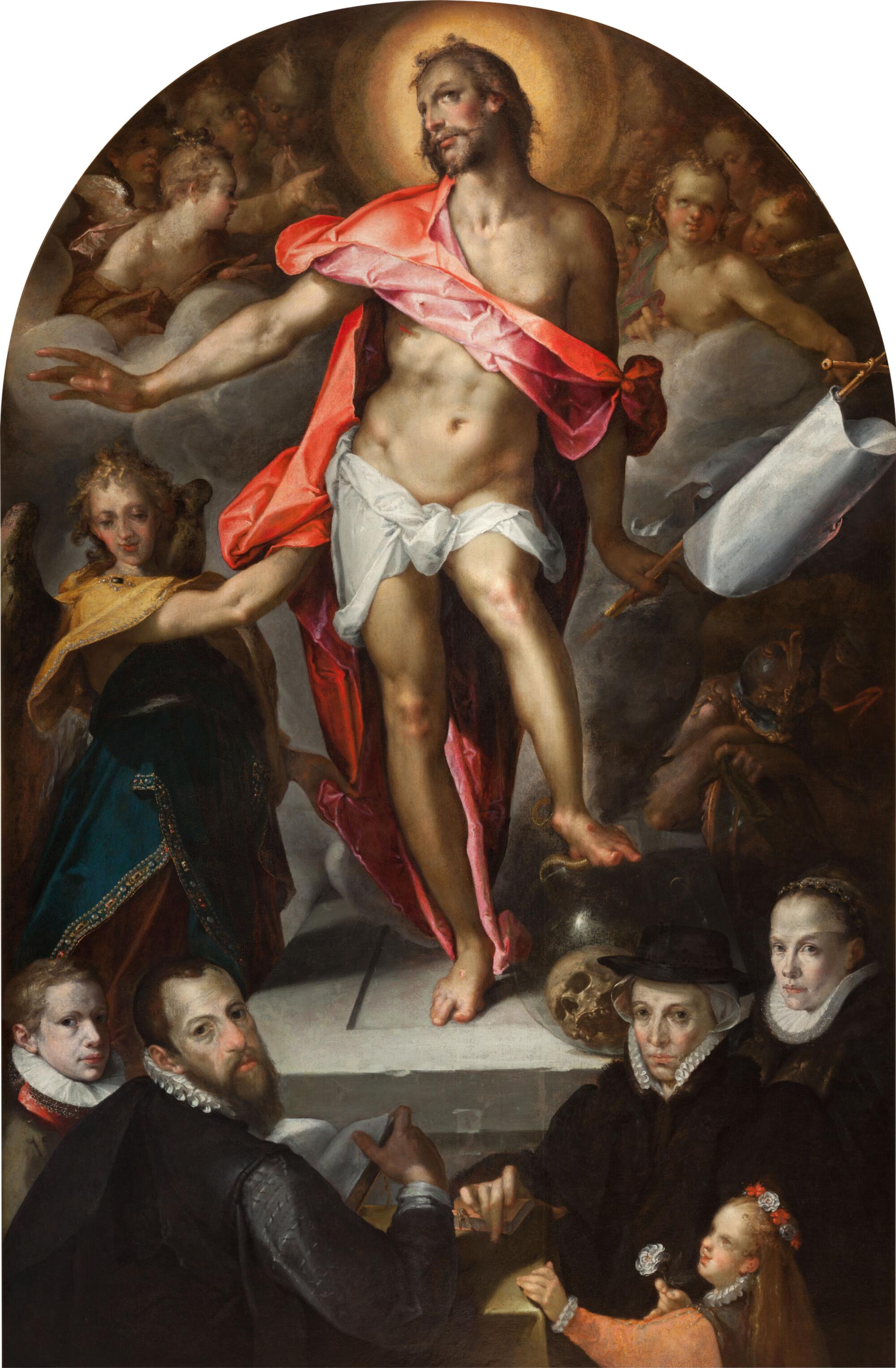
The epitaph of the Prague goldsmith Nikolaus Müller, painted by Flemish artist Bartholomeus Spranger (1546—1611), ranks among the iconic works of the so-called Prague School, the term used for painting at the court of Emperor Rudolf II.1Most recently Marius Winzeler in: Agnieszka Gasior and Marius Winzeler, eds., Von der Renaissance zum Barock (1570−1670) (= Handbuch zur Geschichte der Kunst in Ostmitteleuropa 5), Berlin 2025, 365-366, cat. no. 49; Evelyn Reitz, Discordia concors. Kulturelle Differenzerfahrung und ästhetische Einheitsbildung in der Prager Kunst um 1600 (= Ars et scientia 7), Berlin and Boston, De Gruyter, 2015, 234-278; Sally Metzler, Bartholomeus Spranger. Splendor and Eroticism in Imperial Prague. The Complete Works, exh. cat., New York, New Haven and London 2014, 121-122, cat. no. 52. ↩ It captivates with the refined modelling of Christ’s athletic body and a pronounced contrapposto — effects that contemporaries regarded as displays of artistic virtuosity. This manner of execution was intrinsic to the sophisticated style cultivated in late sixteenth century Rudolfine Prague by artists of transalpine origin who had undergone extensive training in Italy — most notably Hans von Aachen and Joseph Heintz, alongside Spranger. Spranger’s Italian formation is well documented: in the late 1560s—early 1570s he worked in Parma and in Rome with Giulio Clovio and for Cardinal Alessandro Farnese at Caprarola, absorbing Roman disegno and the Mannerist figura serpentinata before departing Italy for Vienna in 1575. Having settled in Prague in 1580, he soon established himself as Rudolf II’s leading painter. Only in the following decade did Hans von Aachen and Joseph Heintz enter imperial service, and it was through their subsequent interplay that the distinctive figural idiom later associated with the “Prague School” began to take shape. Although Spranger is best known for his mythological and allegorical scenes, the Müller epitaph demonstrates that the painter could compellingly apply his distinctive rendering of the human body to religious themes as well.
Spranger’s most monumental and largest painting was originally intended for the Chapel of St Matthew, adjoining the parish Church of St John the Baptist in Obora, in Prague’s Lesser Town. This chapel housed the tomb of Spranger’s father-in-law, the imperial goldsmith and jeweller Nikolaus Müller.2Pavel Vlček et al., Umělecké památky Prahy. 3. díl: Malá Strana, Prague 1999, 423-426. n the tomb monument of Nikolaus Müller, bearing the date of death 1585, see Joannes Florianus Hammerschmid, Prodromus Gloriae Pragenae, Vetero-Pragae, 1723, 452. ↩ In the painter’s biography, the contemporary art theorist Karel van Mander provided a detailed description of the epitaph (Epitaphium): ”… it is the Resurrection of Christ, with figures as if alive (als t’leven); Christ ranks among the best-coloured (ghecoloreert) that Spranger ever painted.”3Karel van Mander, The Lives of the Illustrious Netherlandish and German Painters, from the First Edition of the Schilder-Boeck (1603—1604). Proceeded by the Lineage, Circumstances and Place of Birth, Life and Works of Karel van Mander, Painter and Poet and likewise his Death and Burial. From the Second Edition of the Schilder-Boeck (1616—1618), with an introduction and translation, ed. by Hessel Miedema, Vol. I, Doornspijk 1994, 350 (fol. 273r). ↩ The tall vertical format and semicircular top indicate its original placement within an aedicula frame, as confirmed by van Mander, who explicitly states that the painting formed part of a retable (Frontesprijt) adorned with putti sculptures by the court sculptor Adriaen de Vries and, in the upper section, a painting of God the Father. The Chapel of St Matthew was abolished in 1784, subsequently demolished, and its furnishings dispersed. Müller’s epitaph only re-emerged in public awareness in the 1920s, when it was discovered in a family vault at the Olšany Cemetery in Prague (placed there in 1864), and was later acquired by the National Gallery in Prague.4Rudolf Kuchynka, “Sprangerův domněle zničený epitaf zlatníka Müllera byl nalezen”, in: Památky archeologické 33 (1922—1923), 150-152. ↩
Although Karel van Mander states that Spranger painted the epitaph after the death of Nikolaus Müller, this does not necessarily mean that the painting was created immediately after his passing in 1585. The vertical construction of the composition, the dynamic pose of Christ, the use of chiaroscuro, and the metal-inflected palette suggest a dating closer to the artist’s mature period in the 1590s, when he was producing mythological compositions for the Loves of the Gods series. Particularly striking is the resemblance to the allegorical painting Triumph of Wisdom (Kunsthistorisches Museum in Vienna), where the victorious Minerva-Sapientia assumes an identical posture to the Resurrected Christ, who tramples the serpent underfoot. Similarly, Minerva triumphantly steps on the figure of Ignorance, while around her pedestal are gathered personifications of the liberal and fine arts; in the foreground appear the goddess of war, Bellona, and the muse of famous deeds, Clio.5Eri Kawakami, “Bartholomeus Spranger’s Triumph of Wisdom as an Allegory of the Re-evaluation of the Art of Painting in Sixteenth-century Prague”, in: Studia Rudolphina 17/18 (2018), 67-78. ↩ This formal parallel has already been noted in the literature: Konrad Oberhuber situated it within the tradition of psychomachia, the battle between virtues and vices, whereas Thomas DaCosta Kaufmann interpreted the analogous figures of Minerva and Christ in Müller’s epitaph as variants of the so-called triumphal type---an iconographic scheme employed in Rudolfine art within the framework of imperial allegories.6Thomas DaCosta Kaufmann, “Empire Triumphant. Notes on an Imperial Allegory by Adrian de Vries”, in: Studies in the History of Art 8 (1978), 63-75. ↩
The production of epitaph paintings was widespread in early modern Central Europe. These works, installed in churches or chapels, served to honour the memory of the deceased while also expressing the piety and social status of the patrons.7For an overview of the Czech context, see Ondřej Jakubec, “Epitaphs in Bohemian Protestant Culture”, in: Kateřina Horníčková and Michal Šroněk, eds., From Hus to Luther. Visual Culture in the Bohemian Reformation (1380—1620), Turnhout 2016, 247-280. ↩ They most often depicted scenes such as the Crucifixion, the Resurrection, or the Last Judgment, accompanied by images of the deceased and their family in a kneeling pose. In most cases, such paintings were created by local artists who relied on graphic reproductions of well-known works when composing their scenes. This practice usually reflected the wishes of patrons, who preferred a conventional and easily legible visual language. As a result, epitaphs that were both compositionally inventive and of high painterly quality were relatively rare and typically signalled the exceptional social and cultural standing of the commissioner.
In Prague, however, where a large number of artists were active at the court of Emperor Rudolf II, such commissions for members of the burgher class occurred more frequently. Spranger, in particular, developed close ties with the local community: he was a burgher of the Lesser Town and became a member of the local painters’ guild in 1584. His clear commitment to the work, based on a composition of his own invention, likely stemmed from his personal ties to the family of the deceased goldsmith. In 1585 he married Müller’s daughter Christina, and Müller bequeathed him a significant portion of his estate. Spranger lived near the Chapel of St Matthew, which he also chose as his final resting place — clear evidence that the painting held the significance of a personal funerary memorial.
The eschatological message of the epitaph is conveyed clearly yet with complexity. Christ is shown wearing a loincloth and a red mantle draped across his chest, holding the Resurrection banner in his left hand as a sign of his triumph over death. The stone slab on which he stands is sealed at the front with a strip, recalling the sealed tomb (sepulcrum signatum, cf. Matthew 27:66). Christ’s head is surrounded by a radiant glory; putti are seated in the clouds on either side, a large angel on the left supports his garment, and on the opposite side, a drowsing soldier with an lavishly ornamented helmet can be discerned in the shadowed background. The Saviour’s foot crushing a serpent on a transparent globe containing Adam’s skull expresses a threefold triumph: the serpent symbolizes original sin, the globe worldly dominion, and the skull death. At the same time, the transparent sphere with the skull evokes the transience of human life, likened to a fragile bubble in the Terentian maxim homo bulla (“man is a bubble”). In Renaissance art, the motif of the bubble was a popular metaphor for the vanity of worldly glory and the fragility of earthly existence.8Bernd Ebert, “Homo bulla. Zum Motiv der Seifenblase als Sinnbild der Vergänglichkeit”, in: Moritz Wullen and Bernd Ebert, eds., Der Ball ist rund. Kreis Kugel Kosmos, exh. cat., Berlin 2006, 88-95. ↩
In the lower zone of the painting, the deceased goldsmith Müller and his family appear, situated in a different, historical time. The family members are depicted as half-length figures, conventionally divided by gender into two opposing groups. They maintain eye contact with the viewer, and some of their gestures introduce a certain narrative element into the scene. Müller, seen from behind as if interrupted in his pious reading, turns over his shoulder, while his wife Juliana rests her right hand---arranged in a typically Mannerist gesture---on a closed prayer book. Their children are shown to either side: the son Nikolaus and daughter Christina, who would later become Spranger’s wife. The little girl with a floral wreath in her hair at the bottom edge of the painting is believed to be Spranger’s own daughter; she holds a white rose in her hand and is the only one who, smiling, looks up at Christ.9For further details on the family background, see Michal Šroněk, Pražští malíři 1600—1656. Mistři, tovaryši, učedníci a štolíři v Knize Staroměstského malířského cechu. Biografický slovník (= Fontes Historiae Artium 1), Prague, Artefactum, 1997, 98-99; also Metzler (2014), 22. ↩
Christ’s widely extended right hand makes a protective gesture directed specifically at them, while his gaze is turned upward toward God the Father, who was originally depicted in a pinnacle painting at the top of the sepulchral monument. Some scholars have recently proposed that this upper image may be identified with an oil painting on an oval wooden panel now preserved in the collections of the Kunsthistorisches Museum in Vienna. However, the significantly smaller scale of its figures makes a direct connection with the Müller epitaph unlikely.10The dimensions of the painting are 60 by 45.5 cm. Cf. Metzler (2014), 121, cat. no. 51; Winzeler (2025), 366. ↩ Nevertheless, it is likely that the original upper image was conceived in a similar manner. The epitaph as a whole was thus originally structured as a hierarchically ordered tripartite composition, in which meaning was constructed through the sophisticated interplay of gazes and gestures linking the figures across the vertical axis.
The goldsmith Müller and his family are dressed in dark garments, which sharply contrast with the exposed body of Christ. His athletic physique, dynamically twisted into a spiralling pose (figura serpentinata) combined with a pronounced contrapposto, appears both sensual and idealised. The marks of the Crucifixion are not immediately visible---Christ’s body is perfect, beautiful, and unblemished, recalling Michelangelo’s conception of the human form as an expression of spiritual beauty. This ideal, first theorised in Renaissance art under Neoplatonic auspices and grounded in admiration for ancient sculpture, was later appropriated by Mannerist artists, who reinterpreted it with heightened artifice, elongation, and sensual charge. Although this late Renaissance reworking often aestheticized and diluted the original Neoplatonic framework, some scholars nonetheless interpreted the triumphal iconography of Christ on Müller’s epitaph in philosophical terms. They based this interpretation in part on the existence of a secular variation of the composition---namely, the aforementioned allegory of Minerva triumphing over Ignorance, in which the goddess of wisdom tramples Ignorance and adopts the same pose as Christ in the epitaph. The formal parallels and symbolic structure of both works clearly suggest a deliberate transference of meaning between sacred and profane themes---a hallmark of Mannerist art.11Cf. Reitz (2015), 235-238. ↩
The use of nudity and the eroticisation of religious imagery were characteristic features of Mannerist aesthetics, not only at the imperial court in Prague. This approach, rooted in the period’s striving for expressive refinement, sensual impact, and formal virtuosity, led artists to emphasise corporeality and sensuality in depictions of Christ and the saints. Yet it was precisely these tendencies that increasingly came under criticism in the second half of the sixteenth century, particularly from ecclesiastical authorities---most notably the Catholic Church, which, in response to the Reformation and in line with the principles laid out at the Council of Trent, sought greater control over the visual representation of religious subjects. Criticism focused especially on the portrayal of the nude body in paintings with spiritual content or within the decoration of sacred spaces, citing concerns over the violation of decorum and the potential for moral scandal.12Christian Hecht, Katholische Bildertheologie der frühen Neuzeit. Studien zu Traktaten von Johannes Molanus, Gabriele Paleotti und anderen Autoren, Berlin 2012, 336-354. ↩
This brings us to a crucial aspect of Müller’s painting: the confessional framework within which the work was created and originally functioned.13Especially, see Ondřej Jakubec and Michal Šroněk, in: Kateřina Horníčková and Michal Šroněk, eds., Umění české reformace (1380—1620), exh. cat., Prague 2010, 390-400, cat. no. XIII/1. ↩ The Church of St John served as a parish church for the surrounding area and, according to a list of Prague’s churches compiled shortly before the post-White Mountain re-Catholicisation, it, along with the Chapel of St Matthew, fell under the administration of the Czech Utraquists.14Štěpán Vácha, “Sub utraque, sub una: eine Quelle zur sakralen Topographie des rudolfinischen Prag (zum Jahr 1618)”, in: Studia Rudolphina 12-13 (2013), 116-133 (122). ↩ Both sanctuaries served as the final resting place for other non-Catholic members of the imperial court, including the court painter Joseph Heintz (†1609) and the court engraver Aegidius Sadeler (†1629). The confession of the goldsmith Müller is unknown, while Spranger is believed to have had sympathies with Calvinism, as he contributed financially to the construction of a Reformed church meeting house in Prague’s Old Town.15Jakubec and Šroněk (2010), 400. ↩ Nevertheless, as Evelyn Reitz has argued, the iconography of the epitaph does not express exclusively Protestant doctrinal content, since similar images of Christ trampling the serpent, skull, or globe were also commissioned by Catholic patrons during this period. The epitaph of Nikolaus Müller should thus be understood above all as a reflection of the cultural openness and confessional tolerance that characterised both Prague and the imperial court at the turn of the sixteenth and seventeenth centuries.16Reitz (2015), 255-262. ↩ Although the painting was commissioned for a municipal church and reflects values and beliefs in the afterlife typical of the burgher milieu, its formal sophistication and conceptual complexity fully align it with the visual culture of the Rudolfine court---characterised by a deliberate interplay of religious themes with profane symbolism, heightened sensuality, and intellectual ambition.
Štěpán Vácha, Institute of Art History, Czech Academy of Sciences, Prague