Article
The Knucklebones Player
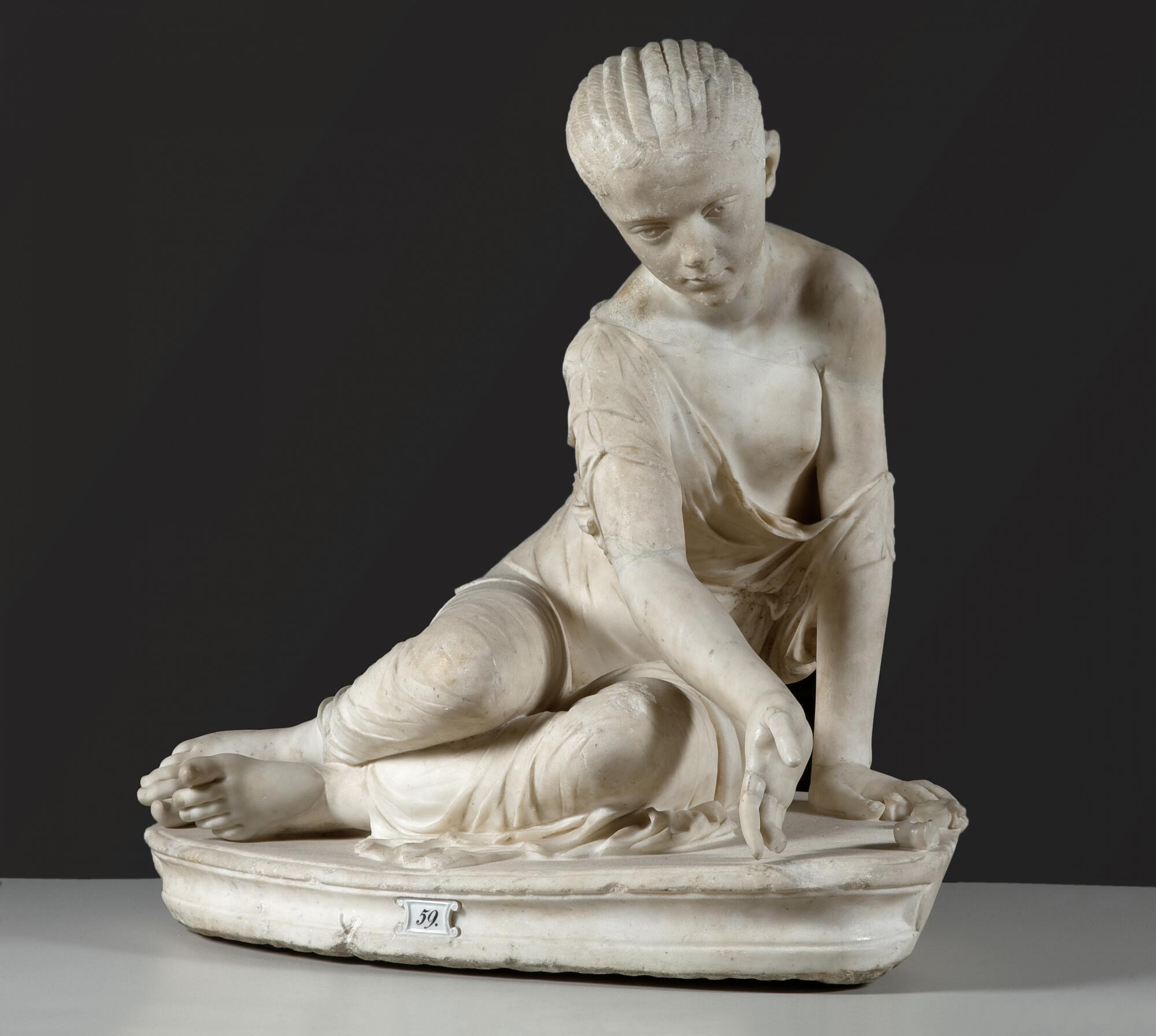
Discovered in Rome in the early 18^th^ century and now housed in the Antikensammlung of the Staatliche Museen in Berlin, the marble statue of Knucklebone Player from the 2^nd^ century CE is one of the most celebrated depictions of this type to survive to the present day.
The girl, portrayed as smaller than life size, sits on a plinth with her legs folded over each other, her torso leaning forward and turned to the left. Her head is tilted slightly, her large, flat eyes gaze into void. She wears a chiton with buttoned sleeves that has slipped off her left shoulder, revealing her nascent bosom. Her left arm rests on the ground, while her right arm is raised. Two astragali, small tarsal bones of mammals, which are known to have been used as gaming pieces in antiquity (mistakenly referred to as knucklebones, i.e. joints of the fingers, in scholarly literature) are held in her left hand, while two more rest on the plinth.
Louis Becq de Fouquières, the author of a monumental study of ancient games from the mid 19^th^ century, interpreted the statue as being caught in a moment of poised concentration, her gaze lost in the void, as if she could foresee her deadly fate in the throw of the bones.1Louis Becq de Fouquieres, Les jeux des anciens: leur description, leur origine, leurs rapports avec la religion, l’histoire et les mœurs, ouvrage accompagné de gravures sur bois d’après l’antique, dessinées et gravées par M. Léon Le Maire, Paris 1869, 332. The funerary destination of the statue — despite the unknown find-context — was postulated in Matthias Oesterreich, Description et explication des Groupes, Statues, Bustes & Demi-Bustes, Bas-Reliefs, Urnes & Vases de marbre, de bronze & de plomb, antiques, aussi bien que des ouvrages modernes qui forment la Collection de S.M. Le Roi de Prusse : l’on y indique la place où chacune de ces Pieces se trouve à présent, celle qu’elles occupaient autrefois & les Collections dont elles ont fait partie on y joint des détails historiques & des Remarques sur les Artistes modernes qui ont travaillé pour le Roi, Berlin 1774, 10, n. 91. ↩ Since then, casting the bones has been seen as an allegory of premature death, and the bones themselves have come to symbolise childlike innocence and feminine grace. This sentimental, gendered interpretation has been mechanically applied to almost every ancient image of a woman holding astragali ever since, influencing art-historical discourse and the interpretation of archaeological evidence to this day.
The statue made its appearance nearly a century after the Nymph with a shell, which shared the same distinctive seated pose. Already a celebrated piece in the Borghese Collection — as evidenced by an engraving from 1638 by F. Perrier —2Gaborit, Jean-René, “Le succès d’une attitude”, in: Jean-Pierre Cuzin, Jean-René Gaborit and Alain Pasquier (éd.), D’après l’Antique, cat. exp. (Paris, musée du Louvre, 16 octobre 2000 - 15 janvier 2001), Paris 2000, 326, fig. 6. ↩ the nymph had generated increasing enthusiasm among collectors in the 17^th^ century and was reproduced numerous times, including in copies for King Philip IV of Spain and Louis XIV of France. Immediately after the discovery of the player, antiquarians associated the two statues and other female figures in comparable poses, thereby creating an artificial “series” of knucklebone players. This supposed typology fostered the belief in a widespread and popular Greek prototype, thereby reinforcing the myth of a popular Greek game with funerary connotations.
This icon of play, fate and untimely death has long fascinated scholars and viewers alike. Yet despite its apparent narrative clarity, the statue is the product of a complex history of restorations and misinterpretations, an assemblage of ancient fragments and 18^th^-century additions that have together crystallised into one of the most emblematic — and misleading — images of Greek antiquity’s “girls at play”.
An Antiquarian Approach: Finding, Restoring and Reinterpreting
Cette statue, qui est très belle, est d’autant plus curieuse qu’on ne trouve point de statues de cette Julie et peu des médailles ; ainsi, je crois avoir fait un achat distingue pour M. le Cardinal de Polignac qu’aime les belles choses ; celle-ci brillera avec justice entre celles qu’il emporte.
Nicolas Vleughels à Louis-Antoine de Pardaillan de Gondrin, duc d’Antin, Correspondance des Directeurs de l’Académie de France à Rome, ed. Anatolede Montaiglon, 1824-1895, Tome 8, 3513.
The earliest known record of the statue derives from the exchange of correspondence between the director of the French Academy in Rome (the Académie royale de Peinture et Sculpture) and his superior, the Surintendant des Bâtiments du Roi, as required by Article XVI of the Academy’s regulations. The Academy was intended to allow painters, sculptors and, from 1720 onwards, architects to complete their training by giving them access to the finest works produced in Italy from Antiquity to the modern era. Copying these masterpieces was considered the ideal method of artistic education.
On 20 March 1732, Nicolas Vleughels, director from 1724 to 1737, reported to his superior, the Duke of Antin, that he had purchased a remarkable marble statue — said to have been unearthed in the Vigna Giustiniani, near San Giovanni in Laterano — to prevent its acquisition by English collectors. He expressed great satisfaction at having secured this treasure for Cardinal de Polignac, French ambassador to Rome from 1724 to 1738 whose collection of ancient artefacts included several important sculptures.3Anatole de Montaiglon (ed.), Nicolas Vleughels à Louis-Antoine de Pardaillan de Gondrin, duc d’Antin, Correspondance des Directeurs de l’Académie de France à Rome, 1898, VIII, n^o^ 3513. On the subsequentsequence of events concerning the statue, Kathrin Schade, “ZweiGesichter der Berliner Knöchelspielerin”,in Jahrbuch der Berliner Museen 40 (1998), 187-189. ↩ The statue, he wrote, was a rare depiction of Iulia, daughter of Emperor Augustus, known for her passion for gambling;4Suétone, Auguste, 71. ↩ to support this identification, he noted that the statue’s facial features resembled those of a woman depicted on a token (médaille) bearing four astragali on the reverse, accompanied by the inscription qui ludit arram det quod satisfecit (sic), “those who play must give a sufficient pledge”, a detail that reinforced the statue’s supposed association with gambling.
Vleughels referred to the copy to be made at the Academy and expressed his wishes to see it displayed alongside the copy of the famous Venus (sic) with the Shell already in Versailles — at that time a vast construction site in need of statues and paintings — to which it bore a striking formal affinity. The Academy itself possessed an earlier copy of the Venus, which in 1732 resulted damaged through age and neglect, as the director himself admitted;5Montaiglon (1898), VIII, n^o^ 3726. ↩ the discovery of the Player rekindled interest in its supposed counterpart, and by pairing the two figures, Vleughels helped cementing an association that would profoundly shape later perceptions of both works.
The director seems to have been aware of the Player’s condition and only mentioned its incomplete state later in his correspondence. In a letter dated 4 September 1733, in fact, he reported that the casting process was still underway because the original statue was missing an arm. The sculptor Claude-Clair Francin, then a pensionnaire of the Academy, had been commissioned to reconstruct the missing limb and complete the model.6Montaiglon (1899), IX, n^o^ 3737. ↩
Given Vleughels’s limited knowledge of the statue’s condition — and of the token, whose inscription actually reads qui ludit arram det quod satis sit — it is reasonable to assume that this imaginative interpretation did not originate from his own speculation. Rather, it was shaped by the prominent Roman collector and dealer Francesco de’ Ficoroni, who appears to have played a decisive role in defining the statue’s modern iconographic identity. Vleughels’ role as an intermediary between collectors and art dealers is well known, and evidence that the two were indeed acquainted can be found in a letter written by the director to the Marquise Capponi on 3 September 1732.7Michel Olivier, “Nicolas Vleughels. Relations et collections”, in: Michel Olivier, Vivre et peindre à Rome au XVIIIe siècle (Publications de l’École française de Rome), Rome 1996, 126. Also, Dov Bernard Hercenberg, Nicolas Vleughels. Peintre et directeur de l’Académie de France à Rome. 1668-1737, Paris 1975. ↩
The fanciful and imaginative interpretation of the statue as Iulia, unattested elsewhere, is fully elaborated in Ficoroni’s treatise I Tali e Altri Strumenti Lusorii degli Antichi Romani (published in 1734, only a few years after the reported discovery near Caelian Hill),8F. De’ Ficoroni, I Tali ed altri strumenti lusorj degli antichi romani descritti da Francesco De’ Ficoroni socio della Reale Accademia di Parigi e dedicati all’em.mo Cardinale Nicolo Maria Lercari, Roma 1734, 151-152. ↩ which also provided its first edited illustration. Ficoroni’s discussion focused on the parallels observed between the young girl’s facial characteristics and hairstyle, and those of a female portrait depicted on a rare tessera. The object was of a type already recorded in the early 17^th^ century by the French numismatist and collector Pierre Séguin;9Selecta numismata antiqua ex Museo Petri Seguini, S. Germani Altissiodorensis Paris. Decani, VI. Eiusdem observationibus illustrata, 1684, 12-13. ↩ however, he claimed to own a unique specimen — illustrated in the book and since lost — that confirmed this identification, also proved by resemblance between the two faces and the known portraits of the emperor. He linked the presence of astragali to the shared taste for gaming of Iulia and her father, as recounted by the Roman historian Suetonius, and interpreted the letters C and S on the tessera as abbreviations of Casus and Sors (“chance” and “fate”) pointing to the characterization of the young Iulia as the goddess Fortuna. Finally, he viewed the garment slipping from the girl’s shoulder to reveal a breast as a reference to Iulia’s reputedly loose morals, for which, according to ancient sources, she was eventually exiled by her father.10Seneca, On Benefits, 6.32.28. ↩
Ficoroni’s approach to the statue exemplifies the interpretive tendencies of early 18^th^-century Roman antiquarianism, which combined anecdotal analysis with narrative invention. Antiquarians of this period often prioritised literary and moral associations over empirical observation, transforming archaeological finds into exempla virtutis through allegorical elaboration. In this case, such a moralising narrative is evident in Ficoroni’s emphasis on the game through which he framed the figure of Iulia within a discourse on gambling and moral transgression.
This way of understanding art was also closely tied to the restoration practices of the time, which often involved reshaping ancient sculptures to conform to contemporary ideals of completeness and narrative coherence. The engraving published in I Tali e Altri Strumenti Lusorii depicts the statue in a restored state, although Ficoroni himself acknowledging that it had been found in pieces.11De’ Ficoroni (1734), 154. ↩ As revealed by modern analysis, the first restoration involved replacing missing parts. The head, on which Ficoroni based his identification of Iulia, does not appear to be original; found detached from the body and showing a marked stylistic incongruity, it was probably reworked at a later stage;12Regarding the controversial chronology of the head, see Schade (1998), 190-192. ↩ its orientation was also altered, as comparison with later drawings reveals.13For instance, Étienne Parrocel (1765), musée du Louvre, Département des Arts graphiques, RF 3729.2, inv. français, t. XIII 517. ↩ Supplemented elements also include the left shoulder and part of the neck, the right arm and hand, the feet, the astragali on the plinth, and the left hand beneath which are two additional bones. These additions, generally regarded as an attempt to reconstruct the statue’s presumed original appearance in accordance with a Greek model,14Schade (1998), p. 190; Astrid Fendt, Archäologie und Restaurierung. Die Skulpturenergänzungenin der Berliner Antikensammlung des 19 Jahrhunderts (Transformationen der Antike, 22, 1), Berlin 2012, 81. ↩ inaugurated a sequence of interventions that gradually and cumulatively reshaped its overall aspect.
The corpus of Knucklebone Players and the Search for the Greek model
While the identification of the statue as Iulia proposed by Ficoroni has not gained acceptance in later studies, the statue of Knucklebone Player has long been regarded as a Roman copy after a Greek original. The idea was based on the alleged popularity of the motif in Greek art from as early as the 5^th^ century BCE, based on mentions of a sculptural group by Polykleitos and a painting by Polygnotus in Roman sources.15Pliny, Naturalis Historia, 34, 55; Pausanias, 10, 31, 1. ↩ The theory was further supported by the apparent similarity between the player and a few contemporary seated figures, which were assumed to share a common prototype. The corpus of the so-called knucklebone players includes the Nymph with a Shell in Paris,16Paris, Louvre Museum, MR 309-N 247 (Ma 18), formerly in the Borghese collection and purchased in 1807. ↩ the figures of Nymphs, one in London (former Townley Collection) and one in Göttingen, discovered in 1765 and recognised as players by J. J. Winckelmann,17London, British Museum (former Townley collection, no. 1710); Göttingen, University Archaeological Institute, no. 149 (former Wallmoden collection). ↩ a statue from Palazzo Colonna in Rome,18Rome, Palazzo Colonna, no. 1714. There is no information about its provenance or date of discovery. It belonged to the Colonna collection of antiquities. ↩ and a statue of a Little Girl in Dresden.19Dresden, Staatliche Kunstsammlungen, no. 396. The date and place of discovery are unknown. The statue was acquired in Rome in 1728 from the Chigi collection. ↩ None of these display astragali, whereas other two statues in the group feature them: one from Tyndaris in Sicily and one formerly in the Smith-Barry Collection.20Jean-Luc Martinez, “Joueuse d’osselets”, in: Jean-Pierre Cuzin, Jean-René Gaborit and Alain Pasquier (éd.), D’après l’Antique, cat. exp. (Paris, musée du Louvre, 16 octobre 2000 - 15 janvier 2001), Paris 2000, 328, cat. 148; Jean-Luc Martinez, “La Nymphe à la coquille”, in: Jean-Pierre Cuzin, Jean-René Gaborit and Alain Pasquier (éd.), D’après l’Antique, cat. exp. (Paris, musée du Louvre, 16 octobre 2000 - 15 janvier 2001), Paris 2000, 325, fig. 4. ↩ Several earlier studies sought to establish a genealogical relationship among these works and to reconstruct the supposed lost Greek prototype.21François Souchal, “Variations sur un thème de sculpture antique : la joueuse d’osselets”, Gazette des Beaux-Arts (1961), 257-272; Kathrin Schade, “Die Knöchelspielerin in Berlin und verwandte Mädchenstatuen”, in Antike Plastik 27 (2000), 91-110 with previous references. ↩ Within this framework, the statues featuring astragali were traditionally considered the closest to the presumed original, while those differing in detail were viewed as later variants of the same type.
Recent research, however, has demonstrated that both the Tyndaris statue and the piece formerly in the Smith-Barry Collection are 18^th^-century forgeries,22Martinez (2000b), 325. ↩ produced in the wake of the discovery and subsequent fame of the Knucklebone Player as well as the revived interest in the Nymph with a Shell.
The Berlin statue therefore remains an isolated example, echoing the pose adopted for a new type of nymph representation developed in the first half of the 2^nd^ century BCE. Clearly inspired by Hellenistic art, this type is exemplified by the statue in Paris (with shells), London and Göttingen (with bows), originally from the Gardens of Sallust in Rome and probably all belonging to the same monument (likely a fountain).23On the issue of provenance, see Kim J. Hartswick, The Gardens of Sallust. A Changing Landscape, Austin, 2004, 116. ↩ The Berlin figure is therefore unique in combining the characteristic gesture of an outstretched hand — as if touching the water — with the presence of astragali, transforming the motif of the Nymph into the image of a player. By contrast, the Dresden statue is now recognised as depicting a distinct subject, as is the statue in Palazzo Colonna, which only fell within the group following restoration.24Souchal (1961), 262. ↩
Therefore, although the label Knucklebone Players continues to appear in scholarly literature, there is no evidence for a coherent iconographic corpus of players, nor for the existence of a lost Greek prototype underlying these Roman works. Rather, the notion of a “series” emerged from the 18^th^-century interpretative approach, whereby antiquarians and collectors, captivated by formal similarities and classical allusions, constructed a lineage that reflected contemporary tastes more than ancient artistic realities.
This idea was also grounded in a conception of antiquity that viewed Greek and Roman cultures as a single continuum, blurring distinctions and fostering broad cross-cultural generalisations. Not only did Roman patrons covet Greek originals, but they also commissioned marble and bronze works rooted in Classical idealism, Hellenistic realism, and Greek mythological themes. However, rather than merely imitating Greek models, the Romans adapted them, infusing Greek aesthetics with distinctly Roman values and beliefs, converting these works of art as visual tokens of cultural erudition, aesthetic taste or imperial propaganda. In other words, far from being passive replicas, many Roman works reinterpreted their Greek antecedents to serve new purposes.
The motif of astragali appears to have gained notable popularity in Roman art as part of this broader reception of Greek themes. Within this process of cultural adaptation, however, the symbolic complexity originally attached to the astragalus in the Greek world25Barbara Carè, Astragaloi. A ‘Toy’ Story. The Making and Unmaking of a Historiographical Tradition, Darmstadt forthcoming (2026). ↩ was reduced to the imagery of a youngster’s game. Scenes depicting children and young women engaged in playful activities — placed within a mythological or allegorical framework — became particularly common, as proved for example by the depictions of Medea’s children from the House of Jason (IX 5,18) and the House of Castor & Pollux (VI 9,6-7) at Pompeii. The group of boys playing astragali (pueri talos ludentes) attributed to the renowned 5^th^ century BCE sculptor Polykleitos, known only through Pliny’s testimony (1^st^ century CE), has long been questioned and is also recognised as a possible artistic creation from the Imperial age.26Pliny is renowned for his practice of collecting works by artists with the same name: cf. Barbara Carè, “Of knucklebones and Kairos. A reappraisal of the astragal-shaped base from Olympia”, in: Perikles Christodoulou, Eleni Papagianni and Annareta Touloumtzidou (eds), Studies on Greek and Roman Cults in Honour of Emmanuel Voutiras, Athens, 2025, 16 with previous references. ↩ Moreover, literary sources show that astragal games were chiefly an adult pastime in Roman society, underscoring the idealised and distinctly Roman reinterpretation of a Greek theme in these images.
On the other hand, astragali are not child- or women-specific objects in Greek visual art, although female figures handling astragali become common from the Hellenistic period onwards, particularly in terracotta production. However, the iconographic pattern of the terracotta figures, which do not necessarily depict acts of play, differs from that of the statues under debate. This difference is evident in the figures’ posture (they are often depicted in groups of two or more kneeling but never seated) and in the gestures associated with the objects. Typically, the figures hold a bag of bones or the bones themselves when depicted in action. In the case of the Berlin statue, the bones are additions placed on the base for the benefit of the statue’s supposed physical integrity, as is also seen in the so-called “Biter group”, the first ancient piece purchased by Charles Townley and foundation of his collection of antiquities.27The fragmentary sculptural group was by far the most expensive single item purchased by Townley. First located in Palazzo Barberini in Rome (recorded in an inventory compiled between 1692-1704), it was then purchased in 1767 through the negotiation of the duplicitous dealer Thomas Jenkins. The story of its discovery seems suspicious, as noted by Herrmann (Ariel Herrmann, “The Biter: a late Hellenistic Astragal Player”, in: Günter Kopcke and Mary B. Moore (eds.), Studies in classical art and archaeology: a tribute to Peter Heinrich von Blanckenhagen, New York 1979, 165, n. 6). Ignored while in a fragmented state, the reconstructed group — recognised as a group of players by Winckelmann in 1762 — was rehabilitated by restorers-dealers at the time of the Grand Tour art boom. ↩ Two other bones lie beneath the left hand, which was also affected by the first restoration, leaving us to speculate about the authenticity of this detail; interestingly, the lost copy by Francin, reproduced as an engraving in Basan’s 1785 catalogue of sculptures, shows no bones −28François Basán and Louis-François Prault, Note des statues et bustes de marbre, qui se trouvent dans les jardins du château de Ménars, Paris 1785, 6. ↩ a feature also missing from the various drawings (Wright, Parrocel) taken from the copy.29J. Wright of Derby, British Museum, notebook inv. 1939,0814.1, c. 8r; Etienne Parrocel, musée du Louvre, Département des Arts graphiques, RF 3729.2, inv. français, t. XIII 517. ↩ These variations invite a closer reconsideration of the statue’s authenticity and the historical processes that have shaped its modern identity.
A Roman Original or an Antiquarian Fabrication?
In early 18^th^-century Rome, the distinction between conservation, creative restoration and outright fabrication was often blurred. Within a booming market fuelled by Grand Tour collectors and patrons, sculptor-restorers and antiquarian workshops regularly completed fragmentary marbles, reassembled disparate fragments, and produced entirely imaginative pastiches to conform to contemporary tastes for completeness and the classical ideal. At the same time, some workshops knowingly supplied works that were passed off as genuine antiquities, exploiting the demand for classical types and buyers’ limited ability to verify provenance.30On the shady practices of art dealers, see Caroline Barron, “Latin Inscriptions and the Eighteenth-Century Art Market”, in: Antonio Guzmán and Javier Martínez (eds.), Animo Decipiendi?: Rethinking fakes and authorship in Classical, Late Antique, & Early Christian Works, Groningen 2018, 265-283. ↩ Catalogues and illustrated collections further legitimised these inventions, shaping a canonical repertoire of classical sculpture to which later scholars and collectors would remain indebted.
The uniquely shaped bone of the tarsus has been a source of great fascination for centuries, capturing the curiosity of scholars, intellectuals and artists. From the 16^th^—17^th^ century onwards, the motif of astragal games became a topos in art and literature and won images of players a recognized place in the antiques market. This created fertile ground for manipulation of ancient texts,31Barbara Carè, “To the bare bones: rethinking astragali in ancient Greece”, in: Maria Gerolemou and Calloway Scott (eds.), Every Bone Has a Story. Exploring Narratives, Symbolism, and Scientific Significance of Bones in Classical Antiquity, Cambridge forthcoming (2026). ↩ artistic restorations (as seen with the “Biter”), and, in some cases, deliberate forgeries including the many fabrications of terracotta figurines of players in the Tanagra fashion, a style inspired by the elegant Hellenistic statuettes from Tanagra in Boeotia.32Tanagra: mythe et archéologie: Musée du Louvre, Paris, 15 septembre 2003-5 janvier 2004: Musée des beaux-arts de Montréal, 5 février-9 mai 2004, Paris 2003. ↩
The type of the Knucklebone Player perfectly illustrates how this fascination with astragal imagery among 18^th^-century antiquarians and collectors stimulated both scholarly and artistic invention. The strong market demand for such subjects encouraged the creation of replicas (like those produced by Manufacture de Sèvres)33Souchal (1961), 267-272; Gaborit (2000), 325-326. ↩ and even counterfeits, as in the well-documented cases of the Tyndaris and Smith-Barry statues. This enthusiasm also drew in leading restorers of the time, including Bartolomeo Cavaceppi, whose workshop — celebrated for its technical mastery and imaginative reconstructions —34N. H. Ramage, “Restorer and Collector: Notes on Eighteenth-Century Recreations of Roman Statues”, in: Elaine K. Gazda (ed.), The Ancient Art of Emulation: Studies in Artistic Originality and Tradition from the Present to Classical Antiquity, Ann Arbor 2002, (Memoirs of the American Academy in Rome. Supplementary Volumes, Vol. 1), 64-68. ↩ appears to have produced a version of the player type, further blurring the line between restoration and artistic fabrication.35Cf. Martinez (2000b), 329, for the hypothesis that the forged statue in the Smith-Barry collection came from Cavaceppi’s workshop. ↩
The involvement of Francesco De’ Ficoroni in the acquisition of the statue now in Berlin adds another layer of complexity to the story. Ficoroni was a shrewd businessman who operated at the intersection of scholarship and commerce, often with little ethical restraint. Through interpretive manipulation and the strategic use of parallels, he transformed fragmentary finds into coherent — and marketable — narratives. As was common practice, he published his collections as illustrated catalogues designed to attract collectors and scholars, often embellishing provenance or inventing discovery contexts. His fabrications were intellectual as much as physical: a notable case is the so-called portrait of the playwright Euripides, now in the Louvre, which he presented in 1745 as an exceptional discovery. The statuette — inscribed with a list of 36 of Euripides’ plays in alphabetical order — was produced by re-cutting, restoring, and re-inscribing a fragmentary figure of Zeus or a similar god, which converted it into the portrait of the famous author.36Hans Rupprecht Goette, “From Father God to Tragic Poet. Remarks on the Statuette of ‘Euripides’ in Paris, Muséedu Louvre MA 343”, in: Perikles Christodoulou, Eleni Papagianni and AnnaretaTouloumtzidou (eds.), Prosodia. Studies on Greekand Roman cults in honour of Emmanuel Voutiras, Athens 2025, 147-154. ↩ Whether the Knucklebone Player originated as an authentic Roman work later “completed” and reinterpreted in the 18^th^ century, or as a modern pastiche inspired by classical models, remains uncertain. At the time of the statue’s publication, however, the Nymph with a Shell was already well known and admired, providing a convenient and authoritative model that could have guided both restorers and collectors.
The statue of the Knucklebone Player, thus, epitomises the intricate interplay between antiquarian scholarship, artistic invention, and the powerful market forces that shaped the creation of antiquity in early modern Rome. The enduring association of the playing gesture with premature death, innocence, and feminine grace has profoundly influenced modern readings of ancient astragal-related imagery.37Cf. Barbara Carè and Michel Fuchs, “La joueuse d’osselets”, in: Alexandra Attia and Véronique Dasen (éd.), in collaboration with Marie-Lys Arnette, Barbara Carè and Samuel Sottas, Louis Becq de Fouquières (1869), Les jeux des anciens et leur réception à l’époque moderne (Collection Jeu/Play/Spiel 12), Liège 2025, 397-412. ↩ Ultimately, however, this reading reflects the sensibilities of the early modern imagination of antiquity rather than the realities of ancient visual culture.
Barbara Carè, University of Lausanne