Article
Senecio
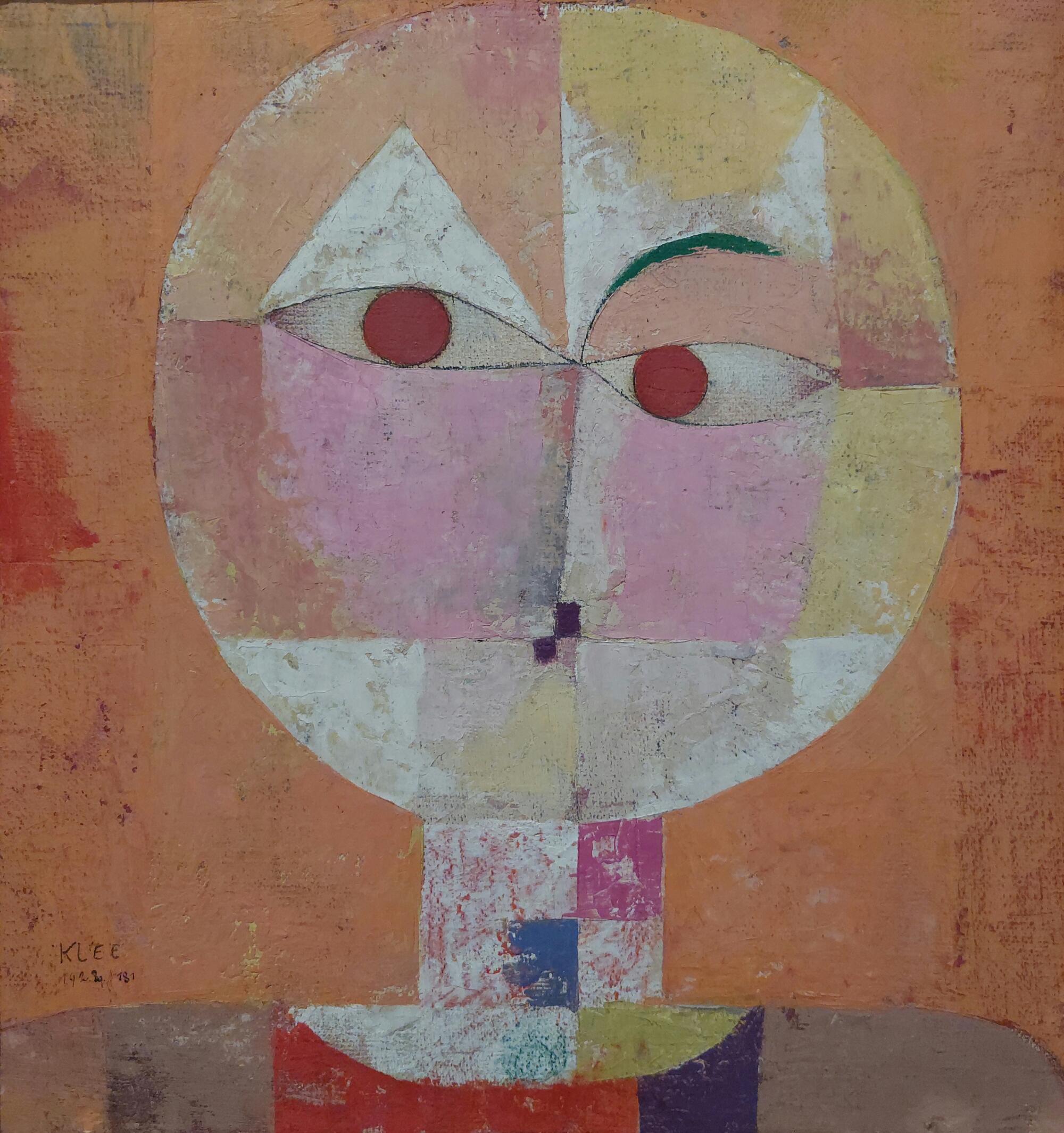
„My human faces are truer than real ones.”1Paul Klee, TheThinking Eye: Notebooks, Vol. 1, New York: Wittenborn, 1961. 20. ↩
Klee’s human faces, his “portraits”, are not portraits in the classical sense, yet the artist intended them to be more real, more true. Klee humorously christened his painting, also known as Senecio or Head of a Man Going Senile, Baldgreis in his oeuvre catalogue.2Paul Klee: Catalogue raisonné, Hrsg. Paul-Klee-Stiftung, Kunstmuseum Bern, Projektleitung Josef Helfenstein und Christian Rümelin, Bern: Benteli, 1998–2004, Bd. 3, 446. Nr. 3005. ↩ It shows a face that is almost grey, figuratively ageing, but not yet grey, as it is dominated by yellowish and reddish colours alongside greyish white. Moreover, the figure has no hair, which could be greying, and the English word “bald” could be a humorous reference to this. However, the yellowish-greyish tone of the Senecio painting and the meaning of the title lead us to nature and botany, since the plant Senecio vulgaris is called Greiskraut in German, i.e. grey herb which has bright yellow flowers. Several other members of the Senecio family are also well known, for example, the flowers of Senecio fulgens are coral red and the leaves are greyish brown, very close to the colours of Klee’s Senecio.
The English folk name for Greiskraut is Old-man-in-the-spring, which is thought to have been inspired by its fluffy, white-hair-covered seeds, which resemble an old man’s thinning grey hair. The bright green soft-stemmed herb with yellow flowers and the greyish-brownish succulent with red flowers are also native to Europe. Its active ingredients are various alkaloids that have antispasmodic, anti-inflammatory and haemostatic properties, so Klee, who was an amateur botanist and a garden “composer”, would have been familiar with it. The Senecio plants, however, appear in the painting only in their colours, which in fact show an abstracted face: the eyes are bright red circles, the two eye sockets are two circular arches, which could also be seen as a leaf shape connected by their tips, which together give the infinity figure of eight, a theme that appears often in Klee’s theoretical work. The nostrils are two small violet squares, one eyebrow a white triangle, the other semicircular and green, and the smiling mouth is just two overpainted curved lines.
The Senecio is therefore an abstract, non-concrete face, not a true portrait, but in form and composition it is arranged in a portrait setting, and in a European visual context it is most reminiscent of the idea of the portrait of children. However, the geometric abstraction points in a different direction, towards avant-garde art and cubism. The face, following the cubist method, is broken down into geometric elements, square planes, but they remain essentially in the same plane, without any reference to different points of view. From the perspective of spatial revolution in cubist portraiture, Jim Jordan compares the Senecio’s composition to Pablo Picasso’s portrait of Wilhelm Uhde (1910).3Jim M. Jordan, Paul Klee and Cubism, Princeton: Princeton University Press, 1984. pp. 184-196. ↩ Klee knew and admired Picasso, and the unnaturally greyish-brown face of Picasso’s deconstructed portrait comically geometrizes the famous art dealer and collector with whom Klee was also associated. But the colourfulness of Senecio points in another direction, for Klee was particularly fascinated by the work of Robert Delaunay, whom he visited in his Paris studio in 1912 and was so intrigued by the principle of Simultanism, which created space out of colour, that he translated one of Delaunay’s theoretical texts for the journal Sturm.4Robert Delauney, “Über das Licht”, Der Sturm: Wochenschrift für Kultur und die Künste, Nr. 144-145, 1913. pp. 255-256. ↩
From this point on, Klee was also enchanted by the form-creating effect of the simultaneous contrast of colours, but he was not so much concerned with space as with time. In other words, he was mesmerized by the fact that the contrast of colours not only created a sense of space in the viewer, but also of movement, vibration and pulsation. The Senecio does not seem to be based on simultaneous contrasts of colours, its colour world is harmonious, but there are two strong complementary colour pairings. At the bottom of the painting, the yellow and purple of the dress sets the composition in motion, while the green of one eyebrow and the violet of the nostrils are a striking break from the predominantly yellowish, reddish and orangey colours. The various transitions between the primary colours, yellow and red and white, and the pinkish-orange tones make the composition dynamic, forcing the eye to move constantly and almost bringing to life the seemingly childlike and abstract composition.
The Senecio’s geometric face is also linked to Oskar Schlemmer’s famous Bauhaus emblem (1922). The emblem, or logo is an abstraction of a male profile, broken down into geometric elements, a combination of lines and planes: the eye, for example, is a black square with two black lines. This kind of geometric abstraction recalls not so much the spiritualism of Mondrian or Malevich as the holistic aesthetics of Russian Constructivism, which affirmed the organic unity of nature and culture, man and technology. Schlemmer’s composition is at once very modern, abstract and geometric, and very archaic, abstract and spiritual, evoking non-modern, “primitive” cultures outside Europe.
Playful Animism
After his experiences of space and colour in Cubism and Orphism in Paris, Klee travelled to Tunisia in 1914, presumably to see the African culture that inspired avant-garde art. In North Africa, however, he encountered primarily the Sahara, with its bright lights and organically geometric architecture. He probably learned about West African sculptures and masks from exhibitions and books. Their first serious aesthetic and artistic evaluation was Carl Einstein’s Negerplastik (1915), which Klee was familiar with because of his good relations with the author.5Carl Einstein, Negerplastik, Leipzig: Verlag der Weissen Bücher, 1915. See further Neolithic Childhood: Art in a False Present, c. 1930, curated by Anselm Franke and Tom Holert, Haus der Kulturen der Welt, Berlin, april 13 – july 19, 2018. ↩ As an aesthete, Einstein discusses the worldview behind the sculptures and masks, which are largely from Central and West Africa. He detects in them an alternative, non-European philosophy of nature, which can be understood as animism, following Tylor, or as totemism, following Durkheim.6Edward B. Tylor, Primitive Culture, London: John Murray, 1871. Émile Durkheim, Les formes élémentaires de la vie religieuse, Paris: Alcan, 1912. ↩ The masks and sculptures visually symbolize the totemic affinity between man, animal, plant and crystal, and the spiritual unity of living and inanimate nature. Consequently, African sculpture is not a representation but a presentation, it does not copy the forces of nature but embodies them, the sculptures and masks carry the spiritual dimensions and forces. This is the spirit that Carl Einstein discovered in Klee’s semi-abstract art, which aims precisely to represent and display the forces of nature.7Carl Einstein, Die Kunst des 20. jahrhunderts, Berlin: Propyläen, 1931. Lásdtovábbá: Bacsó Béla, Paul Klee, Budapest: Kijárat, 2024. ↩
But what makes Klee’s visuality so special is the playful humour of the rendering, which links the spiritual “primitivism” of the masks with European circus culture and the “animism” of children’s drawings, whose irrational fluidity Carl Einstein linked with the spirit of non-European, tribal cultures. Klee’s faces thus intertwine children’s drawings, caricatures, merry clowns and serious spiritual masks, symbols of the unity of man and nature. Klee also intertwines all this with the philosophy of art, since in his interpretation man is not an external observer of nature, but is part of nature. The big question for him, then, becomes how to explore the unity and communion of man and nature through pictorial means? In other words, it is the artist’s task to create a portrait of man as a part of nature, as one with nature. One possible solution to this task is the female Mask of 1922, which is both a bust and a still life, following in the footsteps of the Cubists in form, but doing so in a rather playful way. On a European art historical horizon, Klee “reads” radically different genres and forms together. The Mask is at once a portrait and a still life, with the features of a face emerging from one of its elements, a phallic vase. But the strange geometric shaping of the body parts also evokes the totemic philosophy of “primitive” African and Oceanic visual cultures, whereby living and inanimate culture, the human and the material world, form a single fabric.
Senecio as Baldgreis - in this art historical perspective - plays with geometric abstraction, additive colour mixing and Robert Delauney’s colour planes. The yellowish, brownish and reddish colours, however, can even evoke clowns, and the strong colour contrasts, green eyebrows and purple nostrils, typical of clowns, also make the face dynamic, whose “chessboard” structure is, moreover, linked to Klee’s striped landscapes. Baldgreis’s closest “companion” within Klee’s oeuvre is The Mask with a Small Flag (1925), which also plays with potential landscape and cosmological associations of the human head. The two works are linked by their orangey palette and childlike animism, as well as by a curious pair of eyes reminiscent of a cat’s eye and an infinite figure eight. The humour is, in fact, very serious and even quite philosophical since the human head is also a landscape on which a flag has been planted, which can evoke the visual topos of conquering and taking possession of planets and moons. The most famous use of the cat’s eye motif is also linked to a real cat and the fairytale topos of the cunning cat. The Cat and the Bird (1928) is essentially a portrait of a mysterious cat who does not hunt the bird, as it perches peacefully on, or rather inside, his head. The charming, vivid, colourful composition suggests a strange and surprising harmony, not between the predator and its prey, but between two sparkling creatures of nature. The spirit of nature’s beauty and infinite richness permeated Klee’s entire oeuvre, and his Bauhaus studio can be understood as a modern heir to the Baroque Kunstkammer, where sketches and finished works are displayed among geological, botanical and zoological “models”. The real-life context for the works and images is provided by starfish, sea urchins, coral, crystals, pebbles, branches, dried plants, mosses and lichens. And among them appear the artist himself and a cat, Bondi, the artist’s companion and totem animal.
The Forces of Nature
Klee’s peculiarly European animism, his painterly alchemy, infuses African and Oceanic cosmologies with an art philosophical content. For Klee, the aim of art, of artistic creation, is to reveal the true face of nature, its hidden, invisible, sub-surface structure. One of the defining components of the turn-of-the-century ethos was the scientific updating of the spiritual worldview of alchemy, pioneered by Ernst Haeckel’s monism,8Ernst Haeckel, Der Monismus, als Band zwischen Religion und Wissenschaft, Bonn: Emil Strauss, 1892. ↩ which linked the natural philosophies of Darwin and Goethe. Goethe, Haeckel, Kandinsky and Klee also inspired the art philosophy of Ernő Kállai, a Hungarian art critic who worked as an editor at the Bauhaus, who legitimized abstract art, often criticized by conservatives, as modern scientific “realism”, an exploration of the hidden face of nature.9Kállai Ernő, Atermészet rejtett arca [The Hidden Face of Nature], Budapest: Misztótfalusi,1947. ↩ Kállai and Klee shared the idea that non-figurative artists exploring abstract forms of art intuitively represent the forces of nature that shape reality.
Klee became a teacher at the Bauhaus in 1921, teaching various courses in form making, first in the bookbinding workshop, then in the metal workshop and the glass painting workshop. Klee’s essence of teaching was that the aim of creating form was not to reproduce nature, but to capture living form, living nature. The composition of the picture, the image, must represent life itself, that is, living, evolving, changing, moving reality. In other words, in a rather form-breaking way, the aim of the creation is not the perfectly natural, harmonious form, because it is in fact lifeless, dead, but the aim is to capture the formation (Gestaltung), the permanent transformation. In the spring of 1922, Klee spoke about the dynamic development of the elements of composition, and in the autumn of that year his course was about the form-building energy of colour. In light of this, Baldgreis’s at first glance homogeneous, yellowish-reddish-greyish-brown colour scheme is in fact a complex “play” with the colour palette, as almost all the colours appear, and Klee employs both real and optical colour mixing. The already mixed colours are applied to the canvas in several layers, the square grid structure of the bottom layer being made up of rectangles of purple and red, over which he paints yellow and white. The result is a final orangey-pink colour scheme, with the original red and purple colouring emerging in places. The vibrant, complex colours keep the eye constantly moving, the multi-layered chalky colours evoke murals, and the grid of lines humorously evokes children’s drawings with the Latin title Senecio, from the word senex (old), which evokes classical (Seneca) associations.
The most succinct formulation of Klee’s artistic doctrine, which favoured dynamic creation and openness, as well as non-completeness, is the opening sentence of Creative Credo (1920): “Art does not reproduce the visible but makes visible.”10Paul Klee, Creative Credo, (1920), in: Klee 1961, pp. 76-80. ↩ Art must thus go beyond traditional representation, since the image is not merely a window on the world, but the world itself, or a model of the world, showing its structure and functioning. In the process of creation, the artist thus discovers and reveals the “inner forces” that shape nature and reality. This is the aim at work behind Klee’s geologically structured, layered landscapes, which model the structure of the earth and the world by juxtaposing layers and bands of colour. The layered, “striped” Messenger of Autumn (1922), for example, abstracts the stratigraphy of the universe from the traditional landscape. From this perspective, Baldgreis also appears to be a tectonic image made up of layered bands of colour, and the title suggests an association with the greyish-yellowish-green layered metamorphic rock, gneiss, which is formed by the transformation of sedimentary rocks that have been deposited from the calcareous skeletons of plant and animal bodies.
The combination of artistic form-making and cosmic-scale abstraction harkens back to the almanac and artist group Der Blaue Reiter, which Kandinsky founded and in whose second exhibition Klee participated. The scientific spirit and cosmic philosophy of non-figurative art and abstraction essentially informed Klee’s thinking through the art of Wassily Kandinsky, August Maacke and Franz Marc. Klee, however, wanted to anchor spiritual energies in the material dimensions, in nature itself and in its physical entities.11Wassily Kandinsky, Über das Geistige in der Kunst, München: Piper, 1912. Paul Klee, Wege des Naturstudiums, Weimar: Bauhaus,1923. ↩ Both Kandinsky and Klee were inspired by the spiritualism of the turn of the century, Rudolf Steiner’s anthroposophy and modern reinterpretations of pantheism and vitalism, and Henri Bergson’s philosophy and cosmology,12Henri Bergson, L’Évolution créatrice, Paris: Alcan, 1907. ↩ which linked artistic creation to the workings of the cosmos through the concept of intuition.
The essence of the work, according to Klee, is to capture the forces of the cosmos, which is linked to the artist’s gesture of creating images and forms, of creating the composition, of drawing the line. The line is a visual representation of force, of momentum, of will, which must keep the image in motion, as well as the gaze of the viewer, the reader, the mind and the thinking of the recipient. The logic of the Thinking Eye13Klee 1961. ↩ is that the human visual sense, the eye, not only sees but also thinks, and that thinking is always both seeing and imaging, that is, it is inherently visual, which transcends scientific rationality and everyday logic. In the philosophy of the history of art, the specific visuality of pictorial thinking and the idea of pictorial philosophizing emerged in the work of Maurice Merleau-Ponty’s pupil Hubert Damisch.14Maurice Merleau-Ponty, Le visible et l’invisible, Paris: Gallimard, 1964. Hubert Damisch, Fenetrejeune cadmium, ou, les dessous de la peinture, Paris: Seuil, 1984. Yve-Alain Bois, “Painting As Model”, October, vol. 37, 1986.pp. 125-137. ↩ For Damisch, the works of Klee and Dubuffet were the visual starting point, alongside those of Cézanne, who had already impressed Merleau-Ponty. All three artists sought to capture the infinite complexity and vibrancy behind the apparent simplicity of nature through simple, visual and geometric means. The “portrait” of the yellow and red flowered herb, Senecio vulgaris and Senecio fulgens, the Senecio painting allegorically represents the complexity of the rendering of holistic nature. Klee shows the close physical, chemical and biological relationship between man and nature by combining seemingly simple forms and merging genres - portraiture, floral still life, landscape.
Baldgreis
Senecio’s enigmatic and playful alternative title, Baldgreis, takes Klee’s strange “portrait”, his holistic pictorial riddle, in the direction of humour. Humour, in a sense, according to Schopenhauer’s theory of incongruity,15Arthur Schopenhauer, Die Welt als Wille und Vorstellung, Leipzig: Brockhaus Verlag,1818. ↩ can be derived from the linking of things that do not fit together, or the breaking of familiar boundaries between things. Klee’s pictorial riddles are also explicitly about free association, and in fact there is no single solution to them. Bergson, who revived vitalism, also considered fluidity and flexibility to be the most important components of humour and the sense of humour.16Henri Bergson, Le rire: essai sur la signification du comique, Paris: Alcan, 1900. ↩ And Arthur Koestler linked this idea to the concept of creativity and developed the theory of bisociation, which characterizes not only humour but also the logic of scientific discovery.17Arthur Koestler, The Act of Creation, New York: MacMillan, 1964. ↩ In the act of bisociation, in fact, genius scientists weave together a world of previously unrelated themes, reference planes or disciplines, linking the act of discovery to the practice of humour and poetry.
In this spirit, Baldgreis is a poetic and humorous visualization of the “encounter” between anthropology and botany, man and nature, an old man and an old-man-in-the-spring. The scene of this strange encounter is, moreover, the surface of the picture, the space of the painting, where Klee, true to his philosophy of art, thematizes the organic relationship between surface and depth, appearance and essence. The elementary, geometric forms and complex colours that make up the picture allow room for a multitude of associations. The painting is also complex in its material, with the chalk grounding creating a layered mural-like surface reminiscent of frescoes and cave paintings. Moreover, Klee creates this surface by gluing a layer of gauze on cardboard, a loose grid-like surface, and then priming it with pastel chalk. The image is not simply three-dimensional, but has a microscopic, granular spatiality that is optically perceptible through the light shadow effect. This spatiality, this plasticity, is, however, combined with a peculiar abstraction. The face is broken down into simple geometric elements, but with complex layering and colour harmony. The human portrait, the non-existent figure, the portrait of Senecio, the portrait of Senecio plants and the portrait of the compound Senecionin, whose antispasmodic and analgesic effect elevates the image to a creative and ontological plane.
Baldgreis’s “message” refers both to old age in a spiritual sense and to passing away, but it does so with a deep sense of humour. For those who will soon be grey will soon die, returning to the biosphere cycle, i.e. they will soon become plants, and in the distant future they will become sedimentary and metamorphic rock. Klee’s image of man, his new, holistic “humanism”, can also be put in parallel with the post-anthropocene philosophy of our time, according to which man should once again understand himself as the sole element of biological-chemical-physical nature, of the ecosystem, of the biosphere, of modern Gaia.18Donna J. Haraway, Staying with the Trouble: Making Kin in the Chthulucene, Durham: Duke University Press, 2016. ↩ One of the starting points of post-humanist thought, by the way, is Gilles Deleuze, who discovered the visual forerunner of his own vital materialism in the work of Paul Klee.19Gilles Deleuze – Félix Guattari, Mille plateaux, Paris: Minuit, 1980. ↩ But what in Klee was a human creation, an artistic creation, in the philosophy of Deleuze and Guattari is now an autopoietic becoming (devenir), which characterizes the way nature works.
As the humanist apostle of posthumanism, Klee believed that this becoming, i.e. nature’s own logic and energetics, could only be truly grasped and visualized by a specific and sensual, pictorial thinking, a bildnerische Denken.20Paul Klee, Das Bildnerische Denken, Stuttgart: Schwabe, 1949. ↩ Moreover, the philosophy of Deleuze, Guattari, Haraway and Klee, in addition to its almost infinitely broad associations and strange bisociations, is imbued with the same acerbic humour that is surely essential to our survival in times of the crisis of human culture.