Article
Muiredach's High Cross
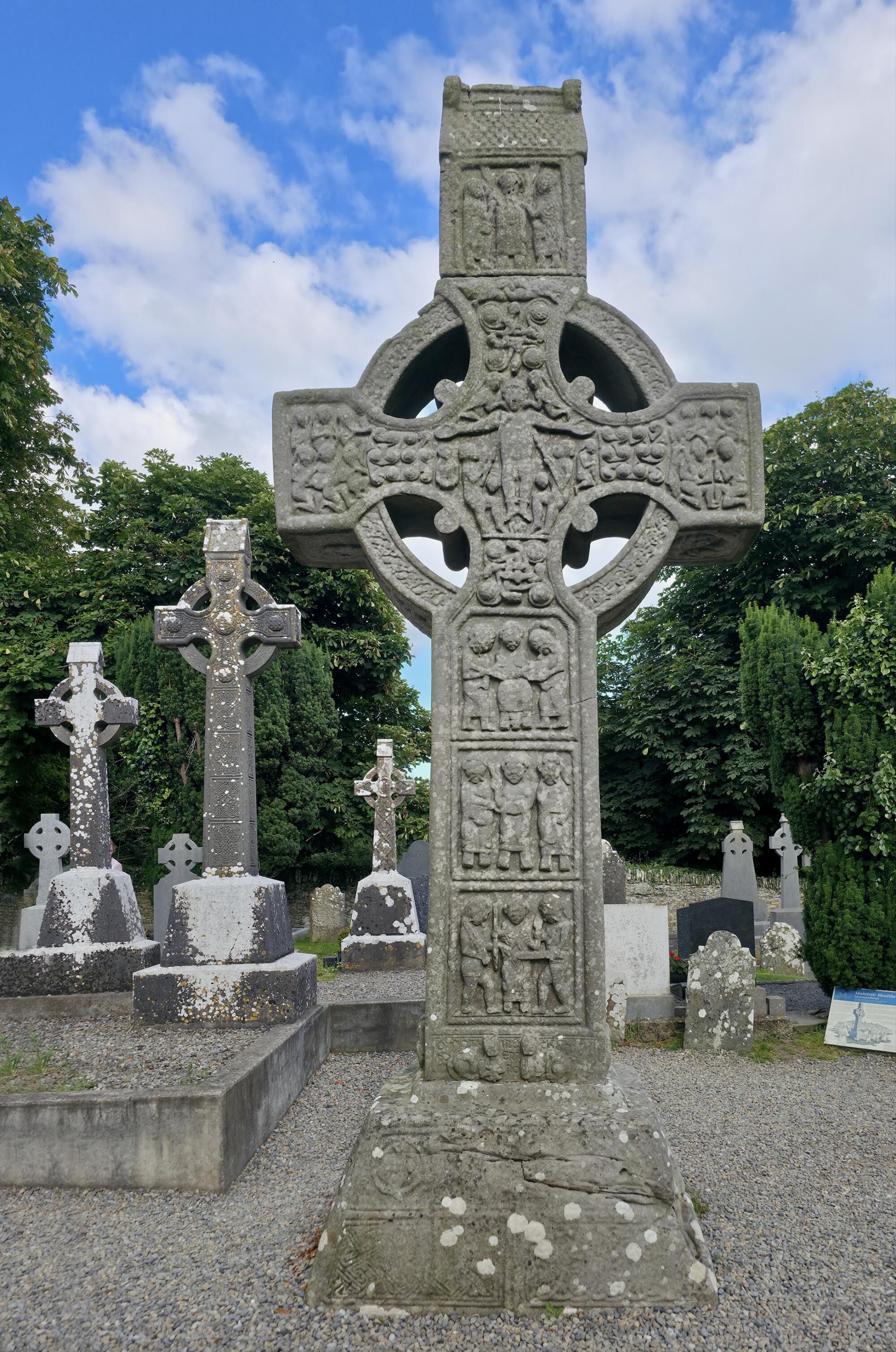
‘Celtic’ or more correctly ‘high’ crosses are one of the most evocative symbols of the early medieval period in Ireland. Created in the form of a Latin cross, intersected by a ring, their distinctive silhouette has become synonymous with Irish, and to a lesser degree Scottish, identity since the revival of the form in funerary and monumental sculpture from the mid-nineteenth century. Roughly 250 of these monuments, intact and fragmented, survive across Ireland. Of these, Muiredach’s cross at Monasterboice in Co. Louth is one of the most substantial and best-preserved examples. As such, it is also one of the best-known, and while still in its original location, in a quiet rural graveyard, copies of it are held in in numerous international museum collections.
A church settlement was established at Monasterboice probably in the late fifth century by St Buithe, whose death is recorded in the early 520s.1John O’Donovan, ed. and trans., Annála Ríoghachta Éireann: Annals of the Kingdom of Ireland by the Four Masters from the Earliest Period to the Year 1616, 7 vols, Dublin 1851; repr. New York, 1966), i, 171. ↩ The monastery only entered the historical record from 723, after which the deaths of ecclesiastics there are recorded with a degree of regularity, suggesting that it was a place of some repute. It was known as an important place of learning and was part of an importance intellectual network including other significant monasteries such as Clonmacnoise and Armagh.2Francis J. Byrne, ‘Church and Politics’ in: Daibhí Ó Croinín, ed., A New History of Ireland. Vol. 1. Pre-historic and early Historic Ireland, Oxford 2005, 656-79; Edel Bhreathnach, ‘Learning and Literature in Early Medieval Clonmacnoise’, in: Heather King, ed., Clonmacnoise Studies II, Dublin 2003, 97-104. ↩ From the start of the twelfth century the importance of the site declined rapidly. This was a period of comprehensive Church reform in Ireland. With the foundation of the first Cistercian house at Mellifont, just 6 kms from Mellifont, the patronage formerly enjoyed by Monasterboice was diverted elsewhere. The former monastery became a parochial centre and operated as such until the early seventeenth century. By 1622 the church was described as ‘ruinous’ and although the cemetery continued in use for burial it ceased to function as a place of orthodox worship.3Thomas Fitzpatrick, ‘The Royal Visitation of 1622’, in: Journal of the County Louth Archaeological Society, 6.1 (1925), 4-11 ↩
Muiredach’s cross is one of several monumental stone crosses that originally graced this important early medieval church settlement.4Peter Harbison, The High Crosses of Ireland, 3 vols, Bonn 1992, i, 139-153; Helen M. Roe, Monasterboice and its Monuments, Dundalk 1981; R.A.S. Macalister, Monasterboice, Co. Louth, Dundalk, 1946. ↩ Together with the surviving so-called ‘Tall’ cross and ‘north cross’ it likely once demarcated the most sacred exterior space of the site, immediately to the west of the now-vanished principal church.5Conleth Manning, ‘The Churches of Monasterboice and the Layout of the Site’, in: Proceedings of the Royal Irish Academy, 121C (2021), 125-155: 145-158 ↩ The cross is in its original location and is orientated east-west.
The name of the cross comes from an inscription at the base of the shaft on its western side, which asks for a prayer for Muiredach ‘who had this cross erected’ in the Irish vernacular [[or do muiredach las ndern (a)d (i) cro(ssa)]{.smallcaps}]. Muiredach was a relatively common name in the ninth and tenth centuries, however, the inscription is mainly associated with one of the two documented abbots of Monasterboice of that name, Muiredach mac Flaind and Muiredach mac Domhnaill who died in 846 and 922 respectively. As the later Muiredach was also sub-abbot of the powerful church settlement of Armagh and high steward of the ruling Uí Neill family, his patronage is favoured by most scholars.
However, there are other suggestions for Muiredach’s identity, including a secular patron, Muiredach, Lord of Meath and son of high king Domhnall, who died in 797.6Helen Roe, ‘Muiredach’s Cross, Monasterboice’, in: Ireland of the Welcomes, 11:5 (Jan-Feb, 1963), 17-21: 17. ↩ The faint presence of the same name identified by Macalister, inscribed of two comparable crosses at Kells, Co. Meath has also highlighted the possibility that the name may be that of the sculptor.7R.A.S. Macalister, ‘The Ancient Inscriptions of Kells’, in: Journal of the Royal Society of Antiquaries of Ireland 64 (1934), 16-21. ↩ Ultimately, this is little help in assigning a date to the cross. Indeed, as the words are awkwardly squeezed around carvings of two cats feasting on a frog and a bird, it may well be secondary to the monument, and thus of little relevance to the actual origins of the monument.
Historiography
Although other features at Monasterboice are referenced in the partially surviving Vita of the local saint, Buithe, there survives no medieval reference to any of the high crosses at the site. The earliest antiquarian reference to Muiredach’s cross comes in 1699, when Welsh antiquary, Edward Lhuyd recorded it as ‘St Patrick’s’ Cross, while a sketch plan among Samuel Molyneux’s papers (c.1707-1712) simply refers to it as ‘the great cross’.8London, British Library, Stowe manuscript 1024, 140,146; Dublin, Trinity College Library ‘Dublin Philosophical Society Papers (Book B) transcribed by Samuel Molyneux.’ TCD MS 883/2/2/4. ↩ By the mid-eighteenth century however, it was commonly referred to as ‘St Buithe’s’ or ‘St Boyne’s’ cross, with Thomas Wright recording the local belief that the saint had precured the monument in Rome to bring home to his monastery, thus imparting on it the status of a saintly relic.9Thomas Wright, Louthiana, or an Introduction to the Antiquities of Ireland, London 1749. ↩
The cross came to greater public attention with George Petrie’s publication The Ecclesiastical Architecture of Ireland Anterior to the Norman Invasion (Dublin, 1845), after which its fame was quickly augmented through a number of publications on high crosses.10Henry O’Neill, Illustrations of the most Interesting Sculptural Crosses of Ancient Ireland, Dublin 1857; Richard R. Brash, ‘The Sculptured Crosses of Ireland what we Learn from them’, in: Journal of the Royal Society of Antiquaries of Ireland 12 (1872-74), 98-112. ↩ A scale model of the cross, made by a Harriet Ross-of-Bladensburg was displayed at the 1851 Great Exhibition in London, bringing it to wider international attention.11‘The Great Exhibition’, The Morning Chronicle, Monday, October 20^th^, 1851, 3. ↩ The following year a mold was made of the cross ‘under the supervision of gentlemen’ with the intention of producing a cast for display at the Dublin internal exhibition, 1853.12John H. Smith, ‘Ancient Stone Crosses in Ireland’, in: Ulster Journal of Archaeology 1 (1853), 53-57: 56-57. ↩ Fresh casts were taken from the molds in the late 1880s to form the centerpiece of the newly opening Dublin Museum of Science and Art (latterly the National Museum of Ireland). The cross was again cast in 1896, by the Italian modeler Sig. Orlandi. Subsequently, requests were received from several international institutions for copies of these casts, including the Victoria and Albert Museum, London, the Metropolitan Museum, New York and the Catholic Church in Sydney, Australia.13Raghnall Ó Floinn, ‘Reproducing the Past: Making Replicas of Irish Antiquities’, in: Peter Harbison and Valerie Hall, eds, A Carnival of Learning. Essays in honour of George Cunningham, Roscrea 2012, 146-157: 149-52, 154-7; National Museum of Ireland, Irish High Crosses, exh.cat., Dublin 2009, 43. ↩ These were ultimately to seal the cross’s status as an Irish national icon.
The Materiality of the Cross
Muiredach’s cross stands over 5.2m high and is made from just three blocks of sandstone: a truncated pyramidal base, a monolithic shaft and head and a capstone. There are no local outcrops of sandstone, the material used for this, and the majority of Irish high crosses. The block of stone used to carve the shaft and head is estimated to weigh a total of about 5 tons, and was brought overland from a quarry at Carrickleck, Co. Meath, roughly 23 kms away as the crow flies.14Roger Stalley, Early Irish Sculpture and the Art of the High Crosses, London and New Haven 2020, 25, 31 ↩ The use of easily workable sandstone enabled the sculptor to cover every surface of the monument with panels of high relief carving. The cross may originally have been painted, however, despite this, the sculptor went to great lengths to include fine detailing, for example on the clothing of some of the figures.
The Sculpture
Irish high crosses have sometimes been referred to as ‘bibles for the illiterate’. But while Muiredach’s cross certainly includes some easily identifiable scenes from both Old and New Testaments, they are not organized chronologically, and some are ambiguous in their representation. Other panels are carved with abstract patterning and figurative representations that imply a more secular origin. Thus, far from representing a visual textbook for the biblically uninitiated, the cross represents a more complex exercise in the illustration of theology and politics.
The base and lowest panels of the cross shaft
The base of the cross is carved in a lower relief than the rest of the monument. This, and its vulnerability to damage over the years, has left its carvings heavily rubbed and, in some places, illegible. All four sides are divided into two registers, the lower decorated with abstract designs, the upper with a variety of figures. On the east face there are what appear to be two lions and a figure; on the south face are two horsemen followed by a chariot: the west face carries more animals, interpreted by some as a hunting scene; and on the north is a procession including a centaur and horseman. In common with similar carvings on the bases of several other high crosses, these panels defy confident interpretation, especially when placed in the context of the carvings on the body of the cross. All that can be said of them is that they reflect perhaps classical and historical sources, rather than biblical ones.
Each side of the bottom of the cross shaft has a narrow panel on which almost whimsical scenes are carved in high relief. On the east are two affronted animals that look like a lion and cat; the south face bears two long-necked lions biting their tails; the west face has two cats eating their prey, with the inscription awkwardly placed around them; and the north face has two seated men, pulling one another’s beards. These images are the sculptural equivalent marginalia in medieval manuscripts, exhibiting no obvious relevant symbolism in the context of carvings around them. This renders their positioning particularly curious. It is known that at various points in history high crosses were venerated by the faithful who moved clockwise around the base of the crosses on their knees. At Muiredach’s cross, this likely explains the positioning of the inscription, which would be at eye level, but also begs the question as to why this imagery was given such prominence.
East face of cross
Above, the shaft is divided into panels framed by a twisted moulding. The four panels on the east face of the shaft contain predominantly scenes from the Old Testament: The fall of man (Adam and Eve flanking a tree and taking forbidden fruit) and Cain slaying Able; the Death of Goliath; and Moses striking the rock. The interpretation of the upper panel on this side of the shaft has been contested. It shows an enthroned mother and child being greeted by four figures. A small circle above the child’s head has been interpreted as a star, suggesting the visit of the three Magi from the New Testament, however, the inclusion of a fourth figure casts doubt on this.
The head of the cross on this face depicts the Last Judgement, the second coming of Christ when the souls of the dead will rise from their tombs and following judgement be assigned either to heaven or hell. At the centre of the head is the figure of a standing Christ, holding a cross staff and flowering rod crossed over his chest. Beneath his feet is an image of the weighing of the souls, St Michael on one side with a devil beneath attempting to tip the balance. To Christ’s right are the blessed, accompanied to paradise by David the psalmist, and on his left the damned are ushered by a devil into hell.
The scene was a popular one in contemporary Christian art, but while the Monasterboice sculptor was clearly familiar with some aspects of the established iconography, he diverged in others. The weighing of the souls or psychostasis ultimately derives from Egyptian art linked to the Book of the Dead, subsequently assimilated into the iconography of Greco-Roman deities and the Egyptian Coptic Christians. Although known in early Christian Byzantine art, it didn’t become widespread in Western Christendom until the late eleventh century, making the Muiredach’s cross scene one of the earliest surviving examples in western Europe.
The figure of Christ is also curious in that it differs from the detailed description found in the Book of Revelation of the enthroned Christ, surrounded by the 24 elders and holding the book of Life. Rather the figure stands and holds a cross staff and flowering rod. One possible source for this strange iconography is a syncretism of the Egyptian God Osiris — sometimes shown judging adjacent to the psychostasis, with his crook and flail held in a similar fashion to Christ’s staff and rod — into Coptic and ultimately Irish Christian art. Another is that the flowering rod alludes to the Old Testament rod of Aaron, which was associated with judgement and the New Testament symbol of the cross, which alludes to salvation.
West face
The west face of the cross shaft is equally divided into panels although here there are just three and the arrangement of the figures is far less crowded. These start at the bottom with a panel variously identified as the arrest or mocking of Christ. Above doubting Tomas thrusts his finger in Christ’s side. Above this is the tradito legis and clavium — Christ enthroned in the centre passing the keys to heaven to St Peter and the law of the church to St Paul. This scene was understood as a visualization of the Old Testament prophecy at Isaiah 2:2—4; that a new Messiah would come and bring peace, reflecting the present time under the protection of Christ. The depiction of Christ enthroned was a means by which early Christian potentates could project their roles as law- and peace-makers onto the person of Christ.15Armin F. Bergmeier, ‘The Traditio Legis in Late Antiquity and Its Afterlives in the Middle Ages’, in: Gesta, 56.1 (2017), 27-52. ↩
The head of this face is carved with a crucifixion scene. Iconographically this corresponds to contemporary Irish depictions showing Christ crucified with two angles flanking his head and the Roman soldiers, Stephaton and Longnus flanking the cross below. However, the scene also includes two small bosses between the soldiers and the cross and a crouching and kneeling figure on either side. It has been suggested that the bosses may be intended to represent Sol and Luna, and the classical personifications of Tellus and Gaia: the sun the moon the earth and the heavens, as found in some contemporary Carolingian Crucifixion scenes.
North and South faces
The narrow north and south faces of the cross are decorated with panels of finely executed abstract designs. On the south side these include a panel of eight men with intertwined bodies; a panel of high relief interlocking spirals reminiscent of pre-Christian, Celtic ornament and a vine scroll inhabited with birds with ultimate Mediterranean origins. On the north face are three complex panels of geometrical interlace. Above these, located under the arm of the cross is a hand, so that a person standing beneath appears to receive a blessing from above.
The cross is capped with a small, separate block of stone worked into the shape of a small church with a shingled roof covering. It has figurative carving on all four sides: the Ascension of Christ above the crucifixion, an unidentifiable scene above the Last Judgement, a horseman on the south side and SS Paul and Anthony, the Egyptian desert fathers being brought food by a raven on the north side.
The sculptor
The carvings on the cross are rendered in a style that seems to have appeared from nowhere in a country famed for its skill in rendering fine abstract ornament in everything from gospel books to brooches, but general absence of figurative art and large-scale sculpture. The figures are carved in deep relief with rounded, almost chubby, features and there is an exquisite eye for detail in the dress and accessories of the characters. For example, in the ‘Arrest’/ ‘Mocking’ scene on the west face, Christ, depicted as a shaven ecclesiastic with long robes and a large annular brooch, is seized by two figures with long moustaches, wearing Viking-style kite-shaped brooches and short breaches.
This distinctive style is found on several other crosses that are undoubtedly the work of the same artist. These include the Cross of the Scriptures at Clonmacnoise and cross at Durrow both in Co. Offaly, the north cross at Duleek, the Market and Tower crosses at Kells, Co. Meath and the other two crosses at Monasterboice. Together with the distinctive style of carving, certain scenes are repeated across a number of monuments, suggesting the possession of an eclectic set of ‘patterns’ or templates drawn from a wide range of artistic traditions, while others scenes appear to be unique. The quantity and spread of the work suggest an individual who enjoyed some repute among the most significant Irish patrons of the day. The identity, origins and background of this individual, sometimes inappropriately referred to as the ‘Muiredach Master’, remain unknown.16Roger Stalley, Early Sculpture and the Art of the High Crosses, London and New Haven 2020, 43-65. ↩
Functions
There has been much debate regarding the original function of such an expensive and complex monument as Muiredach’s cross. Although the three remaining crosses and round tower on the site are in their original locations, the two surviving churches at Monasterboice have been much altered and appear to date to after the period of monastic occupation. A theoretical reconstruction of the original configuration of the monastery suggests that the crosses may once have demarcated a sacred open space in front of the western entrance of the main church (no longer extant). 17Conleth Manning, ‘The Churches of Monasterboice and the Layout of the Site’, in: Proceedings of the Royal Irish Academy, 121C (2021), 125-155: 145-158 ↩ If correct, this would echo a similar layout of crosses at the powerful monastery of Clonmacnoise. Here, archaeological excavation revealed that at least one of the crosses had replaced an earlier timber cross, with which several high-status burials were associated.
It is unlikely, however, that the primary function of these monuments was always to mark burials. Rather, scattered contemporary references suggest their role as boundary markers, symbols of power and protection, cenotaphs and as a backdrop for ceremonial events.18Ann Hamlin, ‘Crosses in Early Ireland: The Evidence from Written Sources’, in: Michael Ryan, ed., Ireland and Insular Art 500-1200, Dublin 1985, 138-140. ↩ The survival of more extensive inscriptions on comparable monuments highlights that the expense of quarrying, transport, carving and erection of high crosses was at least sometimes covered by a royal patron. This mirrors the strong association of the cross symbol with the divine rights of emperors and kings that was revived across the Carolingian empire from the early ninth century.
The precise way that Muiredach’s cross was used when first erected will likely remain a mystery. However, the depth of carving makes this a dynamic monument, its imagery highlighted and obscured by the quotidian passage of the sun and less predictable, but frequent, showers of rain. Although the logic of the programme of sculpture is illusive, the viewers’ clockwise path around it starts with the Old Testament and the theme of Judgement and moves through the New Testament and Mans’ salvation to finish beneath the blessing hand of God.
When the former early monastery was converted to a parochial function, at least one of the cemetery crosses would have been used during specific liturgies such as the Palm Sunday procession. The parish church is known to have been in possession of a relic of St Buithe’s head in 1520, when it was stolen from the church and so potentially a place of local pilgrimage. His cult, which was celebrated up to the mid-twentieth century by the dressing of graves on his feast day, 7^th^ December, also focused on the cross. According to popular relief, moss growing on the cross, boiled variously either in milk or water was an excellent cure for such maladies as whooping cough, ringworm and sick children. 19University Colle Dublin, Department of Folklore, The Schools’ Collection, Volume 0674, 164; The Schools’ Collection, Volume 0677, 029. ↩ Like many potentially vulnerable ancient monuments in Ireland, it was these local beliefs that led to the safeguarding of the cross from iconoclasts over the centuries. The cross is now in State care and remains readily accessible to modern day pilgrims passing on the nearby motorway between Dublin and Belfast.