Article
The Antikythera Mechanism
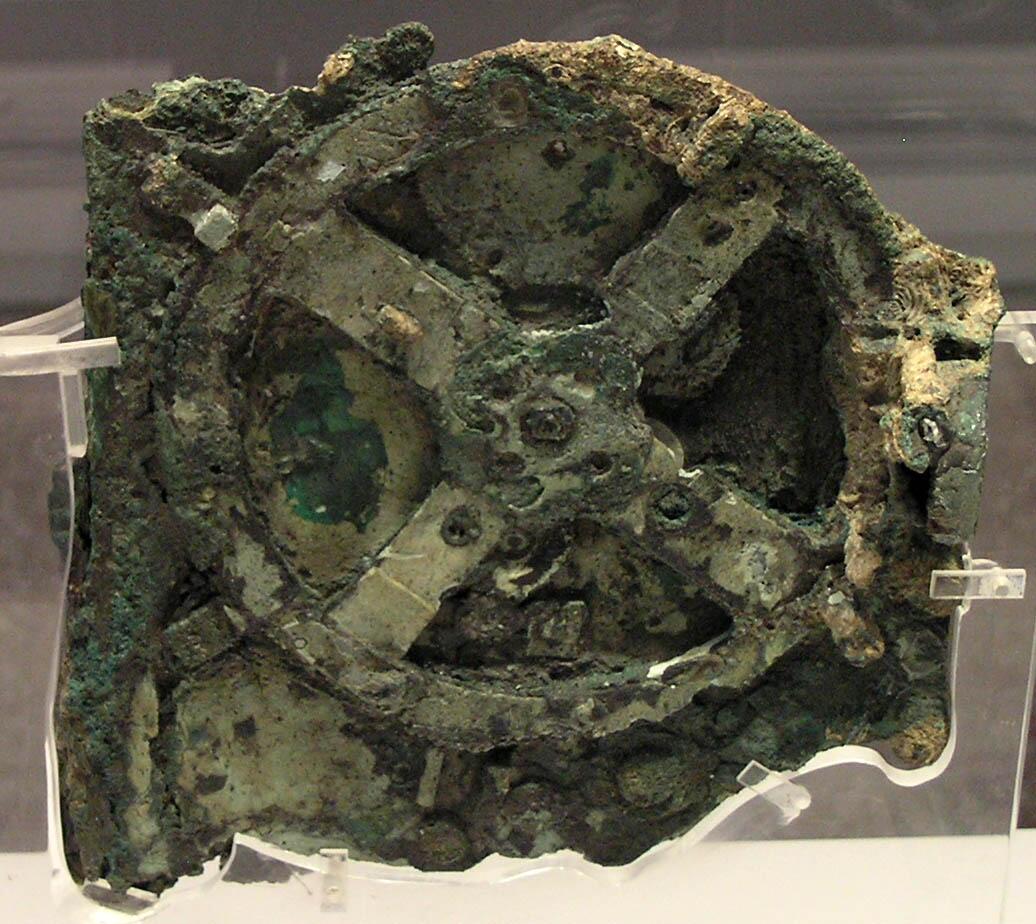
Sometime ca. 60 BCE a large cargo ship sank off the coast of the islet of Antikythera, which sits 30 km northwest of Crete and in antiquity was known as Aigilia. 2,000 years later around Greek Easter of 1900, Greek sponge divers from Syme discovered the shipwreck and months later reported it to the Greek authorities in Athens. From here an underwater archaeological expedition was organized and between November of 1900 and September of 1901 the shipwreck was salvaged and the goods were deposited in the Greek National Archaeological Museum in Athens where they still reside to this day.1For a thorough discussion of the contents of the shipwreck and the shipwreck’sdate, see Nikolaos Kaltsas, Elena Vlachogianni, Polyxeni Bouyia, eds., The Antikythera Shipwreck: The Ship, the Treasures, the Mechanism, exh. cat. (with English, German and Greek versions), Athens 2012. For the history of the discovery and excavation of the shipwreck, see Alexander Jones, A Portable Cosmos: Revealing the Antikythera Mechanism, Scientific Wonder of the Ancient World, Oxford 2017, 1-14. ↩
Among the ship’s cargo were fine bronze and marble statues, including the stunning “Antikythera Ephebe”, fine glass and jewelry, everyday table pottery, amphorae (from Rhodes, Kos, Ephesos and probably also some from the Adriatic coast of Italy), a hoard of silver and bronze coins from Pergamon and Ephesos, and a finely-wrought geared bronze device now known to the world as the Antikythera Mechanism, so named after the island in whose waters it was found. So, what is the Antikythera Mechanism, where was it likely built, and for whom? This article will give a concise summary of the consensus view of these questions after more than 125 years of study using various technologies, particularly the Micro-Focus X-Ray Computed Tomography and the Polynomial Texture Mapping technologies applied to the Mechanism in 2005 by the Antikythera Mechanism Research Project (hereafter AMRP). The discussion will of necessity include ancient astronomy and mathematics, which are an integral part of appreciating the Mechanism’s cultural and artistic meaning.
To begin with, the Antikythera Mechanism had a now-disintegrated outer wooden casing in the shape of a shoe-box that was about 17 cm wide, 32 cm tall, with the depth uncertain but at least 10 cm.2On the existence of bits of the Wooden Casing when the Mechanism was first noticed, see Derek de Solla Price, “Gears from the Greeks. The Antikythera Mechanism: A Calendar Computer from ca. 80 B.C,” in: Transactions of the American Philosophical Society 64 (1974), 1-70: 10,14. ↩ Enclosed in this casing were a series of interlocking gears driven to produce and visualize various astronomical and athletic time periods in the same manner as fine clockwork today, with 30 gears preserved or partially preserved and up to about 35 more theorized for various models.
The front of the Antikythera Mechanism featured a circular dial with two concentric scales. The outer scale is known as the Egyptian Calendar Scale,3On the Egyptian Calendar Scale and the Egyptian calendar, see Jones (2017), 27-28; 58-60; 70-72. ↩ and around the inner edge of this rotatable ring that sat in a sink in the plate there are incised short radial marks. These were probably divided into 13 sectors – 12 sectors of 30 radii each representing the 30 days of the 12 Egyptian months, and a smaller sector of 5 radii representing the 5 additional “epagomenal” days tacked on to the end of the Egyptian calendar for a total of 365 days. The names of the Egyptian months were inscribed in Greek around this with only the months of Pachon, Payni and Epeiph and their associated radii still preserved. 365 holes, of which 82 survive, were drilled around the bottom of the sink into the underlying plate. These would have operated with a peg so that the Egyptian Calendar Scale could be rotated and then secured to keep track of the annus vagus (“wandering year”) of the Egyptian calendar, which was well-known to be short of the solar year by about ¼ of a day.4Because the Egyptian year was always 365 days long with no leap days to keep it in line with the solar year, its months slowly cycled through all the seasons, meaning that every four years the ring would have needed to be adjusted by one day/peg hole to mark its new position with respect to the Zodiac Dial in the manner of a leap year in the Julian and Gregorian calendars. The Games Dial on the back of the Mechanism (on which see below), which employs a cycle of 4 years, may have been used to keep track of the leap years. ↩
There may also be the remains of a Fiducial Mark on the main plate outside the Egyptian Calendar Scale ring between the current position of the radial marks of Payni 1 and Payni 2 and this Fiducial Mark may also be present in the same position on the Zodiac Dial (on which see the paragraph after next) at about Libra 17.7º. If there, it would indicate that the date of Thoth 1, the first day of the Egyptian calendar, was roughly equivalent to Libra 17.7º in the Mechanism’s start-up year.5First noted by Price (1974), 19-20. On the existence and date of this Fiducial Mark, see Jones (2017), 76 and Alexander Jones, “The Epoch Dates of the Antikythera Mechanism (With an Appendix on Its Authenticity),” Institute for the Study of the Ancient World Papers 17 (2020), section 3, https://dlib.nyu.edu/awdl/isaw/isaw-papers/17/ (accessed February 27, 2026). ↩ If one assumes a possible inscribing margin of error of 2º on either side of Libra 18º at noon on Thoth 1 for the meridian of Rhodes – the most likely place for the manufacture of the Mechanism (on which see below) – these criteria are satisfied only between 217 to 202 BCE, which is in keeping with the range of the start-up epoch of the Saros-Eclipse Possibility Spiral on the back of the Mechanism (on which also see below).
The appearance of the Egyptian calendar on the Antikythera Mechanism is not terribly surprising, as ancient Greek astronomers from the time of Hipparchos (ca. 190 – 120 BCE) onwards found it a useful tool to precisely date events in the past,6On Greek astronomers’ use of the Egyptian calendar, see Jones (2017), 72-73. ↩ much more useful than a traditional Greek lunisolar calendar (on which see below), or the Egyptian lunar calendar,7As unconvincingly argued by Chris Budiselic et al. (“The Antikythera Mechanism: The Evidence of a Lunar Calendar,” in The Horological Journal, December 2020, 1-13) and Graham Woon and Joseph Bayley (“An Improved Calendar Ring-Hole Count for the Antikythera Mechanism: A Fresh Analysis,” in The Horological Journal, July 2024, 282-287). ↩ or the erratic Roman calendar before the introduction of the Julian calendar in 45 BCE.
Inside the Egyptian Calendar Scale there was another circular scale – this one inscribed directly into the front plate – called the Zodiac Dial, which almost certainly featured 360 short radial marks incised around the inner edge of its circumference that were divided into 12 sectors, probably each with 30 gradation marks to represent the 12 Zodiac signs. These were thought to rotate about the Earth in fixed relative positions at the outer edge of the cosmos.8First identified by Price in 1959; see Price (1974),17-18. ↩ Of these 12 signs, inscriptions in Greek running clockwise starting with the Libra and Scorpio sectors along with their accompanying 30 radii are mostly preserved, while the sectors, radii and inscribed names of both Sagitta and Virgo are only partially preserved. The appearance of the zodiac is also not surprising, as this was a useful tool adopted from the Babylonians by Greek astronomers as early as Eudoxos (ca. 390 – 340 BCE) to keep track of the sidereal year, which is nearly equivalent to the tropical year.9On the Babylonians development of the zodiac and the Greek adoption of it, see Jones (2017), 103-107. ↩ It has also been compellingly argued that these 360 radii were inscribed nonuniformly to display the variability, or anomaly, in the angular motion of the Sun.10James Evans, Christián Carman and Alan Thorndike, “Solar Anomaly and Planetary Displays in the Antikythera Mechanism,” Journal for the History of Astronomy 41 (2010),1-40. Some who have made models of the Mechanism (be they physical or virtual), such as Michael Wright and Tony Freeth, propose that the Antikythera Mechanism modeled the solar anomaly by means of two pointers, one for True Sun and one for the Mean Sun, rather than a simpler, non uniform scale. On this, see Jones (2017),117-119. ↩
Inscribed to the right of some of the gradation marks of the Zodiac Dial are found small Index Letters (11 are preserved). These tiny Index Letters ran in alphabetical order and were keyed to “stellar events” inscribed on two removable plates, one below and one above the center Dials, that collectively contain what is known as the Parapegma Inscription.11On the Parapegma Inscription, see Yannis Bitsakis and Alexander Jones, “The Front Dial and Parapegma Inscriptions,” in Martin Allen et al., Special Issue: The Inscriptions of the Antikythera Mechanism, Turnhout, Belgium,2016 (= Almagest 7), 68-137. For a survey of parapegmata, see Daryn Lehoux, Astronomy, Weather, and Calendarsin the Ancient World. Parapegmata and Related Texts in Classical and Near-Eastern Societies, Cambridge 2007. ↩ These stellar events probably totaled 46 and included the entry of the Sun into the 12 signs of the zodiac, as well as the solstices, equinoxes, and the morning and evening risings and settings of various stars or star-groups/constellations, the latter of which were a long-established tradition in the time-reckoning of the ancient world. As Geminos explains (Phainomena 17.9-10), astronomers also found parapegmata tied to the zodiac useful, not necessarily for astrological purposes, but because unlike local calendars, the sidereal year applied to everyone, provided one’s latitude was accounted for. The Zodiac Dial itself begins with Libra 1, which is equated with the autumn equinox, and, contrary to the way the Mechanism is on display at the National Museum, which has the Zodiac Dial with Libra 1 pointing up at 0° for ease of reading the inscriptions around the dial, Libra 1 actually pointed down at 180°. Two studies have shown the latitudes with which these stellar events are consistent lie between 33º and 37º N, with the median being about 35º N. This eliminates regions as far south as Alexandria (31º N) or as far north as Corinth and Athens (37.9º N), and is barely consistent with Syracuse (37.1º N), but is very consistent with a Rhodian origin (36.2º N), the most likely place of manufacture.12Bitsakis and Jones (2016), 117-119. ↩
In the circular field in the middle of the Egyptian Calendar Scale and the Zodiac Dial there was also a kinetic geocentric portable cosmos.13See Jones (2017), 161-199 and Freeth et al., “A Model of the Cosmos in the Ancient Greek Antikythera Mechanism,” Scientific Reports 11 (March 2021), https://www.nature.com/articles/s41598-021-84310-w (accessed February 27, 2026). ↩ At its center it may have featured a stationary image of the Earth, now lost. Encircling this was a raised revolving casing that called the Moon-Phase Casing.14On the Moonball display, which was first identified by Michael Wright, see Jones (2017), 59, 125-126. ↩ It featured a pointer (partially extant) on which there was a sphere (now lost) representing the Moon. This Moonball was viewed through an aperture in the casing and was probably colored half white and half black, as the surviving gearing indicates it was able to visually display the phases of the moon while at the same time rotating around the Zodiac Dial. In addition, a preserved pin-and-slot device was employed so as to modify the motion of the Moon’s pointer to model the Moon’s irregular motion in accordance with a lunar theory like that of Hipparchos’ first anomaly.15This refers to the variation of the Moon’s orbital speed due to its elliptical orbit, and Hipparchos is credited (see Ptolemy Almagestbook 4) with being the first Greek able to successfully replicate it by means of an epicyclic model. On the history of the identification and function of the pin-and-slot device, which was also first identified by Michael Wright, and how it could also be applied to the missing gearwork for the planets, see Jones (2017), 218-223. ↩
Further out from the Moon there were almost certainly multiple pointers or rotating rings for the Sun and all the planets with small spheres on them in the manner of a planetarium.16Albert Rehm, who worked on the Mechanism in fits andstarts from roughly 1905 to 1924, in a talk delivered in Athens at the end of1906 was the first scholar to conjecture that the Antikythera Mechanism was a kind of planetarium like the sphairai ofArchimedes or Poseidonios. This talk and his other Nachlass on the Mechanism are now archived at the Bayerische Staatsbibliothek in Munich. On this, see Jones (2017), 209 and 216-218. ↩ While the gearwork for the Sun is extant, the gearwork and pointers for the planets are lost, but the Sun and planets are mentioned on what are called the Front-Cover and Back-Cover Inscriptions, which respectively describe the planetary theory for their display and serve as a kind of product description. On these two inscriptions, the order of the heavenly bodies is given by distance from Earth17On the Front-Cover Inscription, see Magdalini Anastasiou et al., “The Front Cover Inscription,“in Allen et al. (2016), 138-215. ↩ – which is Moon, Mercury, Venus, Sun,18The Sun and Moon were not classified as planetai, or wanderers, but as asteres, or stars (the planets were also asteres, but special ones). The portion of the Front-Cover Inscription between the description at the end of Venus and the beginning of Mars is badly damaged, soit is not clear if the Sun is mentioned in this lacuna, particularly since it is not a “wanderer”, but there is room for asuccinct statement on its consistent movement. ↩ Mars, Jupiter and Saturn. Of the heavenly bodies mentioned in the extant part of the Back-Cover Inscription, only the color of the Sun’s “little sphere” is completely preserved and it is said to be golden (it may also be said to have a sunray as a decorative feature). The Front-Cover Inscription makes clear that the movement of the planets went forward for a certain number of days, then paused at a station for a certain number of days (8 days in all preserved places), and then had retrograde motion for a set number of days, then again paused at station, and then once again advanced forward to their starting point – all of which requires robust epicyclic gearing. It also describes how many times or “returns” each planet made this cycle of movement in a set number long-term years and it is evident the numbers being deployed for these periods, while fairly accurate, were in part chosen based on their suitability to be convertible into workable geartrains in the space of a relatively small device. The model being described here is the pre-Copernican geocentric model with planetary epicycles (or “returns”) best known from the writings of the second century CE astronomer Ptolemy, but Ptolemy (Almagest 12.1, written ca. 150 CE) tells us that the theorem for the stations was worked out by Apollonios of Perga (working ca. 220 – 180 BCE), and it is generally assumed he was the one who invented it.
As for the back of the Mechanism, this consists of a single bronze plate called the Back Plate. In the upper half of this there is a large dial called the Metonic-Calendar Dial, which is divided into 235 cells around 5 turns (47 cells for each turn) across 19 solar years. Within each cell is inscribed the name of a month from a lunisolar calendar from some Greek city-state (for the definition of a lunisolar calendar, see next paragraph). The names and order of the months are Phoinikaios, Kraneios, Lanotropeios, Machaneus, Dodekateus, Eukleios, Artemisios, Pseudreus, Gameilios, Agrianios, Panamos, Apellaios, with the first day of the first month of the cycle, Phoinikaios, pointing downwards at 180º. From a considerable amount of epigraphical and literary evidence it is very likely that this lunisolar calendar belongs to the Corinthian family of calendars, either to Corinth itself or one of its colonies in NW Greece such as Epidamnos or Ambrakia the one-time capital of the Epirote kingdom. Given that the Games Dial (on which see below) references the very minor Naa games of Dodona/Ambrakia in Epeiros, the Epirote calendar is the most likely candidate. It is also likely the month Phoinikaios always began shortly after the third new moon on or after the summer solstice. We shall see in a moment, the start-up month was likely that which began shortly after the new moon on August 23, 205 BCE.19On the Mechanism’s calendar and its likely start-up date, see Paul Iversen, “The Calendar on the Antikythera Mechanism, and the Corinthian Family of Calendars,” Hesperia 86 (2017),129-203. ↩
As for a lunisolar calendar, the calendars of the ancient Greek city-states were nearly all lunisolar calendars before the advent of the Julian and Gregorian calendars slowly replaced them, as are the traditional calendars of the Jews and Chinese to this day. In such a calendar, the months were supposed to stay closely in line with specific seasons of the solar year (usually as determined by solstices or equinoxes) while at the same time tracking closely the phases of the moon, with first day of the month ideally the day on which a crescent moon could be seen waxing visible on the western horizon at sunset, the middle of the month was supposed to be the day of the full moon, and the last day of the month ideally fell at conjunction, or what is also called the new moon, when no moon is visible. Since most religious festivals were tied to specific months and seasons and it was thought important that the gods receive their sacrifices and rituals at the appropriate time of year, the goal of any good lunisolar calendar was to find an integer number of days, an integer number of synodic lunar months (i.e., months measured from conjunction to conjunction or from full moon to full moon), and an integer number of tropical years (from solstice back to that solstice or from equinox back to that equinox) arranged to keep specific lunar months tethered to specific seasons as closely as possible.
It just so happens to be true that two consecutive synodic lunar months are nearly equal to 59 days, and that 235 such months are nearly equal to 6,940 days and to 19 tropical years, off by less than two hours, so this is the sought-after period where one can find an integer number of days nearly equal to an integer number of lunar months nearly equal to an integer number of tropical years. But 19 years multiplied by 12 months equals 228, not 235 – short by 7 lunar months. So, what accurate lunisolar calendars generally do is alternate between “full months” of 30 days and “hollow months” of 59 days while inserting, or “intercalating”, an extra 7 lunar months at regular intervals over 19 years so that 12 of the 19 years are “ordinary years” of 12 lunar months, and 7 out of 19 years are “intercalary years” of 13 lunar months. The Greeks called this the enneakaidekateris or nineteen-year period, but moderns call it the Metonic Cycle, so named after Meton of Athens who is said to have announced its discovery in Athens in 432 BCE,20Geminos (8.50-57) attributed this discovery to Euktemon, Philippos and Kallippos, but the Late Hellenistic universal historian Diodorus Siculus (writing ca. 60-30 BCE) ascribed it to Meton (12.36.2), who he says introduced this cycle during the archonship of Apseudes (433/2 BCE) beginningon the 13th day of the Athenian month Skirophorion, which fell very close tothe summer solstice on 28 June 432 BCE. ↩ although the Babylonians were already using this cycle by about 500 BCE. However, if you follow the Metonic Cycle strictly, this implies years of 3655/19 days, a tad too much, so as Geminos explains (Phainomena 8.59), after every four Metonic cycles, that is after 76 years, 1 day should be removed to make years average 365¼ days. The Greeks called this the ekkaiebdomekontaeteris or 76-year period, while today this is known as the Callippic Cycle, named after the astronomer Kallippos of Kyzikos who is said to have employed it in 330 BCE at Athens. Since the Back-Cover Inscription mentions the figures of 19 and 76 years, we can be confident that within the Metonic Spiral the Mechanism also had a Callippic Dial split into four sectors each representing 19 years, but this is lost from the portion missing to the left.
Within the Metonic-Calendar Dial, however, there is a smaller subsidiary dial to the right still preserved called the Games Dial. This dial is split into four sectors in the manner of crosshairs, each labelled as a year. Given the gearing of this dial, this refers to four tropical years that likely ran from autumn equinox to autumn equinox, the same as the Zodiac Dial on the front of the Mechanism. In Year One there are the Isthmia of Isthmia/Corinth followed by the Olympia at Elis, in Year Two the Nemea of Nemea/Argos followed by the Naa of Dodona/Ambrakia, in Year Three the Isthmia again, this time followed by the Pythia of Delphi, and in Year Four the Nemea again, this time followed by the Halieia of Rhodes.21For the decipherment of the Halieia, see Iversen (2017), 141-146. Some have called this the “Olympiad Dial”, as Greek historians did use Olympiads as a means to date events, but the games are placed in the wrong Olympiad years. ↩ The appearance of the four most celebrated games in Graeco-Roman antiquity – the Olympia and Pythia every four years and the Isthmia and Nemea every two years – is not terribly surprising, but the appearance of the very minor Naa of Dodona/Ambrakia and the somewhat minor Halieia of Rhodes require an explanation, which will be discussed below.
The lower half of Back Plate was taken up by what is called the Saros Eclipse-Possibility Dial, which featured a spiral of four turns made out of 223 cells each representing one of the 223 synodic lunar months of what today is known as “The Saros Cycle”,22In 1691 the astronomer Edmond Halley misnamed this cycle the “Saros” cycle apparently from the faulty information he found in the Suda. Nevertheless, Halley’s terminology has survived. ↩ which Ptolemy simply called “The Periodic”. Within some of the 223 cells there are highly abbreviated inscriptions known in the literature on the Mechanism as “Glyphs”. These are spaced every 5 or 6 cells/months apart and indicated in which months there might be a lunar eclipse at full moon in the middle of the month (abbreviated with a Σ for the Greek word for moon, selene), or a solar eclipse at conjunction on the last day of the month (abbreviated with an Η for the Greek word for sun, helios), or a month with both possibilities. The Glyphs, using other abbreviations, also indicate the hour (using equinoctial hours) of the day or night the eclipse-possibility is expected during the first Saros Cycle. There was also a smaller subsidiary “Exeligmos Dial” within the Saros Eclipse-Possibility Spiral split into 3 sectors, each representing one Saros Cycle, with the first sector left blank, the second sector marked with the letter eta standing for the number 8, and the third sector is marked with the letters iota and stigma standing for the number 16 (numbers to be explained below).
The Saros period of 223 synodic lunar months is very important to eclipse prediction, for the following reasons. The Moon’s orbit around the Earth is tilted 5.1º to the imaginary plane of the Earth’s orbit around the Sun called by the Greeks and us the ecliptic (Hipparchos thought the Moon’s orbit was tilted 5º, so very close to the modern value). The Greeks called the points where the Moon’s orbit intersects the ecliptic the ascending and descending nodes (hoi syndesmoi). Now, for an eclipse to occur, it requires that there be either a full moon or new moon and it also requires both the Moon and the Sun be sufficiently near to one of the nodes (in reality the Sun needs to be close to the line of nodes extended outwards to it). In the case of a lunar eclipse, the Sun and Moon are each at opposite nodes at full moon with the Earth in between them, and for a solar eclipse, the Sun and Moon are near the same node, but this time the Moon is between the Earth and the Sun at conjunction/new moon.
The period of the Moon’s movement from one node of its orbit all the way around the earth back to the same node today is known as the draconitic month, and it averages about 27.21 days. This is not the same as a synodic lunar month, which is its movement from conjunction to conjunction or full moon to full moon that over time averages 29.53 days. It also happens to be the case that 223 synodic months of 29.53 days is nearly equivalent to 242 draconitic months of 27.21 days. The Saros period is thus the shortest chance period of an integer number of synodic lunar months (223) and draconitic (242) months when the Moon and Sun return to very close to the same node for a very similar eclipse to occur. During these 223 synodic months, there are generally 38 eclipse seasons when the Moon and Sun are sufficiently near a node (i.e., in the space of a Saros there are 38 lunar and 38 solar eclipse possibilities). This further means that each eclipse possibility will be spaced about 5.87 synodic months apart (223/38 = 5.87). But again, both kinds of eclipses can only happen at integer numbers of new or full moons – usually at six-month intervals. However, since 5.87 is not an integer number, after 7 or 8 periods where the eclipse possibilities are spaced every 6 synodic lunar months apart, eventually it reaches a point where there is an eclipse possibility after only 5 synodic lunar months. This cycle was first recognized by the Babylonians – probably at least as early as year 1 of Nabonassar (747 BCE) but at any rate no later than 652 BCE – as being useful to ascertain recurring solar and lunar eclipse possibilities.23The Babylonian Astronomical Diaries consist of anextensive collection of cuneiform texts written in the Akkadian language that catalogue astronomical observations, weather events, river conditions, and commodity prices month-by-month and year-by-year. Extant portions of this run from 652 to 10 BCE, but they probably began in 747 BCE. On these, see the seven-volume opus magnum by Abraham Sachs and Hermann Hunger, eds., Astronomical Diaries and Related Texts from Babylonia, Vienna 1988-2022. ↩ It is 6,585 days plus a variable amount of about 6 to 9 hours.
Those extra 6 to 9 hours, however, represent longitudinal movement further west. Many ancient astronomers took this excess to average 8 hours. That is, they assumed that for each successive Saros Cycle, the longitude of visibility would shift 8 global hours later to the west. Since three times 8 hours is 24 hours, or 1 day, that means that after 3 successive Saroi of 223 synodic lunar months and 242 draconitic months, the Sun and Moon return to roughly the same latitude and longitude of the Earth so that a very similar eclipse is repeated at roughly the same hour of the day or night in nearly the same region of the earth (it does move a little westward each time). This period of 3 times a Saros was called by the Greeks “The Exeligmos”, or “The Revolution (of a wheel)” and is 19,756 days. It is to this that the Exeligmos Dial refers – it told the user how many equinoctial hours, 0, 8 or 16, to add to the expected time of syzygy (as indicated in the cells inscribed with Glyphs) through successive Saros cycles.
One further point. Although there are 38 lunar and 38 solar eclipse possibilities in a Saros Cycle, it is clear that the Mechanism was designed for a user in the region of the Aegean, and hence some solar eclipse possibilities in the far south were omitted because they would not have been visible due to parallax.24On this, see Carman and Evans (2014), 707-714. ↩ From the available evidence, it appears the Saros Eclipse-Possibility Dial had 38 lunar eclipse possibilities, and 27 or 28 solar eclipse possibilities. These 27 or 28 solar eclipse possibilities on the Saros Spiral are cross-referenced by Index Letters on an extant inscription that was inscribed directly on the Back Plate to the right of the Saros Spiral known as the Back-Plate Inscription.25On the Back-Plate Inscription, see Iversen and Jones (2019). It is likely the 38 lunar eclipse possibilities were also cross-referenced by Index Letters in an inscription on the Back Plate lost to the left of the Saros Spiral. ↩ Here the eclipses are organized by Index Letters into five groups in order of decreasing lunar latitude. They are also tied to wind-directions, magnitudes (small, medium, large) and colors (probably dark grey, black, and red are the only colors named in the extant portion). From various ancient Peripatetic and Stoic sources from Aristotle onward we know the Greeks thought solar eclipses could cause meteorological disturbances in the Earth’s lower atmosphere (= aer), and it is probably from this tradition that the wind directions on the Back-Plate Inscription derive.
One of the more important aspects of the Saros Eclipse-Possibility Dial is that it refers to a specific set of historical eclipses. Three different groups of scholars have persuasively shown that the epoch on the Saros Eclipse-Possibility runs from the lunar month beginning April 29, 205 BCE to the lunar month ending May 9, 187 BCE.26See Christián Carman and James Evans, “On the Epoch of the Antikythera Mechanism and Its Eclipse Predictor,” in Archive for History of Exact Sciences 68 (2014), 693-774; also see Tony Freeth, “Eclipse Prediction on the Ancient Greek Astronomical Calculating Machine Known as the Antikythera Mechanism,” in PLOSOne (July 30 2014), https://journals.plos.org/plosone/article?id=10.1371/journal.pone.0103275 (accessed February 27, 2026); and also see Jones (2020), section 7. ↩ We already saw above that this range of years is in keeping with the date of the putative Fiducial Mark on the Egyptian Calendar Scale. Based on this, it has also been argued that the start-up date on the Metonic-Calendar Dial was shortly after the new moon of August 23, 205 BCE. Some have taken these dates as evidence that the Mechanism itself also dates to the end of the third century BCE around the time of Archimedes (ca. 287 – 211 BCE),27So, Carman and Evans (2014) and Freeth (2014). ↩ who is said to have constructed such devices (on which see below), while others have argued that it was new merchandise being transported on the ship before it sank ca. 60 BCE, thus more around the time Poseidonios (ca. 135 – 51 BCE) worked on Rhodes and is known to have constructed such devices.28So, Jones (2017), 93-94. Also see Paul Iversen, “The Antikythera Mechanism, Rhodes, and Epeiros,” in Alexander Jones and Christián Carman, eds, Instruments – Observations – Theories: Studies in the History of Astronomy in Honor of James Evans, ISAW 2020, 17-38: 35, https://archive.nyu.edu/jspui/bitstream/2451/61288/47/02.%20Iversen.pdf (accessed February 27, 2026). ↩ Although some have argued on stylistic grounds the writing dates to the end of the third century to the middle of the second century, or from the middle of the second century to the beginning of the first century BCE, the reality is that the writing could date anytime between ca. 200 – 60 BCE.29On the style of writing and its date, see Iversen (2020), 31-35. ↩
Furthermore, there are significant historical problems with dating it before Hipparchos (ca. 190 – 120 BCE). For instance, the encyclopaedist Pliny the Elder (ca. 23 – 79 CE) credits Hipparchos (Historia naturalis 2.57) with the discovery that lunar eclipses are possible after an interval of only 5 months rather than 6 – a gap that is found on the Saros Eclipse-Possibility Spiral. Although it is likely that Hipparchos was merely the first Greek to make use of the Babylonian Saros records, including allowing lunar eclipses after only 5 months, and apply them to his geometric/cinematic models, nevertheless, if Pliny is to be believed, the Mechanism cannot date before Hipparchos.
As for where and when it was built and for whom, there may be an allusion to a geared astronomical device as early as Aristotle (De generatione et corruptione 2.11), but the earliest unequivocal reference comes from Cicero’s De Republica (1.21-22), written 54-51 BCE. This has the famous reference to astronomical instruments built by Archimedes of Syracuse that were taken as the spoils of war by Marcellus when he defeated them early in the year 211 BCE. The reference is problematic since it takes place as a part of a fictional dialogue set in 129 BCE that reminisces about an event almost 40 years earlier in 166 BCE, but nonetheless provides evidence of such devices, possibly as far back as Archimedes, although as we have seen, the Mechanism almost certainly dates to Hipparchos or later.
The second earliest reference also comes from Cicero, this time from his De natura deorum (2.88), which was published in 45 BCE but is set in the 70s BCE. This passage has an explicit mention of a geared orrery built by the Stoic Philosopher Poseidonios of Apamea who worked on Rhodes and under whom Cicero studied Stoicism in 78 BCE on Rhodes. This is the closest literary description we have of such a device, and that around the time of the shipwreck. It is also significant that the Mechanism mentions the Halieia games of Rhodes on the Games Dial – a set of games far distant from all the others located on mainland Greece. Thus, contrary to the popular imagination that associates it with Archimedes of Syracuse, the best candidate for the where and when it was built is on Rhodes near in time to the shipwreck of ca. 60 BCE.30For more on this, see Iversen (2020), 35. ↩
As for the whom it was built and why, from the numerous literary passages we have concerning such devices that span possibly as early as ca. 350 BCE all the way to 506 CE,31For a list of all the passages, see Mike Edmunds, “The Antikythera Mechanismand the Mechanical Universe,“in Contemporary Physics 55 (2014), 263-285: 275-276, Table 1. ↩ it is clear they were used as educational devices by astronomers and philosophers in the context of elite men of letters pondering the cosmos. The appearance of the Rhodian Halieia and the very minor Naa games of Dodona/Ambrakia in Epeiros, as well as the appearance of the Epirote calendar on the Metonic Spiral, suggest the Mechanism was built on Rhodes for such a client who lived in Epeiros, probably for philosophical purposes, or just as a cultural symbol to be displayed above the hearth.
Given that such devices were expensive to make and constructed for a small circle of philosophers and educated elite, and given that all the astronomy found on them suggested a mechanistic view of the cosmos and also had historical ties to pagan religion and popular astrology, it is not surprising with the advent of Christianity there was no longer a market for these.
In conclusion, it should be clear from this description that while the Mechanism is our earliest piece of fine-geared clockwork and engineering – earlier by more than 1000 years from any comparably complex geared device – like its later successors it was also meant to be a sophisticated tour de force philosophic and artistic meditation upon the divine and eternal beauty of time. The Greeks called this being kosmion – that is being well-adorned and orderly, from the noun kosmos, whence comes the words cosmos and cosmetics.